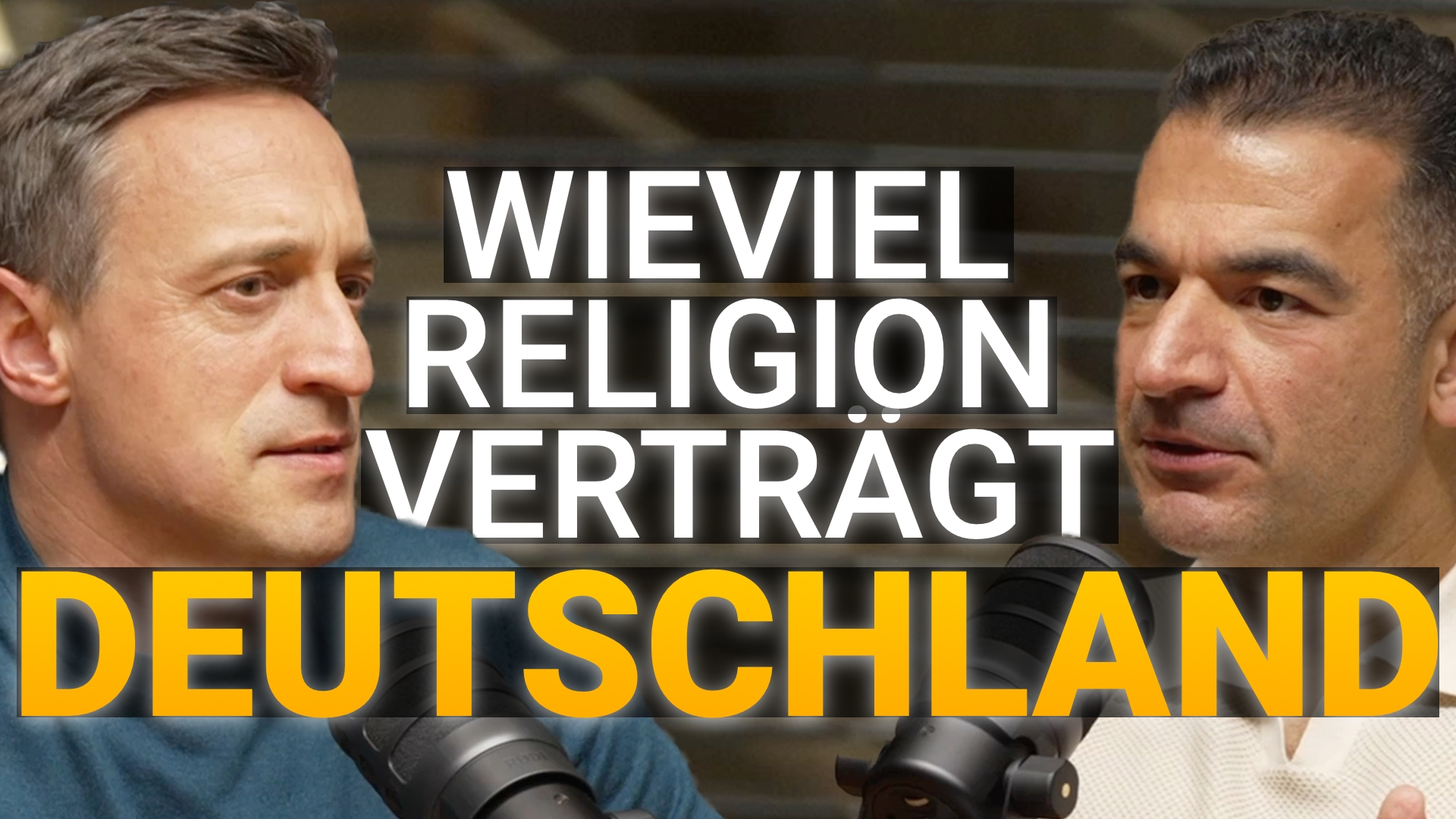

Religion and democracy: Reza Mehman talks to Karsten Kammholz about Christianity, Islam and the future of our society.
English translation of the complete original German article and transcript. The video retains its German audio. Personal beliefs, political assessments and examples reflect the speakers’ conversation at the original publication date.
Religion and Democracy: Summary
In this podcast episode, Reza Mehman and Karsten Kammholz discuss religion, personal faith and fundamental democratic values. Reza, who has no religious affiliation and was shaped by fleeing the Islamic regime in Iran, critically questions how people can believe stories that do not stand up scientifically. Karsten explains his understanding of liberal Christianity: take the Bible seriously, but not literally. The central question is whether a devout believer can also be a committed democrat. Both agree that religion becomes dangerous when it is misused politically and displaces Germany’s Basic Law.
Faith and Fundamental Democratic Values
Can a devout believer really be a committed democrat? That question lies at the heart of an open, honest conversation between Reza Mehman and Karsten Kammholz. Reza fled the Islamic regime in Iran as a child and brings a critical perspective on religion shaped by personal experience. Journalist and Protestant Christian Karsten Kammholz represents a modern, liberal understanding of faith and explains why democracy takes precedence over religion for him. The conversation touches on Sharia versus the Basic Law, the church’s role in Germany’s democratic history and the question of what comes after death.
Context
Who is speaking: Reza Mehman, a podcaster with Iranian roots and no religious affiliation, in conversation with Karsten Kammholz, a journalist and Protestant church elder from Mannheim.
What this is about: Personal faith, the compatibility of religion and democracy, and how Germany engages with Islam.
Why it matters: At a time of democratic crisis, growing Islamism and declining church membership, these questions are highly relevant to society.
Three central questions:
- Can a devout believer also be a true democrat?
- How far can a liberal, non-fundamentalist understanding of religion take us?
- What role does religion play in Germany’s democratic past and present?
Contents
- Personal faith: how religious is Karsten Kammholz?
- The Bible and science: what can you believe literally?
- Jesus Christ and the rock-star question
- Religion as a moral foundation or a power structure?
- Can a devout believer be an unequivocal democrat?
- Islam, Sharia and the Basic Law
- Christianity and democracy in post-war history
- What happens after death?
- Karma, stardust and the wonder of existence
- Conclusion: two worldviews, one respectful conversation
Themes
1. Personal faith and religious belief Karsten Kammholz describes himself as a critical, liberal Christian who takes the Bible seriously rather than literally and sees religion as an ethical foundation.
2. Religion and science Reza asks how people can believe stories that science has disproved. Karsten explains why religious conviction should not be equated with scientific factual accuracy.
3. Tensions between democracy and religion They discuss whether devout people, particularly those with an Islamic background, place Sharia above the Basic Law and thereby cease to be democrats.
4. Islam in Germany The conversation addresses how the state should deal with mosques, DITIB and religious radicalisation, and whether a state–religion agreement with Islam would make sense.
5. Death, meaning and the wonder of existence Both speakers reflect personally on mortality, life after death and the overwhelming fact of human existence in the universe.
Key Takeaways
- Anyone in Germany who places Sharia above the Basic Law is no longer a democrat.
- Democracy is more important than religion; people can take the best from all religions.
- The Bible should not be taken literally, but it should be taken seriously.
- Religion becomes dangerous when it is misused politically to oppress people.
- Liberal Christianity means having an ethical foundation without fundamentalism.
- Religious concepts help people cope with the incomprehensibility of existence.
- Angela Merkel kept the Basic Law and the Moravian Daily Texts side by side on her table, symbolising a balance between state and faith.
- Islam does not deserve to be held responsible for its political misuse, but the risks of radicalisation must be taken seriously.
- Christianity and the churches took on public welfare responsibilities after the war and thereby helped shape democracy.
- A person is only truly dead when the last thought of them has disappeared.
Questions and Answers
Question: Can a devout believer be an unequivocal democrat? Answer: According to Kammholz, anyone who considers Sharia a higher law than the Basic Law is no longer a democrat. Democracy and religion can coexist as long as the state takes precedence.
Question: How religious is Karsten Kammholz? Answer: He describes himself as a typical German liberal Christian who is not deeply versed in the Bible but remains loyal to the church. He recently began volunteering as a church elder in Mannheim.
Question: Why does Reza Mehman have no religious affiliation? Answer: Reza fled Iran as a child, where religion was used as an instrument of power and oppression. That left a lasting impression and made him critical of institutional religion.
Question: Is Islam compatible with German democracy? Answer: Muslims who practise peacefully are not a problem. The danger lies in radicalisation and in teachings within some mosques that are unknown to the state, for example through DITIB structures.
Question: What role did Christianity play in building German democracy? Answer: After National Socialism, which had misused the churches, they took on public welfare responsibilities through Caritas and Diakonie and were institutionally anchored through agreements with the state.
Question: What does Reza believe happens after death? Answer: Reza believes the body decomposes and the cycle of life continues. He finds the idea of life after death beautiful but cannot truly believe in it.
Question: Why does Karsten Kammholz consider democracy more important than religion? Answer: As an enlightened person, he can take the best from all religions without being entirely bound to one. Religion is a foundation, not a law.
Taking the Bible Seriously and Interpreting It
Question: What does it mean to take the Bible seriously without taking it literally? Answer: Biblical stories evoke something in people that goes beyond facts. They convey ethical values without having to be read as historical or scientific truth.
Question: What impressed Karsten Kammholz about Angela Merkel? Answer: In her chancellery office, he saw the Basic Law and the Moravian Daily Texts side by side. To him, that embodied an ideal: a religious foundation and public office clearly separated, yet personally connected.
Question: Does Reza believe in a higher power? Answer: Yes. Reza believes something cannot come from nothing and therefore suspects a higher power. Whether to call it God or the universe remains open for him.
Highlight Quotes
“If you live in Germany and say Sharia is a greater and more important law to you than our Basic Law, then you are no longer a democrat.”
“You must not take the Bible literally, but you must take it seriously.”
“Democracy. Much more important.”
“For me, being religious means believing there is something greater than you as a human being.”
“When religion is misused politically, that religion has a problem too.”
“We are all made of stardust. And that is all there is.”
“I am more than a living creature. I am a spiritual being too, and I want to live a good, exemplary life.”
“To avoid being overwhelmed, to cope with the sheer incredibility of existence, you sometimes need concepts. That is probably why religion exists.”
“The Crusades — justifying wars through religion is always a catastrophe.”
“I have no proof or indication that there is life after death.”
Keywords
religion and democracy, Christianity in Germany, Islam and the Basic Law, Sharia and democracy, liberal faith, Karsten Kammholz, Reza Mehman podcast, devout believer and democrat, leaving the church in Germany, DITIB mosques, religious radicalisation, faith and science, taking the Bible literally, death and faith, Angela Merkel and religion, German church tax, Islam in Germany, democratic crisis, freedom of religion, faith without a church
Names and Terms
Karsten Kammholz, Reza Mehman, Christian Wulff, Angela Merkel, Frank-Walter Steinmeier, Annette Schavan, DITIB, Moravian Daily Texts, Caritas, Diakonie, Basic Law, Sharia, state–church agreement, church elder, Mannheim East parish, Siri Hustvedt, Paul Auster
A Passage to Quote
Religion can complement democracy as long as it does not place itself above it. Anyone in Germany who considers Sharia a higher law than the Basic Law has moved away from fundamental democratic values. A liberal understanding of faith that offers ethical guidance without displacing other convictions is compatible with democracy. The real danger lies not in faith itself but in the political misuse of religion to oppress people. Democracy needs active care; it does not sustain itself automatically. The same applies to a responsible approach to religion.
Complete Transcript
Personal Faith: How Religious Is Karsten Kammholz?
Reza Mehman: Hey Karsten, hello — Reza here. Are you well today?
Karsten Kammholz: I am well. And you?
Reza Mehman: Well too, thank you. I hope you will continue to feel well as the podcast progresses. Today I have a few critical questions about religion, and I know you are a religious person.
That’s right. Before I start, a brief disclaimer: I have nothing against believers who practise their religion peacefully. In today’s podcast, I simply want to question a little critically how good or bad religion actually is and whether it still fits our times. And perhaps, because democracy is also one of your favourite subjects: can religion and democracy coexist at all? If you are devout, can you also be a good democrat? I’ll come to that.
For these questions, I deliberately gave you no preparation — which, incidentally, you never do. I normally tell you roughly what we are discussing, but today I deliberately said nothing except that the subject was religion.
Reza’s Personal Background
Briefly, some background: I have no religious affiliation, as I have said before. There are several reasons. My parents and I fled Iran 40 years ago. We fled an Islamic regime, a very radical regime. We all know the current news too. I have my problems with religion because I know that when it becomes fundamentalist, a great many people face a great many problems. Fortunately, we do not currently have that situation in Germany, with fundamentalist Christians here. But my first question is: how religious are you, if you had to assess yourself?
Karsten Kammholz: I think I am a typical Christian believer in Germany. That means I am not particularly close to the church, yet somehow remain loyal to it. At the moment I am actually a little closer to the church than in previous years because I have taken on a voluntary role. It is called being a church elder. I was elected in Mannheim’s East parish by the congregation in a secret ballot, so properly democratically legitimised. I am now involved within the parish and share responsibility for ensuring that it can continue to thrive in the coming years.
Karsten’s Critical Christianity
So I am a little closer now, but I am a critical Christian. I am certainly no fundamentalist, nor someone who knows the Bible inside out. But I do find a lot in biblical stories. I was shaped by my parents — that is how I have to put it — because my father is a pastor and my mother also studied theology. Christianity was always part of family life. Consequently, I have a fundamentally positive inclination towards it.
Reza Mehman: Do you pass that on to your children?
Karsten Kammholz: Yes, to some extent. When the opportunity arises, I pray at my son’s bedside before he goes to sleep. He is the younger one and accepts it. We also pass it on by going to church together occasionally, and our daughter sings in the church children’s choir. Our children attend a Protestant school in Mannheim where there are morning devotions too. So there is a Christian foundation in everyday life.
The Bible and Science: What Can You Believe Literally?
Reza Mehman: You said you do not know the Bible inside out. What exactly does that mean? Have you not read the whole Bible, or do you not believe every part of it?
Karsten Kammholz: First, I have not read all of it. If you asked me for my favourite story, I would need time to think. I could not retell every story precisely. I am probably not particularly well versed in the Old Testament, especially. It is more that I like remembering the stories and hearing them again. But I do not use them as the basis for living my life today. Do you know what I mean? I do not say, “This is how it was with Jesus, so this is how I will act.” That translation is not in my soul. Something else is happening.
Reza Mehman: I’ll come to that in a moment, but how strongly do you believe the things written in the Bible?
Biblical Creation and Scientific Questions
Karsten Kammholz: The Bible describes the world’s creation in two versions, and I think the seven-day story is difficult to explain scientifically. Naturally, you cannot believe a great deal of it in every precise detail. Nor should you. Instead, you should admire the creativity of the people who compiled the Bible and wrote its stories. They deserve admiration because they tried to make sense of a worldview and pass it down through generations. I think for many religious people, that is the basis: understanding the world they inhabit through a religious foundation.
Reza Mehman: That brings us to my first problem in this context. Creative stories — roughly how you described them. How can you seriously believe creative stories and genuinely follow them? Again, my opening disclaimer: I am not criticising you as a person or religious people generally. I am completely fine with people believing. But if I apply my logic and say I know many of those stories simply did not happen that way — the Flood, Noah, Adam and Eve as the first human couple, the age of the Earth and so on — we have a fairly solid knowledge base allowing us to say it was not like that.
How can you nevertheless say: I will put those things aside, but I still believe in the bigger picture, Jesus is God, and so on? How can you deliberately say you will set that aside but definitely believe the rest?
What Religious Stories Evoke
Karsten Kammholz: Because the stories make us think. They evoke something within us that is more than ourselves. We become aware again and again that we live within a context where perhaps humanity is not the centre, but love of one’s neighbour is. We are social beings, we should live sustainably and pay attention to how we treat nature and animals. You can give religious reasons for all of that. I think religion still exists because people use it as a foundation for being at all: not just living creatures, but intellectual and spiritual beings too.
Reza Mehman: I understand. As far as I can judge, I agree with the fundamental values most religions convey. My eldest, for example, attends a Protestant primary school. I feel comfortable there and can generally support what they do and teach. That is completely fine with me.
But then I wonder whether we should separate the two: call one moral values based on a Christian model, for example, and call the other religion. A central point, after all, is that Christians say Jesus Christ is God. I do not know whether I am expressing that correctly, but God is Jesus Christ. My question is: do you see it that way too? Is Jesus Christ God to you?
Karsten Kammholz: He is the incarnation of the divine. Yes.
Why People Believe Differently
Reza Mehman: Exactly. So why do you believe that particular story, for example, but not the others?
Karsten Kammholz: Religious understanding is not that sweeping. Even with this story, I can say: this is difficult, because how is it supposed to work, and why that one historical figure? Here too, I would step back and say perhaps many things were invented around Jesus Christ that never existed in their most extreme form. Perhaps Jesus was much more ordinary than we imagine today.
That is also what makes Christianity an interesting religion. Liberal Christians who maintain a critical distance from their religion and approach life intelligently are aware of all this and know: yes, but I am still a Christian. There is that saying: you must not take the Bible literally, but you must take it seriously. I said it here a few months ago, and it captures it. I think modern Christians know very well how to engage with what is written in the Bible while carrying what it evokes in them into life. Then Christianity works in our time too.
Jesus Christ and the Rock-Star Question
Reza Mehman: I fundamentally find it difficult to say, on one hand, that Jesus Christ is God or God made flesh, and on the other, that we do not know exactly what kind of person he was and that perhaps he had his problems too. Here is an interesting, entirely hypothetical question: if you could travel back in a time machine to spend time with Jesus Christ, would you do it? Or would you see a big risk of losing your faith because, in the end, perhaps he was simply an ordinary person with problems of his own?
Karsten Kammholz: He had serious problems: he died young, earlier than he wanted to.
That is a really good question, Reza, because it raises the famous rock-star issue. A rock star on stage is a powerful, almost fictional figure. The rock star plays someone. Backstage, that figure falls away and they become an ordinary person. If you then meet the person rather than the rock star, you can be terribly disappointed.
Reza Mehman: Americans say: never meet your heroes.
Karsten Kammholz: So my clear answer would be: I will stay here. Yes, I am not travelling back.
Reza Mehman: For fear that you might lose your faith?
Karsten Kammholz: Yes, for fear of catching some disease there.
Reza Mehman: Apart from that, would you be afraid of losing your faith?
Karsten Kammholz: No, not at all, because Jesus Christ is not the only reason I keep my faith alive.
The Significance of Jesus Christ
Reza Mehman: But he is central. You cannot get more central in Christianity.
Karsten Kammholz: There is more than Jesus Christ. Of course he is the central figure. But for me, what matters more is how we treat one another and how we imagine Christ showed us to do that. As a figure, he showed what people can experience together when they live with the greatest care for one another. In the stories, he lived out some striking examples. Simply knowing those stories can give us a guiding principle.
Reza Mehman: Exactly, but to me that would imply that I could believe other stories too.
Karsten Kammholz: Absolutely. That is why there is a variety of religions. Being Christian does not mean I reject Islam as such. I do not reject Hinduism. I find Sikhism fascinating, and Jainism too. There are religions that fascinate me, including Buddhism. I travelled a long way with my mother to Southeast Asia to visit a famous Buddhist temple site.
Reza Mehman: So you do not believe in the religion as such, but in its moral values?
Karsten Kammholz: To me, that is a modern interpretation of religion: giving each other certainty and, I repeat, a foundation on which we say, let us agree on this, on the ethics by which we want to treat one another.
Personal Encounters and Their Impact
Let me give you an example. In my earlier professional life in Berlin, I occasionally interviewed Angela Merkel. I remember one occasion: I entered her office at the chancellery and saw two things on her large meeting table. One was a small copy of the Basic Law, and the other was The Daily Texts, the Moravian Daily Texts. That is a collection of Old Testament, New Testament and theological reflections. These two little books lay side by side. It impressed me greatly. Was Angela Merkel a fundamentalist? Clearly, she was a pastor’s daughter. Did you notice religious language from her in any way? No, not at all. But she had those daily readings, meaning she prepared herself for the day with a theological reflection. That really impressed me.
Religion as a Moral Foundation or a Power Structure?
Reza Mehman: I am not sure how we should or can bring this together with the idea of God itself, because that is somewhat separate from Christianity. How do you reconcile it personally? We cannot see God or prove God exists. Equally, you could say there is no evidence against God. How do you bring that together with your faith?
Karsten Kammholz: That is fascinating too. I find the idea of some kind of God interesting. I can accept it for myself. At the same time, I find it fascinating how Hindus choose their gods, attribute different powers to them and tell their stories about them. Some of the adventures those gods experience together are extraordinary. All those stories reflect the human range of emotions, actions and ways of treating one another.
For me, being religious means believing there is something greater than you as a human being. Honestly, whether that is one God or several gods I believe in is relatively unimportant to me. I have absolutely no interest in saying, as a Christian, that I have the right religion. I make no such claim and have no such feeling about life.
Reza Mehman: What do you criticise about your religion?
Religion and Historical Responsibility
Karsten Kammholz: Historically, of course, it has done plenty that was not good. The Crusades — justifying wars through religion is always a catastrophe. What do I criticise about my religion? There is intolerance in parts of it too. Otherwise, however, I experience it as a religion that gives me freedom. As a religious person, I do not feel constrained by my religion at all. I am a completely free Christian.
I wonder, for example, how people feel right now — we have talked so much about Iran. They have lived under Sharia law for decades. Their state leaders have consistently been religious leaders in recent decades. How restrictive must religion possibly feel to them? How negatively must they perceive it? That is the misuse of religion. When religion is misused politically, the religion has a problem too. Not just the people doing it: the religion acquires a credibility problem. I would almost say Islam does not deserve to be misused like that.
Reza Mehman: Wow, difficult subject.
Experiences in Religious Education
I noticed this early at school. My religious education was Protestant; at some point, I think I switched to ethics. I no longer know why I started with Protestant classes and then changed; it was too long ago. Even then I often wondered — again, this is not an attack — about how theology was presented in such a highly scholarly way. To me, however, these were simply stories being told, and we could not prove whether they happened that way or not.
Eventually, I increasingly had this impression: we have churches, usually a Catholic and a Protestant one, in every smaller town and community, and in every big city too. They are almost always in the centre, in the best locations, and generally occupy a large area. To me, that always looked like a demonstration of wealth, power, relevance and so on. I no longer perceived it as something scholarly, but simply as a power and wealth structure being openly maintained — for 2,000 years.
Viewed that way, if I called it a business, it would probably be the longest-running business there is, considering the collection of taxes and so on. Nothing can compete. I think the oldest companies are in Japan and are 200 years old. That means Christianity is probably…
Karsten Kammholz: The best business model.
The Church, Property and Power
Reza Mehman: Exactly, thank you. Prime locations, enormous income, hereditary leaseholds and everything else going on. That is where I start finding it hard to see the whole thing as spiritual, because it is so worldly and monetary: power structures. Unfortunately, there are also the many abuse cases, a deeply sad subject in their own right, in which power was exploited. I always had a bit of a problem with it, although I could not articulate it then. On one hand, everything was presented in a very scholarly way, with trained theologians explaining it. You think: it must be true if an academic says it. On the other, we see that it is all very worldly.
Karsten Kammholz: Absolutely right. The church built like crazy. Even after the war, it built many new churches when church-tax income was pouring in and people were all still members. In the 1950s and 1960s, a great many new churches were built in neighbourhoods that did not yet have one. That is now costing the church dearly. Many churches are currently being given up.
Liberal Faith in Everyday Life
Reza Mehman: I am curious how that will develop. Returning to your description of yourself as a liberal religious person, I am not sure how liberal churches themselves are. A small example, not intended negatively: my wife is Catholic and wanted a Catholic wedding. That was only possible — if I had been Muslim, it would not have worked at all. They asked and then asked again whether I really was not Muslim, partly because I have black hair. I have no religious affiliation. That is why we were able to marry in church.
It was lovely for me as a tradition, but it did not necessarily have a deep inner meaning. I am completely fine with my wife wanting it, and she also wanted our children baptised. All good; I am happy to take part. It is a positive tradition that brings people together. Nevertheless, I have the impression that not everyone is as liberal and tolerant as you are.
Protestant and Catholic Perspectives
Karsten Kammholz: Absolutely. There is a difference between Protestants and Catholics. I cannot imagine belonging to a church claiming that God’s representative on Earth exists in Rome today. That would not be my church. Incidentally, in the Catholic Church’s view I am not even a member of that club. According to the Catholic understanding, I am not in a church but in a faith community. Traditionally, the Catholic Church does not fully recognise Protestant churches. In practical terms, Germany operates on a different level, but formally the Catholic Church still has a problem with Protestants. Thank goodness that is no longer visible on very many levels.
I do think I could participate in communion offered in a Catholic church as a Protestant, but strictly formally I should not. I find that remarkable.
Can a Devout Believer Be an Unequivocal Democrat?
Reza Mehman: Interesting indeed. I have many more questions, but I suggest you take a turn now.
Karsten Kammholz: Now it is my turn.
You said at the beginning that coming here from Iran, from a state that oppresses people through political and religious power, shaped you and triggered something. Is that at the heart of your decision not to be religious?
Reza Mehman: I think there are several aspects, but that is one of the most important. I have seen, and continue to see, religion being completely exploited to oppress people. There are also many things — I do not know the details, but you probably know some of how Sharia is practised, for example — that I disagree with. Even in terms of logic, I do not agree at all with much of what is said about what people should do. That is one aspect.
The other comes more from logic: it makes no sense to me. I have researched a little, though not deeply, looking at the age of the Earth and when certain things supposedly happened according to the Bible. If a story does not seem remotely logical to me, I struggle to believe something and then say: that is a matter of interpretation, you do not need to believe that directly, it is only a story, but the other part is the truth. That does not convince me.
Wondering at Our Own Existence
What does absolutely resonate with me — and I am not sure how to express it precisely or correctly — is that I do believe in some kind of higher power. I have no proof for or against it, but the idea of something arising from nothing utterly exceeds my intellect. I cannot understand it, so I believe there is some kind of higher power. Interestingly, in everyday life too, I admire people whose faith is positive, because I think it does a lot for their surroundings. If I go through life positively, I get positive things back. I send out some frequency, something reaches others and I receive something positive in return.
There have been phases in my life when I was more negative and attracted negative things. I can even remember it. Then I told myself: hold on, Reza, relax and be more positive again. And positive things happen.
Karsten Kammholz: Do you believe in karma? Look, that is a religious concept from Hinduism. Your karma helps determine how you are reborn, as a human or a worm.
Reza Mehman: Rebirth — I thought it meant that what you put out is what comes back to you.
Karsten Kammholz: We adopt many religious concepts without realising it, even if we do not feel religious.
Reza Mehman: I understand what you mean. I do not know about rebirth, but I strongly believe in that.
Karsten Kammholz: The nice thing, Reza, is that nobody knows.
Science and the Search for Meaning
Reza Mehman: Exactly. I have a friend who is very scientific, studied physics and maths, and says there is no evidence for God, so there is no God. Very straightforward. Of course, you can argue: provide proof to the contrary, which does not exist either. So there is room to think. I find everything crazy and mind-blowing anyway: everything that is supposed to have happened from the Big Bang to our standing here talking today, over thirteen and a half billion years. It blows my mind that we are flying through the universe at enormous speed on a ball of steel, in a universe whose size we cannot imagine.
Karsten Kammholz: There is that lovely line — how does it go? We are all made of stardust. And that is all there is. It is crazy, and we are a mere flicker.
Reza Mehman: Exactly, it is crazy. Whenever I go through stressful phases, I remind myself what incredible good fortune all of this really is. Perhaps there is some immensely powerful force that made it possible in the first place. In my view, you can call that God or call it the universe.
Faith as Guidance
Karsten Kammholz: Exactly. To avoid being overwhelmed, to cope with the sheer incredibility of existence, you sometimes need concepts. That is probably why religion exists. Whether you call it religion, spirituality, ethics or some greater overarching something, you can keep redefining it for yourself. But in the end, everyone needs it.
Reza Mehman: I completely agree.
Tensions Between Democracy and Religion
Reza Mehman: I want to come to an area I find very interesting, where I think you are the best person to ask. I know you are a huge supporter of democracy; that is how I got to know you. You were at my event at the castle. I will never forget that moment, because it is why we are sitting here together now. You spoke in an almost emotional way about how important it is to stand up for democracy, and how it is not simply something that exists and will last forever: it needs care. That impressed me greatly.
At the same time, you are religious, though not a fundamentalist. Yet there are people, not just in Christianity but in other faith communities and religions too, who rely very strongly on what their religion prescribes. Recently I have genuinely been wondering whether a devout believer can really be a democrat.
Democratic Decisions and Religious Truth
Democracy depends on people deciding. Religion depends on a truth already established in books, for example the Bible or the Quran. That truth was, in effect, pronounced by God. I have several examples, but we do not need to go through them all. Many religions assume there is a divine truth that is not negotiable. Democracy, by contrast, rests on truth and decisions emerging through discussion and majorities. In religion, the overwhelming majority cannot come together and say they want a particular verse changed. Yet that is essentially democracy.
Can a truly devout believer be an unequivocal democrat?
Karsten Kammholz: Exactly: where does “devout” begin? If you live in Germany and say Sharia is a greater and more important law to you than our Basic Law, then you are no longer a democrat. We have a section of society in this country that thinks exactly that way, and it is growing. But we as Germans have learned to be a secular society. We separate state and faith. We say: you may have a religious foundation, but beware of doing something justified purely by religion that might undermine a responsibility belonging to the state.
Separating Religion and the State
We say we are democrats first and foremost. We may also be religious, but we do not mix the two. That is why I always find it interesting to see how senior politicians handle the oath of office: whether they say “so help me God” or not. I completely understand both. Although I am religious, I understand a federal minister or chancellor omitting it to make clear that the office serves society. Whether I am religious plays no role here, and I do not need to state it. Others say: I am religious and need that religious strength within me, so I invoke God in that situation and hope for his help. Both make sense to me.
Reza Mehman: If you had to rank your priorities, which would matter more to you: democracy or religion?
Karsten Kammholz: Democracy. Much more important. In theory, as an enlightened person, I can take the best from every religion and say I am spiritual, drawing from a general store of different religions and choosing what is best for me.
Reza Mehman: You work in media and, I think, understand society and how it operates. Do you think everyone in our society — probably not, but what proportion of people actually places democracy above religion, particularly in German society?
Social Change and the Church
Karsten Kammholz: That is a very difficult question. We currently face a democratic crisis, but an even greater crisis of Christianity. We are certainly not in a crisis in terms of Islam’s presence. Immigration has strengthened Islam in this country over the past ten years. So you cannot answer the question in such general terms. I could not produce a statistic, and I do not think I would find one. Christianity is retreating, but democracy is retreating too. That is currently a fact.
Democracy is still formally there, of course, but we have a real problem with people’s willingness to serve it. That is why initiatives such as the one from our Federal President Frank-Walter Steinmeier — what exactly is it called, the Day of Democratic History on 18 March — are genuinely good. We need reminding that people fought for democracy, that it is a system in which we can enjoy freedom, speak our minds and face no consequences for doing so.
But we must take very seriously why some people now feel they no longer experience this democratic system. We need to examine that closely. Why is it happening? Why do some people no longer feel comfortable with the form of democracy we have? Still, I think it is good to say: let us remember where this concept comes from, how valuable it is and how hard people fought for it.
Faith and Democratic Identity
Reza Mehman: You are saying many interesting things. Returning to the original question, I genuinely think religion is more important to many people. When I look at immigration from Muslim countries, for example, I think you can say with considerable certainty that religion matters more to them than democracy. That is my impression.
Regarding long-established German society, I have wondered how much of a role religion has played since democracy began here — roughly 1945 or 1948, let us say. Was its role large or small? Is it still important that religion exists? It might well be important: we have a major party called the CDU, with “Christian” in its name. I am not demonising religion. I actually think it played a very important part in building the democracy I live in today.
Let us put it that way. I do wonder whether there is a correlation between democracy and religious belief as practised in Germany. If religiosity declines, might democracy decline too? Broadly speaking, that seems to be happening, as I understood what you said earlier.
The Historical Role of the Churches
Karsten Kammholz: That is extremely complex. First, we need to explain why the Protestant and Catholic churches were relatively strong after the war: they had been misused by the Nazis. Christians rightly said they needed to take a very independent position. In the end, there was a kind of agreement that Christianity in practice — through Caritas and Diakonie, care facilities and so forth — would effectively take on state responsibilities. That is interesting. There are state–church agreements. In a sense, part of the church fulfils public responsibilities, specifically welfare duties. That will continue, and the church remains strong there as Christianity put into practice.
I do not know, though, whether the relationship is really that direct. I think you may be overstating Christianity’s role in our country at the moment.
Islam, Sharia and the Basic Law
Reza Mehman: Would you have a problem if, for example, a similar Islamic agreement with the state were established?
Karsten Kammholz: The state is trying to do that. Naturally, it wants to know what is being preached and what religious life is taking place in our country. In some cases, we do not know what is preached in mosques. We still have the issue of DITIB mosques being funded mainly from Turkey, by the Turkish state, and sermons not being delivered in German. There is a certain black box when it comes to Islam. What do you think?
Reza Mehman: Let me refer to an example. The United Arab Emirates — I think we have discussed this before — no longer gives scholarships to citizens wanting to study at universities in England because they become radicalised there and return home. It already sounds absurd for a country to say: you can no longer study abroad because you become radicalised through our religion there and then come back. It was a big news story recently.
So I do believe Islam can be seriously misused to radicalise people. That is why, as things stand today, I do not think it is a good idea to establish an arrangement between Islam and the German state similar to the one between Christianity and the state. I see a risk of major problems ahead.
Religious Practice and State Responsibility
Karsten Kammholz: Yes, but at the same time I understand the state wanting to know how religion is actually practised here. I understand that. Fundamentally, it is a form of oversight and dialogue.
Reza Mehman: But also strong recognition, absolutely, which is a problem too. You could say: hold on, but Islam?
Karsten Kammholz: Look: “Islam belongs to Germany,” Christian Wulff said. When was that? I think 2011, some years ago, quite a while now. It caused a real stir at the time. Yet he was simply using the figures available to say: wait, we have to accept that we have become a religiously pluralistic society. That was all before 2015, before the refugee arrivals. Today, we still have to say that Islam is, in a certain sense, part of Germany. That is a fact.
Reza Mehman: Just to make it clear: I have no problem with devout, peaceful Muslims either. My grandparents were believers, prayed and did everything that goes with it. Where I see it being practised peacefully, I have no problem. But the radicalisation that can happen is where, today, I see the greatest risk in connection with Islam.
Karsten Kammholz: I see it exactly the same way.
Religion, Science and the Question of Change
Reza Mehman: We have already talked a lot. I wanted to examine democracy and religion more closely, but you have covered many points. There is one more thing I would briefly like to discuss, again concerning whether a religious person can also be a democrat. It returns to what I said earlier. At school, theology and religion were presented in a very scholarly way.
Karsten Kammholz: Really? Not at all in my case.
Reza Mehman: In my case, very much so. It is a school subject, after all. That alone raises its credibility and seriousness. It is officially taught. That means the education minister — Annette Schavan at the time — had thought about what should be taught. You cannot give something more credibility than that.
But I still see a fundamental problem: it is a field of scholarship where, as I perceive it, we say we are not willing to change any rules or accept new insights because everything is already fixed. Society, and every science, should approach things with an open mind and say: when I gain new knowledge, I change the rules.
Faith in the Face of the Holocaust
Karsten Kammholz: I do not see it that way. Christianity’s greatest crisis is the Holocaust, because it raises the question: why did God allow it? You can read a great deal of scholarship on precisely that question. It is not remotely the case that professors of religion have fixed everything and said: this is how it is, this is what we teach. Religion is repeatedly re-examined academically, at least within the Christian understanding.
I find that fascinating, because we are an enlightened society. If we do not really have a convincing answer to why God allowed six million Jews to be murdered in such a short time, religion first has a problem explaining itself. Doesn’t it?
Reza Mehman: I agree one hundred per cent. But I still do not get the impression that religion is examined or changed. People do not sit down and say: we will delete this Bible verse and replace it with that sentence.
Karsten Kammholz: I can disagree with you there too. New versions of the Bible keep appearing: in modern language, inclusive language and plain language. There is constant reconsideration of which language and words we want to use to tell the stories.
Reza Mehman: But the stories themselves do not change. They are only expressed more clearly.
Karsten Kammholz: Do you want to cancel stories? Why?
Laws, Knowledge and Change
Reza Mehman: I know laws should and must be changed in light of current knowledge. Some laws were very brutal, even in Germany and not so long ago — marital rape, for example. When society develops, laws have to be specifically amended.
Karsten Kammholz: With a book such as the Bible, though, I would always say: let it stand as it is. But we can engage with it afresh, reinterpret it and reconsider which stories we want to work with and which we would rather leave aside.
What Happens After Death?
Reza Mehman: Karsten, I have the feeling neither of us has convinced the other to change his position, which is completely fine. I absolutely respect people’s faith as long as it is peaceful. Nevertheless, I still find it hard to understand specifically why someone believes so firmly.
Karsten Kammholz: That is interesting, because I was firmly convinced I had made clear that my faith is not rigid at all. It really isn’t.
Reza Mehman: Then why have it at all? That is the fundamental question I have been trying to ask from the beginning. Why have it if everything is so loose? In theory, I could believe anything. I definitely do not want to ridicule it, but then I could believe anything.
Karsten Kammholz: Because I say I am more than a living creature. I am a spiritual being too, and I want to live a good, exemplary life. What can I use for guidance? That is the foundation. Whether I am Christian, Hindu or an atheist with an ethical foundation makes no difference in value to me in the end. Just as going to vote and choosing a party does not mean I identify one hundred per cent with its manifesto. I do not. Do I have to support the Bible and its stories one hundred per cent because I am Christian? No, of course not. I am liberal, but I say Christianity is my foundation.
Personal Thoughts on Mortality
Reza Mehman: Beautifully put. I want to share a story briefly because what you said reminded me of it. At my eldest child’s baptism, the pastor told a very interesting story. I cannot repeat it word for word, but roughly it went like this: two twins were in their mother’s womb, just before birth, talking to one another. This was the pastor’s story. One twin said: do you believe in life after birth?
The other said: no, when we are born, we are gone and dead, and so on. But the first twin said: I firmly believe that once I am born, life will only really begin.
There were lots of children there, and I think the pastor deliberately told a childlike story. I found it very impressive because it showed that sometimes we cannot see beyond our own horizons. We do not actually know what comes afterwards. That is the little door I leave open for myself: I do not have all the information. For those twins in the womb, birth is effectively death, yet life is only just beginning because they cannot see beyond that boundary. In the same way, I think it is of course possible that this religion, this God and so on exist.
Why People Search for Answers
Karsten Kammholz: I am glad you raise that, Reza, because you are providing a reason why religions exist at all. We are born, we are human, and then we discover that people around us die. That could drive us to despair. So we wonder whether perhaps something comes afterwards. Religious concepts also allow us to believe in something: that things somehow continue, that there might be an eternity for us. What could that eternity look like? When you engage with that and realise perhaps there is something else, perhaps it is not simply switching off a television, that is it, and then there is nothing.
To escape that depressing idea, you can begin to believe in something and consider that, if it were so, perhaps a little religious belief in your life would not be wrong. It would give you something to lean on. The idea that something happens after death is a foundation of religion.
Reza Mehman: Beautifully said.
Karsten Kammholz: But I have to ask you again, sorry, even if you want to move to the next subject: what do you believe happens to you after your death?
The Body, Consciousness and Death
Reza Mehman: The logical person in me — I do not know how logical I really am — would put it bluntly: my body decomposes, microbes, bacteria and so on consume it, and I return to the earth, so to speak. That is the cycle of life. For me, the switch is effectively flicked off, and that is it. I have no proof or indication that there is life after death.
That is how I think today. I find it a beautiful idea. Honestly, I sometimes think how lovely it would be if, for example, my grandparents, with whom I had a very close relationship, had a life after death too. Knowing that would warm my heart. But I cannot quite believe it. It is difficult.
Karsten Kammholz: Yes, because as someone left behind, you often miss those who have died and feel they sometimes still speak to you or appear in dreams. The author Siri Hustvedt has just published a book, two years after her husband Paul Auster’s death, writing about love for someone who has died. I find that fascinating. It means something remains. Why does it remain even after you are gone as a person?
How Cultures Deal With Death
Reza Mehman: That really is a fascinating question. I am not sure which culture — perhaps Mexican, though I am not certain — says a person is only dead when the last thought of them has disappeared. They have a different understanding of how long someone lives and what happens after death. The last person who thinks of someone keeps them alive for that long.
I like immersing myself in beautiful stories too, saying how lovely everything is. But when I return to reality and consider the suffering of so many people in this world, I find it difficult to believe firmly that everyone is good, religion is good and God only wants good things. Overall, that is hard for me. There is a lot of disappointment speaking through me too, to be honest.
Conclusion: Two Worldviews, One Respectful Conversation
Reza Mehman: But I broadly understand. I just wanted to make sure, Karsten, that you have not taken offence at anything I asked today.
Karsten Kammholz: I hope I made myself understood.
Reza Mehman: One hundred per cent. I know you are liberal, so I knew you were not a fundamentalist who would immediately lose his temper because I questioned something. I actually hope and wish everyone thought that way. Sometimes, however, I feel you cannot speak openly and freely about religion with many people because they are completely stuck in their own tunnel.
Anyone with a migration background from Middle Eastern countries can probably recognise what I am about to say. I have some very good Turkish friends, among my oldest and closest friends. They are what I would honestly call part-time Muslims. They get up to all sorts, but do not eat pork because the Quran forbids it. I have genuinely been friends with them for 35 years. Yet that sort of thing could make me lose my temper because it makes no sense to me: that half-hearted “this is important, that isn’t”.
Respect Between Different Worldviews
Karsten Kammholz: To me, that too is a sign of a very liberal understanding of religion. I find it rather likeable. My church always calls for seven weeks without something. At this time of year, seven weeks of fasting, in some form. Every time I think: oh God, no, now seven weeks without something. And very often I think: no, not me, I will carry on.
Reza Mehman: Very nice, Karsten. Thank you for being so open in today’s conversation. Thank you.
Karsten Kammholz: My pleasure, Reza.
Watch episode 177 on YouTube. In our conversation about democracy in Germany, Karsten and I discuss political processes and the need for reform.