
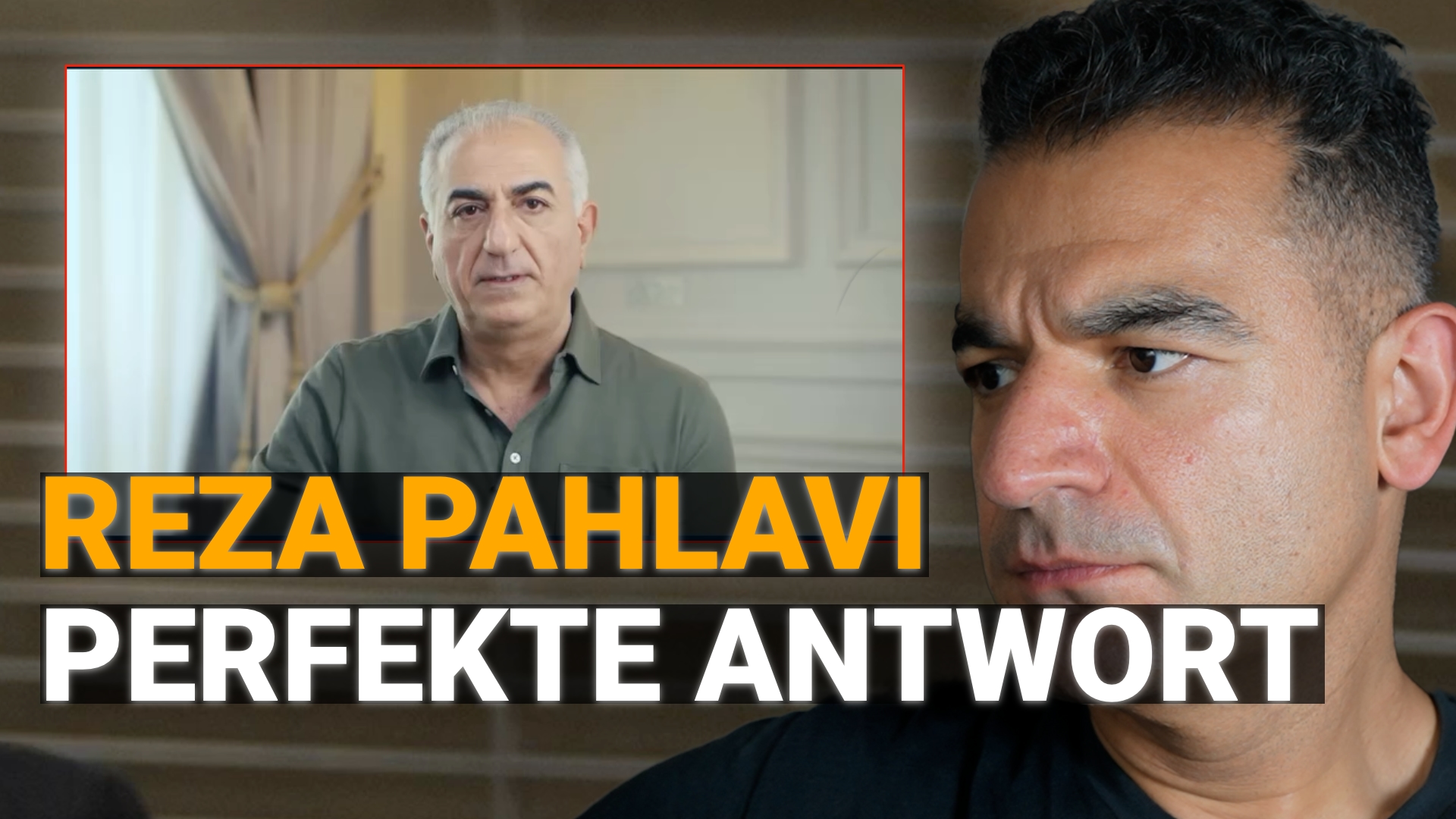

How Europe’s journalists are letting the Iranian people down—and why Reza Pahlavi keeps fighting.
The original episode and video are in German. This page provides the complete English translation of the published article and transcript, including Reza Mehman’s commentary and the quoted statements.
Reza Pahlavi in Germany
Reza Pahlavi, Iran’s best-known opposition figure outside the country, recently visited Germany and appeared at the Federal Press Conference. What followed was, in podcast host Reza Mehman’s view, a disturbing example of European media failure. Journalists did not ask about the thousands of Iranians killed in the streets. Instead, they confronted Pahlavi with the insinuation that he was an Israeli agent. They also indirectly held him responsible for civilian casualties. Pahlavi answered both accusations forcefully and confidently. In a subsequent video statement, he publicly criticised the European press. He said there were 150 journalists at two press conferences. Yet not one question addressed the 40,000 people killed in the streets. This podcast discussion examines Pahlavi’s visit to Germany and the media’s questionable line of questioning. It also covers his ambition to serve as a transitional leader towards a free, democratic Iran.
Summary
In one sentence: Reza Pahlavi appears at the Federal Press Conference and subsequently releases a video statement criticising European media for simply ignoring 40,000 Iranians who were killed.
In three sentences: Reza Pahlavi visited Germany and spoke at the Federal Press Conference, where journalists asked absurd and manipulative questions instead of asking about the fate of Iran’s people. He responded confidently to the allegation that he was an Israeli agent. His answer pointed to the connection between Iran and the Jewish people stretching back thousands of years. In a subsequent video, he publicly criticised 150 European journalists at two press conferences for not asking once about the 40,000 people killed in the streets.
In five sentences: Reza Pahlavi, the leading Iranian opposition figure in exile, visited Germany and appeared at the Federal Press Conference. Instead of asking critical questions about the mullah regime, journalists confronted him with the insinuation that he was an Israeli agent and partly responsible for civilian casualties. Pahlavi responded confidently, emphasising the historic connection between Iran and Israel, Iran’s role in protecting Jewish refugees and that he acts solely as a representative of the Iranian people. In a video statement after the visit, he criticised the European press, stressing that across two press conferences with 150 journalists, not one question concerned the 40,000 people killed or political prisoners sentenced to death. Podcast host Reza Mehman sees this as symptomatic of European appeasement towards the mullah regime and calls for support for the Iranian people.
Context: Who, What and Why
Who is speaking: Reza Mehman, a podcast host with Iranian roots, comments on Reza Pahlavi’s visit to Germany. Pahlavi is the son of Iran’s last Shah, has lived in exile in the US for decades and is regarded as the best-known opposition figure outside Iran. He sees himself as a transitional figure who wants to guide Iran’s transition to democracy.
What it is about: Pahlavi appeared at the Federal Press Conference in Berlin. Journalists asked questions portraying him as an Israeli agent and holding him responsible for deaths during protests. In a subsequent video statement, Pahlavi sharply criticised European media for completely overlooking the fate of 40,000 Iranians who were killed.
Why it matters: How Western media and politicians approach Iran affects international perceptions of one of the gravest human rights tragedies of our time. Pahlavi’s response and the media’s treatment of his visit reflect Europe’s policy of appeasement towards the mullah regime.
Three central questions answered:
- What questions was Pahlavi asked at the Federal Press Conference, and why does the host regard them as problematic?
- How did Pahlavi respond to allegations that he was an Israeli agent and shared responsibility for civilian casualties?
- What does Pahlavi’s video statement reveal about the state of European media and politics in their approach to Iran?
Contents
- Introduction — Pahlavi’s Germany visit and the central criticism of the media
- Summary — Three concise versions
- Context — Who is speaking, what it is about and why it matters
- Topics and analysis — The wider themes
- Key takeaways — The discussion’s most important statements
- Frequently asked questions — Pahlavi, the Federal Press Conference and criticism of European media
- Highlighted quotes — The conversation’s strongest statements
- The complete conversation — The edited transcript with subheadings
- Keywords — Relevant tags and search terms
- Names and terms — Spellings of important names and terms
- Passage for quotation — A paragraph for direct quotation
Topics and Analysis
1. The Iranian opposition and Reza Pahlavi
Reza Pahlavi is Iran’s most visible opposition figure outside the country. He sees himself as a transitional figure without personal ambitions for power.
Keywords: Reza Pahlavi, Iranian opposition, transitional leader
2. Criticism of European media and journalism
150 journalists, two press conferences, not a single question about those killed in Iran: Pahlavi and Mehman accuse the European press of failure and siding with the mullah regime.
Keywords: media criticism, Federal Press Conference, European journalism
3. Iran–Israel relations and historical connections
Pahlavi rejects the accusation that he is an Israeli agent and explains the biblical and historical connection between Iran and the Jewish people over thousands of years.
Keywords: Iran Israel relations, Cyrus the Great, Iranian Jewish history
4. The mullah regime, protests and appeasement
Mehman criticises 47 years of European appeasement towards the mullah regime and calls for genuine support for the Iranian people.
Keywords: mullah regime, Iran protests, appeasement
5. Iran’s freedom movement and external support
Pahlavi argues that external support has historically been necessary and legitimate in certain struggles for freedom, comparing it to Allied support for France during the Second World War.
Keywords: Iran freedom movement, external intervention, democracy in Iran
Key Takeaways
- Reza Pahlavi appeared at the Federal Press Conference in Berlin, where journalists confronted him with the insinuation that he was an Israeli agent.
- Across two European press conferences with more than 150 journalists in total, nobody asked about the 40,000 Iranians killed in the streets.
- Pahlavi described himself as a representative of the Iranian people, not an agent of any state, and referred to the historic friendship between Iran and Israel dating back to Cyrus the Great.
- Pahlavi argues that external help in struggles for freedom is historically legitimate, citing Allied support for France during the Second World War as an analogy.
- European journalists at the press conferences did not ask about the 19 political prisoners executed in two weeks or the 20 others sentenced to death.
- Pahlavi wants to guide Iran’s democratisation as a transitional figure and has written a position paper on this.
- Podcast host Reza Mehman criticises Germany for failing to protect Pahlavi, who had tomato sauce thrown at him after the press conference.
- Mehman collects video footage from Iran showing people chanting Pahlavi’s name in the streets at www.rezamehman.com/iran.
- Both speakers argue that 47 years of European appeasement towards the mullah regime have come at the Iranian people’s expense.
- Pahlavi: “Whether Europe stands with us or not, we will fight until Iran is free.”
Frequently Asked Questions
Who is Reza Pahlavi, and why is he in Germany?
Reza Pahlavi is the son of Iran’s last Shah and has lived in exile in the US since the Islamic Revolution of 1979. He is regarded as the best-known Iranian opposition figure outside the country and travelled to Germany to appear at the Federal Press Conference in Berlin. His stated aim was to make the voices of millions of Iranians, whom he describes as hostages of the Islamic Republic, heard in Europe.
What questions was Reza Pahlavi asked at the Federal Press Conference?
Among other things, Pahlavi was asked whether he was an “Israeli asset” and was indirectly held responsible for the deaths of Iranian protesters. He was also accused of changing his earlier position on military intervention in Iran. By contrast, no questions were asked about Iranians killed in the streets, executed political prisoners or the mullah regime’s actions.
How did Reza Pahlavi respond to the allegation that he was an Israeli agent?
Pahlavi explained that he was not an agent of any country but was a friend of Israel. He pointed to the connection between the Iranian and Jewish peoples over thousands of years, beginning with Cyrus the Great, who first set down human rights on a scroll. Historically, Iran was the only Middle Eastern country to offer refuge to Jewish refugees, including those fleeing the Nazi regime.
What did Reza Pahlavi criticise in his video statement after visiting Germany?
Pahlavi emphasised that he had spent more than two hours at two press conferences in Stockholm and Berlin with over 150 journalists in total. Not one journalist asked about the 40,000 people killed in Iran’s streets on 8 and 9 January, the 19 political prisoners executed in two weeks or the 20 others sentenced to death. He described this as a complete failure of journalistic and moral responsibility.
Why does Reza Pahlavi support external assistance for Iran?
Pahlavi argues that the mullah regime has built a massive apparatus of repression against which the Iranian people stand no chance without outside support. He compares it to Allied support for France in the Second World War, when the Allies landed in Normandy and helped bring liberation. He makes clear that this is about protecting the people, not supporting the regime.
What does Reza Pahlavi mean by “transitional figure”?
Pahlavi does not see himself as Iran’s future ruler but as a figure who will guide the transition from the Islamic Republic to a free democracy. He has written a position paper on this. Once Iran is free, the people should decide their own future. His goal is democracy, not the restoration of the monarchy.
What happened after Pahlavi’s Federal Press Conference appearance?
After his appearance, tomato sauce was thrown at Reza Pahlavi. Podcast host Reza Mehman criticises Germany for failing in its duty to protect one of Iran’s most important opposition figures. He sees it as another sign that Germany places economic interests involving the mullah regime above protecting Iranian opponents of the regime.
What other opposition groups exist in Iran, and why does Mehman support Pahlavi?
Mehman cites the People’s Mojahedin Organisation of Iran (MEK) as an example but does not regard it as a serious alternative for a free, democratic Iran. In his view, Pahlavi is the only internationally visible opposition figure who credibly stands for democracy and freedom and enjoys support from a significant part of Iran’s population, demonstrated by people chanting his name in the streets.
Highlighted Quotes
“Of course not, but I am a friend of Israel. I am a descendant of Cyrus the Great, and we are proud of that.” — Reza Pahlavi
“I am an agent; I am a representative of my people, the Iranian people. I am sitting here because many millions have asked me to convey their own vision of the future.” — Reza Pahlavi
“In those two hours, not a single of the 150 journalists asked me a question about the 40,000 Iranians slaughtered on the streets of my country on January 8th and 9th.” — Reza Pahlavi
“Iranians aren’t just ready for democracy. 40,000 people just gave their lives for it. And I won’t let that be in vain.” — Reza Pahlavi
“We do not apologise for the call for freedom.” — Reza Pahlavi
“I think the world should instead apologise to the Iranian people for ignoring them for 47 years.” — Reza Pahlavi
“As long as we have no other opposition figure, we should work together to bring down this mullah regime.” — Reza Mehman
The Complete Conversation
Pahlavi’s Germany Visit and the Federal Press Conference
Reza Mehman:
Reza Pahlavi recently visited Germany. Among other things, he appeared at the Federal Press Conference. In my view, he was asked some of the most absurd questions imaginable. My standards for, or expectations of, Germany’s public media are already fairly low. But to see private individuals and smaller media organisations asking such absurd questions made me question everything all over again, honestly.
I’ll shortly play the two questions, or the clips in which those questions were asked. But what I wonder is: what are they trying to achieve with statements like these, indirect statements formulated as questions? Here is someone like Reza Pahlavi, acting as the largest opposition figure outside Iran on behalf of a free Iran. He is asked questions that are absolutely absurd.
On one hand, a commentator or journalist indirectly accuses him of being responsible for so many people dying in Iran during the January protests. On the other, he is accused of being an Israeli asset. How absurd are these questions?
But I think Reza Pahlavi answered really strongly at the Federal Press Conference. I’ll play it shortly. In another clip after his Germany visit, he spoke very powerfully about what the media here in Germany are actually trying to achieve with this line of questioning, and why they aren’t critical of the mullah regime.
Reza Pahlavi’s Role in a Possible Transition
He himself acts as a transitional figure. He wants to guide Iran’s transition towards freedom. That is his greatest wish, his life’s mission. In my view, as long as we have no other opposition figure, we should work together to bring down this mullah regime, whether with Reza Pahlavi or another figure who becomes visible. But in this case, Reza Pahlavi is the only visible figure. Other parties, opposition parties and leaders, such as the People’s Mojahedin and so on, are not an alternative for Iran in my view. We want a free, democratic Iran, and currently there is no other figure who wants to bring that about in any form.
Let me briefly play the questions from the Federal Press Conference, followed by Reza Pahlavi’s response.
The Federal Press Conference: Questions and Pahlavi’s Answers
Journalist (Federal Press Conference):
We see that you are here with the help of the Europe-Israel press organisations lobby group. This is the same government that started a war of aggression against your country together with the US. Many people around the world believe that you act on behalf of Israel and are in Israel’s hands.
Reza Pahlavi:
Of course not, but I am a friend of Israel. I am a descendant of Cyrus the Great, and we are proud of that. A cornerstone of human rights was already laid down then on a scroll that can be seen around the world. That was one of the principles of freedom affirmed at that time, and only later was the temple in Jerusalem built. We Iranians and Jews have a biblical relationship, the only country that can claim that. Iran was the only country in the Middle East where fleeing Jews found refuge, Jews escaping Hitler and his regime. They found refuge in Iran. That is part of our history, part of our role in protecting refugees.
There was the revolution of ’54, when people fought to regain justice. It is about protecting people; that is what I stand for, and I do not need to be anyone’s agent. I am an agent, a representative of my people, the Iranian people. I am sitting here because many millions have asked me to convey their own vision of the future.
Questions About Military Intervention
Journalist (Federal Press Conference):
On a French TV show, you said you had never supported military intervention in Iran. Yet on 10 February, you declared that only external military intervention could disable Iran’s apparatus of repression, that only this could be the solution. You are responsible for the many innocent Iranians who died from American and Israeli bombs, illegal bombing attacks that you supported.
Reza Pahlavi:
Attacks on the regime’s infrastructure were something the Iranian people demanded. The regime is acting against the people. According to the president, the response would be very strong. The bombing targeted the infrastructure. Creating a level playing field was the aim. There were massacres of unarmed people in the streets by the regime. How else are people supposed to have a chance of overcoming the regime without outside help? External help is necessary in many conflicts. It was so in Italy. France was supported by the Allies when they landed on the beaches of Normandy and ultimately ended the Second World War. These are interventions that can help people, not the regime.
The Perspective of People in Iran
Iranians showed the world what they think and feel in the streets. That is what Iranians did. Ultimately, it was naturally in their interest to be protected, not simply slaughtered. Something else then has to happen. The death toll has to be reduced. Nobody wants civilian casualties. Nobody wants that. We always regret all that collateral damage, but we do not apologise for the call for freedom.
We took to the streets, and I told people: “Carry your banners through the streets, raise your demands.” But then the regime slaughtered those people, probably more than 40,000. Are we then supposed to say: the regime kills us when we stand up for our freedom, so we must not demand it? Surely people must be allowed to demand their freedom.
I think the world should instead apologise to the Iranian people for ignoring them for 47 years. For 47 years, your governments pursued appeasement towards the regime, against the people. This has happened often over the past 40 years. There have been repeated incidents, later during the Green Movement, then again against the population. Then the women’s freedom movement, a symbolic effort. But today it is happening again. Once again, we are falling back into a kind of appeasement, and that cannot continue.
Pahlavi’s Answer to the Press
You should apologise to the people of Iran for supporting this appeasement. This time, we demand that you support the Iranian people. We will not apologise for that, because the Iranian people deserve your support. We will continue the struggle whether you help us or not. But you must reckon with that in your own conscience.
Mehman’s Assessment of the Appearance
Reza Mehman:
I think he handled it wonderfully. First, he explained again why these questions aren’t being put to the mullah regime and why he is instead accused of being responsible. Second, he also answered perfectly regarding Israel: when conditions here in Germany were truly terrible, Iran ensured Jews were taken in. In my view, it was the perfect answer he could have given.
I also find it interesting that he spoke out again in a video, which I’d like to play shortly. He very specifically raised the question of the purpose behind these at least questionable positions taken by journalists, and what those journalists are actually trying to achieve. I think he is absolutely right. Conditions in Iran mean we urgently need the mullah regime to fall. Here is someone who wants to advance that. There is enough evidence online that people inside Iran themselves take to the streets and chant his name.
Reza’s Sources and Assessment
By the way, you’re welcome to look at all the evidence I’ve found at www.rezamehman.com/iran. People always ask in the end: where are the sources? I’m starting to collect it all so that I can no longer be accused of providing no sources. In my view, there is plenty of material online. Anyone who searches even a little will find something. But I’ve now started gathering it at www.rezamehman.com/iran. I simply link all the videos I’ve found in this context there.
Pahlavi’s Video Statement: An Indictment of European Media
Reza Pahlavi (video statement, in English):
I have spent the past several weeks travelling across Europe, speaking to members of parliaments, governments and the press. My visit had one objective: to give a voice to the millions of Iranians held hostage by the Islamic Republic, its terror and its internet blackout – the millions of Iranians who have been silenced.
But I can now say with confidence that that silencing, that censorship is not just happening at the hands of the regime in Iran, but by the international and particularly the European media. So I want to speak directly to the people of Europe.
In the past two weeks, I have had two press conferences, one in Stockholm and one yesterday in Berlin. Between them, more than 150 journalists attended. We spent more than two hours together. And in those two hours, not a single of the 150 journalists asked me a question about the 40,000 Iranians slaughtered on the streets of my country on January 8th and 9th. Not a single of the 150 journalists asked me about the 19 political prisoners executed in the last two weeks. When I told them that there were 20 political prisoners currently sentenced to death, not a single one of the 150 journalists asked me about them.
When I stood next to a mother whose son was killed, and a father whose son was killed on January 8th and 9th, and asked them to hear their stories, not a single one of the 150 European journalists asked them a question.
The English-Language Video Statement
Here, in the heart of a continent that claims to stand for human rights, justice, and dignity, its journalists have fully abdicated their professional responsibilities and even their moral objectivity. It is clear to me that my 40,000 brave, innocent compatriots who were slaughtered in the fight for liberty are of little interest to these journalists. They seem more interested in criticizing America, asking why the United States and Israel killed the dictator that has slaughtered our people for 47 years, than criticizing the regime doing the slaughtering. They seem more interested in asking questions about Iran’s past and history than about what is happening in Iran today or about the democratic future Iranians are seeking.
One member of Parliament even told me they didn’t think Iranians were ready for democracy. But to that member of Parliament, to those journalists, I remind you: Iranians aren’t just ready for democracy. 40,000 people just gave their lives for it. And I won’t let that be in vain.
So notice: Whether or not Europe stands with us, whether or not your journalists do their jobs, whether or not your politicians demonstrate the courage to act – I will fight for my people and my country. Even if we have to do this alone, we will fight until Iran is free.
Mehman’s Concluding Assessment
Reza Mehman:
Let’s sum up. Reza Pahlavi comes to Germany and speaks at the Federal Press Conference. Let’s set aside the fact that his safety was not guaranteed afterwards. Tomato sauce was thrown at him, as you probably heard. Let’s completely set aside that Germany unfortunately failed in its duty to protect such an important opposition figure. Apparently, continuing to do business with the mullah regime matters far more than protecting Reza Pahlavi. Let’s put that aside.
But then we see questions being asked that I would almost call foolish, probably deliberately foolish, to provoke him. If that is the standard of journalism, I’m quite happy I didn’t become a journalist, honestly, and instead simply try to analyse situations with common sense.
As I see it, Reza Pahlavi first and foremost has nothing to do with his father’s actions. He was simply too young to have had any influence, probably. That’s the first point. He has spent almost 50 years living abroad in a democracy such as the US. He wants, he has even written a position paper on it, to be the transitional leader who introduces democracy in Iran. Then he is asked such strange, almost foolishly absurd questions. Please excuse my wording.
Final Thoughts on the Media Appearance
The other thing is that I think it was very powerful of him to speak out again afterwards and try to explain: wait a minute, when journalists ask questions like these, we have to consider their purpose. Where are they actually trying to go with them? And whom are they supporting by asking such questions?
Thank you for listening. Until next time. Bye, bye, bye, bye.
Keywords
Tags: Reza Pahlavi, Federal Press Conference, Iranian opposition, mullah regime, Iranian freedom movement, European media criticism, democracy in Iran, transitional leader, Iran protests, Iranian Israeli relations, Cyrus the Great, political prisoners in Iran, appeasement, Reza Mehman Podcast, Iran Germany, freedom for Iran, People’s Mojahedin, Israel Iran history, criticism of journalism, Iran 2025
Names and Terms
Reza Pahlavi, Reza Mehman, Federal Press Conference, mullah regime, Islamic Republic of Iran, Cyrus the Great, People’s Mojahedin Organisation of Iran (MEK), Iranian Green Movement, Woman Life Freedom, transitional leader, transitional figure, appeasement, political prisoners, Normandy, Second World War, Germany, Berlin, Stockholm, US, Israel, rezamehman.com/iran
Passage for Quotation
Reza Pahlavi appeared at the Federal Press Conference in Berlin, where he faced insinuations that he was an Israeli agent and shared responsibility for the deaths of Iranian demonstrators.
In a subsequent video statement, he criticised the European press: 150 journalists, two press conferences in Stockholm and Berlin, more than two hours of discussion, and not one question about the 40,000 people killed in the streets.
Pahlavi described this as a complete failure of journalistic and moral responsibility, calling Europe a continent that preaches human rights but has ignored the Iranian people for 47 years.
Podcast host Reza Mehman sees the visit as symptomatic of European appeasement that places economic interests involving the mullah regime above support for the Iranian people.
Pahlavi’s closing words: “Even if we have to do this alone, we will fight until Iran is free.”
Watch episode 187 on YouTube. Find more perspectives on the Reza Mehman Podcast.


[…] episode 188 about Iran and the US, I explain my perspective on the conflict since 1979. Episode 187 about the Federal Press Conference covers Reza Pahlavi’s visit to Germany and my criticism of the […]