
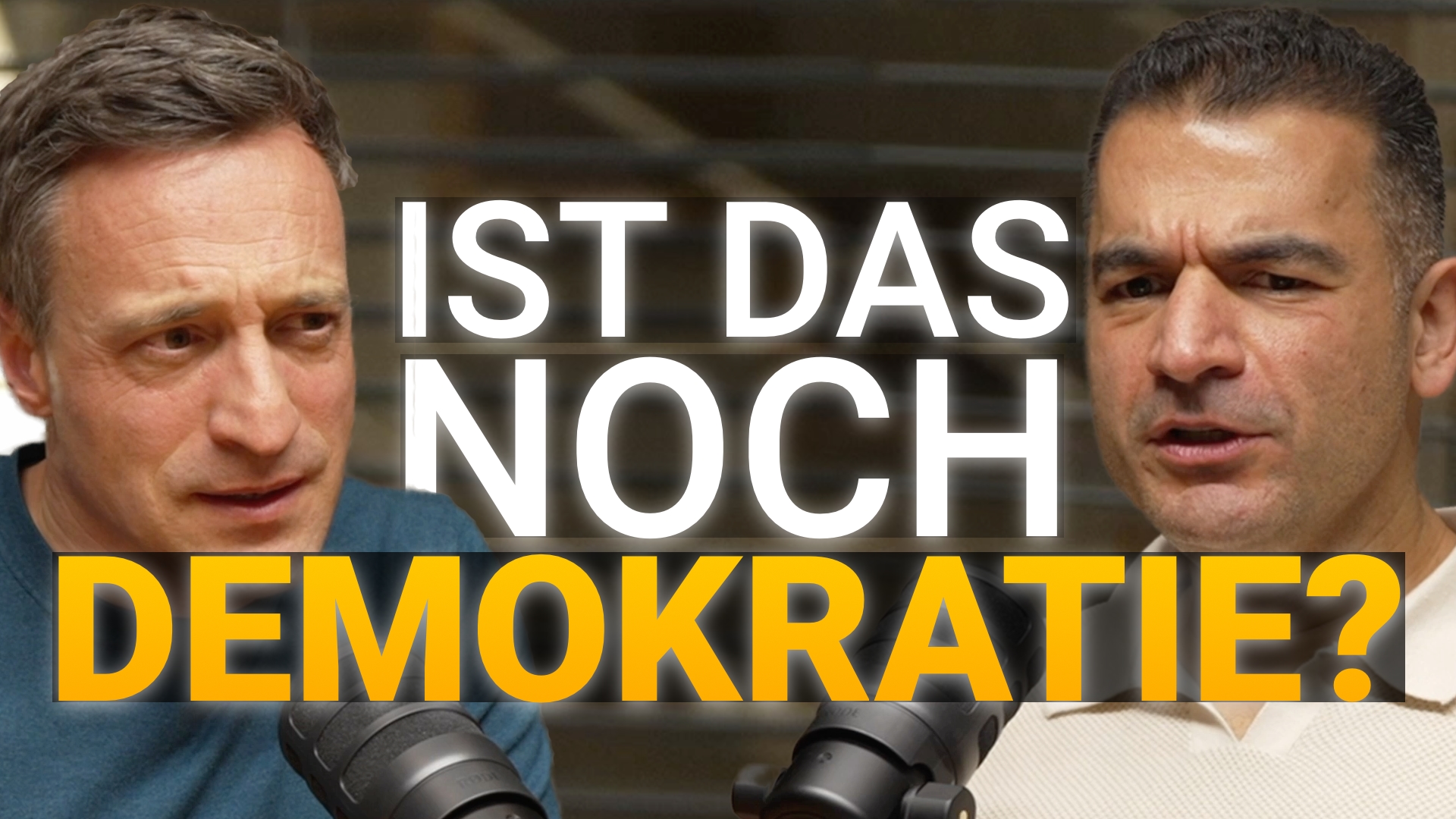

English translation of the complete German article and podcast transcript. The video retains its German audio. Political assessments and examples reflect the speakers’ discussion at the original publication date.
Reza Mehman and Karsten Kammholz discuss the crisis of democracy in Germany, declining trust, coalition politics, the AfD, parliamentary party discipline, courts and whether the political system needs reform.
Democracy in Germany: Podcast Episode 178
Democracy in Germany: What This Episode Covers
“We no longer vote for policies; we vote for negotiating partners.”
This podcast episode explores democracy in Germany, the loss of trust in political processes and whether the political system is still fit for today’s world. Reza Mehman and Karsten Kammholz discuss coalitions, election results, the AfD, parliamentary party discipline, the Federal Constitutional Court and the role of the EU. At its heart is the question of why so many people feel that elections no longer translate clearly into political decisions. The conversation puts current political developments in Germany into context and shows where, in the speakers’ view, democratic structures reach their limits. It is relevant to anyone interested in democracy, German politics, political legitimacy and the need for reform.
Context
Who is speaking:
Reza Mehman and Karsten Kammholz
What this is about:
The state of democracy in Germany, political legitimacy, the distance between voters and political outcomes, and whether democratic processes need reform.
Why it matters:
More and more people feel that political decisions no longer follow clearly from election results, that the system has become too complex, and that democratic processes are losing public trust.
Three central questions:
How democratic is a system in which election winners cannot automatically govern?
How many safeguards does a democracy need, and when do they become a problem themselves?
How can democracy be reformed without abandoning its fundamental principles?
Contents
1. Starting point: Democracy Day and declining trust
Why Frank-Walter Steinmeier’s Democracy Day signals a deeper crisis in our understanding of democracy.
2. Election results, the AfD and political legitimacy
What happens when a party becomes the largest force but still cannot form a government.
3. Coalitions and the problem of political predictability
Why voters often do not get what they actually voted for.
4. Monitoring parties, the ban debate and democratic self-defence
The tension between protecting democracy and allowing political diversity.
5. Parliamentary party discipline and freedom of conscience
Why parliamentary reality and constitutional expectations diverge.
6. The Federal Constitutional Court, federalism and institutional brakes
How the German system is intended to prevent abuses of power and why it also feels sluggish.
7. The EU level and political alienation
Why European decisions have become difficult for many citizens to grasp.
8. Reform and the future of democracy
Why the speakers believe democracy must be defended but also reformed.
Themes
Democracy and the crisis of trust
The conversation shows that democracy in Germany works formally, yet is losing credibility for many people emotionally and in practice.
The AfD, election results and power
A central theme is how to respond to strong AfD election results when other parties form coalitions against it.
A party-based state, coalitions and parliamentary discipline
The speakers discuss whether voters still vote for policies or merely for negotiating partners in a system heavily controlled by parties.
Institutional safeguards and slow politics
The Federal Constitutional Court, Bundesrat, federalism and EU are described as safeguards that also slow political decisions.
Reforming democracy
The discussion ends with a call to make democracy more understandable and bring it closer to people through reform, instead of defending it against change.
Key Takeaways
- In Germany, citizens vote for parties, but do not directly elect a government.
- Coalition negotiations often produce political outcomes that were not clearly foreseeable before an election.
- The response to the AfD puts the prevailing understanding of democracy to the test.
- Debates about banning a party can be perceived as an expression of political helplessness.
- Parliamentary party discipline sits uneasily with MPs’ freedom of conscience under the Basic Law.
- The Federal Constitutional Court is an important safeguard against abuses of power.
- Federalism and European layers make political decision-making more complex and slower.
- Many people experience democracy as something far removed from their own political influence.
- Democracy in Germany must be defended and reformed at the same time.
- Political systems must become more capable of acting in a faster world without abandoning democratic principles.
Questions and Answers
Question: What is this podcast episode about?
Answer: It analyses the crisis of trust in democracy in Germany and discusses coalitions, the AfD, party bans, parliamentary party discipline, courts, federalism and EU influence.
Question: Why does the episode discuss Frank-Walter Steinmeier’s Democracy Day?
Answer: It provides a starting point for asking whether Germany’s understanding of democracy is eroding and why political processes are becoming harder for many people to understand.
Question: What democratic issue does the AfD example illustrate?
Answer: The speakers ask whether people still perceive it as democratic when a party becomes the largest force but cannot govern because it lacks coalition partners.
Question: What is the criticism of coalition governments?
Answer: Voters elect parties, but only post-election negotiations determine which policies will actually be implemented in government.
Question: Why is the debate about banning the AfD criticised?
Answer: A ban can be understood as an admission that established parties have found no political means of pushing the AfD back through better policies.
Question: What is criticised about party discipline in the Bundestag?
Answer: Under the Basic Law, MPs are bound only by their conscience, yet in practice they mostly vote along party lines.
Question: What role does the Federal Constitutional Court play in German democracy?
Answer: It checks whether democratically enacted laws comply with the constitution, thereby providing a safeguard against abuses of power.
Question: Why is the EU described as a democratic challenge?
Answer: Many decisions are made at the European level, and individual voters may feel they have only limited influence over them.
The Central Conclusion
Question: What is the episode’s central conclusion?
Answer: Democracy must be defended, but that defence will only be sustainable if it is reformed, simplified and brought closer to people again.
Highlight Quotes
“On the one hand, democracy must protect itself. On the other, democracy must also allow a diversity of opinions.”
“People go out and vote, and they feel that nothing happens in the end.”
“We no longer vote for policies; we vote for negotiating partners.”
“Unfortunately, untruths are also part of democratic processes.”
“Some of what we are seeing is really damaging to democracy.”
“We have become completely inefficient as a state and as a structure.”
“The world will never again be as slow as it is today.”
“Let us defend democracy, but only if we can now reform it together.”
“Right now, it feels very far away.”
Keywords
democracy in Germany, crisis of democracy, German politics, AfD and democracy, German coalitions, parliamentary party discipline, German Constitutional Court, Steinmeier Democracy Day, political legitimacy, trust in politics, German election results, Federal Constitutional Court, political reform, EU democracy, German federalism, criticism of political parties, German political processes, reforming democracy, Reza Mehman podcast, Karsten Kammholz
Subtopics
- Democracy Day and the crisis of trust
- The AfD, election results and power
- Coalitions and negotiated political solutions
- Monitoring parties and the ban debate
- Parliamentary party discipline and freedom of conscience
- The Federal Constitutional Court, federalism and slow politics
- The EU level and democratic distance
- Defending and reforming democracy
Names and Terms
Reza Mehman, Karsten Kammholz, Friedrich Merz, Frank-Walter Steinmeier, Cem Özdemir, AfD, Federal President, Basic Law, Federal Constitutional Court, domestic intelligence service, Bundestag, Bundesrat, federalism, European Union, Ursula von der Leyen, Climate Change Act, democracy, parliamentary party discipline, coalition
Passages to Quote
- Democracy in Germany is under pressure not only from outside, but also from internal contradictions.
- Many citizens feel that election results no longer translate clearly into political responsibility.
- If democracy is to remain credible, it must be understandable, capable of acting and closer to people.
- It must be defended, but it must also be allowed to be reformed.
Complete Podcast Transcript
Democracy Day and the Crisis of Trust
Karsten Kammholz:
Let me remind you that Friedrich Merz really did not want debt. He wanted to reduce debt, and then suddenly he comes along with this monster package worth billions. We now also know that large parts of it are being diverted from their intended purpose and are not going into infrastructure.
Reza Mehman:
For example, we all know that parts of the AfD have been classified as right-wing extremist. What does that mean? The state assesses politically elected parties and says this party is potentially dangerous to the democratic order. Of course there is a tension here. On the one hand, democracy must protect itself. On the other, democracy must also allow a diversity of opinions.
But the Basic Law says MPs are bound only by their conscience. In practice, however, they always, or almost always — 99.9 per cent of the time — vote the way the party wants. Why? Political pressure, careers, opportunities, trust within the party and so on.
Karsten, in one of our recent episodes we discussed democracy, including Frank-Walter Steinmeier’s announcement of a Democracy Day. I’ll read something very briefly, because we really need to start talking about our perhaps slightly crumbling understanding of democracy. I also know you are a huge fan of democracy, and I would like to understand from you whether everything is really so critical that the Federal President has to give society a little help so that we live, nurture and care for democracy more.
Democracy Day and Political Debates
I’ll read this briefly. On 18 March, Federal President Frank-Walter Steinmeier proclaimed a Democracy Day: a day intended to remind us that democracy cannot be taken for granted, that it needs care, and that it thrives on trust, participation and a shared understanding of how we actually want to live together.
When you look around today, you notice that this understanding is crumbling. Society is more divided than it was a few years ago. Political camps are drifting further apart. We know about current events. Election results do not automatically produce clear political arrangements, and more and more people are asking a fundamental question: does the system as we live it today still reflect what we understand democracy to mean?
You said something extremely important in a recent podcast. Soon, in a state in eastern Germany, the AfD might receive 40 per cent of the vote, yet very probably find no coalition partners. That means it will not be able to govern the state. And you asked a very valid question: is that still democratic?
The AfD, Election Results and Power
Karsten Kammholz:
Not very long ago, you and I discussed who should actually become minister-president of Baden-Württemberg. We had the following situation: 30.2 per cent for Cem Özdemir, 29.7 per cent for the CDU. I am deliberately saying 30.2 for Cem Özdemir, not 30.2 for the Greens. Then 29.7 for the Greens [as stated in the original transcript], equal seats in the state parliament, and we discussed how, in the end, the winner takes it all. Even though the seats are tied, the result means 27,000 more votes. Cem Özdemir should therefore become minister-president.
Election Results and Forming a Government
What do we do if we suddenly have a clear election winner in Saxony-Anhalt, the AfD, but all the other parties around it say: wait a minute, together we could form a majority around the AfD and appoint a minister-president with a significantly weaker starting position in terms of the election result? That has democratic legitimacy, but is it democratic?
Reza Mehman:
That really is the important question here.
Karsten Kammholz:
Viewed purely formally, if we did not have the feeling, and in some cases the evidence, that the AfD does not mean well by our state, we would have to say: of course the AfD must provide the minister-president. Naturally, that is how it should be in a democracy. The largest force provides the minister-president.
But of course the parties will again try to prevent it, out of panic about what would actually happen if the AfD governed here. And that panic is understandable too. What would you do?
Reza Mehman:
Well, it always depends on how we as people define something, how something is defined. I found it almost absurd — sorry, I need to take a step back — when people said Ukraine could not join NATO because that was not provided for and it would take five years and so on. I don’t know exactly what was said back then. In practice, the NATO countries apparently did not want Ukraine to join either, so that collective defence would not be triggered. You understand where I am going with this.
Responses to Russia’s War of Aggression
When I heard that, nearly four years ago when the war of aggression began, I asked myself: now people are acting as though laws cannot be changed, as though they are laws of nature or physics that we genuinely cannot alter. Nothing could be easier than rewriting a piece of paper to say: from now on, Ukraine is a member of NATO. You can do that. These are not laws of nature; you can change them.
That is why I also say democracy is what we as people define it to be. I completely agree with you. Cem Özdemir, even if, compared with a sprinter, he is only one millisecond faster than the runner-up, is still one millisecond faster and therefore comes first. Simple and straightforward. That is almost a law of nature. He simply has more votes; we cannot change that now.
But we can at least change what we understand democracy to mean. I am not advocating that the AfD should govern the state if it gets 40 per cent — Saxony-Anhalt, I think you said. I do not support that. But I think we are undermining the understanding of democracy we have set for ourselves.
The Mandate to Govern
Karsten Kammholz:
Absolutely. With all the other parties, the strongest gets the mandate to govern. With the AfD, we say: but you are not real democrats. And there is something to that. I do not want to conduct this debate naively and say: looking purely at the numbers, the AfD obviously has to do it, so close your eyes and push through; the state will survive. It really is not that simple, because this AfD contains a corrosive element. It wants a different state. The other parties say: no, we want to keep this state as it is. We do not know what we would do if the AfD suddenly governed; we do not know what would happen.
Out of that uncertainty, the other parties cling to joining forces in the most absurd combinations. We could end up with a coalition of the CDU, SPD and the Left, even though the CDU and the Left are supposed to be incompatible. Yet they would rather work with the Left, the successor party to the SED, than with the AfD. The CDU will have some extremely fierce internal debates about that.
Coalitions and Negotiated Political Solutions
Reza Mehman:
Yes, that is what I mean. It becomes partly absurd when you impose these boundaries on yourself and then, in my view, no longer really act democratically.
I would like to go through a few points and hear your opinion. Fundamentally, we now have a very complex system. I would say it is no longer easy to answer what is democratic and what is not.
Coalitions and Negotiating Partners
As a first example, people in Germany do not elect a government; they elect parties. After the election, those parties sit down and negotiate a coalition. A specific example: in 2021 the SPD became the largest party, but with only 25 per cent. The government emerged only through negotiations with the Greens and the FDP. Compromises were made that had not directly been on the ballot in that form. Returning to democracy, I vote for a party but do not know what will come out of it in the end, because I am really only choosing a coalition partner or a negotiating partner. In my understanding, that is not necessarily democratic either. Before the Baden-Württemberg election, it was already clear to me that we would end up with a Green–CDU or CDU–Green coalition.
Karsten Kammholz:
Well, I probably need to explain democracy more clearly here, because if you are a democrat, you know you never get 100 per cent. You never get exactly what you want.
Reza Mehman:
Exactly. We no longer vote for policies; we vote for negotiating partners.
Karsten Kammholz:
No, of course we do vote for an attempt to get a policy into an agreement. We do vote for that.
Reza Mehman:
Yes, but you know — or you end up with something completely new.
Promises and political compromises
Karsten Kammholz:
Yes. Let me remind you that Friedrich Merz really did not want debt. He wanted to reduce debt, and then suddenly he comes along with this monster package worth billions. We now also know that large parts of it are being diverted from their intended purpose and are not going into infrastructure. Unfortunately, untruths are also part of democratic processes. Making 180-degree U-turns in the end is, unfortunately, also part of democracy. Some of what we are seeing is really damaging to democracy.
Monitoring Parties and the Ban Debate
Trust in Political Decisions
Reza Mehman:
Interesting point. I’ll move to my second point, where I think we may have reached certain limits with our democracy: monitoring parties and possible bans.
Germany has institutions such as the domestic intelligence service, the Verfassungsschutz, which can monitor parties if they are classified as extremist. For example, we all know that parts of the AfD have been classified as right-wing extremist. What does that mean? The state assesses politically elected parties and says this party is potentially dangerous to the democratic order. Of course there is a tension here. On the one hand, democracy must protect itself. On the other, democracy must also allow a diversity of opinions. If the state decides which party goes too far, the question is naturally: who oversees that decision?
Karsten Kammholz:
Yes, and that is why proceedings to ban the AfD, or even the whole debate about a ban, are again damaging to democracy. Why are so many people, particularly on the left — and I will include the SPD here — so certain that this party can only be stopped by banning it? Is that not an admission that they have no answer, no political means of simply outperforming this party with better policies?
Responding to Dissatisfaction
People simply say: no, these are populists; voters are so stupid that they vote for them and fall for these right-wingers or right-wing radicals, these populists; we have to stop them. But sorry, at the moment we probably have to believe a great many AfD voters when they say they are desperate about the other parties, because they feel that nothing is happening in this country any more. There is no movement, no development. That is why they vote AfD, not because they are fans of it, but because they no longer know what to do with the other parties.
When parts of the other parties then say: sorry, this AfD is completely unacceptable; we must ban it now and start proceedings, I would always say: why not try fighting it politically first? The AfD has grown over years. That means the other parties had years to see what was happening. They could have delivered better policies, and they simply failed.
Parliamentary Party Discipline and Freedom of Conscience
Reza Mehman:
Another point I see critically in today’s democracy — I am really laying into our democracy right now, but that does not mean I am not a democrat. I do see problems, though.
Karsten Kammholz:
You can criticise it, because democracy in our country really is going through a crisis.
Reza Mehman:
Yes, but I just want to make clear that I am firmly a democrat at heart. I deliberately do not live in another country, and there are reasons for that: I believe in German democracy. But I would at least like to list the problems.
Parliamentary Party Discipline and Personal Convictions
One thing that has always puzzled me is this parliamentary party discipline. It has always surprised me. I think it is fine to indicate your general direction: one person wants to be in the CDU, another in the Greens, and so on. But the Basic Law says MPs are bound only by their conscience. In practice, however, they always, or almost always — 99.9 per cent of the time — vote the way the party wants. Why? Political pressure, careers, opportunities, trust within the party and so on.
There are many examples. With coronavirus policy, for instance, I think many people, many politicians, wrestled with how to decide. Yet they still voted as the party wanted, and the same happens with budget questions generally. I have to say: sorry, but that is not democracy either.
Karsten Kammholz:
Then you would not need party manifestos any more, would you? If you simply elect individuals to the Bundestag and say, “Reach an agreement, have fun,” you do not need parties.
I can partly understand the party pressure that exists. You said at the start that you always vote for a compromise, for an attempt to reach agreement. Now, at the same time, you are criticising a parliamentary group that wants to implement a programme or a political decision for saying: now we need to stand together as a group.
Reza Mehman:
Then we would have to change the Basic Law.
Karsten Kammholz:
What would you like it to say?
Reza Mehman:
No, the Basic Law says MPs are bound only by their conscience. Apparently that is not true, so we need to change it.
Votes of Conscience in the Bundestag
Karsten Kammholz:
There are votes of conscience, yes, of course. There are deliberately selected issues in the Bundestag where the parties agree to vote without party discipline or pressure. Assisted dying, for example, is an issue where cross-party groups are formed so people can think in terms of different approaches. Incidentally, I find it really fascinating how democracy works in those cases.
Reza Mehman:
Yes, those are great examples. It works there, and I like that too. But to me, party politics sounds like organised majorities. That is not me acting to the best of my knowledge and conscience. It is: hold on, I want a little more pay next year within my party, so I should vote this way or do exactly what everyone else does. That is not democracy to me.
Karsten Kammholz:
Yes and no. We have agreed that we are a party-based democracy. In that sense, you do have to ensure that parties and their programmes are visible — and where, if not in votes? Otherwise, at some point it becomes too fragmented.
It becomes difficult when dissenters are put under so much pressure that they are ultimately told: we will not nominate you again. That has all happened before.
Reza Mehman:
Boris Palmer was — was Palmer.
Karsten Kammholz:
Not that, but Mr Spahn has admitted quite a bit in that direction, about how much pressure he puts on MPs.
Reza Mehman:
Mm-hm. I come back to the same point: perhaps we ought to change that wording in the Basic Law a little.
Karsten Kammholz:
Yes, you are right there.
Courts and Political Limits
Reza Mehman:
Good, we agree. I like that.
Karsten Kammholz:
Yes, boring. Completely boring for our viewers.
The Federal Constitutional Court, Federalism and Slow Politics
Reza Mehman:
Right, let’s move to the next point: the Constitutional Court versus majority decisions.
In Germany, the Federal Constitutional Court can stop laws even when they have been passed democratically. Take the Climate Change Act in 2021. The court declared parts of it unconstitutional. What happened here? A court that was not democratically elected decided that what the politicians had decided, or what had been voted for, would not be implemented accordingly. Again, there is a tension between the majority deciding and judges’ powers standing above the majority. What is your view? Is democracy only about majority decisions, or also about protection from the majority?
Karsten Kammholz:
Democracy in Germany builds in a safety net and a second line of protection. It installs safeguards so that you never experience political abuse of power in a way that harms the population. That is what our democracy is supposed to ensure, and it is why we have strong courts. It is why we have the Federal Constitutional Court. If that court says: wait a minute, you have not enacted these laws lawfully; strictly speaking, you have misled the population with the way you designed them, then we are allowed to stop that. As a system, I do not think that is bad at all.
The Basic Law and Majorities
Reza Mehman:
I basically agree with you. But returning to the majority — the Basic Law itself can also be amended with certain majorities — if the majority supported, for example, that Climate Change Act in 2021, whose precise details people can read up on, then the majority decided it. I wonder why — and I do understand checks and balances, I am aware of them — but if democracy means the majority decides something, surely we have to accept that.
Karsten Kammholz:
Yes, but again, our democracy has so many levels that ultimately determine policy. You can say the Bundestag decides one way, but we have federalism, we have the states and we have the chamber representing them, the Bundesrat. On very important decisions, the Bundesrat can also say: no, we see this completely differently, because we as states may be affected, because we have to deal with the consequences, or because our political majorities at state level differ from yours at federal level.
It is incredibly demanding. That is why democracy in Germany is genuinely complicated, and why it appears so sluggish. But why do we have this kind of democracy? So that the abuses of power we experienced up to 1945 never happen again. That remains the foundation of our complicated system. Everything is so demanding precisely to ensure that what we experienced, that history, never repeats itself.
The EU Level and Democratic Distance
Reza Mehman:
Has it been equally demanding since 1945, or has it become more demanding?
Laws and European Responsibilities
Karsten Kammholz:
Yes, that is a good question, because this Federal Republic began with significantly fewer laws. We have built ourselves a lawyers’ state. And, of course, we have added another level, the European level, which was originally also intended to secure peace in Europe but now, in a way, encroaches on the state. At some point we realise: oh yes, there are issues where European law takes precedence over German law. We may have a standstill on German issues because we are waiting for Europe, but nothing happens in Europe. First you have to be able to explain why everything is like that. We have become completely inefficient as a state and as a structure.
Reza Mehman:
One hundred per cent. You have raised something very important with the EU; that is another point on my list. Many decisions are now made at EU level. Take the GDPR, probably a very popular example for many people and businesses. Germany is part of the EU and participates, but an individual voter’s direct control is naturally reduced. So there is a tension between national democracy and supranational decisions. The question is how much influence an individual voter still has over decisions made in Brussels. When I think of Brussels, I do not necessarily see democracy being practised there either.
Discussing the European Commission
Karsten Kammholz:
Yes, look at who leads the Commission in Brussels: Ursula von der Leyen. She never campaigned for Europe; the CDU did not even nominate her as its lead candidate. Suddenly she is President of the European Commission, the head of the European government. What is going on? I can certainly understand people doubting democracy within Europe too. That is understandable.
Defending and Reforming Democracy
Reza Mehman:
I could actually read out more points, but you probably understand where I am going. We have a lot of problems to address. It is becoming harder and harder to explain to people why things work the way they currently do. What you said is absolutely right: we have a safety net and a second line of protection, and so on. All true, but we are becoming very sluggish.
Karsten Kammholz:
Yes. After more than 80 years, we can of course ask whether our democracy is now strong and stable enough for us to rethink the basic organisation of the state. Perhaps we want to streamline some of the state’s decision-making processes after all. Perhaps we want to speed up certain political decisions. Do we want to remove some layers? I do think we can begin to do that now.
The Pace of Political Decisions
Reza Mehman:
Yes, we should. My impression is that the world is becoming — or put another way, it will never again be as slow as it is today. That means the world is getting faster and faster, and we need to make decisions more quickly. If we want to remain a global player, I believe we need the ability to decide quickly — still democratically, of course, but quickly — where things are heading.
Returning to our opening point, I understand why Mr Steinmeier is introducing this Democracy Day. In principle, I think it is good. Honestly, I will look into it a little more; ordinary people can participate too. There is information on Bundespräsident.de, I think that was the site. I have read a little about it, find it interesting and will participate in some form, perhaps through an event. The exact form is not clear to me yet, but I will definitely do it.
I am critical of how slow and sluggish we have become, and of how often we insist: yes, but this is our understanding of democracy. As you say, after 80 years we can dare to adapt that understanding. The fundamentals should stay the same, of course: everyone is equal, people can vote freely, and so on. To me, wanting something different from those principles is absurd. And we should act together as a community wherever possible.
The EU as a Shared Idea
I think the EU is a great concept. We need it. That is one reason I have a problem with the AfD, which does not think the concept is great. That alone has definitely lost me, as have many other points. I support having good relationships with our neighbours, being able to communicate with everyone, move around, trade and so on. That is a wonderful thing.
I am simply afraid that we live in an increasingly extreme society that will eventually stop accepting those fundamentals and say: no, none of this works any more; we have to do everything radically now, we have to become much more radical. We see what is happening in the United States, where things keep becoming more radical. We discussed ICE in the last podcast episode. That has nothing to do with democracy either if you can simply break into homes without a judge’s warrant and so on. That is definitely not democracy.
Defending and Reforming Democracy
Karsten Kammholz:
Yes, but the problem is that if we now start defending democracy more forcefully with the Federal President’s help, we also have to say: please, not this particular version of democracy we are currently living in. Let us defend democracy so that we can reform it, make it understandable to people again and bring it closer to them. Right now, it is not close to them. It feels very far away. People go out and vote, and they feel that nothing happens in the end, or that something happens which they did not vote for at all.
Reza Mehman:
Correct.
Karsten Kammholz:
We have to avoid that impression. So let us defend democracy, but only if we can now reform it together.
Reza Mehman:
Good point. I would say we will talk about democracy again soon.
Karsten Kammholz:
Very gladly. Thank you.
Watch episode 178 directly on YouTube. Find more conversations on the Reza Mehman podcast page.


[…] episode 177 on YouTube. In our conversation about democracy in Germany, Karsten and I discuss political processes and the need for […]