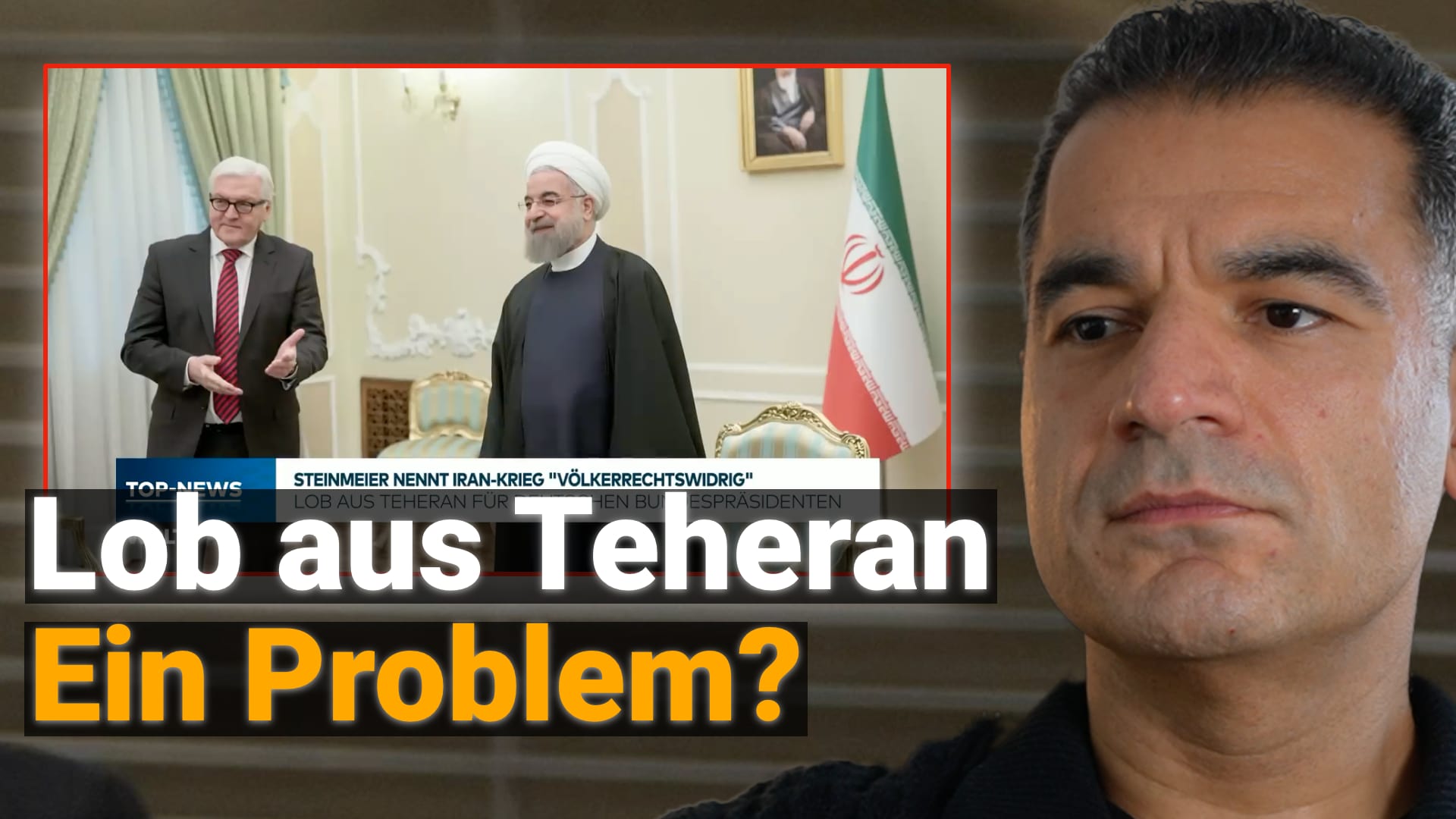

This is the full English translation of the original German article and transcript. The video is in German. The political and legal assessments below reflect the views expressed by Reza Mehman and the quoted speakers at the time of publication.
Steinmeier under fire: why Iran policy and the debate over international law are damaging the office of Germany’s federal president
Steinmeier Under Fire: My Perspective
Federal President Steinmeier is facing growing criticism, particularly over his position on Iran and international law. In this podcast episode, Reza Mehman, an Iranian-born German citizen, analyses why Steinmeier’s congratulations to the mullah regime on the anniversary of the Islamic Revolution are problematic. A particularly contentious point is that Steinmeier described the Iran war as contrary to international law, putting him at odds with Chancellor Merz and the federal government. At the same time, Reza argues, Steinmeier did not identify the annexation of Crimea as a breach of international law while serving as foreign minister. These alleged double standards raise questions about whether Steinmeier is fulfilling his role as a moral compass for Germans. Reza Mehman approaches the debate through both personal experience and political analysis.
Summary
One-sentence version: Reza Mehman criticises Federal President Steinmeier’s congratulations to Iran’s mullah regime, his assessment of the Iran war under international law and what Reza sees as double standards compared with the annexation of Crimea.
Three-sentence version: Federal President Steinmeier is criticised for having congratulated the Iranian regime on the anniversary of the Islamic Revolution in the name of the German people. His assessment of the Iran war as contrary to international law has also caused tension with the federal government under Chancellor Merz. Reza Mehman, himself born in Iran, sees double standards because, he argues, Steinmeier did not describe the annexation of Crimea as a breach of international law at the time.
Five-sentence version: Federal President Frank-Walter Steinmeier is facing intense criticism. Reza Mehman, an Iranian-born German citizen, questions why Steinmeier congratulated Iran’s mullah regime in the name of the German people. As an Iranian who fled that terror regime, he regards this as a personal affront. Steinmeier also describes the Iran war as contrary to international law, contradicting Chancellor Merz’s position, while the mullah regime itself praises him for doing so. Reza finds the alleged double standard particularly questionable: as foreign minister, he argues, Steinmeier did not address Russia’s annexation of Crimea as a breach of international law.
Context: Who, What and Why
Who is speaking: Reza Mehman, a podcaster and Iranian-born German citizen personally affected by the Iranian regime. The episode also includes news clips featuring Jens Spahn, the CDU parliamentary group leader, and political commentators.
What it is about: The role of Federal President Frank-Walter Steinmeier amid tensions between Iran policy, the international-law debate and the expectation that he should serve as the nation’s moral compass.
Why it matters: The Iran war and the related question of international law are highly political issues. Steinmeier’s position contradicts the federal government and is praised by the Iranian regime itself. The debate touches on the fundamental question of what role the federal president may and should play in foreign policy.
Three key questions:
- Should the federal president congratulate a terror regime in the name of the people?
- Has Steinmeier exceeded his authority with his assessment under international law?
- Does Steinmeier apply double standards to the Iran war and the annexation of Crimea?
Contents
- Introduction — An overview of the Steinmeier debate
- Summary — The key points in one, three and five sentences
- Context — Who is speaking and why the issue matters
- Contents — Navigate the article
- Topics and Context — The main themes
- Key Takeaways — The main positions at a glance
- Frequently Asked Questions — Answers to the central questions
- Selected Quotes — Standout statements from the conversation
- The Full Conversation — The complete transcript
- Keywords — Relevant search terms
- Names and Terms — People and concepts mentioned
- Passage to Quote — For direct quotation
Topics and Context
1. The Role of the Federal President
Whether Steinmeier is fulfilling his responsibility as the nation’s moral compass, and where the limits of his authority in foreign policy lie.
Keywords: role of the federal president, moral compass, office of the federal president
2. Iran Policy and the Mullah Regime
Steinmeier’s congratulations to the Iranian regime and the personal impact on exiled Iranians in Germany.
Keywords: Iran mullah regime, Islamic Revolution, exiled Iranians in Germany
3. The International-Law Debate Over the Iran War
The controversy over Steinmeier’s assessment that the Iran war violates international law, and its conflict with the position of the federal government under Chancellor Merz.
Keywords: Iran war international law, Steinmeier–Merz conflict, international law
4. Double Standards: Iran Versus Russia
The comparison between Steinmeier’s response to the Iran war and his earlier position on Russia’s annexation of Crimea.
Keywords: Steinmeier double standards, annexation of Crimea, Russia policy
5. Democracy and Values
The fundamental question of how a democrat should position themselves towards authoritarian regimes.
Keywords: democracy in Germany, democratic values, terror regimes
Key Takeaways
- Federal President Steinmeier congratulated Iran’s mullah regime on the anniversary of the Islamic Revolution, including in the name of the German people.
- For exiled Iranians with German citizenship, congratulations issued in their name to a regime they fled can feel like an affront.
- Steinmeier described the Iran war as contrary to international law, contradicting the position of Chancellor Merz and the federal government.
- CDU parliamentary group leader Jens Spahn stresses that assessing international law is solely the federal government’s responsibility, not the federal president’s.
- The Iranian mullah regime explicitly praised Steinmeier’s position, which Reza sees as further reason to question his statement.
- Reza argues that Steinmeier did not identify Russia’s annexation of Crimea as a breach of international law while foreign minister, revealing a double standard.
- The federal president should serve as a moral compass for democracy and exercise the office with the dignity it requires.
- Even when diplomatic dealings with authoritarian regimes are necessary, a democrat can take a clear position.
Frequently Asked Questions
Why is Federal President Steinmeier being criticised?
Steinmeier is criticised for congratulating Iran’s mullah regime on the anniversary of the Islamic Revolution in the name of the German people. He also described the Iran war as contrary to international law, contradicting the federal government’s position under Chancellor Merz.
Did Steinmeier congratulate Iran on the anniversary of the Islamic Revolution?
Yes, Frank-Walter Steinmeier sent congratulations to the Iranian regime on the anniversary of the Islamic Revolution, including in the name of his fellow citizens. Exiled Iranians in Germany, in particular, regard this as problematic.
What does Jens Spahn say about the criticism of Steinmeier?
CDU parliamentary group leader Jens Spahn stressed that assessing the situation under international law is solely the federal government’s responsibility. He expects officeholders and dignitaries to await and respect that assessment.
What double standards is Steinmeier accused of?
Steinmeier describes the Iran war as contrary to international law, while critics in the episode argue that, as foreign minister, he did not address Russia’s annexation of Crimea as a breach of international law in the Minsk agreement. They see this as a clear double standard.
May the federal president describe the Iran war as contrary to international law?
According to the critics quoted here, the assessment under international law is the task of the federal government, not the federal president. In the view of CDU parliamentary group leader Spahn and other politicians, Steinmeier exceeded his authority with this assessment.
Why is Steinmeier’s position on Iran problematic for exiled Iranians?
Many Iranians in the diaspora fled the mullah regime and have since become German citizens. When the federal president congratulates that regime in the name of the people, they do not feel represented, because it was precisely that rule they escaped.
What role should Germany’s federal president play?
The federal president should serve as a moral compass for democracy. The office is deliberately removed from day-to-day party politics, allowing its holder to speak independently of party positions. It is a dignified office that requires particular care in dealings with other states.
Selected Quotes
“I have the greatest possible respect for this role. I am not joking about that.” — Reza Mehman
“I do not want the mullah regime to be congratulated in my name.” — Reza Mehman
“If a terror regime comes to my defence and tells me I am right, then at that point, at the latest, I should know that I am completely wrong.” — Reza Mehman
“In my view, these double standards really are very questionable.” — Reza Mehman
“I really do think the role of the federal president is important, even if it may not be important in day-to-day politics.” — Reza Mehman
“Our foreign policy does not become more convincing by failing to call a breach of international law a breach of international law.” — Frank-Walter Steinmeier
The Full Conversation
Respect for the Office of the Federal President
Reza Mehman:
There is an office, or a role, in Germany for which I have the greatest possible respect. I am not joking about that. It is the office of the federal president.
The problem at the moment — and I say this with the greatest caution — is that Mr Steinmeier, our federal president, who is supposed to serve as a moral compass for us Germans, is not behaving that way in my view.
Congratulations to the Mullah Regime
It started back then, around ten years ago, when he congratulated the Iranian Revolution, the mullahs, on the Iranian Revolution. Considering that he also offered congratulations in the name of the people, so to speak, that is very troubling.
You need to understand that many Iranians in the diaspora, including me and my family, fled this terror regime because life there had simply become unbearable. Many have since become German citizens too. That means that when a federal president congratulates someone in the name of the people, he naturally includes me. And I can tell you, that is not the case. I certainly do not congratulate the mullah regime on its continued existence.
I found what Federal President Steinmeier did around ten years ago very troubling.
The Debate Over International Law and the Iran War
Even now, I find his comments about the war in Iran very questionable. He describes or labels the whole thing as contrary to international law. I do not entirely agree here either.
Incidentally, I think this is something the federal government must determine or explain: whether it considers it contrary to international law, and whether it says so or not. I do not know what difference that is supposed to make to the situation, but it is not really the federal president’s role to do it.
To show you exactly what I am talking about today, I would like to play this short clip.
News Report: Steinmeier at Odds With the Federal Government
Newsreader:
Criticism of the federal president is not letting up. After Frank-Walter Steinmeier described the Iran war as contrary to international law, putting him at odds with Chancellor Merz, calls for restraint from the head of state are growing louder. Union parliamentary group leader Spahn warned that the legal assessment was solely the federal government’s responsibility. And while political Berlin debates whether Steinmeier has exceeded his authority, praise for the federal president comes from none other than the mullah regime in Tehran.
Report narration:
Cheerful handshakes with the then mullah president Hassan Rouhani in Tehran in 2015. Later, Frank-Walter Steinmeier even sent congratulations to the mullahs on the anniversary of the Islamic Revolution, including in the name of his fellow citizens.
The Personal Impact as an Exiled Iranian
Reza Mehman:
That is exactly what I mean. I see two very troubling things here. First, “in the name of his fellow citizens” means us Germans, or someone like me: I was born in Iran, but I have held German citizenship for many years. I do not want the mullah regime to be congratulated in my name.
You have to remember that we fled many years ago specifically because of this mullah regime, so that we could live in freedom without oppression. If we look at women’s rights in Iran, you know exactly what I mean. Congratulating them in the name of the people, of one’s fellow citizens, is something I find very, very questionable.
When the Terror Regime Agrees With You
That is one side of it. On the other side, when a mullah regime comes to your defence, a terror regime comes to your defence and says, “Mr Federal President, you were absolutely right”, then at that point, at the latest, you must realise: if a terror regime comes to my defence and tells me I am right, I should know that I am completely wrong here.
But first, let us continue with the clip.
Steinmeier’s Independent Course in Foreign Policy
Report narration:
Yet it is Steinmeier himself who now strikes a different tone in foreign policy as federal president from that of the federal government.
Frank-Walter Steinmeier:
Our foreign policy does not become more convincing by failing to call a breach of international law a breach of international law. We already had to confront this during the Gaza war, and we must also deal with it in the Iran war, because in my assessment this war is contrary to international law. There is little doubt about that.
Report narration:
Merz and his cabinet deliberately did not emphasise the possibility that the US attack violated international law. Instead, they pointed to the danger posed by the mullah regime to Israel and the Western world, and clearly do not want to jeopardise relations with the US over it.
Jens Spahn Criticises Steinmeier
Report narration:
CDU parliamentary group leader Spahn attacks the federal president for breaking ranks.
Jens Spahn:
The assessment under international law is the responsibility of the federal government in this case, as in others. I expect officeholders and dignitaries of the Federal Republic to await that assessment and respect it. Incidentally, I ask myself: what now follows from this conclusion?
Reza Mehman:
I have to admit that I am not the biggest fan of Jens Spahn, but here I have to agree with him completely.
Social Democratic Foreign Policy and Anti-Americanism
Report narration:
Steinmeier, meanwhile, mourns the completely failed rapprochement with the radically Shiite Islamic Republic and relies on the political left’s reflexive anti-Americanism.
Political commentator:
What we are seeing really is a very social democratic foreign-policy discourse. It may well be that this war violates international law, that this is entirely clear-cut. Frank-Walter Steinmeier himself does not seem completely certain that it does; you can hear that in his wording. But I believe international law is of only limited help here. There is still a security problem surrounding Iran.
Double Standards: The Iran War Versus the Annexation of Crimea
Report narration:
When the issue is Russia rather than Iran, Steinmeier apparently assesses the importance of international law differently. As foreign minister, he did not address the annexation of Crimea as contrary to international law in the Minsk agreement. As one of the architects of Russia policy over recent decades, he has now himself become a symbol of geopolitical failure and moral self-deception.
Reza Mehman:
That was, of course, very harsh criticism in this report. But I have to say that I agree with it on some points. In my view, these double standards really are very questionable.
On the one hand, saying that a war of aggression against Iran violates international law, and on the other, saying that Russia’s annexation of Crimea back then was entirely acceptable under international law — personally, I find that a double standard unworthy of the office of the federal president.
The Federal President as a Moral Compass
As I mentioned at the beginning, I think the federal president is a kind of moral compass for us Germans. I like the fact that the president is not heavily involved in normal party politics, for example. He can make statements independently of party positions, and that is intentional. It is an office that carries great dignity in the public eye, I would say.
Of course, I can also imagine that the role sometimes involves things you may not like or support. I can imagine that foreign policy, for example, requires handshakes even with terror regimes and so on, to make some form of cooperation possible at all.
Personally, I would have said that it is not right. But I can at least understand trying to cooperate with other nations in some form, even when they are terror regimes, so that global stability can be maintained.
Taking a Clear Position as a Democrat
Nevertheless, I think a democrat can take a very clear position here and say that what is happening there is definitely not right. And I will not offer anniversary congratulations. Nor will I comment — if I am expected not to, I will respect that — on whether something violates international law or not. I think a democrat can abide by those principles.
To be honest, I am somewhat more restrained in my criticism than the report we just heard. The reason is that I really have very, very great respect for this role.
I remember reading a sentence in Der Spiegel many years ago saying that the federal president, or the role of the federal president, is effectively the engine of democracy. To be honest, that sentence has stayed with me very strongly.
I really do think the role of the federal president is important, even if it may not be important in day-to-day politics, or at least cannot intervene significantly in certain issues. On the other hand, it is such a high office, vested with so much dignity, that one really must be very careful about whom one speaks to and how, and whether it all rests on a democratic foundation.
Closing
That is all for today’s podcast episode. Thank you for listening, and see you next time. Bye, bye, bye, bye.
Keywords
Tags: Steinmeier criticism, federal president, Iran mullah regime, international law Iran war, Steinmeier double standards, annexation of Crimea, Jens Spahn, moral compass, exiled Iranians in Germany, Islamic Revolution, Iran terror regime, German foreign policy, Steinmeier congratulations to Iran, role of Germany’s federal president, why Steinmeier is criticised, Steinmeier international law, Merz Iran war, SPD anti-Americanism
Names and Terms
Frank-Walter Steinmeier, Reza Mehman, Jens Spahn, Friedrich Merz, Hassan Rouhani, federal president, federal government, CDU parliamentary group leader, mullah regime, Iran, Islamic Revolution, international law, Crimea, annexation, Minsk agreement, diaspora, Tehran, Gaza war, SPD, foreign policy, Der Spiegel
Passage to Quote
Federal President Frank-Walter Steinmeier faces criticism after describing the Iran war as contrary to international law, contradicting Chancellor Merz’s position.
Podcaster Reza Mehman, an Iranian-born German citizen, also criticises Steinmeier’s earlier congratulations to the mullah regime on the anniversary of the Islamic Revolution.
Reza finds the alleged double standard particularly questionable: as foreign minister, he argues, Steinmeier did not address the annexation of Crimea as a breach of international law.
CDU parliamentary group leader Jens Spahn stressed that the assessment under international law was solely the federal government’s responsibility.
The Iranian regime explicitly praised Steinmeier’s position, further intensifying criticism of his conduct.
Watch episode 180 on YouTube. You can find further clips and references in my collection of sources on Iran.