
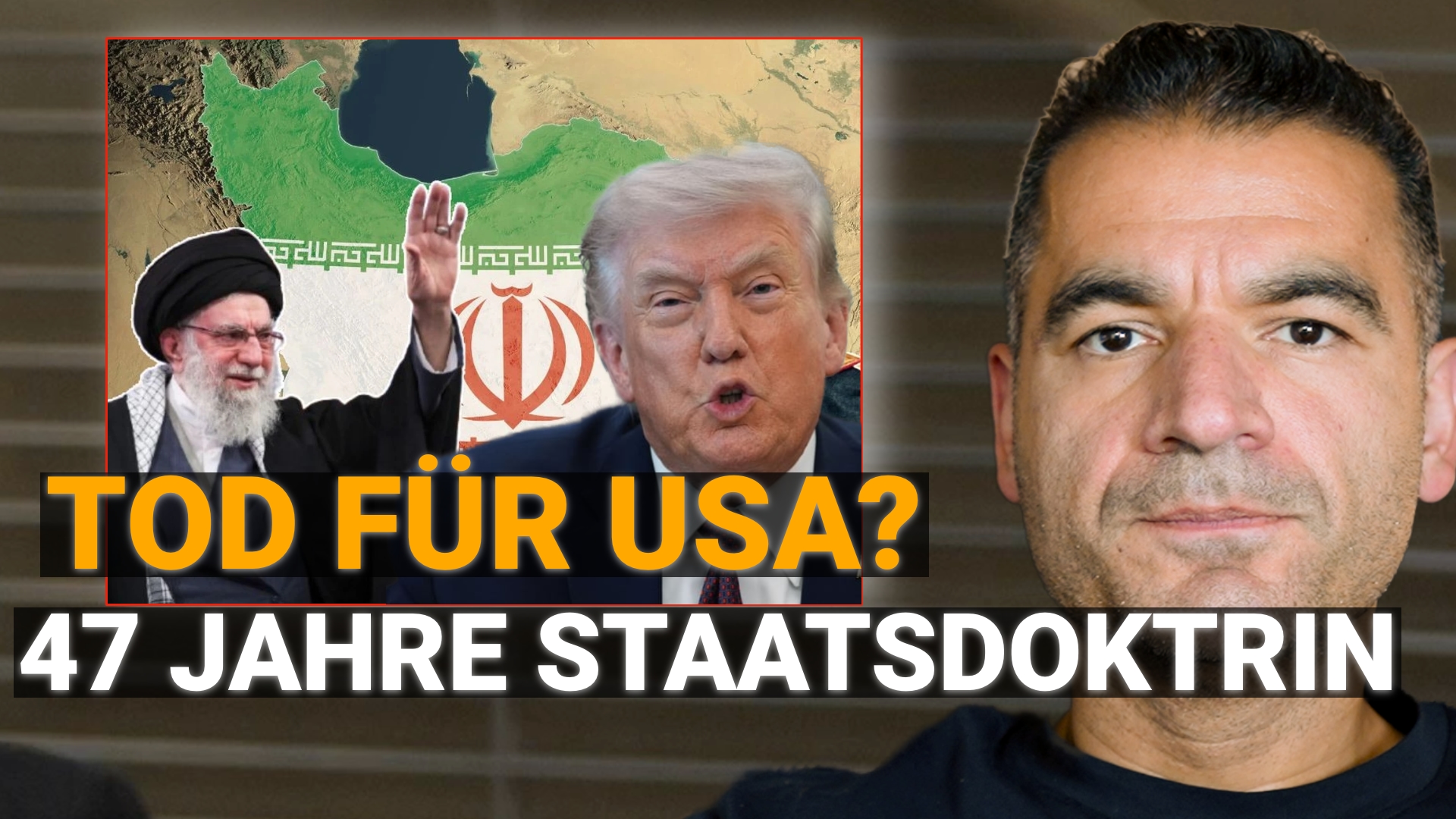

Iran and the US: Why, in my view, America did not start the war—and what that means for all of us.
The original episode and video are in German. This page contains the complete English translation of the published article and transcript, presenting Reza Mehman’s commentary.
Iran and the US: Understanding the Conflict Since 1979
Iran has been waging war against the US since 1979, not the other way round. That assessment is at the centre of this podcast episode by Reza Mehman. Drawing on a clip of an Iranian-American analyst and his own arguments, he explains why the slogan “Death to America and death to Israel” is not empty propaganda but, in his view, the mullah regime’s declared state doctrine of decades. Reza asks why German politicians, from President Steinmeier to the federal government, remain so conspicuously silent towards this regime. He raises questions about international law, humanitarian responsibility and the difference between an aggressor and a response. According to Reza’s analysis, anyone who labels Trump a warmonger outright ignores 47 years of hostility by the Iranian regime towards the West and its own people.
Summary
In one sentence: Reza Mehman argues that the US did not start the war against Iran; rather, the mullah regime itself declared this conflict in 1979 with its slogan “Death to America and Israel”.
In three sentences: Since the Islamic Revolution of 1979, “Death to America and death to Israel” has been the Iranian mullah regime’s official state doctrine. Reza Mehman uses an insider account from Iran’s foreign ministry to show that the regime openly speaks internally of being at war with the US. At the same time, he criticises German politicians for courting this regime instead of showing solidarity with the oppressed Iranian population.
In five sentences: Since 1979, Iran’s mullah regime has promoted a declared state of war against the US and Israel, verbally, ideologically and through proxy wars. Reza Mehman supports this with a clip of an Iranian-American analyst recounting a conversation in which a senior Iranian foreign ministry official openly confirmed this internally. Reza makes clear that he views Trump’s personal motives and interests critically, while separating them from the historical question of who is the aggressor. He calls on German politicians to end their silence towards the mullah regime and show solidarity with Iran’s population. His central concern is freedom for people in Iran, not justifying American foreign policy.
Context: Who, What and Why
Who is speaking: Reza Mehman is a podcast host, entrepreneur and event organiser from Heidelberg with Iranian roots. His Reza Mehman Podcast covers politics, business and society. In this episode, he speaks as a solo commentator and plays a clip of an unnamed Iranian-American analyst.
What it is about: Who historically triggered the conflict between Iran and the US, and Germany’s political stance towards the mullah regime.
Why it matters: Against the backdrop of current military tensions between the US and Iran, historical context is politically sensitive. In Reza’s analysis, media accounts portraying Trump as the sole aggressor fall short.
Three central questions:
- Who really started the war between Iran and the US?
- Why do German politicians remain silent towards the mullah regime?
- What does the international community owe Iran’s oppressed population?
Contents
- Introduction — An overview of Reza’s central argument and the episode
- Summary — The conversation in one, three and five sentences
- Context — Who is speaking, what it is about and why it matters now
- Topics and analysis — Political and social context for the main themes
- Key takeaways — The episode’s strongest statements at a glance
- Frequently asked questions — Answers to the key questions
- Highlighted quotes — The most striking statements
- The complete conversation — The edited transcript with subheadings
- Keywords — Search tags for the episode
- Names and terms — Important names and specialist terms
- Passage for quotation — A paragraph for direct use
Topics and Analysis
1. The Iran–US conflict and its historical roots
The Islamic Revolution of 1979 as the starting point of an ideological war that continues today.
Keywords: Iran US war, mullah regime, Islamic Revolution 1979
2. Trump’s Iran policy and Western reactions
How the current US president responds to 47 years of Iranian aggression and what it means.
Keywords: Trump Iran, US military strike Iran, regime change Iran
3. German foreign policy and double standards
Why Steinmeier’s congratulations to the mullah regime and the failure to receive Reza Pahlavi shock Reza Mehman.
Keywords: Steinmeier Iran, Reza Pahlavi Germany, German foreign policy Iran
4. International law versus humanitarian responsibility
The tension between state sovereignty and the moral duty to help people in need.
Keywords: international law Iran, humanitarian intervention, responsibility to protect
5. Iranian civil society and the desire for freedom
Why many people in Iran want to bring about change themselves, and what that means for the international community.
Keywords: Iranian population, regime change, freedom Iran, Tehran protests
Key Takeaways
- The US did not start the war against Iran; the mullah regime declared it in 1979 with the slogan “Death to America and death to Israel”.
- A senior Iranian foreign ministry official confirmed internally: “We believe that we are at war with the United States.”
- Condemning Trump’s actions in the Iran conflict without acknowledging 47 years of Iranian aggression paints an incomplete picture.
- President Steinmeier congratulated the mullah regime on its anniversary, which Reza Mehman considers completely unacceptable.
- The German federal government did not receive Reza Pahlavi, an opposition figure and potential democratic alternative.
- Trump’s personal interests, for example in the Strait of Hormuz, are real and open to criticism, but do not change the historical question of perpetrator and victim.
- If a neighbour beats his children every day, one has a moral duty as a human being to intervene, even if there are legal consequences.
- Most people in Iran want freedom and democracy; graffiti bearing Trump’s name in Tehran is a signal, not proof.
- Putting a state’s sovereignty above its population’s suffering makes one complicit.
- Reza’s central concern is freedom for Iran’s population, not justifying American foreign policy.
Frequently Asked Questions
Did Trump start the war against Iran?
Not according to Reza Mehman’s analysis. Since the Islamic Revolution of 1979, the mullah regime has waged a declared ideological war under the slogan “Death to America and death to Israel”. Trump is responding to that situation after 47 years; he did not initiate it.
What does “Death to America and death to Israel” mean in Iran’s state context?
It is the mullah regime’s official slogan dating from the 1979 revolution. It is chanted at state events and forms part of the official state ideology, not a fringe phenomenon but a doctrine practised by Iran’s leadership.
Why does Reza Mehman criticise Germany’s Iran policy?
Because President Steinmeier congratulated the mullah regime on its anniversary, while the German federal government did not receive opposition figure Reza Pahlavi. Given Germany’s commitment to Israel’s security as a reason of state, Reza Mehman sees this as a blatant contradiction.
What does international law say about military intervention in Iran?
Reza Mehman places the moral question above the legal one: when a regime brutally oppresses its own population, the international community has a humanitarian responsibility to intervene. He compares it to intervening when a neighbour abuses his children, even if there are legal consequences.
Do people in Iran want regime change?
Reza Mehman says many people in Iran want change, pointing to graffiti bearing Trump’s name in Tehran as an indication. However, he acknowledges that not all Iranians share that view. His concern is freedom and, if possible, democracy for Iran’s population.
Why did Iran’s foreign ministry internally confirm a state of war with the US?
In 2003/2004, a senior Iranian foreign ministry official told an Iranian-American analyst: “We believe that we are at war with the United States. At present, it is a cold war, but it is still a war.” This shows that the state of war is not only outward-facing propaganda but is regarded internally as a reality.
Does Reza Mehman support a military strike against Iran?
Reza Mehman expressly stresses that he is not an advocate of war. His concern is the historical context: who is the aggressor and who is reacting? He openly criticises Trump’s personal interests. His central concern is freedom for Iran’s population, not American foreign policy.
Who is Reza Pahlavi, and why does he matter in Iran policy?
Reza Pahlavi is the son of the last Shah and a prominent opponent of the mullah regime. He is regarded as one of the best-known representatives of a secular, democratic alternative for Iran. Reza Mehman sees the German government’s failure to receive him officially as a sign of misplaced priorities.
Highlighted Quotes
“In my view, Iran has been at war with the US since 1979.” — Reza Mehman
“Imagine having a neighbour who calls for your death all day long. He simply says: I want you to die, I want you gone, because my only goal in life is to destroy you. So who is at war with whom?” — Reza Mehman
“I don’t think it is correct to say that President Trump started a war with Iran. I think President Trump wants to end a war that Iran started in 1979.” — Analyst in the clip
“We believe that we are at war with the United States. At present, it is a cold war, but it is still a war.” — Senior Iranian foreign ministry official, quoted in the clip
“President Steinmeier congratulates the mullah regime on its anniversary, which was completely unacceptable to me.” — Reza Mehman
“If I’m charged and have to pay a fine of, say, €2,000, so be it. But as a decent person, of course I help someone who needs protection at that moment.” — Reza Mehman
“What matters more to me is that people in Iran can finally, hopefully soon, escape this mullah regime and live in freedom, ideally in a democracy.” — Reza Mehman
The Complete Conversation
Who Really Started This War?
Reza Mehman:
Anyone who still thinks today that the US is at war with Iran has it completely wrong. In my view, and I’ll shortly play a clip that supports this very clearly, Iran has been at war with the US since 1979.
Why do I say that? There has been a slogan since 1979: death to America and death to Israel. Imagine having a neighbour who calls for your death all day long. He simply says: I want you to die, I want you gone, because my only goal in life is to destroy you. So who is at war with whom?
The clip I’m about to play illustrates this very well.
The Clip: Voices From an English-Language Discussion
Speaker 2 (English-language clip):
“Two days ago, yesterday, this morning, I was told we were not at war. Today, at the press conference, Pete Cass says: ‘At war.’ So are we at war or not? Do we want regime change or not? In his very first moment, the president told the Iranian people…”
Analyst (English-language clip):
“I know this may sound controversial, and among my friends it is controversial for some. But I believe much of the commentary may be missing the big picture. And there is a big picture. To simplify it, I would put it this way: I don’t think it is correct to say that President Trump started a war with Iran. I think President Trump wants to end a war that Iran started in 1979, 47 years ago.”
Reza’s Response: Germany’s Silence and the Question of Responsibility
Reza Mehman:
That is exactly my point. Since 1979, the mullah regime has talked only about wanting to destroy Israel and the US, wanting death to Israel and the US. I don’t understand why this isn’t raised, especially here in Germany, where protecting Israel is part of our reason of state.
Why does nobody step in and say: “Wait a minute, there is a country like Iran that essentially has only one goal in life, or divides that goal into two: death to America and death to Israel. Yet we do nothing about precisely that country.” President Steinmeier congratulates the mullah regime on its anniversary, which was completely unacceptable to me. The German federal government does not receive opposition figure Reza Pahlavi. So I ask myself: if we all know there is a mullah regime that has had one wish for 47 years, the death of two states, the US and Israel, why is nobody crying out?
The Insider Account From Iran’s Foreign Ministry
Analyst (English-language clip, continued):
“Let me give an anecdote. In 2003, 2004, when I was in Iran working on projects at a very high level, I spoke to deputy ministers. I was at the foreign ministry in Tehran, where I met someone very senior who was reasonably sympathetic to the projects we were working on. As I said goodbye, he looked me in the eye and said: ‘As an Iranian-American, I want you to know something, and listen very carefully.’ He said: ‘We in this building,’ meaning the foreign ministry, the government, the regime, ‘believe that we are at war with the United States. At present, it is a cold war, but it is still a war. That was a war against you.’”
Trump’s Personal Interests—and Why They Do Not Answer the Central Question
Reza Mehman:
That is exactly my point too. In the comments, particularly on Instagram, I’m very often accused of being an absolute fan of this war against Iran. But we have to state very clearly that Iran is at war with the US, not the other way round.
And in my view, setting everything else aside, Trump’s name is being sprayed on walls in graffiti all over Tehran. Certainly not everyone, but many want Trump to intervene. Many want regime change. Very many people want that. But let me set all of that aside.
Iran began this war verbally, and the US is now responding after 47 years. I am fully aware that Trump has enormous personal interests. Apparently, he is now making money from the Strait of Hormuz too, positioning his people there. I understand all of that. I don’t think it’s good either, but that’s Trump. What matters more to me is that people in Iran can finally, hopefully soon, escape this mullah regime and live in freedom, ideally in a democracy.
International Law and the Duty to Intervene
Reza Mehman:
I have another small example, because international law is always raised: that the US is not considering the international legal situation and that Iran is a sovereign state. The example I always give is this: imagine you have a neighbour who beats his own children every day. As a good neighbour and a decent person, you have to say: “Wait a minute, stop, you mustn’t do that.” In an emergency, I would even jump over the fence and help the children. If I’m then accused of trespassing, charged and have to pay a fine of, say, €2,000, so be it. But as a decent person, of course I help someone who needs protection at that moment.
Why do they need protection, and why is it comparable to Iran’s situation? When thousands upon thousands of people die there in January, the Iranian government has obviously lost any legitimacy to govern Iran for even one more day. I think helping people is part of being an international community.
Of course, I could say I don’t care about anyone abroad. But on the other hand, I believe the desire to help other people in need is built into us. It is no coincidence that, in my view, health insurance works similarly here: the stronger help fund the weaker.
To say that concern stops at the border and nothing beyond it interests me—then I have to say I could no longer look myself in the mirror. I think many people feel the same. If a country is suffering under a violent regime, then in my view the international community has a duty to intervene.
Closing: The Real Message
Reza Mehman:
My statement today, which I would like to see taken up much more widely, is this: the US is now indeed at war with Iran, but Iran started this war back in 1979.
Thank you for listening. Until next time. Bye, bye, bye, bye.
Keywords
Tags: Iran US war, mullah regime, Islamic Revolution 1979, death to America, Trump Iran, regime change Iran, Reza Mehman, who started the Iran war, German foreign policy Iran, Steinmeier Iran, Reza Pahlavi, international law humanitarian intervention, Strait of Hormuz, freedom for Iran’s population, Iran US cold war, Iranian foreign ministry, history of the Iran conflict, who started the war with Iran, why the world does not intervene in Iran, what the mullah regime is
Names and Terms
Reza Mehman, mullah regime, Islamic Revolution, Iran, US, Israel, death to America, death to Israel, Donald Trump, Pete Cass, Reza Pahlavi, Frank-Walter Steinmeier, German federal government, German federal president, Strait of Hormuz, Tehran, Tehran foreign ministry, Cold War, regime change, international law, trespassing, health insurance, international community, Reza Mehman Podcast
Passage for Quotation
In this episode, Reza Mehman argues that Iran has been at war with the US since 1979, not the other way round.
The slogan “Death to America and death to Israel” is not fringe propaganda but has been the mullah regime’s official state doctrine for decades.
A senior Iranian foreign ministry official confirmed this internally to an Iranian-American analyst in 2003/2004.
Mehman is critical of Trump’s personal interests and methods but clearly separates that question from the historical assessment of perpetrator and victim.
His central concern is not American foreign policy, but freedom and democracy for people in Iran.
Watch episode 188 directly on YouTube. Find more conversations and perspectives on the Reza Mehman Podcast.

