
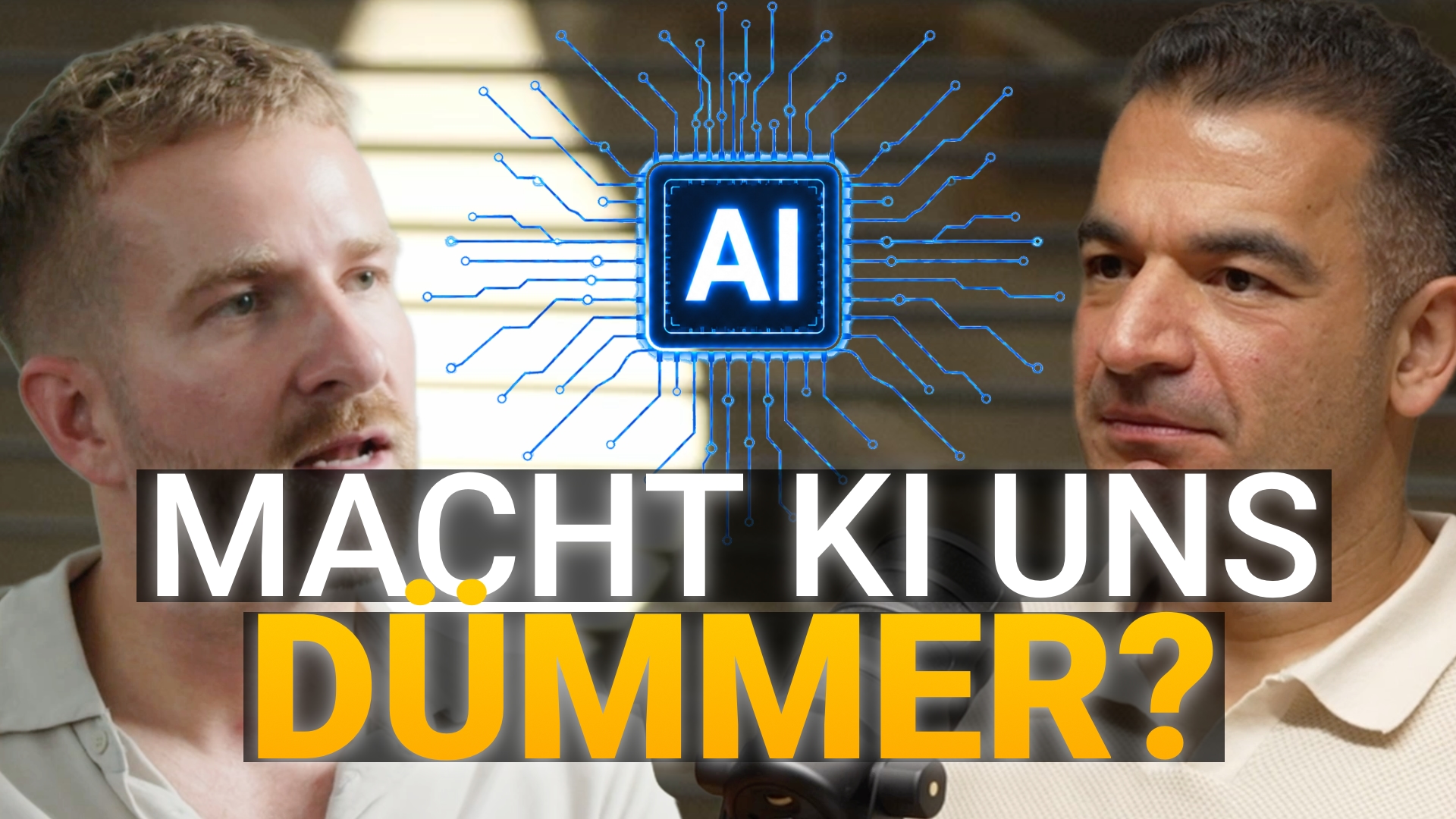

This is the complete English translation of the edited conversation. The original podcast and video are in German.
In conversation with Christoph Zöller: how AI could change work, education, prosperity, politics and participation in society.
Christoph Zöller on AI and the Job Market
Christoph Zöller on AI and the job market is a conversation about how artificial intelligence could change work, productivity, education and social structures. The Instaffo founder talks to Reza Mehman about whether AI destroys jobs or creates new work in the long term. They also examine the shrinking job market, the future of software development, new demands on young workers and the role of curiosity and independent thought. They discuss whether AI makes people more productive or leads them to outsource more and more mental effort. The conversation goes far beyond technology, touching on wealth distribution, universal basic income, politics, democracy, taxes, Germany and social identity. Christoph Zöller remains fundamentally optimistic about technology, while also describing substantial risks from growing inequality, concentrated power and people being unable to keep pace with developments.
Summary
In one sentence: Christoph Zöller and Reza Mehman discuss how AI could change the job market, productivity, education, prosperity and Germany’s future.
In three sentences: Christoph Zöller expects AI to deliver a major productivity boost and believes new jobs and fields of work could emerge in the long term. At the same time, he warns that knowledge, wealth and power could become more concentrated among a few people, leaving sections of society behind. The conversation therefore covers not only technology, but also education, basic income, politics, social identity and the question of which systems need to change.
In five sentences: Christoph Zöller founded Instaffo and observes the labour market at close quarters. He challenges the simple claim that AI must inevitably destroy jobs on a massive scale, because technological revolutions have historically also created new forms of work. Nevertheless, he sees a real risk that productivity gains will be distributed unevenly, with a smaller group accumulating more knowledge, wealth and influence. For young people, he considers curiosity, intrinsic interest and the ability to acquire knowledge independently more important than choosing a supposedly secure career. Towards the end, Christoph Zöller and Reza Mehman discuss basic income, politics, Germany, belonging and entertainment as a potential growth area.
Context: Who, What and Why
Who is speaking: Reza Mehman talks to Christoph Zöller, founder of Instaffo. In the conversation, Instaffo is described as a recruitment marketplace connecting companies with people considering a job change.
What it is about: The impact of artificial intelligence on work, businesses, productivity, education, politics and social structures.
Why it matters: AI is already changing how people work and how businesses operate. The conversation therefore asks which skills, occupations and models of society will remain viable in the future.
Three central questions:
- Will AI destroy jobs, or will technological progress create new activities?
- What skills do young people need when knowledge is becoming easier to access?
- How must the economy, politics and society change if productivity and wealth become increasingly concentrated?
Contents
- Introduction: an overview of AI, the job market and social change
- Summary: the conversation in one, three and five statements
- Context: who is speaking and which questions are central
- Themes and perspective: the main groups of topics
- Key takeaways: concise statements about AI, jobs and society
- Frequently asked questions: answers about Christoph Zöller, Instaffo, AI and the future of work
- Highlight quotes: memorable statements from the conversation
- The full conversation: the complete edited podcast transcript
- Keywords: SEO terms and search phrases
- Names and terms: people, companies, places and technical terms
- A passage to quote: a compact passage for quotations and references
- Social media snippets: YouTube, LinkedIn and newsletter
- Continue exploring: more conversations and the original episode
Themes and Perspective
AI and the Future of Work
The central question is whether artificial intelligence replaces jobs or creates new activities, and how existing roles are changing.
Keywords: AI job market, future of work, automation
Productivity and Social Inequality
Christoph Zöller expects major productivity gains, but also warns of greater concentration of knowledge, wealth and power.
Keywords: productivity, inequality, wealth distribution
Education, Curiosity and Young People
The conversation asks whether traditional educational paths are still sufficient and why intrinsic curiosity and independent thought could become more important.
Keywords: education, curiosity, future skills
Politics, Germany and New Systems
They discuss economic growth, taxes, pensions, democracy, freedom of expression and which political systems need reform.
Keywords: Germany, politics, economic growth
Entertainment, Identity and Basic Income
Christoph Zöller describes entertainment and experiences as a growing field and connects the future of work to questions about purpose, identity and basic income.
Keywords: entertainment, basic income, identity
Key Takeaways
- Christoph Zöller considers AI one of the most significant technological advances since the internet.
- He does not necessarily expect fewer jobs, but new activities and changing occupational profiles.
- The conversation uses the Jevons paradox to argue that lower costs and greater efficiency can increase the overall use of a technology.
- In his view, a central risk is not only job loss but greater concentration of knowledge, productivity, wealth and power.
- AI can massively increase productivity without automatically leading people to work less.
- Young people should focus less on supposedly secure job titles and more on their interests, curiosity and personal motivation.
- AI and digital tools have made knowledge more accessible than ever, increasing the importance of knowing how to apply it.
- Christoph Zöller believes universal basic income could become more relevant in a more automated economy.
- He still considers Germany a good place to live, while seeing pressure to reform its economic and political systems.
- Entertainment and experiences could gain importance if conventional work takes up less space in people’s lives.
Frequently Asked Questions
Who is Christoph Zöller?
Christoph Zöller is the founder of Instaffo. In the podcast, he describes it, in simple terms, as a kind of “Airbnb for jobs”: a marketplace connecting companies with people open to changing jobs.
Does Christoph Zöller believe AI will destroy jobs?
He considers job losses and major changes possible, but challenges the idea that fewer jobs are the only conceivable outcome. Historical technological revolutions also produced new kinds of work.
What is the Jevons paradox in relation to AI?
The conversation uses the Jevons paradox to explain how a more efficient, cheaper service can be used more frequently overall. Applied to software, cheaper development could mean that more software is created in total.
Which jobs does Christoph Zöller recommend to young people?
He does not recommend one particular safe occupation. Instead, he advises young people to find topics that truly interest them, because knowledge is now easier to access and passion, curiosity and initiative are becoming more important.
Does AI make people more productive?
In Christoph Zöller’s experience, AI can significantly increase productivity within companies. At the same time, he sees a risk that people will then expect even more output from themselves rather than less.
Why does Christoph Zöller see social risks from AI?
He fears people will benefit from AI to very different degrees. This could lead knowledge, expertise, productivity, wealth and power to become increasingly concentrated in a small group.
What does Christoph Zöller think of universal basic income?
He regards universal basic income as a possible response to a future in which traditional work and paid employment could become less central and wealth more concentrated.
Is Christoph Zöller optimistic about Germany?
Christoph continues to describe Germany as a very good place to live, but is considerably more sceptical about its economic growth. He calls for a stronger foundation for growth and long-term political decisions.
Why does Christoph Zöller invest in entertainment?
His investment thesis is that people increasingly seek experiences, distraction and entertainment. He cites social media, festivals and experiences as examples of this trend.
Highlight Quotes
“I can imagine people becoming less relevant.” — Christoph Zöller
“I think there will be more jobs.” — Christoph Zöller
“We have an enormous opportunity in the fact that knowledge has become a kind of commodity.” — Christoph Zöller
“Everyone else is only human too.” — Christoph Zöller
“My passion is moving things forward and building new things.” — Christoph Zöller
“I think we are at a turning point.” — Christoph Zöller
“Really, I just want to be in a country where people are doing well.” — Christoph Zöller
“I think we have to reinvent ourselves as a society.” — Christoph Zöller
The Full Conversation
Preview: AI, Jobs and Social Inequality
Christoph Zöller:
I can imagine people becoming less relevant. Above all, what I believe—and what concerns me somewhat socially and politically—is that the gap will widen further. Not just in wealth, which is a consequence of it, but in the accumulation of knowledge and expertise.
Reza Mehman:
My impression—and Philipp Klöckner once said this—is that AI will probably make us a little less intelligent.
Christoph Zöller, Instaffo and the Job Market
Reza Mehman:
Christoph Zöller, thank you for your time today.
Christoph Zöller:
Thank you for having me. I’m delighted.
Reza Mehman:
Absolutely. Finally, someone from Heidelberg on my podcast again. To be honest, I’ve had people from all sorts of regions for a long time, and now another Heidelberg local—and a fairly well-known one. You founded Instaffo, a very successful company that is also well known in Heidelberg. You now have over a hundred employees and a thousand customers, as I’ve heard or read, roughly speaking. As I understand it, you’ve developed a kind of recruitment platform.
Christoph Zöller:
Exactly. First, thanks for the introduction. The simple way I always explain it is that we’ve built Airbnb for jobs. Going one level deeper, what does that mean? It’s a platform, a marketplace. On one side, we have people who are ready to change jobs or are looking for a new job or challenge. On the other, there are companies that want to hire people. Both sides want to do this with as little effort as possible and a good process.
Christoph Zöller on Finding the Right Job
The talent side—the employees—want good jobs that fit them, without having to put a lot of effort into applying. Companies want suitable candidates: high quality and well filtered. That is where we come in as a marketplace. We founded the company twelve years ago now, but it has really had two different life cycles, as I always say. We founded it in 2014, but only went live in early 2017. That first phase lasted from early 2017 until 2020 or 2021. Then we completely reinvented the company, actually rebuilding it from scratch: new technology, new product, new management team. We received a large investment and have raised very substantial investments, most recently from a private equity company two years ago.
Reza Mehman:
Can you say how much?
Christoph Zöller:
That was over €10 million. It’s an exciting time in many respects. The job market has been shrinking since May 2022. If you look at various indices, they have been declining since then. Nevertheless, we’ve performed very well, grown well and gained a lot of market share. I’m curious to see what happens over the next few years, particularly with everything around AI. So much is changing there anyway.
A Changing Job Market Since 2022
Reza Mehman:
Absolutely, and that’s exactly what today is about. I find it interesting that you say the job market has shrunk since 2022. Did I understand that correctly? Right. Now there’s AI, and I know you’re deeply involved in the job market and the potential effects AI is likely to have. I have a few theories. One is that people really will become less relevant in this context. But I heard—or read—something from one of your talks suggesting you don’t see it that way at all, if I understood correctly.
Is AI Taking Our Jobs?
Christoph Zöller:
Yes. First, I’m someone with very strong opinions on various topics, but I also know there are many things I don’t know. In the talk you probably mean—and I’ll explain what I said and where I stand—I described one possible path. I don’t think that path is unlikely, but I’m sure the paths you’ve just described are possible too. I’d agree with you on one point and perhaps see another slightly differently. Briefly, what is my thesis, or what did I share in that talk? The question always comes down to whether AI takes away our jobs or whether we’ll have more jobs in the future than we have now.
We have to ask what the best indicator is. We humans are very bad at predicting the future. That’s why I think it always makes sense to look to the past a little and consider where we’ve come from. AI is one of the most significant technological advances we’ve probably had since the internet, on a level with electricity and industrialisation—the steam engine and all those developments.
Reza Mehman:
If I may briefly add something: Jonas Andrulis, also from Heidelberg, even said this will probably be the last major revolution we invent.
Will Work Disappear in the Long Term?
Christoph Zöller:
That’s a bold claim. I think that would only be true if humanity became extinct fairly soon afterwards. Consider the intervals at which we’ve repeatedly made advances, including advances we hadn’t foreseen. One thing immediately on my mind is quantum computing. It will change many things we aren’t even thinking about today. There are extremely exciting companies in that area too. If you look at various papers, the time frame used to be fifteen or twenty years; now they talk about seven to ten years. A lot is happening. There are some very exciting start-ups now at the stage OpenAI was at
Technological Revolutions and the Jevons Paradox
Christoph Zöller:
ten—or eight or nine—years ago. Atom Computing in the US is one example. But before we drift away, let me return to my thesis about the labour market. We aren’t good at predicting the future, so we should look at the past. When we look back at various technological leaps—almost quantum leaps—such as industrialisation and electricity, we see the same pattern. Take industrialisation: there were existing jobs beforehand, often enormous fear, uprisings and political shifts because of that fear. In the end, things always turned out differently. Compare today with forty years ago, for example. Many jobs exist today that didn’t exist forty years ago.
New Occupations Through Technological Change
Look at all sorts of creative professions: everything around influencers, the media and entertainment. Just consider software development forty years ago. Some of it existed, but many areas simply didn’t. Or take fitness trainers. There are many occupations that didn’t exist in the past, or that existed in a different form. If you had asked someone forty years ago, nobody could have told you that certain jobs would exist, because we couldn’t imagine what the future would look like. There’s also a concept that describes part of this: the Jevons paradox. It concerns what happens when the cost of something falls—
consumption, how frequently it is used and how widely it is applied all increase. I think that also applies to software development, for example. Today, software development is almost a commodity: anyone can do it, and it is very easy. But I think that leads to more software being written and more people getting involved in it.
The Future of Software Development
Will they still be traditional software engineers? Will they have different job titles and different activities in the future? I don’t know. I’m an optimist by nature. Even though I think a lot about the downsides, I always try to remain optimistic. This is genuinely an area where I say: I think there will be more jobs. Will people still work five days a week? I don’t know. Industrialisation also had consequences like this. I think Henry Ford was one of the first to say: people working for me will work only five days, so they also have more time to consume.
On the one hand, I’m very bullish on technology, including in my personal investment strategy. As you know, on the other hand I’m also very bullish on entertainment: bread and circuses. I agree with you there too. I can imagine people becoming less relevant. Above all, what I believe—and what worries me somewhat socially and politically—is that the gap will widen further. Not just in wealth, which follows from it, but in the accumulation of knowledge and expertise. People become more productive, but I feel it isn’t that many people, even with all the technological revolutions happening around AI.
Who Already Uses AI Regularly?
If we look at the figures, we’re talking about a low single-digit percentage who regularly use AI or pay for it at all. We know that if you aren’t paying, you may be putting a query into ChatGPT that you would otherwise have put into Google, or asking for a recipe—something relatively basic. Yet it can do much more now. I think we’re losing so many people along the way. That has enormous secondary effects, starting with mental health and a sense of belonging. I think we’ll become even more divided into social classes, with wealth and then power accumulating among a few.
Does AI Make Us Lazier or Less Intelligent?
Reza Mehman:
Wow, you’ve jumped straight into the subject. I have to admit that I agree with you on certain points. But if we unpack it, I’m more worried in this case than with another technological revolution. My impression—and Philipp Klöckner once said this—is that AI will probably make us a little less intelligent. I don’t yet know whether I can fully agree, but I notice how lazy AI has made me. I’ve picked up a few new skills. You said software might in future be created not only by developers, but by product managers, for example.
Or people like me, who might never previously have dared to write a small program. I do that now, but I don’t need a great deal of intellectual effort for it any more; I can just manage it. At the same time, I now hand over loads of tasks—simple tasks—completely and focus on other things. If I extend that to many other people, we’re outsourcing an enormous amount of thinking. We no longer bother to think for ourselves. Instead, we say: this is a little demanding, so I’ll immediately give it to AI. Honestly, that worries me somewhat about the future: we may no longer be able to keep up with the pace being set.
From a Knowledge Society to AI
Christoph Zöller:
Absolutely. But again, let’s connect that to the past. Over recent decades, we’ve built a knowledge society, particularly in Western countries. Go back a few hundred years and everyone—or most people—did physical work and had practical skills. I’m not particularly handy myself, for example. At some point, machines came along and people no longer had to do as much; machines did those things. Then we developed further.
We became more intellectual and evolved as a society. Everything could turn out as you describe, but this is where I always try to push back: I don’t think that’s the only path available. There are many possibilities. I don’t know what I don’t know, including the directions in which society could develop. To take an example: robotics will follow, but AI is currently mainly transferring or automating a lot of knowledge work. That’s also the area where you say you’re becoming lazy.
The Social Opportunities of Automation
But perhaps it is also an opportunity for us as a society. A lot would have to happen, and we’re still a long way from it, but perhaps we could focus much more on interpersonal community again: interacting with one another, rather than spending all day thinking about work, money and status. We could reach a different level of prosperity. That is what I always want to argue for: there are various paths we can take, not just one inevitable outcome. These are all risks, and some of these scenarios could coexist. Both could happen.
Reza Mehman:
I don’t want to sound so negative either, but I recently read that if you let AI agents talk to one another, they communicate using very few tokens—
AI Agents, Black Boxes and Loss of Control
Reza Mehman:
at a level that requires fewer tokens. That means we humans no longer understand what they’re doing with one another. I find it interesting that we get left behind somewhat and genuinely can no longer trace what is happening. Some time ago, I had a software architect on the podcast. This was a few years ago, and he said something interesting: even a good, ordinary developer no longer knows what is inside an algorithm. Libraries are used on the assumption that a particular library can do something. It is deployed, and as a developer I no longer really know how the whole thing works—but somehow it does.
Now we’re reaching another level where, for example, we let AI agents talk to each other to find a price or get something done, and we no longer know what’s happening. They reach some result, and we can’t even reconstruct how they got there. That worries me enormously.
Understanding and Controlling Technology
Christoph Zöller:
How many of the technologies you use every day can you explain? If you make a phone call from here to Iran, for instance? I couldn’t explain that either. I couldn’t explain how all of this works here: audio, video, laptop, internet. There are many things we simply can’t explain on a technological level. Some people can, but the average person can’t. Of course, those are all risks. But if it really is such a major problem, I think solutions will emerge. Either we trust it, or we have some sort of metric that tells us: up to this point things are fine, and beyond it we need to take a closer look.
There will certainly be risks. I’m not saying it will make the world entirely better, but I don’t believe in this Armageddon scenario in which everything now gets worse. I think the much bigger problems are ours as a society. Perhaps technology simply brings them to the surface and puts its finger on the sore spot.
What the Job Market Is Actually Showing
Reza Mehman:
On your job platform, to put it simply, what movements have you seen—technological shifts? Is there still strong demand for software developers, or are entirely different occupations now in demand?
Christoph Zöller:
First, the job market is fluid. It’s moving and always changing. One narrative people often repeated was that software developers were no longer needed and vacancies were falling. What we saw, and what you can see in the market, is that this trend started before GPT even publicly launched its first model—in 2023, late 2023. Where did it really come from? We had extremely heavy overhiring during the pandemic, when everything was technology and everyone thought people would only shop online and we’d be moving around in the metaverse a few years later. What often goes wrong, I think, is that the smartest people tell narratives that they either genuinely believe or have incentives to promote.
Reza Mehman:
Yes, Zuckerberg was pretty wrong about that.
Expectations About Online Shopping and Technology
Christoph Zöller:
Yes, or simply the idea that everything would move to online shopping. Not just Zuckerberg—the entire stock market was wrong. The money was wrong, or a large part of it. Now, fast-forward four years, and nobody talks about those claims any more: people would only order online, city centres would die out completely, we’d only have online meetings and spend our time in the metaverse, and so on. In the long run, more online shopping is probably a trend, but nowhere near to the extent predicted. We mustn’t forget that at such times there are always people who, consciously or unconsciously, have strong incentives to extrapolate the trend exponentially or linearly. They are also very influential and spread those ideas.
Back to your question about what else we’ve seen in the labour market: for a long time, for example, there was little or no hiring for junior positions. Perhaps AI contributed to that. But there’s research by Anthropic, the company behind Claude, from the beginning of the year. I think it’s called something like “State of Work”. It shows that AI has not yet had a relevant impact on the labour market. Really? Yes. What we see is that the job market is more difficult and, as I said, has now been declining for four years. But that is mainly due to economic factors. I do think something will happen with AI, no question, but that still lies ahead.
Young Workers and New Tools
You mentioned Philipp Klöckner earlier. He strongly argues—and I completely agree—that young people are the ones most readily adopting the new technology around AI. They grow up with it and work with it. Accordingly, many companies are starting to act. You can already see the first examples in America. Cloudflare, for instance, was a company offering substantial severance programmes, not to save costs, but to rejuvenate the workforce. They want fresh people who will also change how they work, because that is going to change fundamentally.
Reza Mehman:
OK, so older people are more likely to have difficulties with it at work.
Christoph Zöller:
Well, I—
Reza Mehman:
Older people who don’t engage with AI—
Christoph Zöller:
Yes. I’d say it isn’t about age itself. Rather, that whole middle-management layer where no real value was being created—AI will simply bring much, much greater efficiency into organisations.
Christoph Zöller on AI Within Companies
I’m already seeing that. We’re extremely close to being an AI-first, AI-native company. Our product managers, for example, and people across product development need to interact much less with one another. They can do far more themselves, and productivity rises enormously. But they also become more burnt out. That’s what I mean by these social issues. They no longer have the personal interaction or all those discussions with the UX designer. Instead, they simply build what they had in mind themselves. I think that’s the issue—
AI-First Companies and New Productivity
Christoph Zöller:
a new technology arrives, and we have our own expectations of ourselves and our productivity. We don’t work less; we work more. We want to generate even more output, and if we don’t manage it, we’re dissatisfied. As a society, we usually face this problem: a new technology arrives and we don’t know how to handle it. I’m not talking about regulation or what is discussed politically, but about us as a community, as human beings.
Reza Mehman:
Yes, very valid points. What you said earlier is absolutely true too: money can be wrong. The metaverse is a very good example. I recently read something from someone in Uber’s leadership—I think it was the CFO. I can’t reproduce it precisely, but he said they had some limit on token consumption—
Christoph Zöller:
They’d already spent their budget for the entire year by March.
Reza Mehman:
Exactly. And they realised it hadn’t brought in much additional revenue. It was essentially just a cost. Perhaps that points in the same direction: as a society, we’re trying to use it without yet fully knowing what we can do with it.
Productivity and the Consequences for Employees
Christoph Zöller:
Exactly. I’m completely bullish on AI, and I think there will be an extremely large productivity boost. But of course it is a completely new technology. Think about the internet or computers in their first four or five years. Naturally, a lot happens that is simply useless, and people may just be experimenting. Right now, there are questions like how to use tokens efficiently, and so on. But as a company, for example, we have already gained quite a lot of efficiency because AI lets us build entirely different workflows.
Which Jobs Should Young People Choose?
Reza Mehman:
What would you recommend to a young man or woman in terms of a career? Here’s why I ask: I can’t in good conscience tell someone to jump into a software project—to study computer science or something similar, develop software and assume everything will be fine. Will junior-level software development even be needed? I can now do everything a junior does myself with Lovable or Claude.
Christoph Zöller:
I think there are two big points. First, something I’ve learned is that everyone else is only human too. I’ve talked to very influential people in senior positions. Initially, you’re often in awe because of their high-ranking position, status or whatever it might be.
But once you talk with them for a little longer, it’s rare that I think: wow, I could never imagine doing that. That isn’t because I overestimate myself. Many people at my level say the same thing, and I’ve heard it repeatedly. I mean this positively: anything is possible. That’s point number one.
Knowledge Is Becoming Easier to Access
Point number two: we have an enormous opportunity in the fact that knowledge has become a kind of commodity. If I don’t know something today, I can look it up and learn almost anything. So, to answer your question about what I would do as a young person, I would really recommend finding something you want to do—something that interests you. I think the people who succeed will be those who don’t see their job as just a job, but say: this is part of my life; this is my passion. I’m speaking from a very privileged position, and I’m aware of that. But I want to be the person encouraging others, because I believe it’s possible.
Not everyone will manage it, because fears, constraints and other issues play a part. But the problem that used to be much greater—having no access to a good education or being unable to acquire knowledge—has changed. It has never been so easy. I’m not saying it is easy; I’m saying it has never been as easy as it is now. I think that is an enormous opportunity. For that, it matters that people enjoy what they do. Before recording, we talked a little about the other things I do on the side, and I—
Reza Mehman:
A little! You love what you do. Now you have to tell us: what is your passion?
Christoph Zöller on His Passion
Christoph Zöller:
My passion is moving things forward and building new things. If I see an opportunity somewhere—something I can do—I want to work on it with people. For example, I no longer want to work with people I don’t like, and for the most part I no longer have to. The people I work with now are also friends. I enjoy spending time with them and get to experience things through that. I simply want to create. That’s my thing: I want to build and shape things. That’s what drives me, and the particular subject is secondary.
Reza Mehman:
OK—
Curiosity, Education and the School System
Reza Mehman:
so if I had to give my children advice, it would be: pursue what you enjoy doing.
Christoph Zöller:
How old are your children now? Eight and five? They still have a little time. I don’t have children myself. My sister has three boys, I grew up with three siblings, and my mother has a day nursery, so I’ve always had children around me. I think it’s much more about curiosity. I see it with my eldest nephew, for example. My sister and her partner have travelled extensively around the world, and they kept him out of the school system for as long as possible.
I’m not advocating keeping people out of school—not at all. But I noticed the intrinsic curiosity he developed. That was the point I wanted to make: he simply wants to understand things and how they work. I think we should give people, or children, that environment: get to know the world through your own eyes and discover your interests. What often happens in our system is different. I experienced it at school myself. I didn’t fit into that system, even though I’m an extremely curious person.
Learning at Your Own Pace
I simply wasn’t interested in the material because of the way it was taught. Fitting into the class was also difficult for me.
I was more of an outsider. I think we as a society need to make sure that children—our future—develop independent thinking and curiosity. We need to value quite different things. Then it becomes much less relevant which job they choose, because they’ll become good at it and find their passion.
Reza Mehman:
But the current system doesn’t fit that at all, we have to say. This isn’t meant as school-bashing, but even in my day it didn’t prepare you for life at all, and that’s still true today. I’m actually more worried. I know you’re optimistic, but I worry that we’re raising generations who will suffer serious harm from social media—or already are—and perhaps won’t be quite as mentally agile because, for example, they use AI a lot and don’t have to work things out for themselves.
The Jevons Paradox and New Demand
You can see it positively through what you said earlier about the Jevons paradox. As I understand it, overall demand increases despite efficiency gains, to put it simply. My impression is rather different. About six months ago, I think, Handelsblatt published an article about Meta, the Facebook group, saying they had launched a major cost-cutting programme. I don’t want to misquote it, but I think they laid off twenty per cent of their workforce because they needed more resources and money for AI, energy and so on. Those are rough figures; I may be a few percentage points off. But I thought: wow, Meta already employs very good people. First you have to get into Meta. Then they cut twenty per cent of those very good people.
What does that mean for average people trying to get a decent, ordinary job somewhere? Where does that lead?
Meta, Job Cuts and Concern About Ordinary Jobs
Christoph Zöller:
Two things, briefly. I’m not fundamentally saying things definitely will turn out as I describe. For that to happen, many things also have to go right. I completely recognise your concerns and largely share them. Let me finish my thesis: it isn’t just the Jevons paradox. Above all, I think technological progress will create so many new things that we will need people again. That is certainly my—
Reza Mehman:
The things I don’t know yet.
Christoph Zöller:
Exactly. That’s the hope I have. That’s my first point.
A Turning Point for the Labour Market and Society
Christoph Zöller:
Now, on the labour market as a whole: I think we’re at a turning point. Many systems that worked for decades, perhaps centuries, and were supposedly improved repeatedly no longer work and need to be broken open. Let me give just one example. I’m a committed capitalist. You can see how capitalism has developed over the years. There’s a very good book—one of my favourite books—by Hans Rosling, “Factfulness”. We just had to cut because I needed to Google it, or rather ask an LLM.
Google couldn’t find the book with my input. It’s about how capitalism has created more and more prosperity over recent decades and centuries. Of course, there are also gaps, but people have moved out of extreme poverty into low-income countries and onward. It also describes fewer natural disasters, fewer deaths from wars and many positive effects. Yet if you live in the here and now, the story is sometimes perceived differently.
Technology Companies and Economic Dependencies
But I think technology is changing things too. We’ve already seen it. Take Elon Musk: is he a trillionaire—or “Billionär” in German? AI will naturally amplify that even further. I think this connects to many of our problems. Starting with Germany: we don’t tax all these big tech companies. It’s like a compulsory levy that we send to America. To me, that is crazy and unbelievable. I don’t understand why German politicians can’t solve it—or rather, it’s a European problem. I don’t understand it.
It will only increase. Every online business now—and soon every other business—uses LLMs, hosts with Google or Microsoft and pays for online services. Perhaps thirty or forty per cent, potentially more in the future, simply goes to America without us getting anything from it in Germany.
It’s crazy, unbelievable. We need some form of universal basic income. The big tech bosses talk about that too, because I do believe there will be less conventional work in future, whether through working hours or—
Capitalism, Basic Income and Concentrated Power
Christoph Zöller:
the possibilities this creates, because people won’t necessarily have to work. I think jobs will exist and working will be possible, but people won’t necessarily need to. They may also earn less because wealth accumulates among a few. We’ll need basic income, because otherwise what will people do all day? But is that capitalist thinking on my part?
I think a lot of that thinking is capitalist: you want people to have money again so they can consume. Think of Facebook and Amazon if people have no purchasing power. The capitalist system grew as people developed more purchasing power. But I don’t want to put a label on it. I just think we’ll face problems that we have to solve. It won’t make sense to keep tinkering a little and expect that to move us forward. Another example for me is our current democracy. Policy is made for voter groups, and the largest group is pensioners.
Pensions and Political Reform
Our pension system is one of our biggest problems and liabilities—the obligations and debts we have as a country. Reforms are being discussed again now, and they’re all more or less unsatisfactory compromises. There is a huge list of issues like that. I don’t know how it will end, but these are the things that worry me. That’s a good point—you as an entrepreneur—
Politics, Pensions and Structural Problems
Reza Mehman:
What are your main concerns when you think about politics? Where do you feel supported, where don’t you, and what would you actually like? Here’s the background: it’s interesting that we all use a lot of software and services from the US.
They pay basically no tax here, or very little, or have models that let them neatly work around it, as I’d put it. On the one hand, that is massively unfair. As an entrepreneur here, I have to pay a huge amount of tax in every direction. It feels like everyone earns from it: my tax adviser, the tax office, the people I work with. Somehow, it feels as though everyone earns more than I do. I feel somewhat—not just somewhat—disadvantaged in global competition, to be honest.
What Entrepreneurs Expect From the State
Christoph Zöller:
That’s interesting. I’ve never thought in terms of what I personally lack as an entrepreneur. What I really want from my country is simply a good basis and a solid foundation on which to work. Compared with other countries, Germany is still OK, but it is getting worse by comparison. What do I mean? I simply want a country whose economy is growing, where people overall—ideally everyone—are doing well. Then I’ll do well as an entrepreneur too. Of course there are individual issues, such as reducing bureaucracy, but to me those are things that need to happen so the economy can grow.
I’m not asking for a particular change to bureaucracy as an end in itself. Really, I just want to be in a country where people are doing well and total gross domestic product grows steadily. Of course there will sometimes be crises. That is what I want, and my expectation—my mandate to politicians—is: make that happen, in a way that lets as many people as possible do well. Naturally, that also involves decisions where you won’t always find a solution that is good for everyone.
Making Long-Term Decisions
Above all, you have to make decisions that may hurt in the short term because you’re carrying debts from the past and someone finally has to clear them up. It’s like this [expletive] that keeps getting bigger, and every four years you throw it on to the next person. You don’t want to be the one dealing with it, because then everyone says: Reza [expletive] it up. You want to be re-elected, so you have different incentives. To me, the whole system is broken.
What Entrepreneurs Need From Germany
Reza Mehman:
How do we fix that?
Christoph Zöller:
Yes, that’s a very good question.
Reza Mehman:
You said you’re bullish on tech. In that sense, are you also bullish on Germany?
Christoph Zöller:
I think I hold almost no German shares, though that’s also because they don’t interest me as much. Am I bullish on Germany? The question is: in what respect? I think it’s still a very good country to live in. In terms of growth—the things you mentioned earlier—I’m not currently bullish. No, not at the moment. I think there are movements that could be positive, and we need a shift. You asked what I would want to do in politics. My answer is that I don’t know yet; first I’d like to understand it better. It would be like looking into your company from the outside, seeing only numbers that don’t look good and saying I could do better.
I would always go inside first. I’m not currently at a point in my life where I want to have an impact there. But I can imagine that changing at some point. Then I would first want to talk to the people involved. Put simply, I’d want to understand it. Take the example you mentioned—
Reza Mehman:
What is actually holding things up?
The Complexity of Political Decisions
Christoph Zöller:
Exactly. Taxes, for example: what is the problem? I think you would get different information from what you have today. They might say: Trump will do this, then he’ll put pressure on us with that, and in the short term the consequences will be such and such. Then you could say: OK, but let’s think it through further. That may be true in the short term, but what about in four years? And so on.
The story we’re told is often either distilled down to a few essential points or doesn’t include all the information and factors involved. The complexity is simply too great, I think, and many people really can’t grasp it.
Is Christoph Zöller Bullish on Germany?
Reza Mehman:
At some point, a system gets stuck or entrenched in certain places. When I occasionally get a glimpse inside a large company, I notice how inefficiently things run, and it can no longer be broken open. It’s accepted, and—
Christoph Zöller:
they simply carry on as before. The last times systems were changed were always after major wars.
Reza Mehman:
Yes, that’s crazy. Honestly, I want to be bullish on Germany. Germany has many things other countries don’t, including this commitment to freedom, which is incredibly important. As someone born in Iran, I know what it means when you can’t go out into the street and express your opinion. We have all of that here. Even if many people say you can’t express your opinion, in principle you can. Of course there may be consequences, such as being ostracised, but you don’t have to fear for your freedom. That is an enormous difference. I think we sometimes move in the wrong direction too, for example with insulting politicians.
Freedom of Expression and Public Debate
That is now being eased again, which I welcome. I heard about the incident involving Habeck—I don’t even know what penalty was imposed—when someone made that “idiot” meme about him. As far as I recall, the person was a pensioner and had to pay a really substantial fine. I find that massively excessive. You could say freedom of expression is being somewhat restricted there. On the other hand, I can see a movement back in the other direction, with something changing again.
I deliberately asked whether you’re bullish on Germany because I know you have many investments and other activities in your life. What I’d also like to understand is whether you see your long-term future in Germany or could imagine living elsewhere.
Christoph Zöller:
I’ve never really thought about it. I’m also happy to pay taxes—well, nobody likes paying tax.
Freedom of Expression, the Public Mood and Politics
Reza Mehman:
I know what you mean.
Christoph Zöller:
I don’t have a problem with it. Recently, I wrote a LinkedIn post that went very viral, saying I would be willing to pay two or three per cent more if there were a system where I knew the money was being used properly and doing good. I haven’t thought about whether I see myself in Germany long term. If you ask me today, I’d say yes; that could change tomorrow. For me, it’s not so much about choosing the place where I can earn the most money. Even if the economy shrinks, the GDP is still enormous, and you can do business in any situation.
Quality of Life and the Mood in the Country
For me, it’s more about how I want to live, what society is like and the mood in the country. What is the mood right now? I think we Germans generally tend to be rather grumpy and pessimistic. Things are often talked down more than they deserve. That can also be a virtue: it makes us work hard and stops us settling for too little. I can’t give you an objective assessment, but subjectively I would say the mood in the country isn’t good. There are various signs of that. It isn’t as though I’ve conducted a representative survey; of course, I live in quite a bubble too.
But I think the mood is bad, partly with good reason. What I find most striking is that politicians don’t seem to respond to it. They sit in their ivory tower. When I look at Bärbel—
Reza Mehman:
Bas, for example, who is almost declaring class warfare against employers, I think: what? How can you do that as a minister? It’s crazy.
Social Systems Under Pressure
Christoph Zöller:
I think we’re seeing some very concerning developments. Systems are also resilient and last longer than expected. Five years ago, people were already talking about the car industry and all sorts of other issues, yet everything keeps going longer. I think systems are much more resilient and may also reinvent themselves in the process. But in Germany, I think society is looking for people with a clear position: this is what I stand for, this is what I want to change. People really want leadership again—politicians who say: this is the way out. The terrible thing, and the risk, is that we’ve had that in Germany before, and we know how it ended.
There are always two sides to the coin. There can be a positive version, with someone pointing out a path we need to take, and it’s a good path. Then there are those who abuse it, leading to a different outcome. That is more my biggest worry. The AfD’s polling figures show it: for most people, it isn’t about being pro-AfD, but being against everything else because they can no longer identify with anything. That is certainly a development that should make us think.
Entertainment and Leisure
Reza Mehman:
Definitely. I think that deserves another podcast so we can go into it properly. Before we head towards the end, I wanted to return briefly to something. Right at the start, you mentioned that you strongly believe in “bread and circuses”—entertainment. I know you’re also investing in that area. Could you briefly explain why you think entertainment could become relevant to us again, including from the perspective of the future and jobs?
Entertainment as an Investment Thesis
Christoph Zöller:
Do you know “The Hunger Games”? That’s a slightly flippant comparison, but social media has already shown that people want distraction and to be entertained. First television, then social media. People are also increasingly looking for experiences. You see it with festivals and many other things.
Reza Mehman:
It feels like there are many more festivals, yes.
Christoph Zöller:
Experiences. People want to feel more, switch off and escape their dreary everyday lives. That is the investment hypothesis behind it, in two sentences.
Reza Mehman:
OK. So you probably also see more job opportunities there in the future, if we return to the labour market?
Christoph Zöller:
Yes. As I said, my dream scenario would be that people earn good money, have some form of basic income and also have enough opportunities to take a job and get involved beyond that. Whether that means more work with people and communities or other activities, that is roughly what I imagine. If we look wildly into the future: SpaceX went public a week or two ago. I only bought on the first day and then sold again. Fundamentally, I think it is massively overvalued, but—
Basic Income, Identity and New Work
Christoph Zöller:
that doesn’t mean much with Elon Musk’s companies. Still, it’s why I didn’t want to stay invested long term. If we think about space and everything beyond that, entirely new possibilities open up. I think there is still plenty for us as humanity to do.
But we have to keep reinventing ourselves, and some people will be left behind. One scenario I don’t hope for, but don’t consider unrealistic, is increasing division into classes, with people left behind and an ever smaller group—the so-called elite—accumulating a large share of the value. We need some kind of system that counteracts that. I’m not talking about socialism or anything like that, but universal basic income is one possibility. Above all, though, we need to work more with people on a deeper level, so they have a sense of purpose and ask: what is my identity? Because for many people—
their job is a very large part of their identity. Definitely. Then the question is: what forms my identity, and where do I belong? We don’t want people to say: I’m Iranian, for example, and I only hang out with Iranians. We don’t want that to be the only basis for belonging either.
Personal Identity and Belonging
Reza Mehman:
And I’m German now.
Christoph Zöller:
Yes, but you know what I—
Reza Mehman:
mean. I know what you—
Christoph Zöller:
mean. I think we simply need something there. We have to reinvent ourselves as a society, and that is an enormous task.
Germany, Belonging and a Sense of Togetherness
Reza Mehman:
One more thought about identity: I find it a genuinely difficult subject. I also notice a major problem with it in Germany. Recently, I spoke with an older woman who said she didn’t understand why German flags only come out once every four years for the World Cup. During the intervening four years, nothing happens with German flags. In fact, you’re more likely to be ostracised for hanging one up. I think that is part of the problem: this identity has been pushed so far away from us Germans. We don’t even have that sense of togetherness, except once every four years at the World Cup. Otherwise, we no longer have it.
Christoph Zöller:
I think that is complete nonsense. The Second World War, the Third Reich—I had nothing to do with them, you had nothing to do with them, and I think almost nobody living in Germany had anything to do with them. I think at some point we have to draw a line under that. Being proud of your own country also helps us enormously as a society.
Shared Culture and a Sense of Togetherness
Reza Mehman:
It helps enormously. Take what happens in Japan: how people treat their culture and how they approach cleanliness. I find it a real shame when I see that we’re no longer proud of our city centres, for example, and don’t really care whether anything gets done or whether they’re kept clean. Compare that with Japan. I recently watched a documentary showing how important cleanliness is there. Here, we just throw things away because we no longer have that sense of togetherness. Someone else will take care of it; it isn’t mine anyway; I’m not interested. A very difficult subject.
Closing Thoughts and Looking Ahead
Reza Mehman:
Chris, I don’t think this will be our last conversation. Thank you very much. I’ve certainly had the opportunity to get to know you better, and I think I’ll prepare a few more political topics for next time. Let’s do that. Thank you so much.
Christoph Zöller:
Thank you.
Keywords
Tags: Christoph Zöller, Christoph Zöller AI, Instaffo, AI job market, future of work, artificial intelligence jobs, AI labour market, German labour market, AI productivity, AI software development, Jevons paradox, future of education, universal basic income, German economy, AI social consequences, entertainment investment, future jobs, which jobs have a future, will AI replace jobs, Reza Mehman Podcast
Names and Terms
Christoph Zöller, Reza Mehman, Instaffo, Heidelberg, artificial intelligence, AI, job market, labour market, recruitment, software development, software engineers, product management, UX designers, OpenAI, ChatGPT, Claude, Anthropic, Lovable, Meta, Facebook, Cloudflare, Google, Microsoft, quantum computing, Atom Computing, Jevons paradox, industrialisation, Henry Ford, private equity, knowledge workers, AI-first, AI-native, LLM, tokens, Factfulness, Hans Rosling, Elon Musk, basic income, Germany, gross domestic product, democracy, pensions, freedom of expression, Robert Habeck, Bärbel Bas, AfD, entertainment, festivals, identity, belonging.
A Passage to Quote
Christoph Zöller expects artificial intelligence to deliver a substantial productivity boost, but does not consider blanket job losses the only possible outcome.
In his view, new technologies can also create new activities that cannot yet be foreseen.
At the same time, he warns that knowledge, wealth and power could become increasingly concentrated in a small group.
Curiosity, personal interests and the ability to acquire knowledge independently will therefore become more important for young people.
He sees the real challenge not only in the technology itself, but in how the economy, politics and society adapt to these changes.
Social Media Snippets
What is artificial intelligence doing to our job market?
I discuss this with Christoph Zöller, founder of Instaffo. Christoph has observed the labour market for many years and has a clear but nuanced view of whether AI will destroy jobs or create new work.
We talk about today’s labour market, software development, AI-first companies, productivity, the Jevons paradox, young workers, education, social inequality, universal basic income, Germany, politics, entertainment and the role work will play in our identity in the future.
Episode timestamps
Timestamps:
00:00 AI and social inequality
00:31 Christoph Zöller and Instaffo
02:28 The job market since 2022
03:20 Is AI taking our jobs?
05:44 Looking at earlier technological revolutions
06:56 The Jevons paradox
08:07 Knowledge, wealth and power
09:30 Does AI make us less intelligent?
10:48 What we can learn from earlier waves of automation
12:39 AI agents and loss of control
14:50 What Instaffo sees in the job market
17:38 Young workers and AI
18:21 AI-first companies and efficiency
20:59 Which jobs have a future?
22:20 Knowledge becomes a commodity
23:31 Christoph Zöller’s personal passion
24:15 Curiosity and education
26:08 Social media, AI and younger generations
27:38 Why technological progress could create new work
28:15 A turning point for existing systems
29:31 Concentrated power and technology companies
30:31 Universal basic income
31:41 Democracy, pensions and politics
32:26 What entrepreneurs need from Germany
34:52 Is Christoph Zöller bullish on Germany?
37:19 Freedom and freedom of expression
38:28 A future in Germany
40:08 The mood in the country
42:28 Entertainment as an investment thesis
43:47 The future of work and leisure
45:34 Identity without a conventional job
46:08 Germany and a sense of togetherness
47:57 Closing thoughts
#ChristophZöller #AI #JobMarket #FutureOfWork #Instaffo #ArtificialIntelligence #Germany #Podcast
Will AI destroy our jobs or ultimately create more work?
I discussed this with Christoph Zöller, founder of Instaffo.
Ideas From the Conversation
Four points from our conversation:
* AI can massively increase productivity.
* New technologies can change jobs without work disappearing entirely.
* The greater risk may be the widening gap in knowledge, wealth and power.
* Curiosity and the ability to learn independently are becoming increasingly important for young people.
I found Christoph’s argument particularly interesting: we need to talk not only about AI itself, but about how it changes our social systems.
The full conversation is available in the podcast and on the blog.
#AI #JobMarket #FutureOfWork #Instaffo #Entrepreneurship
Will artificial intelligence replace millions of jobs, or create new activities we cannot yet imagine? In my conversation with Instaffo founder Christoph Zöller, we explore AI, productivity, the job market and the skills young people will need. We also discuss education, wealth distribution, basic income, Germany, politics and social identity. Read the full conversation on the blog.
Continue Exploring
Find more conversations and ideas on the Reza Mehman Podcast page. Watch episode 193 on YouTube.

