
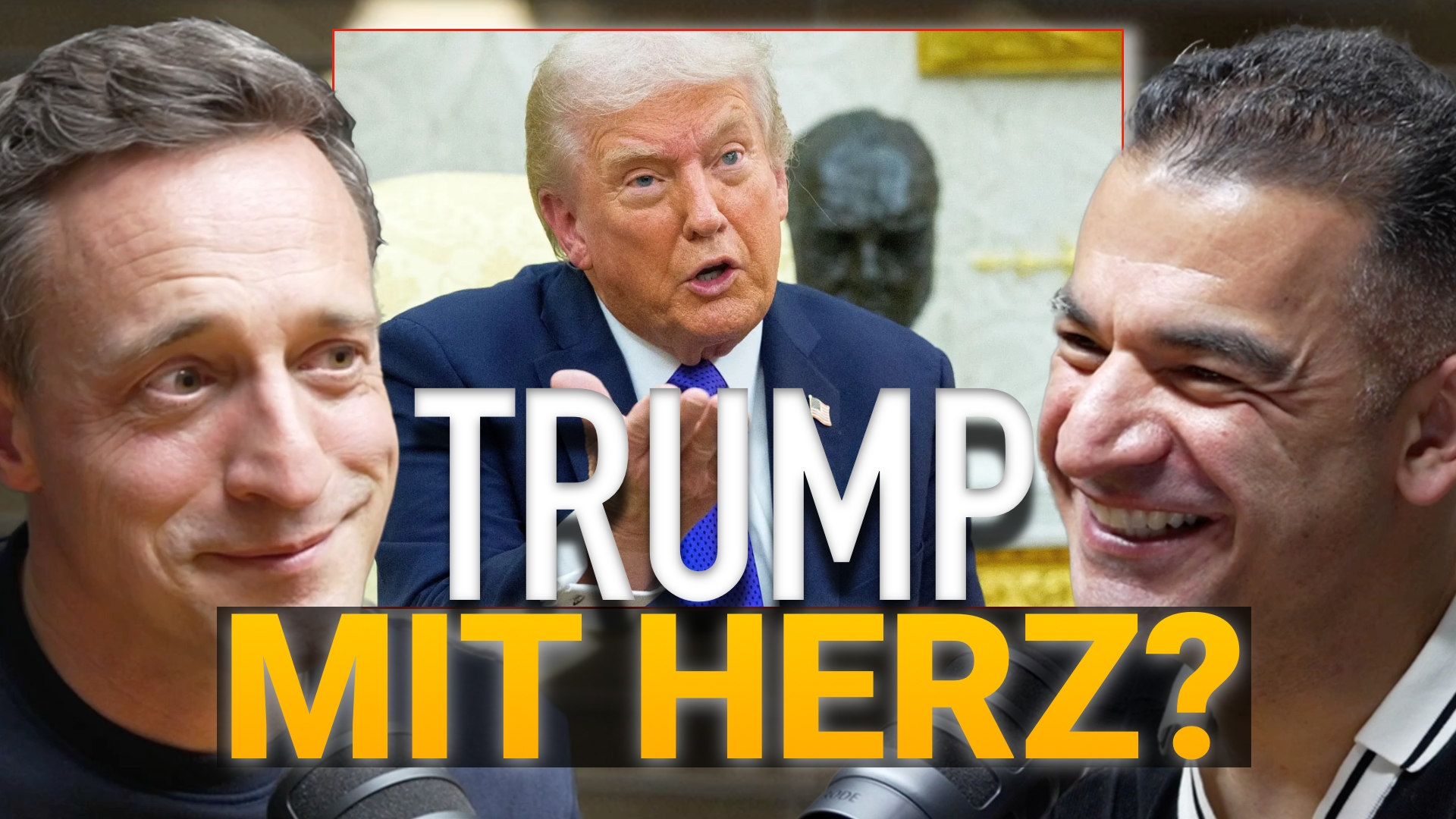

Trump’s offers of help: Reza Mehman and Karsten Kammholz discuss his instinct for power, his offers of assistance and the question of genuine compassion.
The original conversation is in German. This is the complete English translation of the article and edited transcript. Opinions, recollections and allegations remain attributed to the speakers and have not been independently verified for this translation.
Trump’s offers of help: compassion or an instinct for power?
Does Trump have a big heart for people who are suffering? That question is at the centre of this episode of Reza Mehman’s podcast with guest Karsten Kammholz. Starting with a theory Reza heard on another podcast, the two debate Trump’s offers of help to Iranian women footballers, South African farmers and Venezuelan dissidents. Reza, who was born in Iran, describes feeling some gratitude for Trump’s Iran policy. Karsten Kammholz, however, firmly interprets Trump’s actions as driven by power and strategic political theatre. The conversation shows how differently people judge Trump’s public behaviour, and why it is so difficult to draw a line between genuine compassion and political calculation.
Summary
One-sentence version: Reza Mehman and Karsten Kammholz debate whether Trump’s offers of help to Iranians, South Africans and Venezuelans show genuine compassion or a pure instinct for power.
Three-sentence version: Reza Mehman brings the theory that Trump has a big heart for people who suffer, citing examples such as his asylum offer to Iranian women footballers and South African farmers. Karsten Kammholz strongly disagrees, seeing only strategic calculation and media-friendly political theatre in Trump’s actions. In the end, the two agree that Trump at least has “a big mouth”.
Five-sentence version: In this episode, Reza Mehman and Karsten Kammholz discuss the provocative question of whether Donald Trump has a big heart for people who are suffering. Reza cites several examples: the asylum offer to Iranian women footballers, taking in South African farmers and supporting Venezuelan dissidents. Born in Iran himself, he describes the gratitude many Iranians feel towards Trump’s Iran policy. Karsten Kammholz counters that Trump is driven solely by an instinct for power and that his offers of help are pure tactics, for example to legitimise the Iran conflict domestically. The question remains unresolved, but both agree: Trump certainly has a big mouth.
Context: who, what and why
Who is speaking: Reza Mehman, a podcaster and political commentator with Iranian roots, talks to Karsten Kammholz, a journalist and critical observer of international politics.
What it is about: Whether Trump’s offers of help and intervention in international conflicts are driven by genuine compassion or pure political calculation.
Why it matters: Trump’s Iran policy, his rhetoric towards authoritarian regimes and his public promises of assistance divide opinion around the world. The debate raises fundamental questions about political motivation and public image.
Three key questions:
- Does Trump’s behaviour towards Iranians, South Africans and Venezuelans show genuine compassion?
- Are Trump’s actions purely about power politics and media spectacle?
- How do people with a direct connection to these conflicts assess Trump’s behaviour?
Contents
- Introduction — An overview of the conversation and its central question
- Summary — The conversation in one, three and five sentences
- Context — Who is speaking and why the topic matters
- Topics and context — The episode’s main themes
- Key points — The main statements at a glance
- Frequently asked questions — Questions with precise answers
- Highlighted quotes — Standout statements from the conversation
- The complete conversation — An edited transcript with subheadings
- Keywords — Relevant search terms
- Names and terms — A directory of important names and terms
- Passage for quotation — A ready-to-use text
Topics and context
1. Trump and Iran
The gratitude many Iranians feel towards Trump’s Iran policy and his asylum offer to Iranian women footballers as a specific example of his stance.
Keywords: Trump’s Iran policy, asylum for Iranian women footballers, Iranians grateful to Trump
2. An instinct for power versus compassion
The central dispute: does Trump act out of genuine compassion, or does he exclusively follow his instinct for power and political calculation?
Keywords: Trump’s instinct for power, political calculation, Trump’s compassion
3. Political theatre
Karsten Kammholz analyses Trump’s public offers of help as media-friendly political theatre serving domestic objectives.
Keywords: Trump’s public image, media impact, political tactics
4. International offers of assistance
Trump’s offers to South African farmers, Venezuelan dissidents and Iranian women athletes compared with the actions of Western governments.
Keywords: asylum for South African farmers, Venezuelan dissidents, Trump’s offers of help
5. Personal judgement and ambivalence
Reza’s internal conflict between gratitude as an Iranian and a critical distance from Trump’s overall record.
Keywords: judging Trump, ambivalence, critical distance
Key points from the conversation
- Millions of Iranians are grateful to Trump for his intervention in Iran policy, reflected, among other things, in people spraying his name on walls in Tehran.
- Trump offered Iranian women footballers asylum in the United States after they sought to apply for asylum in Australia.
- Trump offered white South African farmers asylum and described them as a threatened minority.
- Karsten Kammholz sees Trump’s actions as driven entirely by an instinct for power, rather than genuine concern for humanity.
- According to Kammholz, Trump’s offers of help are media-friendly tactics to legitimise conflicts such as the Iran war domestically.
- Kammholz says Trump acts entirely in the moment and often forgets his promises the next day.
- Reza describes his own attitude as ambivalent: initially positive, then critical, then somewhat more conciliatory again because of Iran policy.
- Kammholz recalls hush-money payments and other allegations against Trump as evidence of his true character.
- No other Western head of government has made comparable offers of assistance to Iranian women athletes.
- The two speakers eventually agree that Trump at least has “a big mouth”.
Frequently asked questions
Did Trump offer Iranian women footballers asylum?
Yes, as discussed in the episode, Trump offered Iranian women footballers asylum in the United States. The context was a case in Australia where five Iranian players wanted to apply for asylum after a match. Trump publicly said he would take them in if no other country did.
Why are many Iranians grateful to Trump?
Many Iranians are grateful to Trump because he has actively intervened in Iran policy and positioned himself against the authoritarian regime. According to Reza Mehman, Iranians are even spraying Trump’s name on walls in Tehran, illustrating that gratitude.
Does Trump act out of compassion or political calculation?
That is disputed. Journalist Karsten Kammholz sees Trump’s actions as a pure instinct for power and strategic political theatre. Podcaster Reza Mehman allows that individual gestures could be genuine, but remains critical overall.
What did Trump say about South African farmers?
Trump offered white South African farmers asylum in the United States. He justified this by calling them a threatened minority and also raised the subject in an interview in the Oval Office.
Is Trump’s help for Iranians just political theatre?
Karsten Kammholz argues that Trump’s offers of help are media-friendly tactics to legitimise the Iran conflict domestically. Helping Iranian women footballers brings the conflict to the American public through a specific example.
What does Karsten Kammholz mean by Trump’s instinct for power?
Kammholz describes Trump as someone guided solely by an instinct for power. In his view, Trump speaks only the language of power, acts strategically rather than out of concern for humanity, and often quickly forgets promises made in the moment.
What is Reza Mehman’s personal view of Trump?
Reza describes his attitude as ambivalent. Initially, he thought Trump was the better choice than Biden, then became more critical because of Trump’s actions. As someone born in Iran, however, he feels gratitude for his Iran policy. Overall, he remains sceptical.
Highlighted quotes
“The man has a pure instinct for power. He is guided only by that instinct. He speaks only the language of power.” — Karsten Kammholz
“They wouldn’t spray his name, Trump, on walls in Tehran if they weren’t grateful to him.” — Reza Mehman
“It’s nice that there are people out there, probably some Dubai influencers too, who now think the man has a big heart. Sorry, I’m not falling for it.” — Karsten Kammholz
“I don’t see a mind trying to use persuasive words, diplomacy or concern for humanity to turn the earth into a better planet through his position of power.” — Karsten Kammholz
“We shouldn’t forget what sort of person he is.” — Karsten Kammholz
“Can we agree that he has a big mouth?” — Karsten Kammholz
The complete conversation
Opening: Trump’s Iran policy and Iranian gratitude
Reza Mehman:
I heard something very interesting on another podcast. Someone on it claimed that Trump has a big heart for people, and I’d like to know what you think.
For example, he said something very recently — I know you’re not the biggest Trump fan, but I still want to discuss it. “Are you, though? Are you a Trump fan?”
No. At the beginning, I had more of an impression that he was better, the better choice than Biden. To be honest, then I saw everything he was doing and, above all, how he was doing it. Suddenly I thought: ah, maybe not so good after all.
But where he at least won me back as an Iranian was by actually doing something and intervening. I’m not the only Iranian-born person who’s grateful to Trump for that. I think millions — and I’m really not exaggerating — millions of Iranians are grateful to him. They wouldn’t spray his name, Trump, on walls in Tehran if they weren’t grateful to him. I think he’s done a very great favour for a great many people there.
The theory: Trump has a big heart
Reza Mehman:
That’s why I can’t simply say I don’t like him at all. And to get to today’s episode, I found the line of thought interesting: that Trump has a big heart for people, or rather that he is against human suffering.
Of course, we have those ICE stories in the United States, which suggest the exact opposite. Although I think at some point he also said: people, that’s enough, this is too harsh for me, and then made a few personnel changes and so on.
But if I look at a few issues now — and I want to make clear that I don’t know what I think about this myself — I found the idea interesting.
Specific examples: Iran, South Africa and Venezuela
Reza Mehman:
Trump proposed giving Iranian women footballers asylum in the United States. You may know the case in Australia: I think five Iranian players wanted to apply for asylum immediately after the match, and did so. Trump even said while that was happening: if Australia won’t take you, or another country won’t take you, I’ll do it for you. No other president or leader said that. Merz and the others could have said exactly the same, by the way.
Another example: South Africa. Trump offered white South African farmers asylum in the United States. His reason was that they were a threatened minority. There was that one interview — I can’t remember with whom, who was in the Oval Office or visiting Trump — where he confronted the person about the oppression of white farmers in South Africa. And I think he actually brought a few people over, as I understood it.
Then, interestingly, Trump often addresses dissidents who criticise authoritarian systems. He urges people, for example, to resist, to take to the streets and so forth. He did that with Venezuela too.
You can perhaps look at that from different angles, but the things I just read out are things he did. I know he’s a very controversial figure. But with Iran, Venezuela, South Africa and so on, you could get the impression that people’s suffering perhaps matters more to him than it does to many other Western countries and leaders. How do you see it?
Karsten Kammholz: it is all an instinct for power
Karsten Kammholz:
In my opinion, he is relatively indifferent to other people’s suffering. He does things that benefit him, that suit his strategy at that moment. I don’t consider him a person of integrity who follows his heart.
I find the example of the Iranian women footballers really interesting, because of course it fits his tactics perfectly. There isn’t clear support among the American population for this attack on Iran. If he now says: look, we’re helping these Iranian women footballers, we’re bringing them into the country, then he brings the Iran conflict into his own country through a very small example with a very big media impact. He shows Americans: look, this is what I’m doing, this is what it’s about, so please understand why I’m attacking that country. With Trump, it’s all tactics.
The man has a pure instinct for power. He is guided only by that instinct. He speaks only the language of power.
And it’s nice that there are people out there, probably some Dubai influencers too, who now think the man has a big heart. Sorry, I’m not falling for it. And my advice to you, Reza, is: please don’t fall for it either.
I also think Trump really is the kind of person who forgets what he said the day before. He probably just said in the moment: oh, I’ll offer that now. And here’s another issue where I can say: come here, I’ll help you, and so on. By the next day, it’s already gone from his mind.
Iranians’ enthusiasm
Reza Mehman:
But do you believe me that many Iranians are really enthusiastic about him right now?
Karsten Kammholz:
Of course, and possibly Venezuelans too. In the Iranians’ case, they can at least say that something is finally happening.
But I don’t see in Trump’s personality a heart that wants to make the world a better place. I don’t see a mind trying to use persuasive words, diplomacy or concern for humanity to turn the earth into a better planet through his position of power. I simply don’t see any of that. He doesn’t have that ambition.
The veteran at the press conference
Reza Mehman:
You know what I find interesting? I can follow what you’re saying quite well and I agree with you, but there are still individual points for me. An interview with him just came to mind — or rather, I think he was at a press conference — where someone spoke up, a woman who was a veteran and said she couldn’t find a job. He immediately brought her onto the stage and said: hey, we’re looking for interior decorators here and so on, would you be interested? Then it was essentially: deal, you’ve got the job.
I’ve actually seen similar cases with Trump quite a few times. If he likes the person or feels sorry for them — this was an unemployed veteran and so forth — he wants to help and will help. I’m not trying to defend him.
Kammholz: it is all for show
Karsten Kammholz:
Because the cameras are on. That’s it. It’s all for show.
Yes, and at the same time he pays millions in hush money to a woman who accused him of raping her. We shouldn’t forget what sort of person he is.
Conclusion: a big heart or a big mouth?
Reza Mehman:
Yes, I agree with you 100 per cent there. I told you at the beginning that I don’t even know what to think of this claim, whether Trump has a big heart or not. I’m definitely very critical. On the other hand, because of the current situation…
Karsten Kammholz:
Can we agree that he has a big mouth?
Reza Mehman:
One hundred per cent. Karsten, thank you.
Karsten Kammholz:
Thank you, Reza.
Keywords
Tags: Trump big heart, Trump’s Iran policy, Trump’s instinct for power, asylum for Iranian women footballers, Trump’s political theatre, Karsten Kammholz, Reza Mehman podcast, Trump South African farmers, Trump Venezuelan dissidents, Trump compassion or calculation, Trump’s offers of help, Trump human suffering, criticism of Trump, Iranian gratitude to Trump, comparison of Western leaders, Trump big mouth, Trump hush money, Trump media tactics, Trump’s public image, Iranians grateful to Trump
Names and terms
Reza Mehman, Karsten Kammholz, Donald Trump, Joe Biden, Friedrich Merz, Iran, Tehran, United States, Australia, South Africa, Venezuela, ICE (Immigration and Customs Enforcement), Oval Office, hush money, dissidents, instinct for power, diplomacy
Passage for quotation
In this podcast episode, Reza Mehman and Karsten Kammholz discuss whether Donald Trump has a big heart for people who are suffering.
Reza Mehman cites specific examples: Trump’s asylum offer to Iranian women footballers, his support for South African farmers and his solidarity with Venezuelan dissidents.
Karsten Kammholz strongly disagrees and sees Trump’s actions as driven solely by an instinct for power and media-friendly political theatre.
In the end, the two agree on a compromise: Trump at least has a big mouth.
The episode illustrates how differently political gestures are judged depending on perspective.
Watch episode 174 on YouTube. Find further perspectives in my collection of sources and clips about Iran.

