
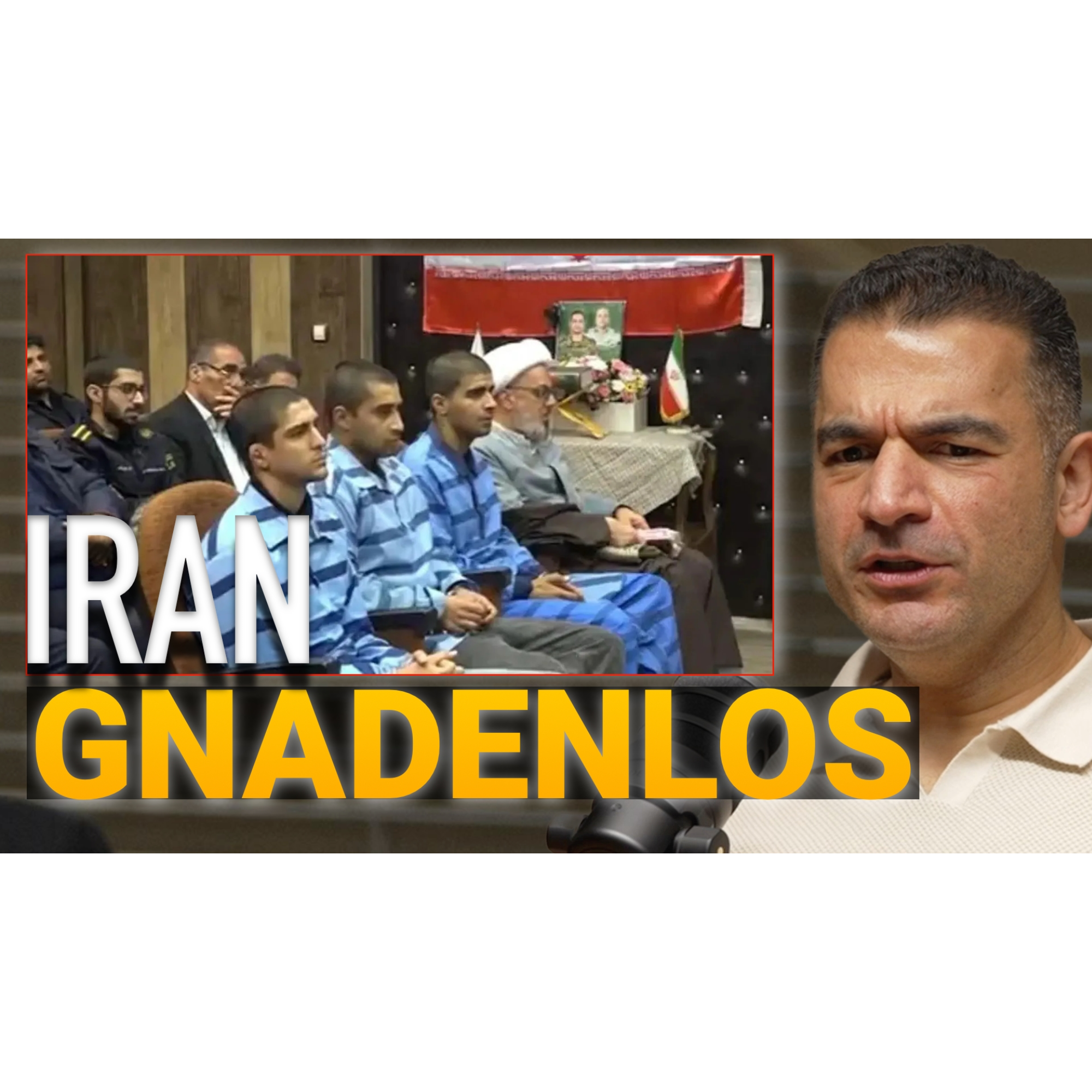

English translation of the original German article and complete transcript. The video retains its original audio. The place name “Rom” and the name “Padawan Takhti” reproduce the original transcript; their spelling has not been independently verified. Original English excerpts are retained.
Saleh Mohammadi: Summary
The 19-year-old Iranian national-team wrestler Saleh Mohammadi was publicly executed on 19 March 2026 in the Iranian city rendered “Rom” in the original transcript. The Iranian authorities accused him of killing a police officer during the January protests and convicted him of moharebeh — “war against God”. However, Amnesty International and Iran Human Rights report torture and forced confessions. They also report a trial that failed to meet standards of due process. Reza Mehman analyses the execution as a strategic means of intimidation by a regime willing to use even prominent athletes as a warning. He asks the fundamental question of whether a nation such as Iran depends on outside support in such a situation.
The Case of Saleh Mohammadi
Iranian national-team wrestler Saleh Mohammadi was publicly executed in Iran on 19 March 2026 at the age of 19. He was a member of the Iranian national team and had recently won an international bronze medal. The Iranian authorities convicted him of alleged involvement in a killing during the January protests. Amnesty International and Iran Human Rights, however, report forced confessions and an unfair trial. In this podcast episode, Iranian-born Reza Mehman analyses the case as a political message from the mullah regime and discusses international responsibility towards Iran.
Context
Who is speaking: Reza Mehman, Iranian-born host of the German-language Reza Mehman podcast, with original quotations from an Iranian military representative, an American former Olympian and an English-language news commentator.
What this is about: The episode covers the public execution of 19-year-old national-team wrestler Saleh Mohammadi in Iran on 19 March 2026 and the political and human rights background to his case.
Why it matters: The execution of a young international athlete amid a wave of state repression following the January protests has attracted worldwide attention. It raises fundamental questions about the rule of law, political control and international responsibility.
Three central questions in this episode:
- What do we really know about the Saleh Mohammadi case, and how do human rights organisations assess the proceedings?
- Why does the Iranian regime deliberately use a national athlete to send a political message?
- Does Iran need outside help, and how can we put that question into historical perspective?
Contents
- The Saleh Mohammadi case — who he was and what happened
- Wrestling as a national sport in Iran — cultural background
- The allegations, the proceedings and the opposing account from human rights organisations
- The Iranian military’s statement — original quotation and context
- Responses from international sport
- Reza’s personal perspective as someone born in Iran
- Pro-regime demonstrations in Germany — a critical question
- Does Iran need outside help? Historical comparison and conclusion
Themes and Context
- State repression and the death penalty in Iran — The regime deliberately uses public executions to suppress political resistance.
- Sport as a symbol and political capital — The execution of a national-team wrestler shows that even highly respected cultural figures are not protected from prosecution.
- The rule of law, torture and human rights — Amnesty International and Iran Human Rights document structural shortcomings in Iran’s justice system.
- International responses and solidarity in sport — Former Olympians and activists around the world respond to the case and place it in a wider political context.
- Outside intervention and historical responsibility — Reza discusses when a regime goes so far that international intervention becomes legitimate or necessary, drawing a historical comparison with 1945.
Key Takeaways
- Saleh Mohammadi was 19, a member of Iran’s national team and a bronze medallist at an international tournament when he was publicly executed on 19 March 2026.
- Human rights organisations including Amnesty International and Iran Human Rights report that confessions were extracted through torture and that the proceedings had serious due-process flaws.
- Wrestling has a similar importance in Iran to football in Germany. Executing a national-team wrestler is therefore a deliberately chosen warning.
- An Iranian military representative publicly stated that anyone classified as an enemy of the regime would be treated as an enemy, regardless of whether they saw themselves as protesters.
- American former Olympians expressed distress and stressed that the sporting community builds international friendships across political boundaries.
- Reza sees the execution as part of a strategic wave of repression following the January protests, during which thousands were arrested, rather than an isolated judicial case.
- He asks why people demonstrate in Germany in support of the Iranian regime but are unwilling to move to Iran and live there.
- As someone born in Iran, Reza considers international reporting incomplete and calls for a more honest look at what is actually happening in the country.
- Reza draws a cautious parallel with 1945: sometimes a population can no longer defend itself against a regime and needs outside support.
- In Reza’s assessment, the execution of a young athlete is meant to send a clear message: even the slightest sign of opposition to the regime can bring the same consequences.
Questions and Answers
Question: Who was Saleh Mohammadi? Answer: Saleh Mohammadi was a 19-year-old Iranian wrestler and national-team member. He had competed internationally and won a bronze medal. On 19 March 2026, he was publicly executed with two other men in the Iranian city rendered “Rom” in the original transcript.
Question: Why was Saleh Mohammadi sentenced to death? Answer: The Iranian authorities accused him of killing a police officer during the January protests. He was convicted of moharebeh — “war against God”. Human rights organisations dispute the fairness of the proceedings and report confessions extracted through torture. Mohammadi himself said he had not been at the scene at the time.
Question: What does moharebeh mean in Iranian law? Answer: Moharebeh is an offence under Iranian law translated as “war against God”, which can carry the death penalty. It is regularly used against protesters and political opponents.
Question: What do Amnesty International and Iran Human Rights report about the proceedings? Answer: Both organisations said the proceedings were unfair. Confessions were allegedly extracted through torture, and the trial reportedly had serious due-process flaws.
Question: What cultural role does wrestling play in Iran? Answer: Wrestling is one of Iran’s most important sports, with a status similar to football in Germany. The Iranian national team has won 55 Olympic medals. Historic wrestlers are still regarded as national heroes.
Question: Why is the execution seen as a political message? Answer: Because the regime deliberately sentenced a young athlete with national and international recognition to death. The message is that even culturally respected people are not protected if they are regarded as a threat to the revolution. It is intended to intimidate the whole population.
Responses From the Sporting World
Question: How did the international sporting world respond to the execution? Answer: American former Olympians publicly expressed their distress. They emphasised that athletes form deep friendships across political boundaries and found the execution of a 19-year-old particularly shocking.
Question: Why do people in Germany demonstrate in support of the Iranian regime? Answer: Reza raises this question critically. He cannot understand why people in Germany support a regime that oppresses its own population through the death penalty and torture, or why they do not move to Iran instead if they approve of it.
Question: Why does Reza compare Iran’s situation with Germany in 1945? Answer: He argues that a population whose regime kills thousands within days can no longer liberate itself. He draws a parallel with 1945, when America had to intervene in Europe to bring change, while explicitly noting that the situations are not fully comparable.
Question: What is this episode’s central message? Answer: Saleh Mohammadi’s execution is presented as a strategic signal from Iran’s mullah regime, willing to sacrifice even prominent athletes to secure its power, rather than an isolated judicial case. Reza calls for a more honest view of events in Iran and discusses whether outside support is necessary.
Highlight Quotes
“Wrestling in Iran is something like football in Germany: an enormously important sport.”
“Now the Iranian government, the mullah regime, is hanging one of its future great athletes.”
“It is meant to be a very clear signal that anyone who shows even the slightest sign of standing out against the regime in any way will be persecuted and hanged in the same way.”
“In my view, it is not normal for young people to be murdered and confessions extracted through torture. That has nothing to do with freedom and democracy.”
“As someone born in Iran, I have to say that the whole situation weighs on me.”
“This is a 19 year old who just wanted to represent his country.” — American former Olympian
“If there is no other possibility, then a nation such as Iran needs outside help.”
“You cannot simply say that people should have taken care of themselves. No, evidently America had to intervene in some form for anything to happen here.”
Keywords
Iran, Saleh Mohammadi, execution in Iran, death penalty in Iran, Iranian wrestler, moharebeh, Iran protests 2026, Amnesty International Iran, Iran Human Rights, mullah regime, public execution, repression in Iran, wrestling in Iran, Iran news, human rights in Iran, current affairs in Iran, political prisoners in Iran, Reza Mehman, outside help for Iran, Iranian justice system
Subtopics
- A national athlete, an execution — and a larger message
- Wrestling in Iran: more than a sport
- The Saleh Mohammadi case: allegations, proceedings and doubts
- The regime speaks: a statement that says it all
- Responses from the sporting world
- What is missing from media coverage: Reza’s personal assessment
- Does Iran need outside help?
Names and Terms
Saleh Mohammadi, moharebeh, Amnesty International, Iran Human Rights, Reza Mehman, mullah regime, Padawan Takhti, Reuters, Associated Press, Euronews, Islamic Republic of Iran
A Passage to Quote
By executing 19-year-old national-team wrestler Saleh Mohammadi, Iran’s mullah regime has sent a targeted political message. Human rights organisations including Amnesty International report torture, forced confessions and proceedings that failed to meet standards of due process. The execution is part of a wider wave of repression following the January protests, during which thousands were arrested. It shows that the regime is willing to sacrifice even highly respected cultural figures to secure its power. In Reza Mehman’s view, this raises the question of whether a population that can no longer help itself depends on outside support.
Complete Transcript
Reza Mehman:
A 19-year-old Iranian wrestler was hanged a few days ago. You have to imagine that wrestling in Iran is something like football in Germany: an enormously important sport. The people who take part are, in effect, national heroes. An important wrestler who died many years ago, Padawan Takhti for example, is still a kind of national hero for many Iranians. The Iranian wrestling team’s international dominance, such as its 55 Olympic medals, also shows how important this sport is in Iran. And now the Iranian government, the mullah regime, is hanging one of its future great athletes.
Of course, you can ask why they are doing this and what they hope to achieve. In my view, it is meant to be a very clear sign of how far the regime is willing to go to continue protecting the revolution it began 47 years ago.
The young man we are talking about today was called Saleh Mohammadi. He was an Iranian wrestler, a member of the national team and just 19 years old. On 19 March 2026, he was publicly hanged in the city of Rom together with two other men. This was reported by international news agencies including Reuters, as well as Euronews and Associated Press.
Allegations and Reports About the Trial
The Iranian authorities accused Mohammadi of killing a police officer during the nationwide protests in January and convicted him of the offence of “war against God”, known in Iran as moharebeh. However, human rights organisations dispute this account and say the proceedings had serious flaws. According to reports from Amnesty International and Iran Human Rights, confessions were allegedly extracted through torture and the trial was unfair. Mohammadi himself had said that he was not at the scene when the offence took place and had been staying with his uncle. Nevertheless, he was sentenced to death after a very short trial.
His execution was part of a wider wave of repression following the protests in Iran, during which thousands were arrested and several defendants face the death penalty. The case attracted considerable international attention, partly because Mohammadi was a young athlete who had recently won a bronze medal at an international wrestling tournament. Many human rights organisations and athletes therefore see his execution as a political message from a state that wants to suppress protests with maximum force, not merely a judicial case.
And this is exactly what a representative of the Iranian army said about it:
Iranian military representative (original English quotation):
“I have officially announced this before and I repeat it here. From now on, if someone acts at the enemy’s behest, we will no longer consider them protesters or anything of the sort. We will regard them as the enemy and we will treat them as we treat the enemy. All our team have their fingers on the trigger, ready to defend the revolution and support our people in our homeland.”
Reza’s Personal Assessment
Reza Mehman:
To me, this shows just how contemptuous of human life this regime is. I simply cannot imagine a normal government in a normal country handling things this way. In my view, it is not normal for young people to be murdered and confessions extracted through torture. That has nothing to do with freedom and democracy.
I also ask myself this because I keep reading more and more comments on social media about the subject and seeing more videos of waves of protests taking place here, with people taking to the streets for the Iranian regime. Not only against the regime — of course, there are quite a few of those, many in fact — but I now also see many people demonstrating in support of it. Naturally, I wonder why these people take to the streets here for the Iranian regime and why they do not decide, for example, to move to Iran and live under that regime if they think it is so wonderful.
Responses from America — and here I really am speaking as a passionate sportsman. I think sport is something that brings people together. Even American athletes, former athletes, say how distressed they are that an athlete from another country — in this case Iran, America’s opponent, so to speak — is actually being murdered.
American former Olympian (original English quotation):
Voices From Olympic Sport
“When I was competing, you know, during my time in the Olympics, we would develop really strong friendships, even with countries that the United States wasn’t allied with. So it’s the type of thing that just cuts to your heart, because this is a young teenager. I mean, this is a 19 year old who just wanted to represent his country.”
Reza Mehman:
In my view, Iran’s mullah regime is deliberately acting very strategically and brutally, with a real contempt for human life, by showing that it is prepared to brutally murder and hang one of the nation’s strongest members — physically, in this case, one of its wrestlers. I think it is meant to be a very clear signal that anyone who shows even the slightest sign of standing out against the regime in any way will be persecuted and hanged in the same way.
Here is another commentary on the alleged reason why this wrestler and the other two men were hanged:
English-language commentator (original English quotation):
English-Language News Commentary
“Yesterday Iran carried out a public execution in the city of Rom of a 19-year-old wrestling champion. His name was Saleh Mohammadi. He was seen as a rising talent who had competed in international championships, but his accolades couldn’t secure him leverage to express dissent. He was arrested for protesting against the Iranian government earlier this year. Along with him, two more men were executed: Mohsen Ghasemi and Said Davudi. This was after the Iranian Supreme Court upheld their sentences. The trio were found guilty of murder. According to the Iranian judiciary, they killed two police officers with knives and swords. They were also convicted of the waging of war against God, which is a serious crime under Iranian law. Iranian authorities also claimed that the three men acted allegedly in favor of Israel and the United States.”
Iranian military representative (original English quotation, second excerpt):
“He arrives on a motorcycle near the riots, parks the motorcycle and enters the riot scene. He presented all the details to our prosecutor, explicitly stating in the reconstruction of the scene in which area of the shoulder he stabbed the martyr.”
English-language commentator (continued):
“The public hangings mark the first executions linked to the deadly protests. Human rights activists believe Mohammadi’s confession was forced through torture and that his trial wasn’t fair.”
Personal Impact and Closing Thoughts
Reza Mehman:
As someone born in Iran, I have to say that the whole situation weighs on me. You can hear that here in the podcast too: I talk about Iran very frequently. But I think parts of the media do not tell the whole truth about what is actually going on there. There are attempts to say that American intervention in Iran is wrong. Yet when you really see what is happening and how they treat their own people, you have to say this: if there is currently no other option — and I read many other comments about it on YouTube and Instagram — but if there is no other possibility, then a nation such as Iran needs outside help.
Here is that example again: many people say every country should take care of itself. Yes, but imagine if America had not intervened in some form in 1945. Europe would look very different. You cannot simply say that people should have taken care of themselves. No, evidently America had to intervene in some form for anything to happen here.
I believe we have a similar situation in Iran. Of course, it is not fully comparable with Germany in 1945. However, it is similar in the sense that people within the population can no longer help themselves, while the regime kills thousands within just a few days. In my view, outside help is needed.
Thank you for listening. Until next time. Bye, bye.
Watch episode 179 on YouTube. You can find further clips and references in my Iran sources collection.

