
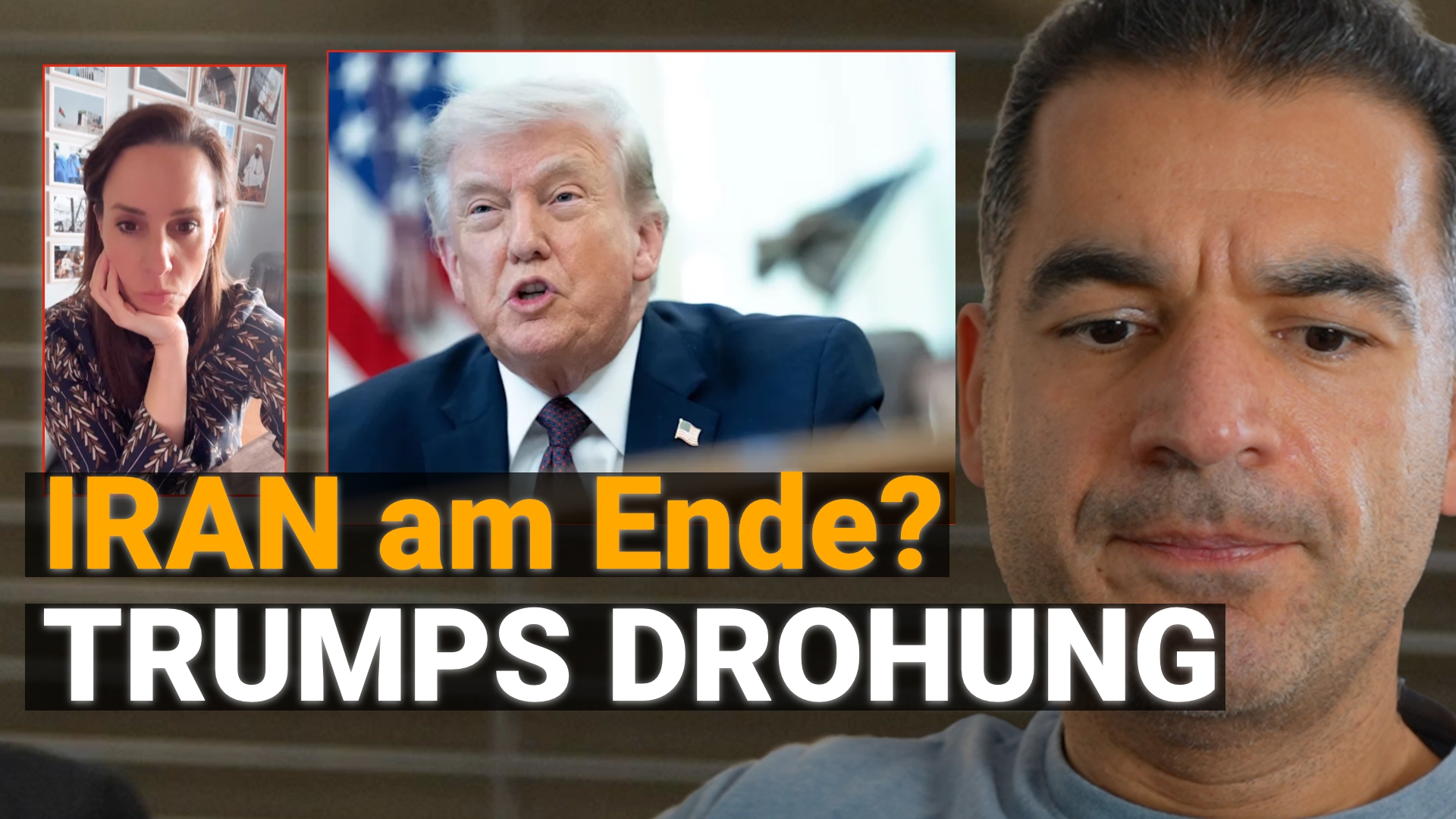

Trump’s war rhetoric, fear in the diaspora, and why opposing bombing does not mean supporting the mullah regime.
The original episode and video are in German. This is the complete English translation of the published article and transcript. Some passages in the original refer to April 2025, although the article was published in April 2026; those date references are retained here.
The Mullah Regime and Trump: What Do Iranians Want?
Trump’s threat against Iran and the question of what Iranians really want are at the centre of this podcast episode. When Trump wrote on Truth Social that a whole civilisation would die tonight, it caused immense fear among Iranian men and women worldwide. Reza Mehman puts this moment into context: what lies behind Trump’s war rhetoric? Why do many Iranians reject both the mullah regime and an American military strike? And how does the regime try to exploit that position politically? As of 8 April, a possible ceasefire is being negotiated, and Trump is reviewing an Iranian proposal. This episode offers a personal, analytical perspective from a German with Iranian roots and close contact with people in Iran.
Summary
One-sentence version: Reza Mehman explains why Iranians can oppose both the mullah regime and Trump’s bombing threats without contradicting themselves.
Three-sentence version: Trump posted on Truth Social that a whole civilisation would die — a sentence that shook millions of Iranians. Reza Mehman explains why rejecting a military strike does not mean supporting the mullah regime. He analyses Trump’s statements as war propaganda and explains why a full-scale bombing campaign against Iran would have been very difficult to implement politically at home.
Five-sentence version: When Trump announced on Truth Social that a whole civilisation could die, Iranians worldwide reacted with horror. Reza Mehman agrees with journalist Nathalie Amiri: such threats cannot bring the mullah regime to its knees because it cares neither about civilisation nor the people of Iran. At the same time, Mehman makes clear that not wanting your country bombed into ruins does not automatically put you on the mullahs’ side. Many Iranians want to get rid of the regime, have a free economy and live without sanctions or compulsory headscarves. Mehman sees Trump’s escalating rhetoric as a deliberate intimidation strategy rather than a serious attack plan.
Context: Who, What and Why
Who is speaking: Reza Mehman, host of the Reza Mehman Podcast, an entrepreneur and podcaster with German and Iranian connections. In this episode, he refers to a statement by journalist Nathalie Amiri responding to Trump’s Truth Social post.
What it is about: Trump published a post suggesting that an entire Iranian civilisation could die, while also opening the door to negotiations. Mehman explains what this means for the Iranian diaspora, the protest movement and ongoing negotiations.
Why it matters: On 8 April 2025, active talks are taking place about a possible ceasefire between the US and Iran. Trump’s escalating rhetoric in the preceding weeks prompted an important debate: people in the West who oppose bombing are quickly labelled regime sympathisers. Mehman rejects this simplification.
This episode’s three central questions:
- What really lies behind Trump’s threats against Iran?
- Can Iranians oppose both the regime and a military strike?
- How does the mullah regime exploit sentiment in the diaspora?
Contents
- Introduction — Overview of the topic and the current geopolitical situation
- Summary — Three short versions for quick understanding
- Context — Who is speaking, what it is about and why now
- Topics and analysis — Themes for playlists and content strategy
- Key takeaways — The episode’s most important positions
- Frequently asked questions — FAQ for Google and AI search
- Highlight quotes — Strong statements directly from the conversation
- The full conversation — Edited transcript with subheadings
- Keywords — SEO tags for this article
- Names and terms — Consistent spellings
- Passage for quotation — A paragraph ready to use
Topics and Analysis
1. US–Iran Geopolitics and War Rhetoric
Trump’s escalation strategy towards Iran, the question of a possible military strike and the current status of ceasefire negotiations.
Keywords: Trump Iran threat, US–Iran conflict, Iran ceasefire
2. Iranian Civil Society and the Protest Movement
What people in Iran really want: freedom, an economy without sanctions and an end to the mullah regime — and why they still do not want bombing.
Keywords: Iranian protests, mullah regime, freedom for Iran
3. Diaspora Perspectives and Narratives
How Iranians abroad experience developments and how the regime tries to exploit sentiment in the diaspora.
Keywords: Iranian diaspora, Iranian exiles, regime propaganda
4. Media and Context
The role of journalists such as Nathalie Amiri and how Western media report on the Iran conflict.
Keywords: Nathalie Amiri, Iran media, war reporting
5. Islamist Rule and Its Limits
How the mullah regime has sought to maintain its revolution for 47 years, and why the population is increasingly unwilling to accept it.
Keywords: Islamic Republic of Iran, Islamism, revolution of 1979
Key Takeaways
- Trump’s Truth Social post announcing the death of an entire civilisation filled Iranian men and women worldwide with enormous fear.
- Anyone who does not want Iran bombed into ruins is not automatically on the mullah regime’s side.
- The mullah regime tries to present opposition to bombing as support for its rule — a deliberate misrepresentation.
- In Reza Mehman’s view, Trump’s threats were primarily war rhetoric and an intimidation strategy, rather than a realistic attack plan.
- Many Iranians want to get rid of the regime because of the lack of freedom, economic decline and sanctions.
- The mullah regime uses its own population as human shields on bridges and at nuclear power stations.
- As of 8 April 2025, active negotiations are taking place about a possible ceasefire, and Trump is reviewing an Iranian proposal.
- The violent suppression of protests in Iran shows how desperate people really are and how threatened the mullahs’ rule is.
- Trump would have faced enormous domestic political problems if he had actually ordered a full-scale military strike on Iranian territory.
- The Iranian protest movement risks lives not out of political interest, but out of existential hardship under an Islamist regime.
Frequently Asked Questions
What did Trump write about Iran on Truth Social?
Trump posted that “a whole civilisation will die tonight”, never to return. At the same time, he opened the door to regime change and ended with the sentence “God bless the great people of Iran.” The post was read as both a threat and an offer to negotiate.
Do Iranians want the US to attack the mullah regime?
Many Iranians want the mullah regime to end, and some also support targeted attacks on the regime’s civilian infrastructure. At the same time, hardly anyone wants their own country bombed so extensively that nothing works any more. Both positions can coexist; they are not contradictory.
Does rejecting a US attack on Iran mean supporting the mullahs?
No. Anyone who does not want their country bombed into ruins is not automatically on the mullah regime’s side. The regime tries to exploit this equation politically, but it is false.
What is the status of negotiations between the US and Iran in April 2025?
As of 8 April 2025, a possible ceasefire is being negotiated. Trump is reviewing a proposal put forward by the Iranian side. A final deal remained unresolved at that point.
What does Nathalie Amiri say about Trump’s Iran policy?
Nathalie Amiri warned that Trump’s threat had caused enormous fear among Iranian men and women. She stressed that such threats would not bring the mullah regime to its knees because it cares neither about civilisation in Iran nor the people there.
Why do Iranians take to the streets despite the danger to their lives?
Because they live under an Islamist regime that denies them basic freedoms, from economic participation to removing their headscarves. The violent suppression of protests shows how serious the situation is and how urgently people want change.
Should Trump’s threat to bomb Iran into ruins be taken seriously?
Reza Mehman sees Trump’s statements primarily as a rhetorical intimidation strategy. A full-scale military strike on Iranian territory would have caused Trump enormous domestic political difficulties and was not, in his view, a realistic scenario.
What does the mullah regime do to protect itself from attacks?
According to Reza Mehman, the regime sends members of its own population onto bridges and to nuclear power stations and other strategic infrastructure to create a human shield. This shows how little its own people matter to the regime.
Highlight Quotes
“A whole civilisation will die tonight, never to return.” — Trump, quoted from Truth Social (read aloud by Nathalie Amiri; translated from the German article)
“If Trump thinks this will bring a regime that cares neither about civilisation in Iran nor about Iranian men and women to its knees, he is mistaken.” — Nathalie Amiri, quoted by Reza Mehman
“Wanting it not to be bombed into ruins does not automatically put you on the mullah regime’s side.” — Reza Mehman
“I think it was pure war propaganda, war rhetoric, simply intended to frighten the Iranian mullah regime as well.” — Reza Mehman
“They, in turn, send their own people onto all the bridges, to all the nuclear power stations and so on, creating a kind of human shield. That shows just how crazy the mullah regime is.” — Reza Mehman
“You also have to ask yourself: why are there so many protests in Iran, and why do they have to be suppressed with bloodshed? That is not normal.” — Reza Mehman
The Full Conversation
Trump’s Truth Social Post — Amiri’s Reaction
Nathalie Amiri (quoted by Reza Mehman):
A few minutes ago, Trump published a post on Truth Social, and this post — I have to be completely honest — frightens me enormously. Within a very short time, I have already been in contact with so many other Iranian men and women.
The post says: “A whole civilisation will die tonight, never to return. I do not want that to happen, but it probably will. Now, however, that we have complete and total regime change, with different, smarter and less radicalised minds gaining the upper hand, perhaps something revolutionarily wonderful can happen. Who knows? We will find out tonight. God bless the great people of Iran.”
If Trump thinks this will bring a regime that cares neither about civilisation in Iran nor about Iranian men and women to its knees, he is mistaken.
Context: Rejecting Bombing Does Not Mean Saying Yes to the Mullahs
Reza Mehman:
On that, I definitely have to agree with Nathalie Amiri. At times, you can get the impression that Iranians are suddenly saying: “Hey, wait a minute, Trump, first you offered help, or said ‘help is on the way’, and now you are talking about wiping out an entire civilisation.” And therefore we are now siding with the regime.
That is not the case. Of course, there are still some people on the mullahs’ side, including here abroad, including Iranian exiles who take to the streets and protest for the mullahs. But as far as I can observe, and from conversations with family, friends and acquaintances in Iran, I know that most people simply no longer want the mullah regime.
What they also do not want — and unfortunately it could happen — is for the Americans to bomb everything into ruins.
The Negotiations and an Assessment of Trump’s Rhetoric
Reza Mehman:
Trump had announced that he would and could raze Iran to the ground if he wanted to. But now, as of today, 8 April, a kind of ceasefire is being negotiated. Trump is looking at the deal the Iranians are proposing.
In my view, however, it was also fairly clear that Iran would not be bombed into ruins. I think Trump would have had enormous problems in his own country if he had said, for example, that he was going to flatten pretty much everything, all the civilians, and so on.
I think it was pure war propaganda, war rhetoric intended to frighten the Iranian mullah regime. They, in turn — and I have talked about this in another podcast — send their own people onto all the bridges, to all the nuclear power stations and so on, creating a kind of human shield. That shows just how crazy the mullah regime is.
But I think it was clear that Trump would not have dared to bomb an entire country back into the Middle Ages — that is roughly how he put it.
What Iranians Really Want — and What They Do Not
Reza Mehman:
Nevertheless, I still have to agree with Nathalie Amiri: even though many Iranians support the Americans destroying the mullah regime’s civilian infrastructure, they naturally do not want their entire country bombed into ruins. Many Iranians support it because they finally want to get rid of the mullahs, because they finally want a normal economy again without sanctions, and because they finally want to live in freedom again — including, for example, having the option to remove their headscarves.
These are many individual issues on which the mullah regime uses all its force to try to carry the revolution it started 47 years ago into the future and keep it present.
Nevertheless, of course no Iranian man or woman wants their country to be bombed so extensively that nothing there works any more. That is completely normal. And wanting it not to be bombed into ruins does not automatically put you on the mullah regime’s side. They do try to present it that way: “Look, suddenly the Iranians are back on our side after all.” No, that is not the case.
The Question Everyone Should Ask
Reza Mehman:
You also have to ask yourself: why are there so many protests in Iran? Why do they have to be suppressed with bloodshed? That is not normal. In other democratic countries, people do not take to the streets wanting to sacrifice their lives to change democracy.
No, this is happening in an extreme Islamist country such as Iran, and I think there are reasons why people take to the streets and are prepared to sacrifice their lives to get rid of this regime.
Thank you very much for listening. Until next time.
Keywords
Tags: Iran, Trump, mullah regime, war rhetoric, Iran ceasefire, Nathalie Amiri, Iranian diaspora, US–Iran conflict, Iranian protests, Islamic Republic, Iran sanctions, regime change in Iran, Trump Truth Social, Iranian exiles, Middle East policy 2025, what Iranians want, why Iranians protest, Reza Mehman Podcast
Names and Terms
Reza Mehman, Nathalie Amiri, Trump, Truth Social, Iran, mullah regime, mullahs, Islamic Republic of Iran, Iranian exiles, Iranian diaspora, ceasefire, nuclear power station, Islamism, revolution of 1979, compulsory headscarves, sanctions
Passage for Quotation
Anyone who does not want Iran bombed into ruins is not automatically on the mullah regime’s side.
The regime tries to present it that way, but this equation is false and politically calculated.
Most Iranians want to get rid of the regime because of the lack of freedom, economic decline and sanctions.
At the same time, nobody wants their own country and family bombed into rubble and ashes.
Both are true, and both can coexist — which is precisely what makes the situation so complex.
Trump posted on Truth Social: “A whole civilisation will die tonight.” This sentence shook Iranian men and women worldwide and prompted a crucial debate.
In this episode, I explain what lies behind Trump’s escalating rhetoric towards Iran, why many Iranians do not want a military strike, and why that does not mean they support the mullah regime. I refer to Nathalie Amiri’s assessment and speak from what I personally hear in conversations with family and friends in Iran.
Watch episode 183 on YouTube. Find additional clips and references in my collection of sources on Iran.

