Heidelberg Mindset: Mayor Würzner on courage and decisions
The Heidelberg mindset: a conversation with Eckart Würzner about welcome, integration, decisions and the city that changed my life.
Introduction
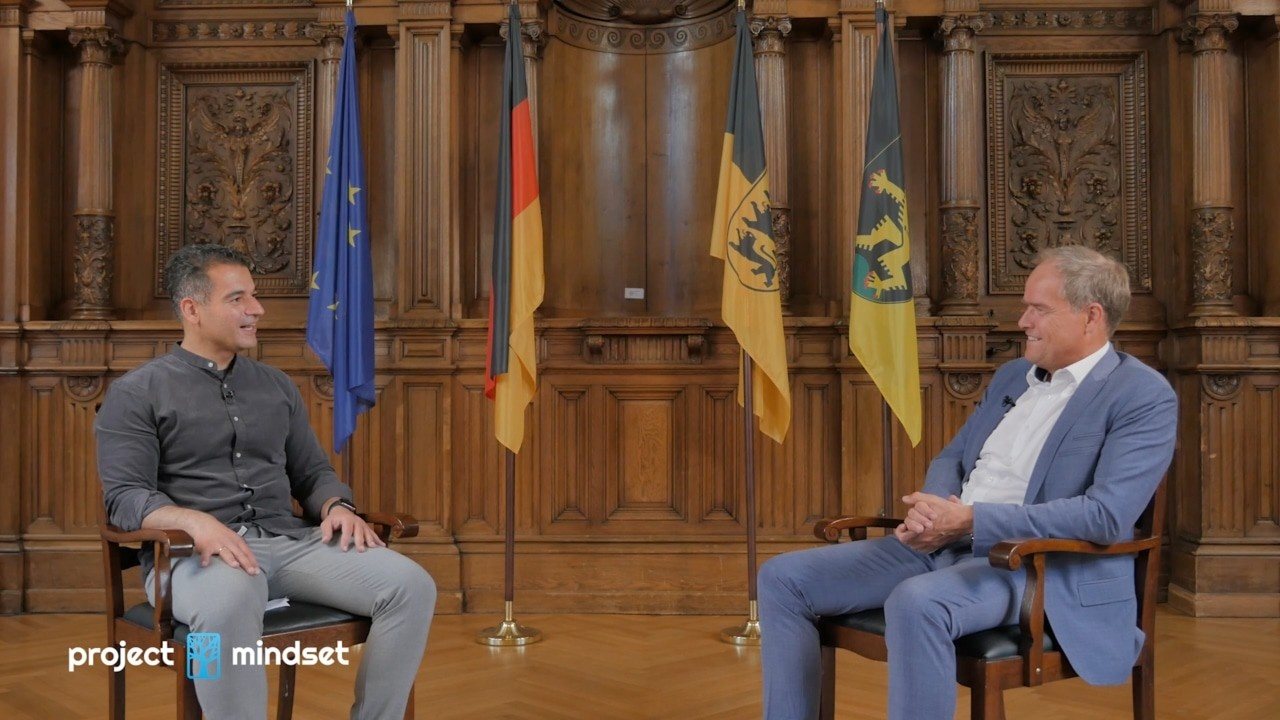
The Heidelberg mindset stands for cosmopolitanism, the courage to make decisions, and a genuine culture of welcome. In this special episode of Project Mindset, Reza Mehman speaks with Prof. Dr. Eckart Wuerzner, the mayor of Heidelberg, about the values that make this city so unique. Reza came to Heidelberg as a refugee from Iran 36 years ago and experienced safety, education, and a sense of belonging there. The conversation explores how a city makes courageous decisions, how integration can succeed, and why “not making a decision is worse than making the wrong one.” Prof. Wuerzner offers insights into his leadership philosophy, how he deals with mistakes, and the art of moving a city forward. An emotional and insightful episode for anyone who wants to understand how the right mindset can shape entire communities.
Heidelberg mindset: the episode in brief
In one sentence: Heidelberg’s mayor, Eckart Wuerzner, explains why cosmopolitanism, decisiveness, and long-term thinking form the foundation of a successful city.
In three sentences: Reza Mehman speaks with Mayor Eckart Wuerzner about the unique mindset of the city of Heidelberg, which has relied on openness and international expertise for centuries. Wuerzner emphasizes that courageous decisions are crucial and that indecision is worse than making the wrong decision. They both reflect on integration, leadership, a culture of learning from mistakes, and the responsibility that comes with shaping a city.
In five sentences: In this personal episode, Reza Mehman visits the mayor of Heidelberg, Professor Dr. Eckart Wuerzner, to discuss the Heidelberg mindset. Reza came to Heidelberg as a refugee 36 years ago and is deeply grateful to the city. Wuerzner explains how Heidelberg has cultivated a cosmopolitan tradition since the founding of its university in 1386 and voluntarily operates an arrival center for refugees. The conversation touches on decisiveness, dealing with mistakes, balancing citizen expectations with long-term urban development, and the importance of passion in leadership. Wuerzner summarizes the Heidelberg mindset as a combination of openness, tolerance, and the will to make a difference together.
Context: Who, What, Why
Who is speaking: Reza Mehman, host of the Project Mindset Podcast, in conversation with Prof. Dr. Eckart Wuerzner, Mayor of the City of Heidelberg.
What is it about: To understand the mindset behind one of Germany’s most famous cities. How do you make bold decisions for an entire city community? How does integration succeed? And what makes Heidelberg so special?
Why is this relevant? In a time of global crises and rising refugee numbers, Heidelberg demonstrates how openness and decisiveness can strengthen a city. The episode combines personal gratitude with universal lessons about leadership and mindset.
Three key questions of the episode:
- What defines the Heidelberg mindset and why is it so successful?
- Why is not making a decision worse than making the wrong decision?
- How can integration succeed in a city, and what rules are needed for it?
Table of contents
- Introduction – Why this episode is so personal
- Summary – The key messages in brief
- context – Who is speaking and why it is relevant
- Table of contents – Overview of all sections
- Topics and classification – The central themes of the episode
- Key messages – The most important messages at a glance
- Frequently Asked Questions – Answers to the episode’s central questions
- Highlight quotes – The most defining statements
- Transcript – Full conversation to read
- Keywords – SEO-relevant keywords
- Names and terms – Key references at a glance
- Quotable passage – For sharing and quoting
Topics and classification
1. The Heidelberg Mindset: Open-mindedness as a Tradition
Since the university’s founding in 1386, Heidelberg has relied on international expertise and openness. Mayor Wuerzner describes how this tradition continues to shape the city’s identity and makes Heidelberg a place where people from all over the world feel welcome.
Keywords: Heidelberg mindset, cosmopolitanism, university city of Heidelberg
2. Integration and refugee policy: Heidelberg as a model
Heidelberg voluntarily operates an arrival center for refugees for the entire state of Baden-Württemberg. Wuerzner explains how decentralized distribution, citizen dialogue, and clear rules ensure acceptance among the population.
Keywords: Integration Heidelberg, Fluechtlingspolitik, Patrick Henry Village
3. Decisiveness and a culture of learning from mistakes in leadership
One of the central messages: Not making a decision is worse than making the wrong one. Wuerzner speaks openly about how he deals with mistakes and why decisiveness is essential for progress.
Keywords: Decision-making, culture of learning from mistakes, leadership
4. Urban Development and Prioritization
How do you prioritize the tasks of an entire city? Wuerzner provides insights into the balance between short-term citizen wishes and long-term strategic planning.
Keywords: Urban development, prioritization, local politics
5. Personal gratitude and the value of home
Reza Mehman’s personal story as a refugee who found a second home in Heidelberg forms the emotional framework of the episode and shows the impact an open urban community can have on individual life paths.
Keywords: gratitude, home, personal development
Key messages
- Not making a decision is worse than making the wrong decision, because you can learn from mistakes and adapt.
- Since the founding of the university in 1386, Heidelberg has relied on cosmopolitanism and international expertise as the foundation of its urban development.
- Successful integration requires clear rules of the game: high acceptance of people of other faiths while simultaneously upholding democratic values.
- When every neighborhood contributes, a feeling of fairness is created that significantly increases acceptance towards refugees.
- Passion is the key to great goals. Those who pursue something with passion can achieve even ambitious goals.
- Decisions that are right in the long term are more important than those that are popular in the short term, even if they initially encounter resistance.
- Children should learn to take responsibility and make their own decisions early on, instead of having everything done for them by their parents.
- Economic strength and social openness are mutually dependent: those who are economically strong can integrate more easily and reduce fears.
- Citizen dialogue and decentralization are key instruments to avoid conflicts when receiving refugees.
- The Heidelberg mindset is a combination of openness, tolerance, a focus on education, and a shared desire to make a difference.
Frequently Asked Questions
What is the Heidelberg mindset?
According to Mayor Wuerzner, the Heidelberg mindset describes an attitude of cosmopolitanism, tolerance, a commitment to education, and a shared desire to move things forward. This tradition dates back to the founding of the university in 1386 and continues to shape the city today.
Why is Heidelberg voluntarily taking in more refugees than required?
Heidelberg has a long tradition of cosmopolitanism and possesses the economic strength to successfully manage integration. The city voluntarily operates an arrival center for all of Baden-Württemberg because the city council and mayor are convinced that openness enriches the city.
Why is no decision worse than a wrong decision?
According to Mayor Wuerzner, indecisiveness leads to stagnation, while valuable lessons can be learned from wrong decisions. Mistakes can be corrected and adjustments made, but missed opportunities due to inaction are often irretrievable.
How is Heidelberg dealing with its capacity limits when accepting refugees?
Heidelberg is committed to decentralized distribution and citizen dialogue. Every district is expected to contribute, fostering a sense of fairness. At the same time, the city is careful to preserve ecologically sound functional areas and avoid unlimited growth.
What rules does Heidelberg expect from newcomers?
Heidelberg expects acceptance of the democratic code of values, tolerance towards people of different faiths and people from other cultural backgrounds, as well as the renunciation of violence and the imposition of one’s own convictions.
How did Eckart Wuerzner become mayor of Heidelberg?
Wuerzner came to Heidelberg to study, influenced by his parents’ enthusiasm for the city. His passion for environmental protection first led him to the office of environmental mayor, before he was elected mayor.
How does a mayor prioritize the tasks of a city?
According to Wuerzner, the ability to balance short-term citizen desires with long-term strategic planning is needed. Decisions that are important in the long term take precedence, even if they may be unpopular in the short term.
What can parents learn from Wuerzner’s leadership approach to raising children?
Wuerzner emphasizes that children should learn to take responsibility and make their own decisions early on. Parents shouldn’t do everything for them, but rather create spaces where children can learn from their own experiences.
According to Eckart Wuerzner, what role does passion play in success?
Passion is Wuerzner’s central driving force. Those who pursue something with passion can achieve great goals. This conviction shapes both his personal career and his work as mayor.
Highlight quotes
“Most of the time, it’s because no decisions are made. Of course, you can make wrong decisions sometimes, but the worst thing is not to make any decisions at all.”
– Eckart Wuerzner
“If you do something with passion, then you can achieve such goals.”
– Eckart Wuerzner
“We are open to everyone.”
– Eckart Wuerzner
“We provide a tolerant, open platform. Here you can live, here you can work, here you can fall in love again.”
– Eckart Wuerzner
“36 years ago, I came to Heidelberg with my family. We were warmly and openly welcomed, and people took good care of us.”
– Reza Mehman
“Anyone who becomes overbearing in this direction, who tries to impose their opinion on others as a guideline, actually has no place with us.”
– Eckart Wuerzner
“If everyone has the impression that everyone is making a contribution, or even has to make one, even in a crisis situation, then the feeling definitely arises that things are being handled fairly.”
– Eckart Wuerzner
The full conversation
Most of the time, it’s because no decisions are made. Of course, you can make wrong decisions sometimes, but the worst thing is not making any decisions at all, because then… Hi everyone and welcome to Project Mindset, the channel for all those who know for sure that with the right mindset, anything is possible in life. Today we have a very personal and almost intimate episode of Project Mindset. It’s about the following: 36 years ago, I came to Heidelberg with my family.
We were welcomed warmly and openly; people took good care of us. I went to school here, was able to graduate from high school, and was able to study—all of which was only possible because Heidelberg welcomed us so openly. Accordingly, I’ve always wanted to talk to someone about the Heidelberg mindset. And who better to talk to than the mayor, who, instead of Heidelberg, calls himself Professor Dr. Würzner, whom I’m about to meet and ask about the Heidelberg mindset?
But what I’m also interested in, especially in such difficult times as we’re currently experiencing, is how one actually makes decisions for a city, for its people—which direction does one take, what priorities does one set, and how? These are topics we’d like to discuss today, and I hope you enjoy it. Mr. Würzner, thank you so much for your time today and thank you for the invitation to this beautiful building. It’s always my pleasure; this is my daily workplace, but it really is lovely.
Personal connection to Heidelberg
I really, really like it here. As mentioned in the introduction, that feeling goes back a long way. I’m incredibly grateful that Heidelberg welcomed us so openly and warmly many years ago—36 years ago, to be precise. We were allowed to do everything here, go to school, graduate from high school, and always felt so well looked after. You get the feeling that you’re not alone, that someone is looking out for you. And that’s why, as I’ve already said, I’m incredibly grateful and will always be eternally grateful to the city of Heidelberg.
Since my podcast is about mindset, I wanted to capture the mindset of Heidelberg, however unusual that might sound. And I think you’re probably the right person to talk to about that. Who better to discuss the Heidelberg mindset with than you? So, thank you again for your time. And my first question is, how does one actually become mayor of such a great city?
Yes, the love for the city. To be honest, my parents fell in love with it and always raved about Heidelberg. I myself was born in Goslar, so not in Heidelberg at all. But for my parents, yes, Heidelberg was always the ideal city. So it was quite a natural choice. “Where are you going to study?” they asked. We were living in Düsseldorf at the time. It was a great city, a fantastic old town, absolutely wonderful. But where are you going? And then we said, well, why not Heidelberg?
To study in Heidelberg
And then we came to Heidelberg to study. And that was a fantastic decision because we were immediately captivated by Heidelberg. We already had children relatively early on, or rather, one child, Tatjana. And of course, as you just said, it was a wonderful city. It’s not too big a city. Anyone who has ever lived in Frankfurt, which I also did, or in Düsseldorf, knows that big cities certainly have their advantages, but they also have their downsides.
In Heidelberg, everything is, let’s say, quite sheltered. Everyone knows each other, you get the impression that everything is within walking distance. So we really liked it there, and we haven’t regretted it to this day. And that’s more or less how I became mayor. I’ve always been passionate about environmental protection. I always wanted to do something in that area. Klaus Töpfer was a great role model for me. Then I thought, wow, I have to do that sometime too. So I didn’t become active at the UN later on, but rather I was elected to this position after serving as environmental mayor.
And I always do it with great passion. And if you do something with passion, then you can achieve such goals. Which brings us to one of the important topics: Heidelberg has always done more, for example, for refugees, than was actually required by the state. Take the PHV issue, for instance. I think Heidelberg is doing more than was expected. How did that come about?
Continued
So I believe even our Electors were very forward-thinking. I think that’s the important thing, being forward-thinking. And they always said that if we wanted to achieve something here in the Palatinate, we needed international expertise. You brought that international expertise with Marcius from Paris, from Montpellier. Back then, that was the big, wide world. And through the founding of the university in 1386, they laid a really solid foundation here for an international, cosmopolitan city.
I think that’s the most important thing. That’s why people who are refugees, who have a high level of education—wow, great, Heidelberg, an ideal place. And that has continued to this day. I myself am also someone who has always stood for freedom, for people who want to live their freedom, no matter where they come from. You have to follow certain rules. Otherwise, everyone can develop as freely as they like. That’s also my maxim. So it plays an enormous role for me.
And so we found fantastic support and a great willingness in the city council. The state also agreed to welcome all refugees here in Heidelberg before distributing them. At the time, this was a politically far-reaching decision because many hadn’t actually considered it. We haven’t regretted it to this day. And I think that’s what makes Heidelberg special. We’re open to everyone. Absolutely. You just mentioned something interesting, the rules of the game.
Integration and mutual expectations
What does the city of Heidelberg actually expect from newcomers? Especially now, given the current situation and the terrible events happening worldwide, we are, of course, very happy to welcome people. But what are our expectations of them? We provide a tolerant and open platform. Here you can live, here you can work, here you can fall in love again. Everyone should be able to live here as they wish. This includes questions that are expressed or lived today as queer or in other ways.
Yes, we also make sure that the rules of the game aren’t redefined, but rather that there isn’t—I’d say—a high level of acceptance is very important, a high level of acceptance towards people of other faiths, for example, from other cultural backgrounds. But at the same time, this cultural background, or others for that matter, mustn’t become so dominant that they also dictate the outcome. That’s something we reject, something I reject as well. So, everything is fine as long as everyone adheres to our, let’s say, code of values, which is based on democratic principles. That’s all good; we completely reject violence.
Anyone who becomes overbearing in this direction, who tries to impose their opinion on others as a guiding principle, has no place here. And that goes in all directions. And I believe that if you move a city forward with this mindset, to stick with this term, then everyone has a chance, everyone has a perspective, and then the rules become clear relatively quickly. Is there actually such a thing as a capacity limit? Like, where you say, “We can manage this,” and after that it becomes difficult?
Opportunities and limitations of a city
As an outsider, it’s hard to imagine. For example, how many people can a city actually accommodate in this situation? Well, to be honest, it certainly depends on the available resources. Let’s say a city is already struggling with extremely high unemployment and can barely afford to stay afloat. The social welfare costs are spiraling out of control for the mayor. They don’t really know how to develop the city economically, where to lead it.
When a situation arises where many, let’s say, other foreigners arrive, this naturally triggers anxieties. We’ve seen this quite extensively in other regions of Germany as well. And then something happens that isn’t good. The foreign element is perceived as evil, as an aggressor in whatever form, simply due to vague fears. This must be taken very seriously. We are in a different situation here; we are economically very strong. We are an international city, a cosmopolitan city.
But of course, we also have financial resources, so we can include a great many people. This helps to minimize these points of conflict. But it’s clear that what we’ve always done, including in Heidelberg, is that I’ve gone to almost every district and said everyone has to do their part in addressing the refugee crisis. The point isn’t to locate a central facility in one district, but rather to ask where you could do something, to make suggestions. We’re engaging in dialogue.
Continued
And when everyone has the impression that everyone is contributing, or even has to contribute, even in a crisis situation, then the feeling definitely arises that things are being handled fairly. The way we’re being treated here is fair. And then acceptance is high. If it only affects one neighborhood, the situation is completely different. We also had a situation like that at the beginning with Patrick Henry Village, when no vehicles were yet provided. The people are from the facility; it’s not a prison.
I walked to the nearest supermarket, and there was a stream of hundreds of people all moving into one part of town. This immediately caused problems because, quite naturally, the cashiers were saying, “I’m being approached by individuals.” This is unacceptable, but given the sheer number of people, such reactions quickly arise. Therefore, we changed things very quickly and decided to organize a bus shuttle directly to the city center.
The city center is larger, more spread out. We’ve decentralized it, and that’s why we’ve gained acceptance. I’d like to ask in return—I don’t want to mention quantity limits at this point, but yes, of course, it has to fit somewhere. That’s certainly true, and we have to be fair about that. And we ourselves believe that a city like Heidelberg needs good development prospects. We want to develop, but we’re not going to build on every piece of farmland, because we also need it as a surrounding area, as a green belt around Heidelberg, to function as ecologically important spaces. If we say no, we don’t want to go too far.
Creating long-term perspectives
Then you simply have to move somewhere else. That’s actually a normal process. You just mentioned development prospects. What I was wondering beforehand is, as mayor of a city like Heidelberg, you naturally have a very significant influence, I assume, on the city’s own development. If you connect that with the issue of a culture of learning from mistakes, how much damage can you theoretically do to the development prospects? Perhaps even with a little bit of coercion in mind.
Are there control mechanisms in place, not in a legal sense, but are there many decisions you can make that might go in the wrong direction, potentially ending badly for Heidelberg in some way? How does this process generally work for an outsider? It’s like a carpenter’s workshop; when planing wood, shavings are inevitable. So, you can always make the wrong decisions, or perhaps a decision that, in hindsight, proves to be wrong.
At the time, it might have been the right decision, but in hindsight, it turned out we misjudged things. That always happens. You have a regulatory framework; you have to work with the city council on every decision, even major ones. That plays a crucial role. But yes, for me, the biggest mistake is doing nothing at all. Then you don’t make any mistakes, but the city has no future, and in the medium and long term, that’s the downfall of any city.
Actively shaping urban development
You no longer have jobs, you no longer have future-oriented apprenticeships, families are leaving, and you’re caught in a downward spiral. A city doesn’t develop, which of course is always a positive development. And most of the time, it’s because no decisions are made. Of course, you can make wrong decisions sometimes, but the worst thing is not making any decisions at all, because that’s when this stagnation process begins. You might think you’ve left everything as it was, but you haven’t created anything attractive for young people, you haven’t evolved, you haven’t provided any new impetus for businesses and the economy, you can’t start new social projects because you don’t have any financial returns – that’s a much greater danger.
Now, if we delve a little deeper into your personal mindset, how do you deal with mistakes? I mean, if you know—or I don’t know if this has happened or not—maybe you’ve made a decision where you thought, “Wow, that wasn’t such a good idea.” How do you personally deal with that? Well, the same way everyone does. I think everyone makes mistakes, and I believe it’s presumptuous to think you don’t make any..
Responsibility for daily decisions
Especially if you’re in a position to do this, imagine going to the office in the morning after a jog and finding a stack of signatures about half a meter high next to you. It’s all about contracts: are we building the daycare center using timber construction or the classic monolithic method? How much money are we spending on the Heidelberg Pass Plus? Shouldn’t we increase it? Can we finance it? What does the regional council say? Signature.
And this happens every two minutes, each time a different decision: do you build an air-source heat pump power plant in Pfaffengrund or do you go for biomass wood, which is 20% more expensive, but they’ve made it sound like it’s actually the worse option. Do you go for that option? This decision happens constantly, every day and roughly every 20 minutes, and these are big decisions with significant consequences. Therefore, you make many decisions where you have to be at peace with yourself, both intuitively and in terms of knowledge; I think that’s the most important thing.
Continued
In all my time so far, I haven’t really made any decisions that I’ve truly regretted. There are decisions that I’ve regretted in retrospect, wondering why we didn’t, for example, bring it up again in a political forum and discuss it again with the citizens. Then we wouldn’t have had a referendum, for example, that stopped a project. It usually has something to do with the procedure, not with the actual content. So yes, that’s true, but it was more about the methodology and the procedure, the decisions.
You make decisions every day, so many that you have to learn to make quick decisions. This role requires enjoying those decisions; otherwise, you cannot hold a position like it. You need to have a deep knowledge of your city so you don’t feel like you’re deciding on things you don’t understand; that’s really bad. So, naturally, the longer you’re in this role, the more confident you become. Yes, you can’t just learn all of that overnight. A solid education is essential, of course.
I’m asking this specifically because one of the topics in my podcast is raising my children—what kind of mindset I want to instill in them. And one thing I find incredibly important is that they understand how to take responsibility; that’s my feeling, and that they’re capable of making decisions. What can I teach them, and how, so that they take responsibility, make decisions, and aren’t afraid to do so?
Practice making decisions early on
So the first thing is to take them seriously, to acknowledge them, to delegate decisions to them, and you can do this very early on when the children are younger. Let’s take an example, something I’ve done myself – not with all the children, but with some – simply go to a climbing wall with a rope, you rope yourself up, the children are roped up, and now the little boy is supposed to hold his dad when he jumps off the wall. Even though he’s much lighter, he can do it if he belays me properly.
The feeling that he can do it gives you enormous energy. Of course, you have to guide him properly so he doesn’t panic and throw the rope away or react incorrectly. If he reacts correctly, that’s exactly what he needs: self-confidence in his own ability and competence to make decisions. That’s absolutely crucial, and I’d say it’s naturally a bit easier for children who, like ours, grow up in a family of four. There’s a constant discussion and even a little bit of competition going on.
And that’s a good thing, because they learn through play, in small ways, what they’ll need later when they’re grown up. This is also a big issue because many children don’t have any siblings anymore. So they usually only learn these things in daycare or playgroups or somewhere similar. With us, they were already able to do that at home. And that’s why you should take time for your children, include them in your world. Try to give them the freedom they need, and then they’ll grow into confident, responsible individuals.
Dealing with expectations and criticism
The topic is expectations. I think my impression is that if something goes well, then well, that’s just how it is. If it goes badly, it’s your fault. How do you deal with this? I mean, the fact that this kind of finger-pointing might happen at the end of the day, something you might not even be responsible for. How do you deal with such high expectations placed on you personally? Well, first of all, it’s obviously no fun when someone opens the newspaper in the morning and thinks, “My God, what’s in there now?”
But for me, it’s always a motivation. I have to be completely honest about that. What did we do wrong? Why did this happen? I don’t understand it at all. We had actually agreed that we wanted to complete the construction project in that area two months ago. Why didn’t that work out? I absolutely have to look into that. Was it because we had problems with the materials, or was it an organizational error? An organizational error can be corrected, at least for the next process.
So, learn from the mistakes and at least send out the message: “Oh, that didn’t go so well, but next time we’ll have an additional controller involved.” That’s always my way of dealing with it. I always try to analyze why it happened that way. And most of the time it’s just normal human behavior. You have an employee who’s sick, who couldn’t fill the position, so you don’t immediately jump in with “What did you do wrong?”, but first listen, but also clearly state what you expect.
Continued
You always have to do that. Otherwise, you can’t be responsible for such a large organization—if you can even call a city administration a large organization—with its more than 2,500 employees, who work in kindergartens, schools, and then there are the municipal utilities, the energy supplier, and the public transport company. And they definitely want clear directives. When they talk about incentives, I’d guess that also means they’re probably a bit competitive.
Yes, I’m an athlete, you have to have goals and try to achieve them. I’m quite someone, I mean, I lived in the Ruhr area for a long time, where there was always a nice saying: hard work, fair pay. I think that’s fair, that’s good, but you also have to work for it. This attitude that everything just falls into your lap is completely wrong. Cities that don’t react, that don’t work on their issues, that don’t do anything about it, won’t offer their residents the prospects they need in the medium term.
That’s why you have to make sure you’re constantly active. And that’s always been my motto. Ideally, you’re not a sprinter—I’m not one for quick, great results and then running out of steam—but rather, I’m more of a marathon runner. You have to work consistently to improve things, and then you’ll have a medium- and long-term perspective for the next generation. So, you always have to look 10 years ahead.
What citizens expect from the city
What do you think the citizens of a city like Heidelberg actually expect from their mayor? And is it even relevant to you in that sense? Yes, of course. I listen very carefully to their concerns. For most people, I would say, it is largely irrelevant as long as their surroundings are functioning. I mean, the schools, the kindergartens, the roads—some of those things aren’t working well at all. Potholes everywhere, to give you a small example.
But people get over that. They also accept that they don’t have money for everything. What’s important is that the direction a city takes—and people notice this—is heading in the right direction. And that can’t always work perfectly, but still, it’s the right path. And if the path is the right one, and is accepted by the population—and the population has a deep, high sensitivity to this, and in my opinion, a very good sense and perception—then they are fundamentally satisfied, and then they don’t need to constantly meet with the mayor or lord mayor.
Freedom and security in everyday life
That’s also what gives them security: the freedom to live their lives here as freely and independently as they wish. And then they’re happy. If that’s not the case, then conflicts arise: why can’t I live here if I come from a different cultural background and am constantly being harassed, or whatever. These are issues that, of course, immediately backfire. But in Heidelberg, in my opinion, we have this at a truly excellent level. With the sheer number of tasks you presumably have on your plate, how do you actually prioritize them?
So how do you even prioritize a city’s tasks? That might be a strange question, but somehow almost everything is equally important. Kindergartens are just as important as schools. Yes, so the most important thing is that a city has to be sustainable. And sustainable means you have to create a future for the next generation. That’s the most important question. Even if it sometimes seems odd, even if some people don’t understand the measures you’re taking now because there’s no direct context, but they are crucial for the future.
Learn from other cities
And you simply have to live that, and you have to see that. And you have to immerse yourself in that world, even at home. That’s why an international perspective is so important. Look at other cities, learn, gain experience, and then try to take the best examples for your own city. That’s certainly a path I take very often. I have many international contacts, and that’s good because you’re also within that context. They have a huge problem there, but I don’t have any problems at all because we do this, that, and the other thing.
And that plays a huge role, and that’s something I always try to convey. So, in that respect, the two-year plan, the financial budget, in the range of 600 million per year, that’s not a small amount, that’s considerable money, you can do a lot with that. But spending every fifth euro on children’s and youth education, that’s something. Not many do that. That’s foresight, that’s why you’re investing in the future. And then you also take care of the other issues, but in a differentiated way within this structure.
Continued
Something else I’ve wondered about, given that I always have the opportunity to speak with the mayor, is what you do or how you deal with it when certain decisions are made, for example, by your colleagues here on the council, decisions you might not entirely agree with, but know that’s your mandate to make. How do you handle such a situation? Well, I’m always very open. I clearly state what I think of certain decisions. I also make my decisions based on the facts, at least that has always been my guiding principle.
And that almost always pays off. So that’s the path we have to take, because anything else will backfire. Yes, there are also decisions where you say, can we do that now? It’s too expensive, or we can’t finance it. Well, then you can’t take that path because you don’t have the resources. You then take a detour, but you should also say that this isn’t actually the right path, but rather just a detour because the funds aren’t available.
Communicating decisions clearly
But if they do come, then we would further expand this program area, for example, something like this. That needs to be communicated clearly. That’s important. The most important thing is to clearly communicate to the public what you think, what you feel, and which direction you’re heading in; then you’ll have the public’s acceptance. What you think and what you feel—that, I believe, is a very brief way of saying that you also show emotions, that you’re simply human. And, as you’ve already said, you make decisions to the best of your knowledge and conscience.
Considering the time, I’d like to wrap things up a bit. I’m truly grateful that you’ve taken the time to speak with me. Here are my last two questions, so to speak. But before I ask them, where can people follow you online if they want to find out more about you? Well, on Instagram, Eckhard Würzner—that’s not too hard to remember. I’m easily reachable on Instagram, LinkedIn, and other traditional social media platforms like Facebook.
In direct exchange with citizens
I hold open office hours every six weeks at the town halls, where anyone can come. You just need to make an appointment, and you can tell me about your personal problems. Or problems that are related to the city administration. This accessibility is very important. And as mayor, you really need to be approachable at all times. You’re walking down the main street or around town, and someone approaches you. You should take the time to at least listen and say, “Okay, I know you can’t discuss everything right now, I have other appointments too,” but that you’re open to these conversations.
So, I’ve naturally looked at your profiles on Instagram and LinkedIn. I can definitely recommend checking them out, as there are some really nice photos there. Please keep it up. Now let’s move on to the last questions. This time there are two final questions. One concerns your personal mindset. What is the mindset that has had the greatest and most positive influence on your life? And what do you think is the Heidelberg mindset? Well, I’m a fundamentally positive person.
So, I always see a future. That’s just how I’m wired. There are problems, but there are no catastrophes. There are problems, we have to work on them, and then the right people have to come together. Whatever else, I’m a deeply freedom-loving person. So, I always live by the principle of never wanting to impose my opinion on others as a guideline. Everyone should be able to live, feel, and love as they wish, provided the rules of the game, as we discussed earlier, are defined accordingly.
Family and personal memories
So, yes, it was an experience, a wonderful experience. I’m a very family-oriented person. I live with my great-grandmother, who cooked for us until she was 96. Growing up in such a large family was perfectly normal for me. A large family provides security. Of course, you constantly have disagreements. That’s perfectly normal, too. But you stick together. That’s very important. You can trust, and that fundamental trust is crucial. I have that, and that’s why I’m not really afraid of any challenge.
The real question is, how do you approach it? Where are the experts? Where do you find them? How quickly do you organize a task force on the topic of Corona? That’s the real challenge. But if you know that, then you can always look to the future with optimism. Very interesting. And now the Heidelberg mindset? The Heidelberg mindset is a bit different. I would say that the people of Heidelberg are a bit more pleasure-seekers. They’re not quite so forward-thinking, they’re rather more laid-back.
Continued
But that also presents a certain risk, because of course we have many people in our city who are doing well. And we have to be a bit careful to ensure that we also have a future for the next generations. If things get too good for you, as we all know, there are certain sayings about that. I always say that the Heidelberg mindset is a very calm, leisurely, contented, slow-paced approach. So, the people of Heidelberg are somewhat associated with that. I’m not so much a fan, because I say we need to pick up the pace a bit, otherwise we’ll fall behind.
Mr. Würzner, thank you so much for your time. I really enjoyed it and learned a lot. Thanks again. You’re very welcome.
This transcript was automatically generated using Whisper AI and may contain occasional errors.
Keywords
Tags: Heidelberg Mindset, Eckart Wuerzner, Mayor of Heidelberg, Integration, Refugee Policy, Decision Making, Culture of Learning from Mistakes, Urban Development, Leadership, Open-mindedness, Patrick Henry Village, Local Politics, Gratitude, Culture of Welcome, Project Mindset
Names and terms
Reza Mehman, Prof. Dr. Eckart Wuerzner, Heidelberg, Patrick Henry Village (PHV), University of Heidelberg, Baden-Württemberg, Kurpfalz, Marcius von Inghen, Goslar, Düsseldorf, Frankfurt, Klaus Toepfer, Iran, Heidelberg City Council, Project Mindset Podcast
Quotable passage
“Not making a decision is worse than making the wrong decision,” says Heidelberg’s mayor, Prof. Dr. Eckart Wuerzner, in conversation with Reza Mehman.
For centuries, Heidelberg has shown that cosmopolitanism and the courage to make decisions make a city stronger than fear and hesitation.
Wuerzner emphasizes that valuable learning effects arise from mistakes, while stagnation through inaction exacts the highest price.
This attitude shapes not only the city’s refugee policy, but the entire Heidelberg mindset: open, tolerant and decisive.
You can find more discussions about personal development and responsibility at Project Mindset.
Prefer listening? Explore the original Project Mindset podcast recordings.