
Make it count: how conditional happiness and delayed gratification prevent us from being in the here and now.

Introduction
Make it Count is a mindset principle that describes how we can consciously and intensely experience time with our loved ones. In this second episode of Project Mindset, Reza Mehman discusses the phenomenon of being mentally elsewhere even when physically present. He explores two deeply ingrained concepts that prevent us from living in the here and now: Conditional Happiness and Delayed Gratification. His examples come from life as a father, partner and entrepreneur. They illustrate why time with family and friends can be more precious than we think. Finally, he provides practical tools to break out of autopilot mode and make moments truly count.
Summary
1-sentence version: Reza Mehman explores living more in the here and now. His personal principle “Make it Count” is designed to help.
3-sentence version: In episode 2 of Project Mindset, Reza Mehman discusses the importance of truly experiencing the moment. He shows how conditional happiness and delayed gratification unconsciously cause us to miss out on important moments with family and friends. Using concrete, everyday examples and practical techniques such as breathing exercises and mental preparation, he provides tools to change this.
5-sentence version: Reza Mehman opens episode 2 with Eckhart Tolle’s words: “realize deeply that the present moment is all you have.” That idea anchors the discussion. Many people live mentally in the past or future instead of enjoying the present moment. Reza describes having only a few hours daily with his family as an entrepreneur. Even then, his mind can remain on the last work call. Two psychological patterns explain this phenomenon: Conditional Happiness, which is making happiness dependent on future goals, and Delayed Gratification, which is postponing rewards. His principle, “Make it Count,” is the answer: When time is available, it should be used fully and consciously.
Context: Who, What, Why
Who is speaking: Reza Mehman, entrepreneur, podcaster and family man from Heidelberg, is the host of Project Mindset. In this solo episode, he speaks directly to his listeners without any guests.
What is it about: It’s about the ability to consciously experience the present moment, especially when spending time with family and friends. Reza presents his personal concept “Make it Count” and explains the psychological reasons that prevent us from doing so.
Why is this relevant? Distractions, work pressure and working from home can make presence difficult. Being truly present is therefore an important skill. This topic resonates with parents, entrepreneurs, and anyone who knows the feeling of being physically there but mentally somewhere else.
3 key questions in this episode:
- Why are we so often not mentally present in the here and now?
- What are Conditional Happiness and Delayed Gratification, and how do they influence our experience?
- What specific methods help to truly experience moments?
Table of contents
- Introduction – Overview of the episode’s topic
- Summary – The most important points in one, three, and five sentences
- context – Who is speaking, what it’s about, and why it’s relevant
- Topics and classification – Topics and keywords
- Key messages – The most important messages at a glance
- Frequently Asked Questions – FAQ with schema markup for AI search
- Highlight quotes – The strongest statements from the episode
- The complete conversation – Prepared transcript of the episode
- Keywords – SEO tags for this episode
- Names and terms – Important mentions spelled correctly
- Quotable passage – A directly usable text excerpt
Topics and classification
1. Mindfulness and presence in everyday life
The ability to be present in the moment is a core competency of modern life. Reza explores why we find this so difficult and what can help.
Keywords: Mindfulness, Here and Now, Presence
2. Psychological concepts: Conditional Happiness and Delayed Gratification
Two deeply ingrained thought patterns prevent us from truly experiencing moments. Reza explains both concepts clearly and with concrete, everyday examples.
Keywords: Conditional Happiness, Delayed Gratification, If-then Thinking
3. Family, time, and awareness of transience
Reza makes it clear that the time we have with loved ones is more limited than we think, for example through the “20 times” concept when visiting his uncle.
Keywords: family, lack of time, transience
4. Everyday life of an entrepreneur and work-life balance
As an entrepreneur and father, Reza knows the conflict between professional commitment and time for family from his own experience.
Keywords: Work-life balance, entrepreneur, home office
5. Practical mindset tools
Breathing exercises, mental preparation and conscious switching are the tools Reza recommends to get out of autopilot mode.
Keywords: Breathing exercises, mental preparation, mindset techniques
Key messages
- The only moment that truly belongs to us is the present moment.
- Many people live mentally either in the past or in the future and miss out on the present.
- Conditional happiness means making one’s happiness dependent on future goals or events.
- Delayed gratification makes sense in many areas of life, but not when it comes to spending time with family and friends.
- As an entrepreneur and father, Reza Mehman only has a few hours a day with his family, which makes the issue of presence particularly urgent.
- Seeing someone close only once a year can leave surprisingly few encounters ahead. Reza illustrates that thought with an estimate of 20 remaining visits.
- “Make it Count” means: When time is available, it is used fully and intensively.
- Working from home means missing the commute as a natural buffer zone to mentally switch from work to family.
- Five minutes of breathing exercises after work can help you become mentally present.
- Preparing mentally for family situations is already half the battle for a conscious experience.
Frequently Asked Questions
What does “Make it Count” mean?
“Make it Count” is Reza Mehman’s personal principle of using available time fully. That includes moments with a child, partner, family or friends. It’s not about having more time, but about truly experiencing the time you have.
Was ist Conditional Happiness?
Conditional happiness describes the pattern of making one’s happiness dependent on future events or the achievement of certain goals. For example: “Once I’ve finished my studies, then I’ll be happy.” This if-then thinking prevents us from being content in the present moment.
Was ist Delayed Gratification?
Delayed gratification describes the principle of foregoing an immediate reward in order to receive a greater reward later. For example: saving instead of buying immediately. That principle makes sense in many areas of life. But time with family and friends cannot simply be postponed or recovered.
Why is it so hard to be in the here and now?
Reza points to conditional happiness and delayed gratification as ingrained thought patterns. Work stress and working from home also contribute. At home, the transition between work and private life can disappear. Thoughts are still circling around the last work call, while physically one is already with family.
How can one be more present in the moment?
Reza recommends two methods. First, turn off your laptop and phone after work. Then spend five minutes on breathing exercises before joining your family. Second, prepare mentally for encounters. Before a family gathering, decide to make the most of the moment and attend to your partner or others present.
What does Reza Mehman mean by the “20 times” concept?
Reza explains that his uncle visits him once a year and has about 20 years left to live. This doesn’t mean 20 years together, but realistically only 20 more encounters in total. That awareness makes “Make it Count” more valuable to him. It highlights how finite and precious shared moments are.
What is Project Mindset Episode 2 about?
In episode 2 of Project Mindset, Reza Mehman discusses the topic of truly experiencing the moment, under the title “Make it Count.” He explains conditional happiness and delayed gratification. His experiences as a father and entrepreneur lead to practical tips for more conscious living.
Selected statements from Reza Mehman
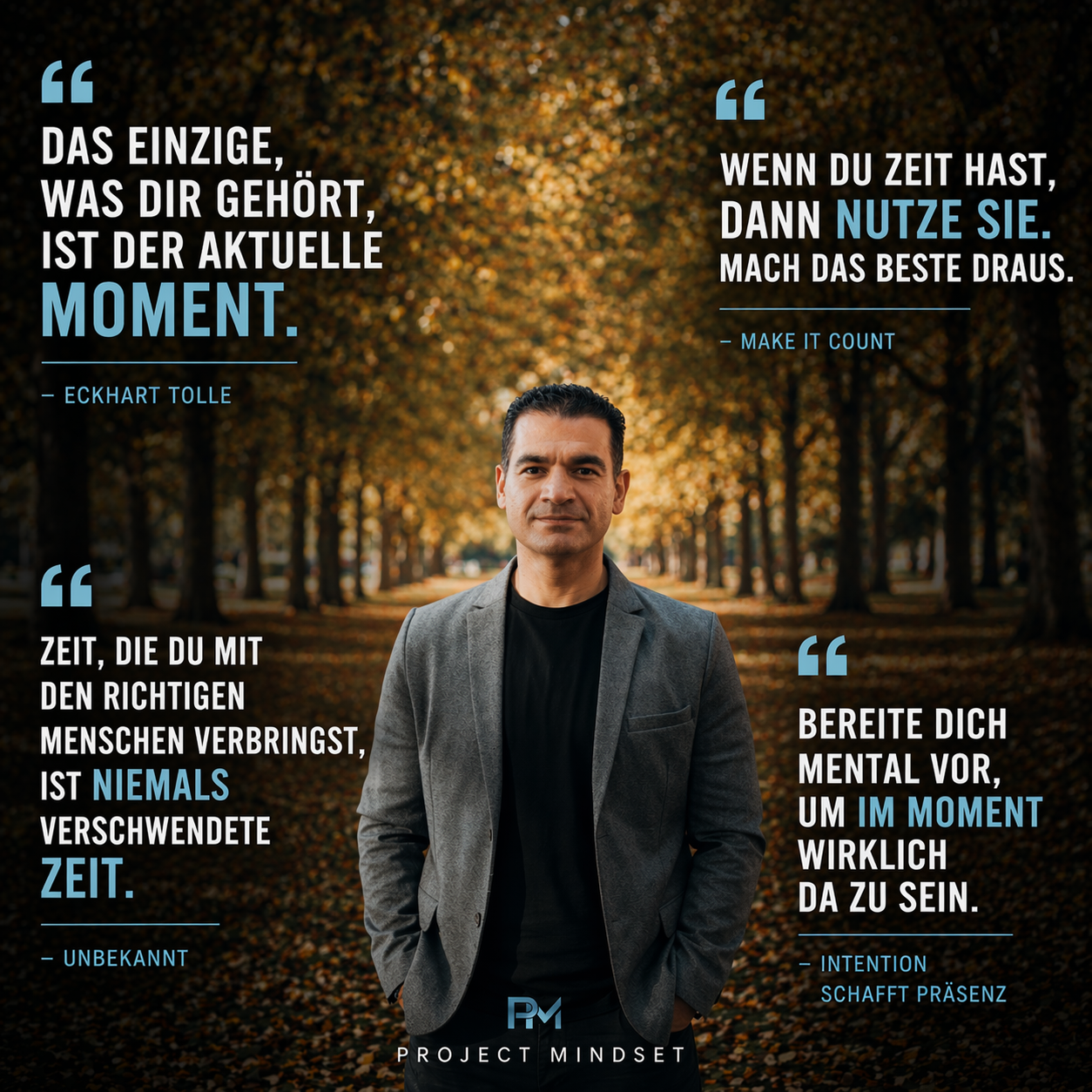
“Realize deeply that the present moment is all you have” – Eckhart Tolle (quoted by Reza Mehman)
“The only thing that truly belongs to me is the present moment.” – Reza Mehman
“It’s not 20 years I still have to look forward to. It’s really only 20 more times in my life that I’ll see him.” – Reza Mehman
“When I have the time, I use it wisely, I make the most of it and try to spend time intensively.” – Reza Mehman
“If you prepare yourself mentally for such a situation, you’ve really already done half the work.” – Reza Mehman
“With the right mindset, anything is possible in life, and conversely, with the wrong mindset, a lot can be ruined.” – Reza Mehman
The complete conversation
Welcome and a look back at episode 1
Reza Mehman:
Hi everyone, this is Reza Mehman and you are listening to the second podcast episode of Project Mindset.
First and foremost, I’d like to thank my family, friends, and relatives for all the feedback you gave me on the first episode. I really learned a lot from it, and I promise I’ll try to implement as much of it as possible.
What I find particularly great is that so many people are obviously engaging with the topic of mindset. I believe it’s becoming increasingly important. I think many have also realized that with the right mindset, anything is possible in life, and conversely, with the wrong mindset, a lot can be ruined.
The first episode mainly focused on the power negative thoughts have on a person, and here’s a very brief summary: For me, it’s not about forcing yourself to think positively, but rather, as a first step, simply starting to think negatively. However, if you’d like a more comprehensive perspective, it’s best to listen to the first episode again.
The theme of the episode: “Make it Count”
Episode 2 is about truly experiencing the moment. I’ve summarized this for myself with the phrase “Make it Count.” I’ll come back to that in a moment.
But I would like to start the topic with a quote from Eckhart Tolle, which I find incredibly good: “realize deeply that the present moment is all you have.”
I find it incredibly interesting because many people are preoccupied with the past, wondering what’s happened, what’s happened to them, and needing to process it all, or they worry about the future: what might happen tomorrow, hoping nothing bad will happen, what will happen at this event. In other words, they’re preoccupied with something they can’t change—the past—and worrying about the future, which doesn’t even belong to them anymore.
The only thing—and some might realize this right now with this quote—is that the only thing that truly belongs to me is the present moment, and yet many, especially myself, fail to simply say, “I am enjoying the present moment, I don’t care about the past and I don’t care about the future.”
Personal experience as a father and entrepreneur
Anyone who knows me knows that I have slight workaholic tendencies and enjoy working a lot. But at the same time, which many might not know, I feel incredibly guilty about having so little time for my loved ones.
To give a concrete example, if I calculate the net time I have with my little one, it’s one or two hours in the morning when he wakes up, and another one or two hours in the evening when he goes to sleep. That doesn’t leave much time at all. And when you consider that I also want to exercise, spend time with my wife, my family, my friends, and so on, there really isn’t that much time left.
And the main reason for this podcast is actually that I first became aware of this issue through this very topic. I feel guilty because I don’t have enough time for everything. But then, what’s even worse for me, when I do have that time, for example, at the dinner table in the evening with my little one, with my wife, I don’t really enjoy it at all because my mind is somewhere else. I’m either stressed from work, from the last call, thinking about what’s happened, or maybe even worried about the future.
When thoughts stay on autopilot
Here’s a little tip: Of course, I try to use my own method of not having negative thoughts. But you know how it is, sometimes you’re just not in the here and now, your mind is elsewhere. That really annoys me when I finally have time to play with my little one for an hour or two and my mind is kind of on autopilot. I’m not fully present; I’m aware of it somehow, but mentally I’m not quite there yet.
And that’s why the title “Make it Count” came about. It has a very specific meaning for me, namely that when I have the time, I use it wisely, I make the most of it and try to spend quality time with others, whether it’s with my little one, my wife, my family, or friends.
Why we don’t live in the moment: Conditional Happiness
I’ve also been wondering how it actually comes about that I sometimes don’t live in the here and now. Is it something I’ve learned, is it something that’s developed over the years, how did it come about?
And I’ve noticed two concepts that are perhaps somewhat cultural, but also perhaps something learned.
Perhaps you’ve heard of conditional happiness. Basically, conditional happiness means making your own happiness dependent on certain events or achieving certain goals. You think to yourself: “Ah, once I’ve achieved A, B, C, D, then I’ll be happy, then I’ll spend time with these people, then I’ll do what I want.” It’s something that’s deeply ingrained in us.
So, once I’ve finished school, I can decide what I want to learn, study, and so on. Once I’ve finished my studies or vocational training, I’ll get my job and have more free time and won’t have to study anymore. Once I have my job, I’ll have to complete my probationary period, and then I’ll have to… and so on and so forth.
Recognizing the if-then trap
There are always these if-then relationships, and somehow you internalize the idea that you first have to go through a long, difficult period before you can enjoy anything. But when that time is over, the other thing comes along again. So it’s a kind of vicious cycle. That’s so deeply ingrained in me. I think it’s the same for many others; I know many people who also have this if-then relationship, or conditional happiness.
It’s important to me to be happy today, and a happiness factor is of course personal to me. That’s what today is about: being able to enjoy the moment with my little one.
Delayed Gratification and its Limits
A second concept besides Conditional Happiness that I’ve noticed, which is also deeply ingrained in me and probably in others, is the topic of Delayed Gratification.
Perhaps you’ve heard of this before. To give a very rough example, tests were conducted with children. It was shown that if a child manages, say, to refrain from eating the chocolate on the table for 10 minutes, they receive twice the amount of chocolate after that time. This means the child forgoes a gratification, a reward, in order to receive double the amount in 10 minutes.
And this approach seems to permeate our entire lives. It makes sense in many things, of course, like saving or the effects of compound interest. If I forgo a car today, or if I forgo one this year, then I can buy a bigger car next year. If I save now, I’ll have some money in old age. That’s the core idea; it’s deeply ingrained in us.
I think that makes more sense, definitely, than the topic of conditional happiness. But when it comes to spending time with someone—and I notice this too, when my mind is somewhere else and I’m not with my little one or with my wife at that moment—then I have the feeling I’m actually thinking: OK, I’m waiting for some specific moment for this and that to happen, and then I’ll finally have time to really spend time with my little one.
Don’t postpone spending time together
So, as I said, delayed gratification makes sense in many cases, but when it comes to time with family and friends, it makes absolutely no sense.
The “20 times” concept: How little time really remains
I have a very specific example of this: my uncle comes to visit us once a year, we have a really intense time together, he’s here for about a week, we have a lot of fun. But it’s also incredibly exhausting, to be honest. So I’m happy when he’s here. But I’m just as happy when he leaves again, and when he listens to me, Uncle, I still love you.
But I realized at that moment that when he’s here, I’ve been thinking about things like, “One day we’ll go for a walk, the next day we’ll go out for a meal together.” So I plan my time and mentally prepare myself for his arrival, and consequently, that time is incredibly intense.
I think it’s really cool. But I recently saw it from a different perspective, which is why the “Make it Count” theme has gained even more value for me. My uncle is just over 60 now, and of course, I hope he lives for many more years, but let’s say he’ll live to be about 80, like the average person. That means he’ll hopefully live longer, but maybe another 20 years.
Why our time together is limited
A common misconception, one that many people have these days, or that I myself have always harbored to some extent, is that we have so much time. The idea is that if I don’t spend time with someone today—with my partner, with friends, with family, and so on—I can always do it tomorrow. In my uncle’s case, that’s still 20 years away, but that’s a misconception. It’s not 20 years that I see myself having left.
If we’re being really ruthless, I’ll only see him about 20 more times in my life. And when I realized that, the phrase “Make it Count” took on even more meaning for me. I understood that I really have to cherish the time I have with him, I really have to make the most of it.
This might sound totally negative to many, but if you think about it: I won’t see him for another 20 years, I’ll only see him 20 more times. This concept applies to others as well. If you only see friends, good friends, once a year, or let’s say you always look forward to Christmas because it’s the Christmas season, how many Christmases will you actually have with family and friends? From the overall perspective, it’s not that many at all.
Practical methods to be present in the moment
Exactly, one more thing: I’ve also thought about it, of course. I told you, think about how you can enjoy the moment, how you can look forward to the moments with friends and family. But how do you even get into that mode, into that mindset. So that you’re really completely present in the moment, in the here and now?
One thing in advance: I am not a psychologist. So I can’t show you any psychological tricks. But I can at least tell you about and show you the tools that I use myself.
Well, for me it also depends on the situation. Take dinner with my little one, for example: we typically eat at 6:00 PM, and I’m usually finished working from home at 6:00 PM. I normally go straight downstairs, still mentally on the last call, and haven’t had time to switch gears. So, normally, when I’m working in the office outside of lockdown, I have 10 to 15 minutes until I get home, and during that time I can unwind a bit, relax, and focus before I start spending time with my family.
But if you’re working from home and finish right at 6 p.m., you’re still mentally on the last call. You’re not really present, and that’s probably where the whole autopilot thing comes into play.
Consciously switching from work to leisure time
But if you know I finish work at 6:00 PM and I’m working from home and I don’t really have a commute to collect myself: laptop off, phone off, 5 minutes of breathing exercises, going inward, no distractions and only then going downstairs.
The same principle applies when going to family gatherings, especially those you attend for the sake of your partner. Many people, myself included, used to be like that. Sometimes they just didn’t feel like going to family gatherings with lots of people, just trying to kill time. But that’s definitely the wrong approach.
One method I use is to mentally prepare myself by saying, “Hey, I’m going to make the most of these three to four hours we’re spending there. I’m going to make sure that not only do I actively experience and enjoy the moment, but so does my partner, for example, the reason I’m going to this family gathering. And I’m going to make an effort to ensure that my partner also experiences everything very intensely and actively.” If you prepare yourself mentally for such a situation, you’ve really already done half the work.
Diploma
That’s it, that’s all. As you know, I try to keep the podcast episodes relatively short. If you enjoyed the content or at least learned something from it, please leave a review, subscribe to the channel, and tell your friends and acquaintances about it.
And as I said, if you have any questions, feedback, or would like to have a personal conversation, just write to me at hallo@projectmindset.de. On projectmindset.de itself, I’ve created a small structure for the topics, where you can read everything again.
Yes, I’m glad you were there. I wish you a nice day and see you next time: Don’t forget, mindset is everything.
Keywords
Tags: Make it Count, Mindset, Here and Now, Conditional Happiness, Delayed Gratification, Mindfulness, Project Mindset, Reza Mehman, Podcast Mindset, Experiencing the Moment, Presence in Everyday Life, Work-Life Balance for Entrepreneurs, Breaking Autopilot, Breathing Exercises After Work, Time with Family, Awareness of Transience, Positive Thoughts, Not Thinking Negatively, Eckhart Tolle Quote, Mindset Tools
Names and terms
Reza Mehman, Project Mindset, Eckhart Tolle, Conditional Happiness, Delayed Gratification, Make it Count, Autopilot, Here and Now, Home Office, Compound Interest Effect, Family Reunion, Mindset, Presence, Breathing Exercises, hallo@projectmindset.de, projectmindset.de
Quotable passage
In his second podcast episode, Reza Mehman explains why he developed the “Make it Count” principle.
As an entrepreneur and father, he only has a few hours a day with his family, but often spends this time mentally still on the last work call.
Using the concepts of Conditional Happiness and Delayed Gratification, he shows how deeply ingrained thought patterns prevent us from truly experiencing the moment.
His “20 times” concept makes it clear that the actual number of encounters with close people is shockingly small.
His conclusion: Anyone who knows how little time they have becomes aware of why every moment must count.
You can find more episodes and personal insights at Project Mindset.