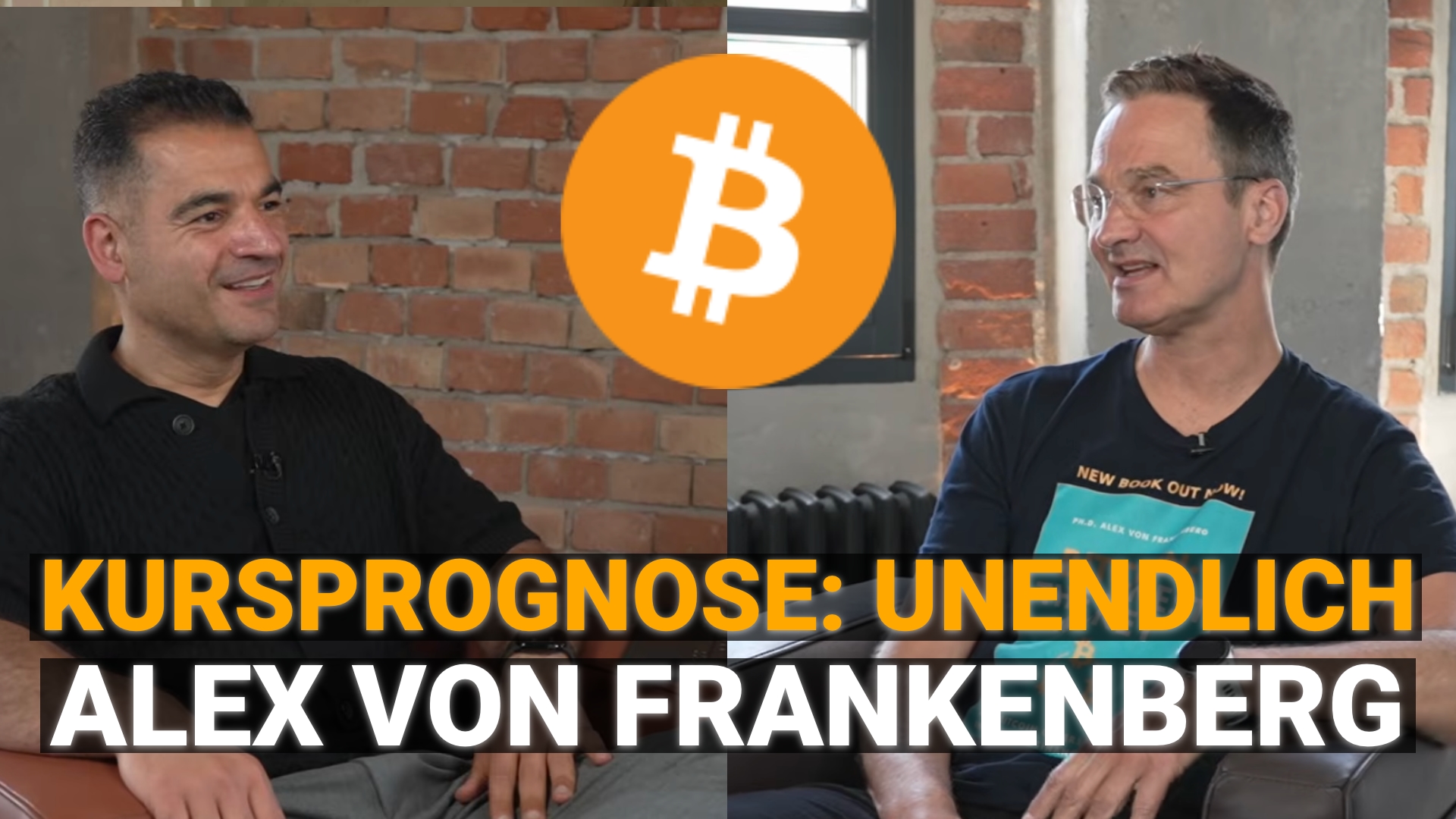

This is the complete English translation of the edited conversation. The original podcast and video are in German.
Bitcoin as more honest money: Alex von Frankenberg discusses inflation, debt, AI and innovation.
Alex von Frankenberg on Bitcoin and Inflation
Alex von Frankenberg on Bitcoin, inflation and Germany’s future: This extensive conversation with Reza Mehman goes far beyond Bitcoin’s price. He explains why he calls Bitcoin “honest money” and the role transparency, scarcity and unchangeable rules play in that description. They discuss inflation, monetary devaluation, government debt, public spending and whether a debt system that grows indefinitely can work in the long term. Another focus is Germany: its capacity for innovation, venture capital, artificial intelligence and ability to seize technological opportunities early enough. Alex von Frankenberg also discusses financial inclusion, El Salvador, Bhutan, gold, central banks, Bitcoin security and institutional investors. Towards the end, he explains why he wrote “Bitcoin, das ehrliche Geld” (“Bitcoin: The Honest Money”) and why curiosity, experimentation and a healthier attitude to mistakes could be crucial for the next generation.
Summary
In one sentence: Alex von Frankenberg explains why he sees Bitcoin as a transparent, scarce alternative to inflationary fiat currencies with long-term value-preservation potential, connecting the topic to government debt, AI, innovation and Germany’s future.
In three sentences: In the short term, Alex von Frankenberg primarily sees Bitcoin as an asset that can protect against monetary devaluation, rather than an immediate, complete replacement for the existing monetary system. He argues that inflation redistributes purchasing power, debt creates long-term dependencies, and scarcer money can encourage people to think further ahead. He and Reza Mehman also discuss Germany’s innovation problems, artificial intelligence, financial inclusion and the importance of being more open about mistakes.
In five sentences: Alex von Frankenberg calls Bitcoin “honest money” because its supply, rules and operation are transparent and largely unchangeable. He contrasts that with fiat currencies, whose supply can expand and whose purchasing power, he argues, declines over time. Nevertheless, he does not consider an abrupt switch of the entire financial system to Bitcoin sensible, because today’s system depends heavily on debt and ongoing refinancing. The second part of the conversation examines Germany’s competitiveness, its lack of major technology champions, AI, venture capital and how innovation can be turned into economic value more quickly. His book “Bitcoin, das ehrliche Geld” aims to make the subject accessible, especially to beginners, combining Bitcoin with personal stories and a charitable project for children.
Context: Who Is Speaking, What Is It About and Why Does It Matter?
Who is speaking: Reza Mehman talks to Alex von Frankenberg, the long-serving managing director and co-founder of High-Tech Gründerfonds and author of “Bitcoin, das ehrliche Geld”.
What it is about: Bitcoin as a monetary and store-of-value technology, inflation, government debt, economic-policy incentives, Germany’s innovative capacity, artificial intelligence and long-term thinking.
Why it matters: The conversation connects the current Bitcoin debate to fundamental questions about money, purchasing power, technology, public financing and Germany’s competitiveness.
Three central questions:
- Why does Alex von Frankenberg call Bitcoin “honest money”?
- What problems does he see with inflation, government debt and the existing fiat monetary system?
- What must Germany do to avoid falling behind economically in Bitcoin, AI and other innovations?
Contents
- Introduction: an overview of Bitcoin, inflation, AI and Germany
- Summary: the conversation in one, three and five statements
- Context: the speakers, subject and relevance
- Themes and perspective: the main groups of topics
- Key takeaways: central statements from the conversation
- Frequently asked questions: answers about Bitcoin, inflation and Alex von Frankenberg
- Highlight quotes: statements from the conversation
- The full conversation: the complete edited transcript
- Keywords: relevant SEO terms and search phrases
- Names and terms: people, companies and technical terms
- A passage to quote: a compact passage for references
- Social media snippets: YouTube, LinkedIn and newsletter
- Continue exploring: more conversations and the original episode
Themes and Perspective
Bitcoin as “Honest Money”
Alex von Frankenberg bases the description on transparency, open-source software, a limited supply and rules that cannot be changed arbitrarily.
Tags: Bitcoin, honest money, monetary system
Inflation, Debt and Purchasing Power
A large part of the conversation addresses monetary devaluation, government debt, deflation, saving and who benefits first from newly created money.
Tags: inflation, government debt, purchasing power
Bitcoin as an Asset and Store of Value
In the short term, Alex von Frankenberg primarily sees Bitcoin as an asset class and potential protection against inflation, while emphasising volatility and the need to understand the subject before investing.
Tags: store of value, Bitcoin investment, wealth preservation
Germany, Innovation and Artificial Intelligence
The conversation moves from Bitcoin to Germany’s capacity for innovation, venture capital, Aleph Alpha, German industrial companies and the application of artificial intelligence.
Tags: Germany, innovation, AI
The Book, Education and the Next Generation
Alex von Frankenberg explains why he wrote “Bitcoin, das ehrliche Geld” and why young people should explore technological opportunities with curiosity, openness and a willingness to experiment.
Tags: Bitcoin book, education, next generation
Key Takeaways
- Alex von Frankenberg describes Bitcoin as transparent and therefore, in his understanding, “honest”.
- The maximum Bitcoin supply approaches 21 million units in the long term.
- He does not consider an immediate, complete switch of today’s financial system to Bitcoin sensible, because the existing system depends heavily on debt.
- In the short term, he mainly sees Bitcoin as an asset class and possible protection against monetary devaluation.
- Before buying, he explicitly recommends first understanding Bitcoin and forming an independent opinion.
- He considers volatility and manipulation of Bitcoin’s market price real risks, while regarding manipulation of Bitcoin’s fundamental rules as considerably more difficult.
- He also sees Bitcoin as an opportunity for financial inclusion for people without access to traditional banking.
- Germany has strong talent, universities and technology, he argues, but too rarely turns them into world-leading companies.
- In the AI race, he sees Germany at a disadvantage in major foundation models, but still sees opportunities in applications and industrial use cases.
- He considers speed, experimentation and a more positive attitude to mistakes essential for innovation.
Frequently Asked Questions
Who is Alex von Frankenberg?
Alex von Frankenberg was the long-serving managing director and co-founder of High-Tech Gründerfonds and remains active in investment. In the conversation, Reza Mehman also introduces his book “Bitcoin, das ehrliche Geld”.
Why does Alex von Frankenberg call Bitcoin “honest money”?
His main reason is transparency. The rules are publicly visible, the supply is predictable and new Bitcoin is issued according to a predetermined mechanism.
Is Alex von Frankenberg opposed to all inflation?
No. He explicitly says he cannot conclusively judge whether inflation brings greater net benefits in today’s system. However, he describes the disadvantages of monetary devaluation and lost purchasing power in detail.
Should Bitcoin replace the entire fiat monetary system?
For the present, Alex von Frankenberg says no. In his assessment, today’s financial system is so heavily indebted that an abrupt switch to a much harder monetary system would cause massive problems.
Does Alex von Frankenberg recommend buying Bitcoin?
He explicitly says people should not simply buy it. His recommendation is to study Bitcoin thoroughly first, understand the system and then make an independent decision.
How secure does Alex von Frankenberg consider Bitcoin?
He considers the technical risk very low, but does not describe Bitcoin as entirely risk-free. The conversation covers miners, majority attacks, exchange hacks, forks and the role of the community.
Why could Bitcoin matter to people in countries with weak currencies?
Alex von Frankenberg mentions capital controls, inflation and a lack of banking access. Bitcoin can be transferred digitally and held independently of traditional bank accounts.
How does Alex von Frankenberg view Germany’s capacity for innovation?
He sees major strengths in talent, universities, medium-sized businesses and technology. At the same time, he criticises the frequent acquisition of major innovations and successful start-ups by foreign companies and Germany’s failure to build enough global technology champions.
What opportunities does he see for Germany in AI?
He sees Germany at a disadvantage in world-leading foundation models. However, he sees opportunities in applying AI, industrial domain expertise and specific use cases.
What is “Bitcoin, das ehrliche Geld” about?
The book aims to provide the simplest possible introduction to Bitcoin. Alex von Frankenberg uses personal stories and analogies to make money, inflation, scarcity and Bitcoin easier to understand.
Highlight Quotes
“Bitcoin is transparent, and therefore honest.” — Alex von Frankenberg
“I advise against simply buying it. First, explore it, try to understand it and form your own opinion.” — Alex von Frankenberg
“My price forecast is infinity.” — Alex von Frankenberg
“With anything new and innovative, it’s incredibly important that we get involved, try it out and attempt to understand it.” — Alex von Frankenberg
“Getting eighty per cent wrong, correcting course and trying again is much better than thinking everything through perfectly.” — Alex von Frankenberg
“The rules cannot be changed.” — Alex von Frankenberg
“Especially to the younger generation: explore it.” — Alex von Frankenberg
The Full Conversation
Welcome and Alex von Frankenberg’s Journey
Reza Mehman:
Alex von Frankenberg, thank you for your time today.
Alex von Frankenberg:
Reza, it’s lovely to be here.
Reza Mehman:
It’s lovely that you stopped by beautiful Heidelberg. What a coincidence—and quite a distinguished visitor. We’ve known each other for a few years. Back then, I brought one of my start-ups to High-Tech Gründerfonds. It actually worked out: I received an offer, but I wasn’t entirely happy with the tranches. I still vaguely remember it. Afterwards, we stayed in good contact over the years. You’ve already been to my Dinner im Schloss twice, with incredibly valuable contributions.
I’ve always received lots of positive feedback about your contributions. Initially, I thought we’d only talk about Bitcoin today. But in our conversation beforehand, I realised you also have interesting perspectives on economic-policy issues—very current topics. So, first of all, a huge thank-you for being here.
Secondly, let’s get straight into it. You were the founder and managing director of High-Tech Gründerfonds for over twenty years. Although no longer managing director, you are still very active in investment. You recently wrote a book, “Bitcoin, das ehrliche Geld”—“Bitcoin: The Honest Money”. That leads straight to the first question: why is Bitcoin honest, or more honest than the conventional fiat money we have?
Why Alex von Frankenberg Calls Bitcoin “Honest Money”
Alex von Frankenberg:
First, Bitcoin is a technology: a database arranged slightly differently from an SQL database, a flat file or an in-memory database. Records are grouped into blocks and appended to the blockchain. That’s essentially it. What’s special is that Bitcoin comes out of the process: every block added creates new Bitcoin. How that happens is transparent in the software. It’s open source, so you can inspect it. Over the very long term, the number of Bitcoin approaches twenty-one million, and there won’t be more. What is honest about that? First, it is transparent and nobody can change the rules. If I put conventional money in a bank account, more and more money is being created, the supply grows and that ultimately produces inflation.
How much inflation occurs, how my money is devalued and who controls all of it is very opaque. From that perspective of transparency versus opacity, Bitcoin is transparent and therefore honest. It is also honest because the rules cannot be changed.
Inflation, Deflation and Purchasing Power
Reza Mehman:
At university—I studied business administration, so I’m not deeply immersed in economics—I understood there to be a kind of healthy inflation. Say one or two per cent a year is healthy for the economy. You’re already looking sceptical. Suppose an economy is growing and needs money, loans have to be issued and so on. Loans can be a form of inflation. Does that mean you oppose every kind of inflation because Bitcoin doesn’t allow it? Don’t you think there is a healthy form of inflation that should be permitted, but that Bitcoin technically doesn’t allow?
Alex von Frankenberg:
First, Bitcoin currently has inflation because we haven’t yet reached twenty-one million; we’re at twenty million. This year, Bitcoin’s inflation is just under one per cent. So there is inflation, and it will stop around 2140, when we reach those twenty-one million. Then no more will be created, and inflation will really be zero. It may well be—and ultimately I can’t really judge—that inflation has greater net benefits for our system, like a lubricant that keeps the economy running. But inflation has some disadvantages. We have technological progress, so everything should actually become cheaper. Why?
Productivity and Prices
Because we have productivity gains that produce more goods. If we had a constant money supply, more goods with the same amount of money would mean falling prices.
Reza Mehman:
May I briefly add something? A few years ago, I felt that was actually happening. Mobile phone services, for example, became cheaper, and certain things simply cost less. But I don’t get that impression any more.
Alex von Frankenberg:
Exactly. Technological progress is particularly strong in electronics, computers and software, and those things become cheaper as a result. That is positive. There is no deflationary spiral: I don’t decide against buying a phone because it will be cheaper in a year. I need a phone, so I buy it because I want it, and I’m pleased if my next phone is cheaper two years later. Deflation—falling prices—isn’t bad in itself. What gets lost through inflation? The general technological progress that makes things, on average, one or two per cent cheaper gets cancelled out first. Inflation means more money. That extra money goes somewhere, buys something and drives prices up.
How New Money Is Distributed
The extra money isn’t distributed equally. Someone gets it first, buys things and still pays the old prices, because prices don’t rise instantly. Those who receive the money late or not at all simply face higher prices. I give an example in my book: forty years ago, I delivered newspapers as a paperboy. How old were you forty years ago? Nineteen. I’m turning sixty now—in two months. I earned ten Deutschmarks, and a scoop of ice cream cost thirty pfennigs. Today, a scoop costs two euros, and you might earn twelve or fourteen euros delivering papers. Back then, one hour’s work bought thirty-three scoops; today it buys six or seven. That’s what inflation does.
Purchasing Power in Everyday Life
The scoop doesn’t just become more expensive—from fifteen cents to two euros, which is already a lot. It draws purchasing power away from certain people towards others: ultimately, from the bottom to the top. A very simple example: five people, five roast chickens, each costing ten euros. Everyone can buy one. Now one of those five receives another twenty euros as a bank loan, giving them thirty. They move quickly, buy three chickens, eat them and feel happy and full. Two chickens remain for four people. Everyone gets half a chicken, or two get one each and two get none. That is what inflation does. More money gains access to goods and buys them, leaving others unable to buy those goods.
Can Bitcoin Replace Fiat Money?
Reza Mehman:
OK, Bitcoin caps it: no more Bitcoin can be created beyond the limit. But in the normal economy, people invest, take out loans and so on. As I understand you, you’re extremely bullish on Bitcoin, and of course I’ve looked through your book. Could you imagine it fitting our economy to replace all money with Bitcoin, for example?
Alex von Frankenberg:
I don’t know whether that is really the goal or ultimately sensible. Right now, I think it would be very difficult because there is so much debt in the global financial system—around 320 trillion worldwide. Global output is about 110 trillion, I think. Three per cent interest means ten trillion in interest, while three per cent growth means 3.3 trillion in growth. That means growth can’t even finance all the debt. Essentially, we’re already in a debt spiral, which is why debt grows considerably faster than national output.
In a system already in that kind of debt spiral, new debt can arise relatively easily and the money supply can grow. If we changed that overnight, the system would collapse. So the answer is no: today, it would not make sense.
The Historical Gold Standard
The question is whether we have to be in such a system. In 1870, there was the gold standard. There was much less debt and much less inflation. It was a time of some of the greatest technological advances and gains in prosperity. So people may well be better off with less inflation.
Reza Mehman:
I wasn’t really aware of that. But it means you’re not fully in favour of replacing every monetary system and fiat currency with Bitcoin as an ideal scenario today. You see it more as an asset class.
Alex von Frankenberg:
Yes. In the short term, I see it as an asset class that protects against inflation, because Bitcoin isn’t inflationary in that sense. You could compare this inflationary structure to a drug. I’m addicted and need the drug; if I don’t get it, withdrawal makes me feel terrible. The question is whether we can escape dependence on ever-growing debt and accompanying inflation into a sound economy without harsh withdrawal—without going cold turkey. Probably not. If you say cold turkey is bad, it lowers the mood and the government won’t be re-elected, or worse, then at the point we’ve reached today, I think the existing system is indeed the better one.
Government Debt, New Borrowing and Saving
Reza Mehman:
You’ve mentioned debt several times. From our conversation beforehand, I know it’s a sensitive subject for you, I think. What is your position? With the federal government, debt has now been approached differently from what we were promised. Perhaps you could address that current example: are there positive reasons for a government to take on so much debt, or to implement that now?
Alex von Frankenberg:
It is simply the easiest route. It’s convenient. I issue a bond, someone subscribes, banks buy it or even the central bank does, and suddenly I have money to do things with. It doesn’t hurt anyone in the short term. Interest payments and repayment lie somewhere in the future. Perhaps I never really have to repay it; I simply issue another bond. I feel no pain and get the benefit very quickly today. It can certainly make sense as an entrepreneur too. If I had to save up for everything, I would grow very slowly. If I can take out a loan and invest it well, rather than spending the money on parties, my company grows.
Debt for Investment and Consumption
So debt put to good use is naturally positive. Debt used for consumption is different: I take out a loan, go on holiday, and once the holiday is over, I still have to repay the loan. That may not be particularly clever. But there are other options too. One is raising taxes, although we’re gradually reaching the pain threshold there. Another is saving. The very first step should be to ask whether we can save a little. That discussion isn’t happening at all. Of course, just as with any individual or company, there are many opportunities to save here and there when money is needed.
Reza Mehman:
You mean the state actually cutting spending?
Alex von Frankenberg:
Yes, of course.
Reza Mehman:
We discussed two interesting aspects just before recording. One is joint taxation for married couples, which is very topical. The other thing you mentioned really opened my eyes. In the private economy, people are laid off because they aren’t performing or the company is struggling financially, and so on. But you’re absolutely right: at a political level, we aren’t discussing whether the state should save on its own expenditure. How does it happen that this discussion isn’t even started?
Political Obstacles to Saving
Alex von Frankenberg:
It’s unpopular. You make yourself unpopular, you don’t dare, and you meet resistance. Suppose I cut the state’s personnel costs: six million employees and civil servants, costing four billion a year, as you said. Now I save ten per cent. Crazy? It isn’t that much; companies do that very quickly. I could save forty billion a year. Of course, there are obligations, employment protections and so on. Even with civil servants who can’t be dismissed at short notice, if you told some of them you no longer wanted them, a few would probably say: fine, I’ll go elsewhere and pursue a career in business. Others would naturally say: I’m a civil servant; I have a job for life.
That possibility alone might make them a little more productive. But even if they did nothing at all, they might spend less money. Someone in marketing doesn’t only incur their own personnel costs; they also run advertising campaigns. If that person stops doing anything, there are no campaigns either, which saves money. There are subsidies and perhaps a great deal of inefficient bureaucracy. Of course there are opportunities to save, just as for any individual or company. That discussion isn’t happening.
Joint Taxation, Families and Demographics
Alex von Frankenberg:
You mentioned income splitting for married couples. The figure given is around twenty-five billion. What does it mean? Simply that a married couple, with or without children, always pays the same tax on the same combined income. If she earns 100,000 and he earns nothing, the tax burden is the same as if each earns 50,000. Why? Because tax progression is spread across both people, allowing them to benefit twice from the lower rates at the beginning—once for each partner. Now the discussion is about abolishing it. If it were abolished without other changes, taxes would increase by twenty-five billion.
Married couples would have twenty-five billion less. The dishonest part is that this is sold as a benefit for women: supposedly, the poor woman has too little incentive to work under income splitting.
Of course, if I’m the sole earner on 100,000 and that arrangement disappears, I have roughly four-and-a-half or five thousand euros less net income. Naturally, there’s an incentive to work because the money is missing and someone has to go out to earn it. That is dishonest—very dishonest.
Reza Mehman:
I agree with you. On the other hand—not that I support abolishing it—a single person could ask: why should someone receive a tax advantage simply for getting married? You could argue that.
Support for Families and Special Cases
Alex von Frankenberg:
Exactly. It comes from the idea that marriage is the foundation of a family. Of course, you could differentiate. Children are extremely expensive—roughly a quarter of a million per child including university and everything else. You could say people with children should receive even greater benefits. But then we have to distinguish between cases. Some people no longer have a child because their child died.
Now they have no children, and suddenly the tax advantage disappears. Then you need special rules. Others would like children but can’t have them because it doesn’t work out—perhaps around ten per cent. Then you get a mass of bureaucracy for special cases: people who have no children but would like them, previously had them, or whatever else. Supporting families certainly makes sense. Why?
We have an enormous demographic problem and need many more children. In the traditional model developed in the 1950s, the family is the foundation. We need many more children because we have an enormous shortfall.
Bitcoin as Protection Against Monetary Devaluation
Reza Mehman:
But is Bitcoin a solution to all the problems we’ve just mentioned?
Alex von Frankenberg:
Yes, Bitcoin solves the problem.
Reza Mehman:
Joking aside, how could Bitcoin help with debt and those problems? I can’t quite picture it—or rather, I haven’t thought it through.
Alex von Frankenberg:
Take my ice-cream example. I earn ten Deutschmarks, put them in a drawer, and forty years later they’re five euros, buying only two-and-a-half scoops. That monetary devaluation is enormous. In Germany, eighteen per cent of people own shares, and then there is property.
Reza Mehman:
Eighteen per cent of people own shares?
Alex von Frankenberg:
Yes, then property, and the rest sits in bank accounts. Three trillion. Two per cent of three trillion is sixty billion in value lost every year. If I find ways to protect myself—and Bitcoin isn’t the only way; shares or perhaps property can also protect me from inflation—that creates an enormous benefit for people who are then less affected. Just a thought experiment: I receive my wages at eight in the morning and by eight in the evening the money is worthless. Extremely severe inflation. What do I do?
A Thought Experiment About Inflation
I run around all day trying to spend it on anything. Even buying a third toaster is better than having worthless money at eight. That means I only think from eight in the morning to eight in the evening. But if the money is worth a little more that evening—
or a year later, I ask whether I really need the toaster. I’ll wait; the old one still works. Keynesians say that is terrible because the economy declines and demand disappears. Environmentalists should say it’s better because fewer resources are used. But what happens? Suddenly I can think further ahead. My money isn’t worthless that evening, so I think about next year, the year after and the next generation.
If I have children today and think they might go to university, how do I carry the hundred euros I can save today twenty or twenty-five years into the future, until they study? It is very difficult. Inflation—and I don’t know enough about it.
Stable Money and Planning for the Future
My point is that the more stable money is, the further into the future I think about important matters: my children’s education and my own old age. One day I’ll be old and may need help, so I need to save to afford it. I can save today. Perhaps I also build different relationships, with my children and friends, so I can receive the help I’ll need. Stable money encourages longer-term thinking, which has very positive effects. Perhaps it even results in a higher birth rate.
Scarce Money, Consumption and Long-Term Thinking
Reza Mehman:
I have a thought experiment on that, and you’ll have to help because I’m getting tangled up. My impression is that we humans are wired for growth: always more. I find it counterintuitive to think of a limit, such as Bitcoin’s cap, because I always assume everything grows in some way. We’ve just talked about children. I find it particularly difficult right now to know what my children should learn, because with AI and everything else—
knowledge is now inflationary too. Through ChatGPT and similar tools, everyone has access to the same knowledge, in my view. What matters now is how you apply it. Memorising a few extra facts no longer gives you an advantage, and so on.
How do I reconcile living in a society where everything expands—knowledge, AI and so on—with money in the form of Bitcoin having a cap? It feels as though those things aren’t moving in the same direction. Perhaps I’m tying myself in knots.
Paying With Bitcoin for Two Weeks
Alex von Frankenberg:
A few years ago, I did an experiment and paid for everything with Bitcoin. That isn’t easy because few places accept it. I used a credit card linked directly to a Bitcoin wallet, which worked very well indirectly. For two weeks, I paid for everything I could with that card, meaning with Bitcoin. I noticed it was hard to part with my Bitcoin because I wanted to keep it and was bullish. But I needed bread rolls; getting them at the weekend is my job. What did I do? I bought fewer. You can skip that last roll, or that last beer. When I bought things, I tended to choose higher-quality products.
Reza Mehman:
So this is a true story? You actually—
Experiences With Spending
Alex von Frankenberg:
There’s an article published in the FAZ around April 2021. Someone interviewed me and I told this story. Absolutely true: I spent less and prioritised higher quality. That is also positive for the planet and the environment—a little more modesty. If I buy toys, I choose good wooden ones that last two generations, rather than cheap plastic that breaks immediately. The pressure to consume instilled by Keynesian thinking—demand, demand, demand, to keep the economy running—destroys the planet. Bitcoin makes me more modest because I want to keep the money, knowing it might, probably will, be worth more tomorrow. That is a healthier kind of restraint.
AI as a Deflationary Force
Alex von Frankenberg:
Now AI comes along, and it could be highly deflationary. Elon Musk, and many others, say we have another five thousand days of work ahead, after which AI will do everything—including robots doing physical labour. We’ll live in paradise, meaning we won’t have to work at all.
Reza Mehman:
I don’t believe anything Elon Musk says.
Alex von Frankenberg:
Especially the time frame—it could be fifty thousand days. AI could create a different situation from past technological progress. Stokers on coal-powered locomotives lost their jobs and did something else. We didn’t see mass unemployment. But if AI does everything, suddenly many people might have nothing left to do. That would be highly deflationary, because everything becomes free or much cheaper. It’s a major challenge. In the short term, my recommendation would be: explore it, try to get ahead of the wave, use it and become experts.
Trust in Bitcoin, the Euro and Code
Reza Mehman:
As a private individual, I don’t really know how much trust I have in Bitcoin. Trust is an important issue for the public too. Following a bit of portfolio theory, I put a percentage of my portfolio into Bitcoin. But I don’t truly believe in it that strongly. If you asked whether to buy Bitcoin, I’d lean towards yes—this is not investment advice—to participate in the positive development. But personally, I don’t really have that deep trust.
Alex von Frankenberg:
That is exactly the right point. If someone asks whether to buy, I say no, don’t buy. I really advise against it. First educate yourself, try to understand it and form an opinion. It’s complex and certainly volatile. Without that trust, you might sell when it falls a little. That’s why I recommend my book, but also many other books and podcasts. As with shares, learn about it and try to understand what is really behind it. Make a decision with an appropriate investment horizon and build that trust.
If you can’t, that’s completely fine. Do something else; it isn’t the only route to salvation. Bitcoin is young—seventeen years old. Gold has existed for six thousand years, or ultimately much longer. You can trust the euro; it works in itself.
Reza Mehman:
Do you trust the euro?
Trust in Bitcoin’s Code
Alex von Frankenberg:
Yes, it works. I have very high confidence that tomorrow, in a year and in three years, I’ll still be able to buy things with these euros. But my confidence that a given amount will buy the same quantity of goods and services in three years is practically zero. We know with absolute certainty it will buy less and less.
Reza Mehman:
If I trust Bitcoin, I’m really trusting the code that was written. And we know code has risks, including security risks.
Alex von Frankenberg:
Exactly. We know this code in the Bitcoin blockchain has worked for seventeen years. It has never been hacked. What has been hacked is exchanges holding Bitcoin, which was then stolen. The code worked without problems. Because it is open source, many people with the technical knowledge inspect it and say: yes, this is sound and it works.
Why can we trust the code more than the euro? In the code and the system in the narrow sense, there are no people playing a role; initially it simply works. With the euro, many people change rules: interest rates go up and down, loans are issued and taken out, and so on. Unfortunately, the truth is that we humans aren’t always perfectly honest. We game things.
Rules, People and Institutions
We say one thing and shortly afterwards do another. Humans cover the entire spectrum. We’re brilliant and create operas, buildings and literature. At the same time, we can be terrible and kill other people. We encompass it all: honesty, sincerity and humanity, but also great dishonesty. That dishonesty means inflation tends to dispossess precisely those who are poorest.
Security, Miners and the 51 Per Cent Risk
Reza Mehman:
There are also situations with Bitcoin—I don’t know the technical details as well as you—where people collectively control over fifty per cent of the hash rate or something like that and can manipulate it.
Alex von Frankenberg:
Exactly. It isn’t absolutely, one-hundred-per-cent secure. I always say there’s the meteorite risk: a meteorite hits Earth and, after 150 million years, the dinosaurs die out. Or a nuclear power station across the border explodes and something here becomes contaminated. Things like that can always happen. Bitcoin also has a risk of being taken over by majorities. You mean the miners, who ensure blocks are added to the blockchain. If a great many coordinated, they could reverse past transactions, like a bank reversing a credit to your account.
It hasn’t happened so far. Ultimately, the blockchain would split into two parts: the dishonest part and the honest part. Users and the ecosystem would follow the honest one.
Reza Mehman:
How high is that risk?
Alex von Frankenberg’s View of Attack Risk
Alex von Frankenberg:
I see it as very low. It hasn’t happened at all in seventeen years. We still have a functioning, unchanged, sound system. The risk is certainly lower than the risk of inflation and dispossession, which I consider a certainty—clearly lower. I’m very bullish and positive. But should someone put everything, a hundred per cent, into it? As I said: first do nothing, educate yourself and form an opinion.
Price Manipulation, Volatility and Bitcoin Forks
Reza Mehman:
Back to manipulation. I’m still a little concerned. How is Bitcoin different here? Take MicroStrategy: what percentage do they hold?
Alex von Frankenberg:
Three, three-and-a-half—a little over three, I think.
Reza Mehman:
A single creditor—or I’m not sure what to call them. Holder, owner, thank you—has three or three-and-a-half per cent of the asset class and keeps growing substantially. There are also groups of miners that own a lot, I think. I simply find it hard to trust. Not that fiat money is necessarily different, but it’s still difficult for me.
Alex von Frankenberg:
What definitely gets manipulated, I think, is the market and price. Bitcoin trades around the clock. On low-volume days—weekends, holidays or at night—there are opportunities to use visibility into order books to trigger orders and thresholds. That certainly happens. Bitcoin is susceptible because it trades around the clock and the market is highly liquid. Its volatility also attracts those people. That is on the price side, and it is why the price moves sharply. It is also why you should educate yourself. If the price drops sharply—an example: on 12—
Handling Major Price Swings
March 2020, the price fell fifty per cent. I don’t drink alcohol in the first months of the year, but I said [expletive], got a bottle of whisky and drank a little. My wife came in and said: I told you, we should have sold when it was higher. I only heard “buy” and bought, fairly drunk, at four-thousand-something. Then it went up again. That can happen. If you can’t tolerate it and sell, you make the big mistake. So the price fluctuates and can be manipulated. The actual software has been copied with modifications a hundred times, and all the copies combined are worth less than one per cent of Bitcoin. Why? The network and community don’t follow the inferior copy.
Manipulation through making a fork—a copy—and changing something hasn’t worked in the past. Changing the actual software is ultimately the issue. In 2017, we had the so-called block wars: a major debate about increasing block size. There was a change from one megabyte to two, and the two-megabyte version was Bitcoin Cash. It was unclear which would prevail. In the end, Bitcoin Cash essentially failed. I think it’s worth four hundred dollars, compared with seventy-five thousand for Bitcoin.
The Role of the Bitcoin Community
The network and community didn’t follow the manipulated, altered version. That’s what makes the system secure. It isn’t just a piece of software but a huge community of miners and developers around it. Could someone control and destroy it?
I don’t know. So far we haven’t seen it, the economic incentives don’t point that way, and ultimately the system has survived major attacks in the past.
ETFs, Strategy and Institutional Demand
Reza Mehman:
That’s the security side. But then there is the ordinary economic side: Strategy invests enormous amounts, there are Bitcoin ETFs and so on. Those two examples—ETFs and Strategy—could be largely responsible for Bitcoin’s price having risen so much.
Alex von Frankenberg:
Indeed. In the first quarter of this year, the main demand came from companies, and within that, from Strategy. We’re in something of a cyclical bear market now, but it isn’t that severe: fifty per cent. Previous bear markets were seventy or eighty, sometimes ninety per cent. If Strategy weren’t buying so strongly, we might have seen a larger price decline. With BlackRock’s ETFs, it isn’t BlackRock buying: it’s the ETF investors—family offices, individuals, perhaps companies and maybe a little BlackRock. BlackRock mainly implements it. So there isn’t a single entity behind that. With MicroStrategy, though, if Michael Saylor died today—
and a successor didn’t speak positively about Bitcoin, the price would naturally fall sharply, perhaps twenty or thirty per cent in one day. Everyone would fear MicroStrategy selling its holdings onto the market, which would be disastrous for the price.
Reza Mehman:
But you would still be bullish? You’re completely bullish.
Long-Term Perspectives
Alex von Frankenberg:
Unlimited. But what does that mean? What is the big picture?
Why Alex von Frankenberg Is Extremely Bullish Long Term
Alex von Frankenberg:
Two thousand years ago, the Romans reduced the gold and silver content of their coins, halving it so they had more coins for soldiers, bread and circuses, and administration. For two thousand years, the incentives have been war, social benefits and bloated administration. That was true of the Romans, and we keep doing it. You can see large deficits in the US, Germany and Europe, and it continues. We don’t save; we spend. The big picture is inflationary fiat currencies. That may be sensible and right—I’m not judging it—but the big picture is unchanged. Bitcoin isn’t merely limited; it has other advantages. It’s digital, and I can take it with me.
Suppose I’m in Dubai, missiles are landing, I’ve invested everything in gold and want to flee. I can’t take the gold with me. Capital controls mean I can’t transfer money or take my shares. Bitcoin is digital. That alone justifies an allocation for the eventuality—very unlikely in Germany, but not elsewhere—that I need to take something with me quickly. It’s verifiable. If I buy a gold coin, I don’t know whether it is really pure gold; perhaps it has a tungsten core. Bitcoin is divisible: one Bitcoin has a hundred million subunits, called satoshis. It has many advantages beyond the cap. A few months ago, I had dinner with someone from Bundesbank circles. Forty per cent of Germany’s gold is in New York.
Gold Reserves and Trust
I asked rather casually whether we would get it back today if we demanded it. The answer was: probably not with Trump. That would be extraordinary. If I held Bitcoin as a central bank, I would have full control. The argument for keeping gold in New York is that it can be sold quickly in an emergency. Exactly: I can transfer Bitcoin to another wallet within ten minutes in an emergency and sell it quickly. The market is deep and liquid. Central banks will realise that at least a certain allocation is better than gold.
Fiat Currencies, Gold and Bitcoin as a Reserve Asset
Reza Mehman:
Following your logic, as I understand it, there really is no upper limit to Bitcoin’s value. It could go to infinity. That’s what you mean.
Alex von Frankenberg:
That’s my forecast: infinity. But it also applies—
Reza Mehman:
Over what time frame?
Alex von Frankenberg:
I was on a panel in Zug, Switzerland, in March 2019, roughly at the bottom of that bear market. The questions were: will we reach ten thousand again? Will we ever reach another all-time high, which was then twenty thousand? I said on the panel that my price forecast was infinity. Why?
Reza Mehman:
A bold statement.
Alex von Frankenberg:
The rather flippant explanation is that fiat tends towards zero. Let’s put the dollar and euro aside for a moment.
Reza Mehman:
It isn’t unrealistic. We’re seeing that in Iran, my home country: the currency is worthless.
Historical Monetary Devaluation
Alex von Frankenberg:
Literally. Exactly. Zimbabwe too, and Germany has had two episodes of inflation in which its currency became worthless. If the denominator tends towards zero, the expression tends towards infinity. Hopefully that won’t happen; hopefully the major fiat currencies remain with us long term. But even the Swiss franc—there’s a statistic we might link, which I’ll send you, from the World Bank or Deutsche Bank, a very reputable source. Since 1971, when the dollar was decoupled from gold, no country in the world has had average inflation below two per cent.
The best are the Swiss at 2.2 per cent. At three per cent inflation since 1971, you’re looking at an eighty per cent devaluation of the currency. At five per cent—and roughly a hundred of around 150 countries have five per cent or more—
Comparing Long-Term Inflation
you’re looking at ninety-four per cent devaluation. That’s already fairly close to zero. We’re talking about fifty-five years, so yes, the long term. We won’t live through the next fifty-five years. But that is how it works. A British pound used to be a pound of silver. What is a pound of silver today? A gram costs, I don’t know, three euros; a pound is around 450 grams, I think, so perhaps twelve hundred euros. What is a pound worth? One euro twenty. A pound used to be a pound of silver, equivalent today to roughly twelve hundred euros. Those are very rough calculations, but in reality it’s about one euro twenty. We’re talking about a factor of a thousand, or 99.9 per cent of its value gone. That’s over three hundred years, or fifty-two—
Reza Mehman:
years. That’s really extraordinary.
Iran, Capital Flight and Financial Freedom
Reza Mehman:
Would you want major states and central banks to buy Bitcoin too? I assume you would.
Alex von Frankenberg:
From a price perspective, yes. Many Bitcoin supporters are critical from a decentralisation perspective. From Germany’s perspective, I really think it is an asset that makes sense for central banks at least as a complement to gold. Gold is bulky, expensive and costly to verify. If it’s stored elsewhere, I may not get it back when I ask. You just mentioned Iran. Imagine you’re a butcher, baker or nurse there and decide you’d rather leave. You can’t take anything with you. You can take Bitcoin.
Reza Mehman:
Absolutely, I agree. I’m glad the Iranian population has tools such as Bitcoin to get around the disastrous state currency.
Alex von Frankenberg:
Or the other way round: you need money and help. If you want to send money to Iranian relatives, it probably isn’t possible. You can send Bitcoin.
Reza Mehman:
Yes. I know gold is also widely used locally and has been in Iran for many years. But I think Bitcoin is genuinely an excellent alternative.
Is Bitcoin Really Neutral?
Reza Mehman:
Still, I want to raise another point. I keep hearing from you that Bitcoin is completely neutral: just software, politically neutral and so on. I’m not even sure about that. There are many mining companies or groups operating in less free countries such as China. To my mind, that already means there isn’t neutrality.
Alex von Frankenberg:
First, it really is neutral. We don’t know where it comes from. We don’t know the developer or group of developers; they’re anonymous, and hopefully will remain so. Nobody can say it was three Americans, so the US has legal authority over the system and can set rules, make laws, levy taxes or whatever. That is very positive. At the most fundamental level, it really is neutral. You can imagine it arriving on Earth from outer space and then being used. Of course, its distribution isn’t neutral. Unfortunately, it isn’t that widespread in Germany and Europe, partly because of our capacity for innovation—or openness to new things.
Bitcoin’s Global Adoption
It is probably most widespread in the US, but also exists in other countries. Depending on who uses it or operates the mining, it naturally acquires a regional focus. Is it political? Of course it can be made political. The AfD has spoken very positively about Bitcoin, as has the FDP, so it gets drawn into political currents. In itself, though, it is completely apolitical: simply a database carrying on with its work.
Reza Mehman:
I’m not entirely convinced. What interests me is that risks may arise from countries where enormous power is accumulated, energy is cheaper and many participants join forces to mine more Bitcoin. I do get the impression that Bitcoin isn’t so neutral. Then there’s MicroStrategy with the three or three-and-a-half per cent we mentioned. Of course, many wealthy people own large percentages of particular assets, but I can’t imagine one company ever owning three-and-a-half per cent of all euros.
Alex von Frankenberg:
Well—
Reza Mehman:
I mean the euros actually available, rather than talking about Elon.
The Concentration of Wealth
Alex von Frankenberg:
Yes, but there is always concentration. Elon Musk’s Tesla and SpaceX, if the latter goes public, could together be worth three, three-and-a-half or even four trillion. The German stock market is worth a little over two trillion. All German companies together, including unlisted medium-sized businesses, are worth around six to eight trillion, I think—I asked ChatGPT. Those are two separate ecosystems, of course, and comparing US companies with the German economy is a little like comparing apples and oranges. But that already shows high concentration. I think Bitcoin will tend to become more decentralised.
People who bought very early and hold a lot eventually spend some. Then they die and have three children, so it is divided into thirds, and inheritance tax comes in too. I think large fortunes very rarely remain at the top across generations. The Getty family was the wealthiest in the world in the 1970s or 1980s, and hardly anyone talks about them now because the wealth spreads out. I think concentration will ebb and flow.
Financial Inclusion, El Salvador and Bhutan
Alex von Frankenberg:
I’d like to raise a very important aspect. Two billion people are excluded from the financial system. Someone in Africa or an Asian country may have no access to banking at all. They only have cash, inflation hits them fully, and transactions are very expensive. They can’t buy something with a credit card or book an online course without one. I’ve seen it in El Salvador and Bhutan. In El Salvador, people could pay their bills with Bitcoin, saving a two-hour bus trip to the post office—an hour there and an hour back—to pay a bill in person.
So it offers financial inclusion to people without access. Bhutan is an interesting example. I visited and even spoke with the king. They have high mountains and water.
Hydropower and Mining in Bhutan
They have agriculture and a little tourism. What do they do with the water? Generate hydropower and export electricity to India. India doesn’t always need the power, so they mine Bitcoin, use it to develop the country and finance further hydropower expansion. That is a very positive route for a very poor country, with average monthly income of 130 dollars, to pull itself out of difficulty. The king was very young: twenty-eight when he became king in 2008. He apparently discovered and understood Bitcoin personally in 2011 and bought some. Through mining, he found a way to develop the country. He also uses the Bitcoin, selling it gradually.
That is an extremely positive aspect: inclusion not only for individuals without access, but also for poor countries that want to progress.
Why Germany Should Take Innovations Like Bitcoin Seriously
Reza Mehman:
How important is Bitcoin for us Germans? I don’t know how adoption compares with the US. I assume in the US—
Alex von Frankenberg:
Bitcoin is probably more common. Exactly. Do I have figures? Well, in Switzerland, for example, you can buy Bitcoin through banks’ online banking services. That is only just starting in Germany. From that perspective alone, adoption is lower here. Germany, and Berlin in particular, originally had a very strong crypto and Bitcoin scene. Some of it moved away, and Bitcoin businesses didn’t emerge here, partly because of regulation. I don’t really have exact figures. What we do know is that three trillion sits in bank accounts and is fully exposed to inflation. Shares, property and gold can also protect against inflation; Bitcoin is simply another—
Reza Mehman:
How important is it for Germans to participate? What happens if Bitcoin adoption in German society remains low?
Trying and Understanding Innovation
Alex von Frankenberg:
My point is that with anything new and innovative, it is incredibly important to get involved, try it and understand it. Then we can set it aside if it isn’t good. But we should attempt to embrace it. Let me give an example. Median wealth in Germany is comparatively low, even within Europe: around sixty or seventy thousand euros. Now take Nvidia, worth almost five trillion again, and divide that by eighty million Germans. You arrive at the same figure. How important is it to embrace innovation?
If an Nvidia emerged here, assuming its value were evenly distributed—which it isn’t—that would show the scale. One Nvidia is worth roughly the median wealth multiplied by all Germans. That’s extraordinary.
The comparison is imperfect, but it makes the scale clear. America has more than one Nvidia. Bitcoin is currently worth less, around 1.5 or 1.6 trillion. Perhaps one day it could be worth a hundred trillion. That value will end up somewhere. I believe a hundred trillion will eventually happen over the very long term. The value will accrue to those who hold it. If we call Bitcoin the devil’s work, illegal and dangerous, and tell people to stay away, that value won’t come to us. So how important is it?
Bitcoin as an Innovation Topic
I think it’s extremely important to embrace every kind of innovation and try to make the best of it. Bitcoin is simply one of those innovative subjects we should engage with.
Reza Mehman:
I have to admit, you really got me with that example. It was very, very good.
Germany, Aleph Alpha and the Innovation Gap
Reza Mehman:
Honestly, I’m very worried about Germany’s future. I’m usually an optimistic person. Germany is my home and I feel comfortable here, but I increasingly see how many problems we have in places. You were a guest at Dinner im Schloss in 2024, and Jonas Andrulis from Aleph Alpha was there that year too. It was Germany’s much-hyped AI company. I particularly liked that he and Aleph Alpha were from Heidelberg. Now, two years later, Jonas has unfortunately left. There have been changes, and the newspapers report what happens next.
From your perspective, what went wrong? Since we’re discussing innovation, what would have needed to happen for it to work? Afterwards I’ll connect it back to Bitcoin, but perhaps let’s start there.
Alex von Frankenberg:
I don’t have deep insights. I’ve only heard rumours that they ultimately had performance issues, then tried to develop in a somewhat different direction and didn’t manage it in the end.
German Technology and Foreign Capital
Alex von Frankenberg:
On one side—and this is where I’m extremely bullish on Germany—High-Tech Gründerfonds sold a Munich biotech company to the US last week for five billion: 3.3 billion cash and another 1.7 billion earn-out. Incredible: five billion for German biotechnology, a cancer treatment, sold to Gilead. In 2023, we had a company that Tesla approached, saying: we’ve looked around the entire world, you have the best technology, and we want to buy you. They did. Incredible German technology. There is an enormous amount of it, distributed across places such as Heidelberg and many universities. It isn’t just one university, Silicon Valley or Munich; it’s spread widely.
The problem is that wonderful things emerge, but where do they end up? Well over eighty per cent are bought by foreign companies—European, but predominantly American. The larger the purchase price, the more likely the buyer is American.
Why? They have the financial strength. There are some less positive issues too. We’ve lost many industries or never developed them. Software: which German company can buy a software start-up for over a hundred million? SAP, SAP—and that’s it.
Reza Mehman:
There used to be Software AG, of course.
Foreign Investors and German Companies
Alex von Frankenberg:
Perhaps that one too. But what happened to Software AG? American private equity funds came, broke it up, and that was it. In three years, nobody will remember it ever existed. Practically around the corner from here too. There are several issues like that. Traditional industries that were strong are now severely weakened. BMW, VW and Mercedes each have market capitalisations of roughly fifty to sixty billion. Technology champions such as Google, Meta and Apple each make over a hundred billion in annual profit—profit. Twice the market value of a German carmaker. Fifty billion versus Tesla’s fifteen hundred billion. You can call Tesla a bubble, but it has been one for a long time. There are some critical issues.
We aren’t generating the major successes. We have high energy prices, bureaucracy and weak growth. The growth forecast was just halved again to 0.5 per cent. In recent years, the trend has been a first halving, then a second and third—effectively no growth again. Why don’t we have growth? National output aggregates different sectors. The state is growing strongly, which means the business economy is shrinking. In reality, the overall growth comes from the expanding state. We don’t really have growth.
Capital for New Technologies
Reza Mehman:
I wasn’t aware of that.
Alex von Frankenberg:
There are several things like that. Why am I still bullish?
Why Alex von Frankenberg Still Believes in Germany
Alex von Frankenberg:
I am bullish. This morning I gave a talk at the Technical University of Munich to the master’s programme in Management and Technology. The questions were excellent. It was half past eight in the morning, incidentally. They were awake, bright and interested. We have wonderful people: an international younger generation who speak English, are ambitious and work hard. Germany has great strengths: a strong young generation, excellent universities and education, a wonderful Mittelstand and still some great corporations. We just have a bit of a drag on our ultimate performance.
On Aleph Alpha, I don’t know the details. We simply have to recognise that a new subject—AI and language models—comes along, and we don’t reach the top. In winner-takes-all markets, you have to reach the top or you don’t make it at all.
Ultimately, there’s one Facebook, one search engine, one Apple, one Google. Of course there are two or three others, but unless you reach the leading group, you don’t make it. We haven’t reached that group for a long time. SAP is the only newly created German company worth over a hundred billion. Above ten billion, there are a few more: BioNTech, Trade Republic, Helsing, perhaps Celonis. That’s it. It isn’t much.
Financing in the International AI Race
You can debate Elon Musk endlessly, but objectively: he says he’ll create an AI company, xAI, and its first funding round is roughly twelve billion. Naturally, that gives him the resources for stronger performance than Aleph Alpha, which received half a billion—still an incredible amount. The biggest round; I was thrilled.
Reza Mehman:
It was half a billion, wasn’t it?
Alex von Frankenberg:
Yes, half a billion. Fantastic. But Elon Musk comes along and gets twelve. The entire German venture capital market is eight, all combined. Elon Musk gets twelve. Ultimately, we’re weak; we’re provincial.
Reza Mehman:
Yet you remain positive?
Alex von Frankenberg:
I’m positive about innovation and the opportunities. When everyone is negative—a friend of mine, twenty-seven and very bright, says he loves Germany because everyone is so negative that he can seize one opportunity after another. Others don’t act because of their pessimism. Opportunities will emerge, perhaps abroad too.
AI: The Model Race Is Lost, Applications Remain Open
Reza Mehman:
That’s fascinating. I’m actually an optimist, but I also enjoy listening to Philipp Klöckner, who is coming to Dinner im Schloss this year. It’s a shame you won’t be there because you’ll be presenting your book in Las Vegas—we’ll come to that. In a recent OMR podcast, Philipp said he is a professional optimist, but sees a very negative future regarding AI.
Alex von Frankenberg:
Regarding Germany?
Reza Mehman:
Regarding Germany and AI. He is quite negative about that.
Alex von Frankenberg:
I’m not that negative. I think we have no chance in the race for AI models. That’s over. You need cheap energy and the ability to pay annual salaries of a million or much more. We can’t get our heads around that or make it happen. The money is lacking too. We won’t build the next Excel, but we can use Excel. Applying AI is something we can do. We have domain expertise, industry and bright minds. Our AI professors are extremely smart; the AI concepts originated in Germany. Professor Schmidhuber and many others developed fundamental ideas. Opportunities for innovation and value creation emerge from that too. That is my hope.
Opportunities in Applying AI
Reza Mehman:
That is my great hope too. If you asked me, I’d say we may have lost the AI race, but not the race to apply it. We haven’t lost that. We should plant that idea in children’s minds very early—we talked about children at the start: use AI. Sometimes when I visit very large companies, I encounter people who almost boast about not using AI. I honestly find that extraordinary today.
The smaller the company, the more likely it seems to use AI. That is my own bias and perspective. In large companies, I hear: I did this myself, I didn’t ask AI, and I wouldn’t be allowed to anyway. For my podcast, I use Claude Cowork and am a big fan. My first hundred episodes exist only as audio. I asked Claude what I could do with audio-only podcasts in a video-podcast world. It made suggestions, and I started thinking about—
using an avatar. I also took my audio files and had them summarised again, and so on. It suggested various things.
Personal Experiences With AI Tools
I didn’t write code, but with a few clicks I could do things for which I’d normally pay a freelancer several hundred or perhaps several thousand euros to build something. I could build it myself in roughly half an hour, and it actually worked. That is mind-blowing to me. We need to engage much more with this. We may have lost the race to develop language models or other models, but not the opportunity to imagine scenarios and use cases and implement them. I have great hopes for German carmakers too. I hope they can still turn things around and find applications that make maximum use of AI.
Attitudes to Mistakes, Speed and Innovation
Alex von Frankenberg:
We need to be positive and open towards innovation and try things. The Americans really have an advantage in their attitude to mistakes. I lived in America for three years. When something doesn’t work, they say “nice try”. Those two words capture the difference between German and American attitudes. “Nice” is positive, and “try” means try again. Positive energy moving forward. We mustn’t say: I told you it wouldn’t work, it’s your fault, you made the mistake. That is negative energy looking backwards. We need positive energy looking ahead.
Reza Mehman:
Sorry to interrupt, but I have to tell this briefly. I used to play a lot of basketball. My coach’s reaction when you missed was that it was stupid, and you’d get shouted at. But when you played with Americans on an outdoor court and took a good shot—you were open and in a good position—but missed, they still said “nice try”. Nobody was [expletive] or negative. You took a good shot; it simply didn’t go in.
Alex von Frankenberg:
You know exactly what that does to you: I’ll try again, and next time I’ll make it.
Reza Mehman:
In our club, you first got a telling-off.
Speed and Learning From Mistakes
Alex von Frankenberg:
That’s how we need to approach innovation. Speed is crucial because there are many exponential trends: Moore’s law, network effects, cheaper storage and so on. Imagine a curve rising steeply. One person is ahead, another behind, and both take a step forward. The person ahead jumps much further upwards along the exponential trend. That means getting ahead and then extending the lead. Being fast means simply doing things. Getting eighty per cent wrong, correcting course and trying again is much better than planning everything perfectly and then achieving perfection.
By then, I may be so far behind that I can’t catch up. The wonderful thing about innovation is that the dice are continually rolled again, creating new opportunities.
We just have to seize them. That’s where I’m very bullish.
Reza Mehman:
Very bullish—I like that. Honestly, you’ve already shifted my thinking a little again.
Why “Bitcoin, das ehrliche Geld” Was Written
Reza Mehman:
Returning to your book, something really interests me. You spent years at High-Tech Gründerfonds, supported many projects and had considerable success. You could keep Bitcoin to yourself; you don’t have to go out and talk about it. Why write a—
Alex von Frankenberg:
book about Bitcoin? Good question. In 2016, we financed Bitwala, which ultimately became a kind of crypto exchange. It wasn’t successful and failed; there is now a relaunch. In autumn 2015, we spoke with them and did some due diligence. The founders were hugely enthusiastic about Bitcoin, and I knew nothing. I sat at home that autumn and decided to buy a Bitcoin.
The price was three hundred then, I think. I bought it on Bitcoin.de, which was a little cumbersome and gave me a bit of a headache. But once you own something, you suddenly read much more about it because you’re attuned to it. Gradually, I went deeper and eventually understood a little: this is different, something special.
The Idea for the Bitcoin Book
In early 2022, my wife and I were at a sauna. I was sitting on a lounger when something clicked. Stories from my life came to mind, along with connections between them. I’ll tell one that is also in the book. I thought: I have to write these stories down; I’ll write the book. So I simply sat down and wrote.
Hyperinflation in Kindergarten
Alex von Frankenberg:
One true story is from kindergarten, when I was five or six. We had a reward system: a board on the wall with our names. If you behaved well, you got a black dot; badly, a red dot. Completely transparent—no data protection back then, a long time ago. If you were exceptionally good, you got a scrap of fabric. These scraps were special, hard to earn and a status symbol. You could exchange them for sweets or something desirable in the sandpit. They really had value. Then a new teacher arrived who perhaps didn’t know the rules well or wanted to become popular. She handed the scraps out much more easily. Children who had worked hard for their old scraps complained.
Then she handed out even more. Soon you could take as many as you wanted, and they lay worthless in the corner. I personally—
Reza Mehman:
Hyperinflation.
Alex von Frankenberg:
Exactly. Real hyperinflation in that kindergarten group at five or six years old. I tell that story in the book and ask what it has to do with Bitcoin. The rules cannot be changed, as we discussed. Changing the rules for issuing scraps of fabric was easy. The children whined—lobbying. With Bitcoin, you can whine as much as you like; there will never be more than twenty-one million, whatever happens.
Stories as an Introduction to Money
Pandemic, war, whatever. With that story and several others, I draw people into the subject. Then, when I make the connection, they simply keep reading and understand the analogy. Mention Bitcoin directly and you often get rejection: money laundering, energy use, everything is complex. By chance, this idea of telling stories gave the book a very accessible introduction to Bitcoin. That is also why the American publisher discovered it and said: this is good, we want something like this. Now it is being published in the US too.
Reza Mehman:
Very cool. You had kindly agreed to speak at Dinner im Schloss again this year, then told me you had a book presentation in Las Vegas. A good excuse not to come! I wish you every success with it.
The Book’s Purpose and Donations for Children
Reza Mehman:
One final question: what do you want to achieve with the book? I understand you wrote it to tell the stories behind the subject, but what is the purpose? Should it encourage people to get into Bitcoin?
Alex von Frankenberg:
It has two major purposes. One is genuinely to write a very accessible book for beginners, giving them a chance to understand. As I said, I advise against simply buying. First, explore it, try to understand it and form your own opinion. There are podcasts, YouTube and many other books for that, not just this one. That aim has been achieved to some extent, because I’ve often heard from people who read it—or whose parents, perhaps over sixty, read it—who previously found the subject very difficult to access and now say they understand it.
Even my father-in-law, who is eighty-eight and was previously very critical, read it. We visited him last July and gave him the book. He is a bookworm, which is why he read it.
Feedback From Readers
Then he said: “I’m going to buy a Bitcoin.” I said: “What, really?” He said yes. I asked what had convinced him. He couldn’t bring himself to say it was the book, so he said: “Oh, I was always convinced.” That simply wasn’t true, and we all laughed. The way it is written reaches people who aren’t interested in technology or innovation. That is one purpose: getting the message out. The other is a donation code here, through which you can donate only Bitcoin, not euros or dollars.
I use it to collect donations for poor and sick children. Where did that come from? I’ll read a short passage. On page nineteen: in the second half of 2016, we spent a family holiday in Italy.
Donations for Poor and Sick Children
Out of nowhere, our then thirteen-year-old daughter asked: “Dad, why don’t they print more money for poor and sick children?” A child had absorbed the idea that there is a problem—poor and sick children—so let’s print money. I was speechless. Perhaps we talked about it a little, but not really. Yet a thirteen-year-old had picked up that printing money solves a problem. Not saving or perhaps raising taxes, but printing money. I connect that subject and the ice-cream example, collect donations, and yesterday we were actually in Kempten at a children’s hospice and a school for children with disabilities, with an ice-cream van. All the children could have as much ice cream as they wanted. It was funded by donations received through the book. Around sixteen hundred euros had come in.
It was beautiful and incredible. Some children had profound disabilities. They received a scoop, saw it and tasted it—it was excellent ice cream—and you saw happiness, a smile, contentment. Seeing that alone makes it worthwhile.
Reza Mehman:
That is a wonderful purpose for the book. What you’re doing is very powerful. I have another question, then we can slowly wrap up. Sorry for all the questions.
Bitcoin, the Internet and Artificial Intelligence
Reza Mehman:
You also write that Bitcoin is a revolution comparable to the internet. That is a strong statement, since the internet was an enormous revolution, just as AI is. Would you put Bitcoin on the same level as AI in terms of revolutionary importance?
Alex von Frankenberg:
I think AI is actually bigger. I sometimes say Bitcoin is the biggest, but we have to mention AI because of what it does. As you said, it brings major productivity gains very quickly with much less effort. There is a link between AI—
AI Agents and Bitcoin as a Possible Transaction Currency
Alex von Frankenberg:
and Bitcoin. An AI agent doing things can’t open a bank account. It might operate an account that has already been opened, but it can’t open one itself. It can set up a wallet. There are already early statements from agents on a notebook being asked what they would do if they had money. They have probably been briefed somewhat, but they say they would buy Bitcoin. If AI agents do business with one another—provide services and pay one another—it is quite possible they will choose Bitcoin as their transaction currency.
Then both could become very large together. I think the major AI revolution will lie in agents that do enormous amounts of work. If they use Bitcoin, we could see gigantic demand very quickly.
We’ll see. Perhaps they’ll choose something else.
Reza Mehman:
So new price structures could emerge because AI agents choose Bitcoin?
Alex von Frankenberg:
We’ll have millions upon millions of agents. Even if each holds a tiny amount, their sheer number creates substantial demand.
Reza Mehman:
I hadn’t considered that perspective. Very interesting.
Possible Payment Methods for AI Agents
Alex von Frankenberg:
Some people say that is what will happen. They might also choose stablecoins, such as Tether. Bitcoin’s advantage is that nobody can take it away. If your Bitcoin is in your wallet and you control access, nobody can take it. Tether can be frozen—and rightly so—if there are illegal connections. In my view, agents will understand that Bitcoin gives them full control over the value they create and may choose it for that reason.
Bitcoin as a Technology Platform
Alex von Frankenberg:
Why is Bitcoin comparable to the internet? It is a technology platform you can use to do things and on which applications can emerge, much like the internet. In 2000, there were websites, people read news and e-commerce was beginning. It developed slowly, and we couldn’t see much beyond that. But Apple also rests on the internet. Smartphones are internet devices. Without the internet, they wouldn’t be so exciting and that entire universe wouldn’t have emerged. My point is that we can’t yet see what else might happen. Extremely smart people, perhaps Germans in Germany too, may have wonderful ideas and build exciting applications on Bitcoin technology.
Two Extra Eyes and Children’s Creativity
Reza Mehman:
That’s fascinating. There is something I really wanted to mention—not a question, more a request that you repeat something you said. At Dinner im Schloss in 2024, you made a very interesting point: you have two eyes and can wish for two more. Where would you put those extra eyes? Could you briefly explain the example?
Alex von Frankenberg:
Exactly, and perhaps connect it to Bitcoin. Dear listeners, where would you put two extra eyes?
Reza Mehman:
You can wish for two extra eyes. Where would you place them?
Alex von Frankenberg:
Where on your body? Your first two are here, and you can put the others anywhere. There is an age boundary around eight to ten. Everyone older puts them on the back of their head: I can see ahead but not behind, so I’ll put them there. That isn’t the optimal solution. Younger children—not all, but much more often—put them on their fingertips. Very clever. Why? Suppose I want to look under this table. With two eyes on the back of my head, that’s quite awkward.
Creativity and Childhood Curiosity
With my finger, I simply look underneath. Why do children think of that more readily? They touch everything, so you constantly have to clean the windows. They literally grasp the world. Young people also have a creativity that we lose, which is a normal part of ageing.
For example, you can learn a foreign language without an accent if you learn it before about twelve. Afterwards, an accent usually remains. A young brain is more receptive, better able to learn and more innovative. Small children’s imagination is incredible.
The Younger Generation and New Opportunities
Alex von Frankenberg:
What is the connection to Bitcoin? Especially to the younger generation: explore it. We are handing the world over to you, and you have to carry it forward. That has been true for a hundred thousand years and will remain true. You’ll do it better than we did, just as we did compared with those before us. In my view, Bitcoin is one of many truly major opportunities, alongside AI, biotechnology, understanding between nations and treating the planet better. There are many subjects. Because there are many problems, there are many opportunities. Engage with them. Bitcoin is a tool, and ultimately its appreciation also matters.
It started at zero and is now at seventy-five thousand dollars. If parts of established asset classes—bonds and real estate [figures unclear in the original transcript]—flow into Bitcoin, and Bitcoin perhaps reaches a hundred trillion, we could still have a factor of sixty or seventy ahead. So it is also a vehicle for generating resources and value that can then be used for parties, but also for innovation. Use the opportunities. They are everywhere.
Bitcoin Compared With Ethereum and Solana
Reza Mehman:
You explicitly mean Bitcoin itself, rather than all the other coins?
Alex von Frankenberg:
Other coins offer different opportunities. Ethereum, Solana and smart contracts certainly present an enormous opportunity to automate processes. But they aren’t the same store of value. Why? Because they aren’t capped, or because an existing cap can be changed. That has already happened with Ethereum and happens elsewhere. From the perspective of a store of value, decentralisation and nobody having control, only Bitcoin has that. That is what makes it special and unique.
Closing Thoughts
Reza Mehman:
Alex, thank you so much. You gave very clear, vivid examples. Your aim, you said, was to write an accessible book, and that really came across. You explained it extremely well, including the emotion behind it. It’s clear you mean it sincerely; it’s very authentic. Thank you for all the information today and for the conversation.
SEO Keywords
Tags: Alex von Frankenberg, Bitcoin, Bitcoin the honest money, inflation, fiat money, government debt, purchasing power, store of value, Bitcoin security, Bitcoin ETF, Strategy, High-Tech Gründerfonds, German innovation, artificial intelligence, Aleph Alpha, AI agents, gold, central banks, financial inclusion, Reza Mehman Podcast
Names, Places, Organisations and Terms
Alex von Frankenberg, Reza Mehman, High-Tech Gründerfonds, Bitcoin, blockchain, open source, fiat money, inflation, deflation, purchasing power, gold standard, government debt, government bonds, central bank, joint taxation of married couples, demographics, ChatGPT, artificial intelligence, AI, Elon Musk, miners, hash rate, 51 per cent attack, MicroStrategy, Strategy, Michael Saylor, Bitcoin ETF, BlackRock, Bitcoin Cash, block wars, gold, Bundesbank, Iran, El Salvador, Bhutan, hydropower, Nvidia, Aleph Alpha, Jonas Andrulis, SAP, BioNTech, Trade Republic, Helsing, Celonis, xAI, venture capital, Claude Cowork, Philipp Klöckner, OMR, Bitwala, Bitcoin.de, Ethereum, Solana, smart contracts, store of value, satoshi, wallet, stablecoin, Tether.
A Passage to Quote
Alex von Frankenberg calls Bitcoin “honest money” because its rules are transparent and its long-term supply is predictably limited.
Nevertheless, he does not consider an immediate replacement of the existing fiat monetary system with Bitcoin sensible, because today’s financial system depends heavily on debt and refinancing.
His central recommendation is therefore not to buy Bitcoin blindly, but first to understand the technology and form an independent opinion.
At the same time, he sees Bitcoin as an example of how important it is for Germany to understand new technologies early and put them to economic use.
In AI, he sees Germany’s greatest opportunities less in foundation models than in specific applications and industrial domain expertise.
Social Media Snippets
Why does Alex von Frankenberg call Bitcoin “honest money”?
In this episode, I discuss that with Alex von Frankenberg, long-serving managing director and co-founder of High-Tech Gründerfonds and author of “Bitcoin, das ehrliche Geld”.
We talk about Bitcoin, inflation, monetary devaluation, government debt, fiat money, gold, central banks, security, miners, ETFs and whether Bitcoin could create an entirely new monetary system in the long term. We also discuss Germany, innovation, venture capital, Aleph Alpha, artificial intelligence and why we so often miss technological opportunities.
Alex also explains why he advises learning before buying Bitcoin, how his book came about and why he recommends that young people explore new technologies with curiosity.
Timestamps:
00:00 Alex von Frankenberg on the podcast
01:18 Why Bitcoin is described as “honest money”
02:30 Do we need inflation?
05:18 How inflation redistributes purchasing power
06:47 Can Bitcoin replace fiat money?
09:32 Government debt and new borrowing
11:06 Should the state save more?
13:25 Joint taxation and families
16:13 Bitcoin as protection against inflation
17:17 How stable money changes long-term thinking
19:20 Scarcity, growth and AI
20:28 Paying only with Bitcoin for two weeks
22:05 AI as a deflationary force
23:12 Trust in Bitcoin
25:11 Trusting code rather than institutions
27:13 How real is the risk of an attack on Bitcoin?
28:54 Manipulating Bitcoin’s price
30:56 Forks and Bitcoin Cash
32:29 ETFs and Strategy
33:52 Why Alex remains bullish long term
34:45 Bitcoin versus gold
36:17 Could Bitcoin theoretically rise to infinity?
More Chapters in the Video
39:09 Bitcoin for central banks
39:42 Iran and capital flight
40:31 Is Bitcoin politically neutral?
44:35 Financial inclusion
45:31 Bhutan and Bitcoin mining
46:44 How important is Bitcoin for Germany?
49:57 Germany’s innovation problems
50:14 Aleph Alpha and AI
51:14 German technology and foreign buyers
54:28 Why Alex remains bullish on Germany
57:24 Has Germany lost the AI race?
58:41 Opportunities in applying AI
60:49 Attitudes to mistakes and “nice try”
62:02 Why speed matters in innovation
63:13 Why Alex wrote a Bitcoin book
64:53 Kindergarten hyperinflation as an analogy
67:14 What the book aims to achieve
69:05 Bitcoin donations for children
70:52 Bitcoin as a revolution
71:29 AI agents and Bitcoin
73:27 Bitcoin as a technology platform
74:24 Two extra eyes and creativity
76:17 A message to the younger generation
77:46 Bitcoin versus Ethereum and Solana
78:22 Closing thoughts
Podcast
Book: “Bitcoin, das ehrliche Geld” by Alex von Frankenberg
Website
Instagram
#Bitcoin #AlexVonFrankenberg #Inflation #MonetarySystem #Germany #AI #Innovation #HighTechGründerfonds #Podcast
Is Bitcoin really “more honest money”?
I discussed this with Alex von Frankenberg, long-serving managing director and co-founder of High-Tech Gründerfonds and author of “Bitcoin, das ehrliche Geld”.
Four ideas from our conversation:
* Inflation is not only about prices, but also about the distribution of purchasing power.
* Today, Alex sees Bitcoin more as an asset and store of value than as an immediate, complete replacement for our monetary system.
* Before investing, he explicitly recommends understanding first and deciding afterwards.
* In his view, Germany still has strong talent and technology, but needs to turn innovation into global economic value more quickly.
We also discuss government debt, gold, central banks, AI, Aleph Alpha, attitudes to mistakes and the next generation.
The full conversation is available in the podcast and on the blog.
#Bitcoin #Inflation #AI #Innovation #Germany
Ideas From Episode 191
Why does Alex von Frankenberg call Bitcoin “honest money”? In our new conversation, we discuss inflation, purchasing power, government debt, fiat money, gold, Bitcoin security and whether Bitcoin could play an entirely new role in the financial system over the long term. We also explore Germany’s capacity for innovation, artificial intelligence and why speed and attitudes to mistakes are crucial for technological progress. Alex explains why he wrote “Bitcoin, das ehrliche Geld” and why he does not recommend buying Bitcoin before understanding the subject.
Continue Exploring
Find more conversations on the Reza Mehman Podcast page. Watch episode 191 on YouTube.