
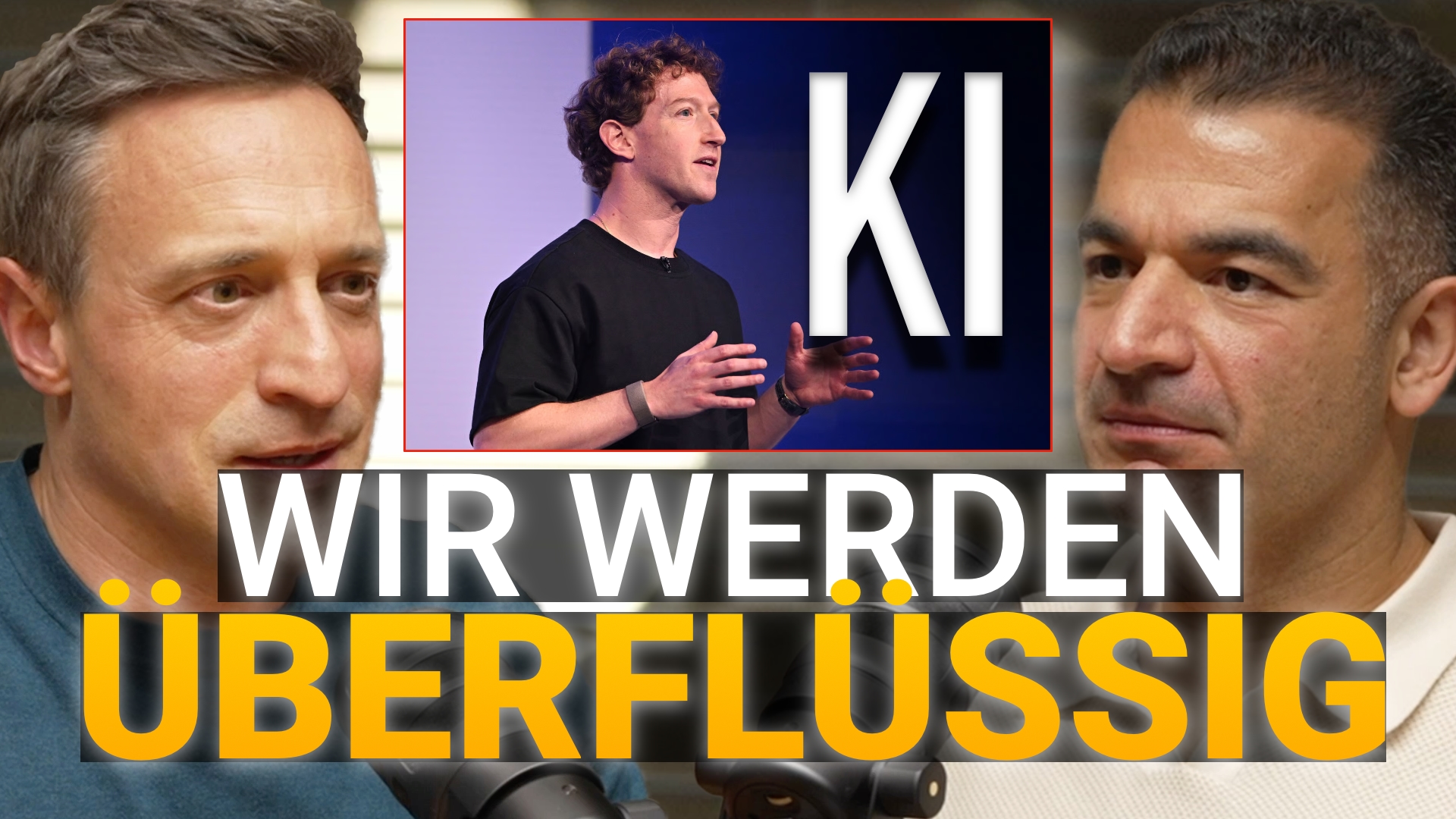

English translation of the complete original German article and transcript. The video retains its German audio. Reports, predictions and personal examples reflect the conversation at its original publication date.
AI and the Job Market: Summary
AI and the job market: Meta plans to lay off around 20 per cent of its employees, not because business is poor, but because AI development consumes enormous resources. Reza Mehman argues that AI is not replacing individual jobs but changing the entire structure on which society is built. Karsten Kammholz stresses that human intelligence has always developed and advocates public speaking, connected thinking and the ability to debate as key skills for the future. They discuss the danger of a society obedient to AI, where decisions are based on algorithms rather than intuition. They conclude by calling for a societal debate about how much power we want to give AI and which human abilities we must actively preserve.
AI, Meta and the Future of Work
AI and the job market face a historic turning point: Meta plans to lay off up to 20 per cent of its workforce, not out of financial distress, but because artificial intelligence demands resources previously allocated to people. In this podcast episode, Reza Mehman and Karsten Kammholz discuss the social consequences and ask whether AI is replacing not jobs but the structure of society itself. They examine which skills people still need in an AI-dominated workplace and the risks of blindly trusting AI. The discussion ranges from practical examples in podcast production to the provocative question of whether AI could govern Germany better than elected politicians. It is a conversation about creativity, the ability to put ideas into practice, constructive debate and who will still have work in the future.
Context
Who is speaking: Podcast host Reza Mehman and journalist Karsten Kammholz talk in an episode of the Reza Mehman podcast.
What this is about: The starting point is a media report that Meta is considering cutting around 15,000 to 16,000 jobs, not because business is poor but to free resources for AI development. This develops into a deeper debate about AI-driven structural change in the world of work.
Why it matters: One of the world’s largest technology companies choosing to lay off highly qualified employees in favour of AI investment signals that systemic change has already begun. The conversation makes clear that this goes far beyond efficiency and touches on what it means to be human.
Three central questions: Is AI replacing individual jobs or the entire structure on which society is built? Which abilities do people and their children need in a world increasingly directed by AI? How much power do we want to give AI, and what happens when we stop making our own decisions?
Contents
- Meta and AI investment at employees’ expense
- AI and automation: a historical pattern or something fundamentally new?
- Which skills do people need in an AI world?
- Expert knowledge as a commodity: what if knowledge loses its value?
- The podcast example: how AI changes creative professions
- Lee the videographer: from a three-person team to a one-person operation
- AI avatars and the future of podcasting
- The Airbus argument: technology creates more jobs than it destroys
- The idol hypothesis: AI as a new deity
- A society obedient to AI: what happens when we stop listening to our intuition?
- Google Maps and lost navigation skills: an everyday example
- What should we pass on to our children?
- Creativity and the ability to act as key skills
- Could AI replace the German government?
- ChatGPT makes mistakes: why human oversight remains essential
Themes and Context
AI and the job market: Meta’s layoff plans prompt a broad discussion about whether AI structurally changes work and therefore society itself, rather than simply eliminating individual positions.
Human abilities in the AI era: Both speakers ask which skills, from public speaking and constructive debate to creativity and implementation, will make people distinctive and valuable.
Trust in technology and social dependence: The conversation examines the risks of handing AI decision-making authority in more and more areas of life, from choosing partners to politics.
Generations and parenting: Reza and Karsten reflect on what they can give their children when the professions of the future do not yet exist.
Democracy and control over AI’s power: The provocative idea of an AI-run German government reveals the fundamentally political dimension of AI development.
Key Takeaways
AI does not merely replace individual jobs; it changes the entire structure on which society is built.
Meta is laying off 15,000 to 16,000 employees not for profitability reasons but because AI infrastructure demands resources previously allocated to people.
Humans increasingly become an accessory to a system whose primary purpose is to keep AI running, rather than the other way around.
Since ChatGPT, knowledge has become a commodity: the advantage of expert knowledge shrinks when almost everyone can access the same information.
The ability to debate and think across connections can distinguish humans from AI over the long term.
Creativity alone is not enough. What matters is the ability to act: actually putting ideas into practice.
The danger of a society obedient to AI is that people stop deciding intuitively and instead hand life decisions to AI.
AI makes mistakes. ChatGPT supplied incorrect data and subsequently justified it with sources that did not exist, making human oversight indispensable.
The jobs children will eventually enter do not exist today, so fundamental human abilities matter more than occupation-specific knowledge.
The Airbus A320 shows that technology outperforming humans can also create new professions and markets, but the speed of AI development is unprecedented.
Questions and Answers
Question: Why does Meta want to lay off 20 per cent of its employees? Answer: According to the report cited in the podcast, business is not the problem. AI infrastructure is so expensive that resources must be reallocated. People become a cost centre because of AI development’s capital requirements, not because of poor performance.
Question: Does AI replace individual jobs or the whole social structure? Answer: Reza Mehman argues that AI changes the entire structure on which society is built, not just jobs. Humans become an accessory to a system whose primary function is to keep AI running.
Question: Which abilities do people need in an AI-dominated workplace? Answer: Karsten Kammholz emphasises debate, connected thinking and public speaking. Reza adds creativity and implementation: developing ideas and actually putting them into practice.
Question: Does expert knowledge still have value in the AI era? Answer: Reza argues that knowledge has become a commodity since ChatGPT. He describes completing a trademark application himself with AI instead of a lawyer, saving several thousand euros.
Question: What should parents pass on to their children today? Answer: Karsten recommends interpersonal and communication skills, confidence, persuasiveness and connected thinking. Reza adds creativity and the courage to implement ideas, because the jobs children will eventually do do not yet exist.
Question: Could AI govern Germany better than people? Answer: Reza instinctively rejects this: he can assess a politician but not an AI. Karsten is cautiously optimistic that AI could contribute rational perspectives on some issues, but stresses the need for society to discuss how much power it wants to give AI.
Preserving Independent Thought
Question: What is the risk of a society obedient to AI? Answer: Karsten sees the greatest danger in people abandoning intuitive decisions and trusting AI with life questions, from relationships to how they live. Being human changes fundamentally when algorithms replace personal judgement.
Question: Why is human oversight indispensable? Answer: Reza gives a specific example of ChatGPT supplying incorrect information and subsequently supporting it with nonexistent sources. Karsten concludes that humans think in more interconnected ways than AI and will therefore always be needed for oversight.
Question: How does AI change creative professions such as podcasting? Answer: Reza describes tools that automatically extract podcast clips, add captions, rank them by potential virality and publish them, replacing work previously done manually by several people. He imagines AI avatars generating entire podcast episodes in five years.
Question: Does AI create more or fewer jobs overall? Answer: Karsten points to the historical pattern of technological leaps, such as calculators or the Airbus A320, creating more jobs over time than they destroyed. Reza stresses that AI’s speed is different this time and will hit new entrants and older workers particularly hard.
Highlight Quotes
“AI is not replacing jobs; it is replacing the entire structure on which society is built.”
“We need to teach people, young people, from school onwards, particularly public speaking and the ability to debate.”
“Humans as a cost centre have always existed. That is my spontaneous reaction.”
“I cannot recommend professions to my children because the jobs they will do do not exist today.”
“AI needs us so that it can become better and stronger.”
“If we abandon our intuition because we trust AI, I do not know whether that is good for us.”
“It is faster than us and will never again be as slow as it is today.”
“We become a society that is highly qualified and unemployed.”
“There are no sources for this, but I read this and that elsewhere, and from that I decided this was the most likely answer.”
“You will always discover that in some respects you think in more interconnected ways than AI.”
Keywords
AI and the job market, artificial intelligence and jobs, Meta AI layoffs, AI and society, AI structural change, expert knowledge and AI, ChatGPT errors, future professions, debate skills and AI, AI dependence, AI podcasting, workplace automation, AI and parenting, AI government, AI avatars, AI risks, ability to act, creativity and AI, human oversight, AI in Germany
Subtopics
Meta, layoffs and AI as a cost driver; AI displaces structures as well as work; expert knowledge as an outdated model; Lee the videographer and everyday podcast production; AI avatars and the future of podcasting; the Airbus argument and new professions; AI as a new deity and systemic change; a society obedient to AI when intuition falls silent; what we pass on to our children; creativity, implementation and fear of mistakes; could AI replace the German government?; ChatGPT lies and the indispensable role of human oversight.
Names and Terms
Karsten Kammholz, Reza Mehman, Meta, ChatGPT, AI (artificial intelligence), fly-by-wire, Airbus A320, OMR Festival, Philipp Westermeyer, DPMA (German Patent and Trade Mark Office), Google Maps, Nintendo Switch, WhatsApp, Cem Özdemir, Baden-Württemberg, quantum computers
A Passage to Quote
“AI is not replacing jobs; it is replacing the entire structure on which society is built.” Reza Mehman gets to the heart of it: while LinkedIn debates work–life balance, companies are already asking whether they still need people at all. Meta illustrates a systemic shift: the resource demands of AI infrastructure, rather than pressure on profitability, determine how many people a corporation employs. Karsten Kammholz adds: “It is faster than us and will never again be as slow as it is today.” Both agree that society urgently needs to discuss how much power it wants to give AI before that decision overtakes us.
Complete Transcript
Reza Mehman: Karsten, I am somewhat involved with AI, and I have to say hardly any subject frightens me more than our development, or the speed of development, around AI. I have built today’s podcast around an article I just read. Meta is considering laying off 20 per cent of its staff, not because business is poor but because artificial intelligence is so expensive that people suddenly become a cost centre. What does that mean for our working world? Are we at the beginning of a development much larger than Meta itself?
My argument today is this: we always talk about AI replacing jobs, but increasingly I feel it is replacing the entire structure on which society is built. Before I continue, perhaps you have an initial thought.
Karsten Kammholz: Humans as a cost centre have always existed. That is my spontaneous reaction. Staff reductions for various reasons have always existed too. Automation cost jobs, but new ones always emerged. That is now the interesting question for society: to what extent will AI destroy jobs and change entire organisations so that work as we knew it may no longer be done by people? If work remains, which work will people do? That is the fascinating social question of the future, and once again we are experiencing acceleration. Things are moving faster than we thought. We will see where we stand as a society in just two or three years.
The Questions Society Must Ask
Reza Mehman: One hundred per cent, and I think you are asking the right questions. But I am not sure society is discussing them. Looking at my LinkedIn feed, practically every second post debates work–life balance while companies ask whether they need people at all. Literally half the posts I see concern remote work, work–life balance and so on. I think: people, in three or four years perhaps most of us might not have jobs at all.
Karsten Kammholz: Some time ago I moderated an event with a labour-market researcher. He discussed the skills needed in a world where we must find our way through automation and AI. He said we need to teach young people from school onwards, particularly public speaking and the ability to debate. If AI handles much factual communication, such as instructions and guidance, or even carries out work itself, if it takes over things that previously required human communication, we must ask what human communication will look like in future. What strengths will people need?
Connected Thinking and Human Communication
His argument was that people must learn to think in more interconnected ways than before. They need to develop their rhetorical abilities enough to enter decision-making processes and challenge AI. They must be better at debate than AI, otherwise humans will always lose in the end. That really changes what it means to be human.
Reza Mehman: Absolutely, I agree. But I am not sure — and this may sound strange — whether that really is the skill we need. Let me give you an example. I always thought public speaking and communication were what remained for us humans. That would be the first thing I recommended to my children: speak well in front of people, present well, and so on. Things AI perhaps cannot yet do today.
Recently, partly because of the podcast, I have thought a lot about how podcasting itself will develop. As things stand, Lee has been with me since day one, my loyal companion in podcast production. He edits and records the episodes. About a year or a year and a half ago, we manually extracted clips together and added captions. It was a very long process. Now there are tools for it.
Automatic Video Clips in Everyday Podcasting
I told you about them: you simply paste the YouTube link, and the tool makes 30 captioned clips, even ranking them by virality. Sometimes what the AI tells me is actually right. They are then posted automatically. Previously I paid Lee for that. He edited them, processed them, sent them to me and I posted them. All of that has disappeared.
Karsten Kammholz: But Lee still works here, which I think is very nice.
Reza Mehman: Exactly, and I am very glad. But looking at the coming years: you can get good avatars that look like me, for example. I speak briefly into the system and it captures my voice too. I saw a training video. It still looked a little jerky, but you could almost think a person was talking to you. It speaks, moves, has some facial expressions and gestures, everything. Let that development continue for two or three years, or say five.
How Podcast Production Could Change
In five years, if I am still podcasting, I can imagine simply telling AI: today’s subject is A, B, C; my guest is Karsten. I want to corner him with my questions and so on. Generate it all, and at the end perhaps I will tell you whether it is good or bad. Use your priorities based on virality and edit it for me. In other words, two avatars talk to each other, having roughly worked out that if I say this it could go viral, and if he answers that it would be great. It is posted online, and we have a finished podcast.
That means I barely have a job as a podcaster, my videographer has no job, and many others around us — perhaps camera operators too — lose work because cameras may no longer be needed when everything is generated with chips and so on. All of that can happen, and it will. Mark my words.
Karsten Kammholz: Do you want to watch videos of avatars?
Reza Mehman: Not today.
Karsten Kammholz: Okay.
Reza Mehman: But you know how successful some AI influencers are on social media.
Human Connection and Digital Offerings
Karsten Kammholz: Yes, but they are not the majority yet, and I cannot imagine they will become the majority. People still want to see people. Perhaps that is precisely how we keep humans employed and visible in an AI world. Ten or twenty years ago, Lee might have come here with a sound engineer. He might then have gone to an editor and asked them to polish the video. Three people became one. Now you have just said that some of what Lee did a year ago can be done with software. But we still need Lee for fundamental things.
The good thing is that Lee is not stupid. He will think carefully about which niche to enter next, where he is irreplaceable, where he might advise people like you and me even better and convince us with his human qualities. We would then say what you do matters more to us than what AI offers. Human intelligence must develop too. It always has, including in the economy. I am optimistic enough to say: yes, many jobs will disappear, but perhaps many jobs will emerge that we cannot yet imagine.
New Roles for Service Providers
Reza Mehman: I see it differently. Lee is definitely intelligent; we agree on that. But here is where I differ: as an open question, how easy or difficult is it today for a 60-year-old to find a decent job? Easy or hard?
Karsten Kammholz: It depends on the industry. Overall, rather difficult.
Reza Mehman: Exactly. That is why I think this will continue. In future it will be difficult for 50-year-olds too. It will be difficult for biographers, software developers and many other people.
Karsten Kammholz: I agree. The best example is entering a profession. Some entry-level jobs are no longer really needed.
Reza Mehman: Exactly, that is my point. I am sure new jobs will emerge. I once heard that when calculators appeared, people thought many mathematicians would become unemployed. Not at all: there were even more jobs for mathematicians. Typewriters disappeared, replaced by computers. Many jobs vanished and naturally new ones emerged. Returning to the opening point, I find the headline interesting precisely because Meta is considering laying off 20 per cent of its staff when business is not bad. Until now, poor business or profitability was generally the reason for treating people as a cost factor and dismissing them.
Technological Change and New Professions
Karsten Kammholz: But that is not true. Technological and industrial development has always prompted companies to reconsider how many people they need.
Reza Mehman: Correct, but now they say AI development is so expensive, from energy infrastructure onwards, that they no longer want or can afford to employ these people. Perhaps they even need them. But they have to bet everything on being part of the AI world.
Karsten Kammholz: I would not fall for that Meta story, Reza. Twenty thousand employees, or what was it, 20 per cent?
Reza Mehman: It says 15,000 to 16,000 here.
Karsten Kammholz: Even fewer. Looking at Meta’s revenue and profits, 15,000 to 16,000 is really a drop in the ocean. That story is a lovely fairy tale for investors, but it does not reflect reality. Of course Meta could somehow carry those 15,000 to 16,000 people.
What the Layoff Figures Mean
Reza Mehman: But Karsten, my point is that 15,000 to 16,000 is an enormous number of people. I even have a very clever friend — I am not sure whether he is still at Meta — but many clever people work there. Those 15,000 to 16,000 may not be the very best there, but on average they are certainly highly educated, and they are being laid off. That is my point. They are not extreme low performers where you say there is no point keeping them. Getting into Meta is a different hurdle from getting into Deutsche Bahn, without that being… you understand what I mean.
Karsten Kammholz: I want to understand. Are you saying we become a society that is highly qualified and unemployed? Is that your scenario?
When Expert Knowledge Is Automated
Reza Mehman: That is the scenario I am pointing towards. Recently — I do not know whether we discussed it on the podcast — I wanted to register a trademark. Usually you go to a trademark lawyer for advice. I did it through AI: the application, the classes of goods, what should be included, all of it was created for me. I also checked with a friendly woman at the German Patent and Trade Mark Office: does this look right? Yes, perfect. I submitted it, all fine. Previously I would have needed an expert, a trademark lawyer, to tell me what to do. Perhaps it is only €2,000 to €3,000, but I saved it. I did not need that expert knowledge, and this runs through every profession.
Another example — I do not know whether it is cardiologists or another profession in that area — is reading X-rays. It is now quite clear that AI can evaluate such images much better than people. My mother had a case a year or two ago where she was asked whether she wanted her X-ray checked by AI as well, for €50. It was strongly recommended because AI tends to read X-rays better than a person. That means some of the highest-paid people have less to do. That is what I mean by structure.
Changing Qualifications
Karsten Kammholz: That is true. Of course you can say: oh God, highly paid and highly qualified people are suddenly out of work. Viewed soberly, they are no longer highly qualified because the world has changed. They now need different qualifications to find their place and find work again in a changed world where we live, work and think with AI.
Let me give you another example of why I do not want to join this chorus of panic. In the 1980s, an aircraft manufacturer called Airbus was relatively new. There was the A300 and the A310, serving a niche. Europe politically wanted an answer to the big manufacturers Boeing and McDonnell Douglas. Then engineers came up with the Airbus A320 and fly-by-wire. Suddenly they built an aircraft sending this message: dear pilot, we do not trust you; the aircraft is smarter than you. Looking back over decades of crashes, we know the biggest problem when an aircraft crashes is the pilot. So we will build a plane smarter than the pilot.
Automation in Aviation
That system prevailed. Did it ultimately cost pilot jobs? No. It revolutionised aviation, made it safer and further democratised it. More people fly than ever. Pilots are needed more than ever, despite an aircraft revolution declaring that the pilot was no longer the decisive element, but the software. That is one example of development.
Reza Mehman: In principle I agree. I am actually very enthusiastic about technology and normally optimistic about the future. What genuinely worries me is expert knowledge. Since ChatGPT at the latest, knowledge has effectively become a commodity. Knowing a little more than someone else no longer gives you much advantage. Of course interconnected knowledge matters, being able to connect A and B. But it is probably only a matter of time before AI becomes somewhat superior to us there too.
A Comparison With the OMR Festival
I need a completely different example to explain my concern. Do you know the OMR Festival in Hamburg? I went two or three years ago. The event is cool, I think, and so is Philipp Westermeyer. I met him and had a good conversation, gathering ideas for improving my own event. Really cool guy. Three years ago, I met a very interesting man at an event and we stayed in touch. I asked how he had liked OMR. He said: not at all.
I asked why, because I thought it was quite good. He said he had felt used: he was part of the event, which needed him to function, but the event was not there for him. It used him to make itself work.
Do AI Systems Learn From Us?
This may be a stretch, but let me apply that to AI. What I now read into the Meta headline is that AI needs us to become better and stronger. That headline captures it for me. We allocate infrastructure and capital and remove people, not for profitability, but simply because AI needs more resources. The human does not matter; AI needs it. I do not want to exaggerate, but perhaps we are heading towards a new deity, whatever that means. AI needs resources, so let us remove 20 per cent. Meta is only one example. If Meta does it, it will happen in Germany in five years, perhaps three. That is what I mean by systemic change.
It is no longer about how people work. Yes, we will always need plumbers, tradespeople, salespeople and so on. But increasingly I feel the system needs us merely as accessories so that it functions.
Karsten Kammholz: Fascinating thoughts. The religious dimension you introduce is not insignificant, because AI has an answer to everything. If you ask it, it directs you. People often make themselves small when dealing with AI, trusting it already on genuinely major life questions, perhaps in some respects more than another person.
Discussing AI in an Understandable Way
We must discuss that. This brings me back to my original argument: a society living with AI needs the ability to articulate and debate these things. We have not reached any consensus about it. Who are we as a society if we say AI is always part of it? We cannot yet answer that.
Reza Mehman: Exactly, but another problem is that we do not understand AI at all. I am completely convinced of that. About three years ago, I recorded a podcast with an excellent developer, a programmer and chief architect at a software company. I will not name him. Three years ago, ChatGPT was not yet prominent; you probably first heard about it two years ago. He said something interesting then: most of his developers did not know what was inside the algorithms because they used software libraries.
One library does this, another does that, but none of them knows exactly what is inside. There are algorithms, and most can no longer write their own. He told me that three years ago. Most do not understand exactly what is happening. I am sure that process has intensified. You want a society capable of discussing something when we no longer understand what we are discussing?
How Much Power Do We Give AI?
Karsten Kammholz: Yes, but I also want a discussion about how much power we formally give AI. That is not part of our debate at present. Sometimes I feel companies and people use AI almost secretly without admitting it. In some cases, solving something with AI is even regarded as a flaw.
Reza Mehman: That makes no sense. I am absolutely in favour of using it, and I understand your point. Especially in large companies, many pretend not to work with AI. When I work with someone and discover they do not use it, I ask: are you crazy? Of course you need to use it now; it is so much more efficient. It would be like me saying I will not have these podcast clips made with AI because I think I must do it myself. That is a small contradiction within me too.
On one hand, I have serious fears that we are creating a new deity and completely subordinating ourselves to it. On the other, I know I must use this new deity if I want to keep up with the competition.
The Future Role of Humans
Karsten Kammholz: That is why we must not forget the second part of the discussion: what will people do in future so society continues to function? What do we want to pay people for? Which services and abilities? That debate is arriving faster than expected. We will reconsider care work because care robots may soon exist on a large scale. Or is care delivered by people more important after all? How will we pay for that human care in future? We will have to keep reassessing other professions too. In that sense, society is being redrawn.
Reza Mehman: Is there anything about that which frightens you?
Karsten Kammholz: Yes. I fear we may eventually become a society completely obedient to AI, no longer acting intuitively and with human trust, but only doing what AI wants. If we abandon intuition because we trust AI, if we no longer say a gut decision mattered or we listened to our instincts, but instead that we listened to AI, I do not know whether that is good for us.
Reza Mehman: Fascinating question. In medicine, AI will probably be superior, for example with findings and diagnoses. If I had to decide as a patient, would I listen to the doctor’s gut decision, or should the doctor not…
Medical Experience and Digital Support
Karsten Kammholz: The doctor should not — I do not want a gut decision there either. I see the doctor as a scientific professional who makes the right decision through expertise. What I mean is human interaction, our social ethics and feelings. I can imagine a society where, for example, relationship decisions are no longer made with the heart. Instead we ask AI: should I be with this person? Should I give it a try? Let me tell you some of their attributes, dear AI. Do you think they suit me? If we cut off and switch off much of what makes us human and transfer it to AI, saying it will probably tell us everything correctly, then we have a problem.
Reza Mehman: I completely agree. On the other hand, it is surely normal that many abilities we once had are no longer there. As silly as it sounds, I was driving in another city recently and my phone’s GPS was not working properly. I had absolutely no sense of direction, not even the slightest idea what to do. Fortunately it started working again.
When Navigation Reaches Its Limits
Karsten Kammholz: Do you also feel something is wrong with Google Maps? I get directed into road closures, traffic jams and along routes I find absurd. Suddenly I realise that when I know the area, I say: no, Maps, forget it. I am not doing that nonsense you want; I will take another route.
Reza Mehman: Funny, Maps has been problematic for me in recent weeks too. Perhaps it is exactly what you say: make your own decision now and then.
Perhaps I am making too much of the Meta headline I read earlier. My reading was that slowly but surely we become accessories. It is no longer about us. Twenty per cent are laid off because AI needs it. That was the communication. We must not confuse that with profitability or anything else.
Karsten Kammholz: Yes, and Meta deliberately wants to send that message, because it claims dominance over the digital world and wants to control all our communication with one another. Meta already has enormous influence over all our lives. With such a decision it says that influence will grow further. WhatsApp, dear human…
Reza Mehman: Perhaps one of my last questions: what do you want to teach or recommend to your children?
Which Professions Will Remain in Demand?
Karsten Kammholz: We briefly discussed that beforehand. Which professions would I recommend to my children? I cannot recommend professions because the jobs they will do do not exist today. That is the truth. So what do I give them? Human skills, communication skills, confidence, principles, joy in life, the ability to approach people, be persuasive and think in interconnected ways. That is what I need to give my children today. I cannot control anything else. Over the coming decades, it will develop in ways I cannot begin to foresee.
And you? What do you give your children?
Reza Mehman: You made very valid points. I think about this a lot too. Children are extremely important to me because I naturally want to prepare them for the future as well as possible. One thing I believe will matter enormously is creativity: developing creative ideas and implementing them. Those two things. Of course I also want them to speak well and persuade others. But I think we are losing some of our ability to implement things. Many people have great ideas. You can train your idea-generating muscle well too. I heard another podcaster say he writes down 20 business ideas every day.
Creativity Can Be Practised
I tried it for a while, and you genuinely become more creative over time. With practice, you can come up with 20 new business models every day. I did it for a few weeks until it became boring. That is what I mean by developing ideas: it matters. Creativity matters, but so does implementation, including daring to do it.
Here is what I mean: I am almost at the point of running many emails through AI first to correct spelling and grammar. LinkedIn posts too, I freely admit. I provide the basic idea, adapt it a little, do a final check and publish. Simply writing and making a mistake, perhaps putting a comma in the wrong place, has become almost too daunting for me. I do not dare do it. Some of my ability to act independently has been lost. I do not know whether I would ever post without ChatGPT again. Preserving that ability to act matters to me, because losing a little here and a little there affects your whole life.
Putting Ideas Into Practice
One key point is therefore not just being creative but also implementing what you had in mind. I think that will increasingly separate people who only think about ideas from people who actually do something, make things and make mistakes. Today, especially in Germany, mistakes are frowned upon. Yet I think making mistakes is the most important thing. How many people put something into practice? I try to instil that in my children: try it.
My youngest had an idea a few days ago and wanted me to print something so he could make a Nintendo Switch out of cardboard. We must do it immediately: that is implementation. He has a creative idea; we put it into practice straight away. I want him to carry that forward. That is the one thing I definitely want to give my children.
Karsten Kammholz: Another thought about using AI for your posts: I think it is completely normal. Even there, with what you call the ability to act, you are using your intelligence. You see that you previously had to write everything yourself, whereas now AI can write it and you just check it. Nobody should feel uncomfortable about that.
How Tools Change Everyday Life
As you described it, I thought about how people used to prepare meat. At some point they began eating it, perhaps raw, which did not taste very good. Then they made it palatable over a campfire. Today you put it in a pan or microwave, without thinking you ought to build a campfire first and hang the meat over it. Nonsense, you no longer need to. In the same way, you can use your intelligence to identify what you no longer have to do yourself and consider what to do with that time instead. You can say: AI has made me more efficient, great, now I can think further.
Reza Mehman: But not many people will do that, Karsten.
Karsten Kammholz: Oh, some will.
Reza Mehman: We are currently debating social-media bans, doomscrolling and so on. I am convinced that, given how society is currently structured, many people will become consumers of content, particularly digital content, doomscrolling and so forth. That seems a real problem to me. I do not believe that when many jobs and tasks are taken off our hands, we will simply say: now I can think creatively.
Karsten Kammholz: I have a rather devious question. Suppose you replaced the entire German government with AI. Who would govern us better?
People in Positions of Responsibility
Reza Mehman: Honestly, that is a very interesting question. My gut says there still has to be a person there, because I can assess a human better than AI. Thinking it through: we just had the state election in Baden-Württemberg. I can probably assess Cem Özdemir a little, what kind of person he is. Honestly, I cannot assess the AI we use today at all. I also do not know what it may already be capable of at another level I cannot access. When we have quantum computers, everything will escalate completely in terms of speed too.
Purely on a human level, I would rather live in an environment where I can assess the person opposite me. As things stand, that still means a human. So today I would be inclined not to replace the government with AI. What would you do?
Rational Decisions and Their Limits
Karsten Kammholz: On some issues, I would like AI at least to examine the economy and society very rationally and contribute ideas politicians might not have. I am extremely cautious. But I ask for another reason: we must become capable of discussing AI, because the question is not that outrageous. Could you govern a state with AI? It is not absurd. That is why we must consider what kind of society we want to work in with AI and how much power to give it. It is faster than us, always faster than us, and will never again be as slow as it is today.
Reza Mehman: Perhaps a closing thought on exactly that. Recently I had AI create something, did not check it or research further, then later discovered with other people that the data was wrong. I returned to the same ChatGPT conversation and asked: you gave me these answers, please give me the sources. I wanted to see how it reacted to the false information it had supplied. It showed “thinking longer”, as it sometimes does, then said: there are no sources for this, but I read this and that elsewhere, and from that I decided this was the most likely answer.
Why Human Judgement Still Matters
Karsten Kammholz: And it was wrong. That is why people will always be needed. Always. You will always discover that in some respects you think in more interconnected ways than AI. There will therefore always be jobs where people work with AI but provide the oversight, because humans currently think in more interconnected ways.
Reza Mehman: We will have to see what it looks like in ten or twenty years. I am one hundred per cent certain we can no longer see that far ahead today.
Karsten Kammholz: We cannot even predict the next two years.
Reza Mehman: Saying it will remain exciting would be an understatement. It will be more than interesting in my view. Perhaps I am giving the Meta headline too much weight, but I thought it worth mentioning that humans are being completely subordinated. That was definitely worth discussing. Karsten, thank you for your time.
Karsten Kammholz: Thank you, Reza.
Watch episode 176 on YouTube. For another perspective, see my conversation with Christoph Zöller about AI and jobs.

