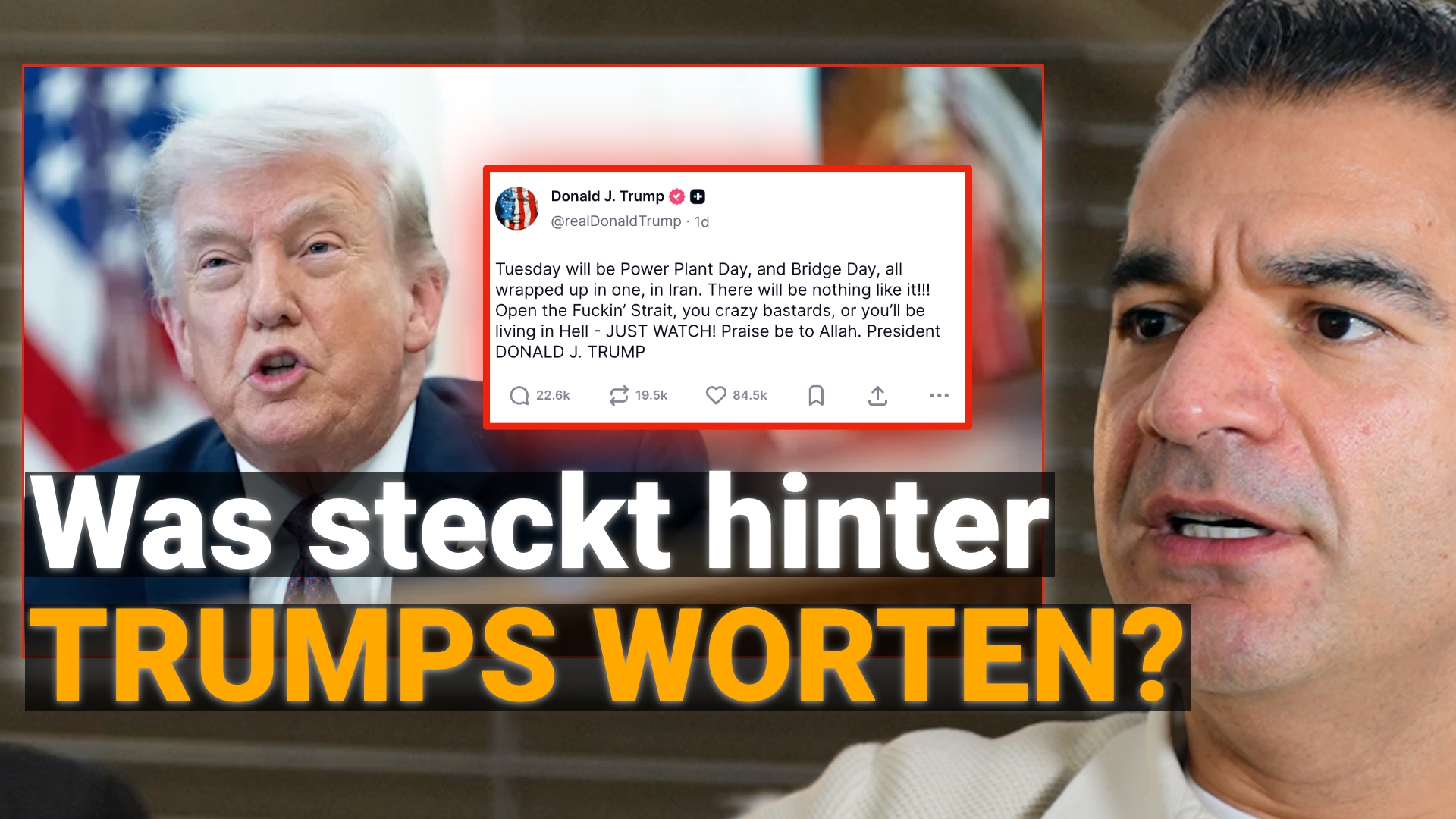

English translation of the complete German article and transcript. The video is in German; this commentary reflects Reza Mehman’s perspective when recorded on 6 April 2026.
A shocking Truth Social post: Reza Mehman explains why he believes Trump’s threat against Iran is calculated.
Trump Threatens Iran: My Perspective
Trump’s threat against Iran on Truth Social is attracting worldwide attention. The US president announced that Tuesday would be both “Power Plant Day” and “Bridge Day” in Iran. His post ended with the words “praise be to Allah”. Reza Mehman takes a closer look at this unusual post and explains why, despite its provocative language, he is convinced it reflects a calculated strategy. Propaganda plays a central role in the ongoing conflict between the US and Iran, and Reza shows how both sides use it. He also considers whether the Iranian population needs outside help, drawing a historical comparison with the end of the Second World War. The podcast was recorded on Monday, 6 April, one day before Trump’s own ultimatum.
Summary
One-sentence version: Reza Mehman analyses Trump’s provocative Truth Social post against Iran and explains why he sees it as calculated propaganda rather than madness.
Three-sentence version: Trump published a post on Truth Social threatening Iran with the destruction of power stations and bridges, ending with “praise be to Allah”. Reza Mehman is convinced that, despite the extreme language, Trump follows a clear strategy and deliberately cultivates an image of unpredictability. Reza also reflects on his own position on the Iran conflict and explains why he considers external support for the Iranian population necessary.
Five-sentence version: Donald Trump published a post on his Truth Social platform with unprecedented language: he threatens Iran with the destruction of power stations and bridges and writes “praise be to Allah”. Reza Mehman analyses the post and concludes that Trump calculates very carefully what he says, strategically deploying the image of a madman. He examines the propaganda machines on both sides of the conflict. His own comment sections contain what he believes are mullah-regime bots. Reza also asks whether the Iranian population can free itself from the regime and concludes that it cannot, given the strength of the IRGC. Finally, he draws a historical parallel with the liberation of Europe in 1945. Personally, he does not care who brings help to the Iranian people, as long as it arrives.
Context: Who, What and Why
Who is speaking: Reza Mehman, a podcaster, entrepreneur and event organiser with Iranian roots who regularly comments on German and international political issues.
What it is about: A Truth Social post by Donald Trump in which he threatens Iran with the destruction of power stations and bridges and ends with “praise be to Allah”. Reza places the post in a geopolitical context and shares his personal position on the Iran conflict.
Why it matters: The conflict between the US and Iran is intensifying, propaganda from both sides is increasing, and Trump’s language is unprecedented in the history of the American presidency. The podcast was recorded one day before Trump’s self-imposed ultimatum.
Three key questions answered:
- What is behind Trump’s shocking Truth Social post against Iran?
- Can the Iranian population free itself from the mullah regime?
- How does Reza Mehman view outside intervention in the Iran conflict?
Contents
- Introduction — An overview of Trump’s threat and this episode’s perspective
- Summary — The content in one, three and five sentences
- Context — Who is speaking, what it is about and why it matters now
- Topics and Context — The conversation’s main themes and keywords
- Key Takeaways — Reza’s central arguments
- Frequently Asked Questions — Answers to the main questions
- Selected Quotes — Standout statements from the episode
- The Full Conversation — The complete transcript with subheadings
Topics and Context
1. Trump’s Communication Strategy and Propaganda
Trump deliberately plays the unpredictable figure to put pressure on Iran. In Reza’s view, his Truth Social post forms part of a calculated propaganda strategy.
Keywords: Trump propaganda, Truth Social post, psychological warfare
2. The US–Iran Conflict and the Strait of Hormuz
Trump’s focus on the Strait of Hormuz allows him to connect his military course with the international community’s economic interests.
Keywords: US–Iran war, Strait of Hormuz, global oil supply
3. Propaganda on Both Sides
Both the US and the mullah regime actively use propaganda, including social-media bots and staged videos from command centres.
Keywords: mullah-regime propaganda, Iranian social-media bots, information warfare
4. The Iranian Diaspora and the Mullah Regime
Reza considers why Iranians fled after the revolution of 1979 and challenges arguments made by exiled Iranians who defend the regime.
Keywords: Iranian diaspora, Islamic Revolution of 1979, fleeing Iran
5. External Support for the Iranian People
Reza draws a comparison with the liberation of Europe in 1945 and explains why he considers outside help necessary for the Iranian population.
Keywords: liberation of Iran, IRGC power, Richard von Weizsäcker 8 May
Key Takeaways
- Trump’s Truth Social post against Iran uses unprecedented language, but Reza sees calculated strategy in it rather than mere madness.
- Both sides actively use propaganda in the war between the US and Iran, including social-media bots and staged videos by the mullah regime.
- Trump deliberately uses the image of unpredictability to put maximum pressure on Iran.
- Trump’s emphasis on the Strait of Hormuz is intended to give the war an economic justification in the eyes of the international community.
- The IRGC is so heavily armed and well connected that an unarmed Iranian population has no chance of overthrowing the regime on its own.
- Reza argues that the Iranian diaspora emerged after the Islamic Revolution of 1979, rather than under the Shah, and sees this as a decisive argument against defenders of the mullah regime.
- Reza draws a parallel with the liberation of Europe in 1945 and says that sometimes a population needs help from outside.
- Trump is not acting for humanitarian reasons; he is pursuing his own interests, which do not always align with those of the Iranian population.
- Reza stresses that he does not welcome war, but considers outside help necessary for the Iranian people, regardless of who provides it.
- The words “praise be to Allah” in Trump’s post surprised Reza personally, because he had not previously seen Trump mention Allah.
Frequently Asked Questions
What did Trump write about Iran on Truth Social?
Trump wrote on Truth Social that Tuesday would be both “Power Plant Day” and “Bridge Day” in Iran. He called on Iran to open the Strait of Hormuz, threatened life in “hell” and ended the post with “praise be to Allah, President Donald J. Trump”.
Does Reza Mehman believe Trump is really mad?
No. Reza is convinced that, although Trump appears unpredictable, he calculates very carefully what he says. He uses the madman image strategically to build maximum pressure and signal that he is prepared to do anything.
Why does Trump mention the Strait of Hormuz?
The episode argues that the US itself does not obtain oil through the Strait of Hormuz. Many NATO partners, however, depend on it. Trump uses this argument to give his actions an economic and global justification that goes beyond purely American interests.
Can the Iranian population overthrow the mullah regime itself?
Reza does not believe so. The IRGC is heavily armed, deeply embedded in society and has been authorised to act independently in a crisis. An unarmed population has no real chance against that power structure.
Why does Reza date the Iranian diaspora to after 1979 rather than the Shah’s rule?
Reza observes that all the Iranians he personally knows fled after the Islamic Revolution of 1979, rather than under the Shah. For him, this clearly indicates that life in Iran was no longer worth living after the revolution. In his view, people might have emigrated under the Shah, but they did not flee.
Does Reza Mehman support the US war against Iran?
No. Reza does not want war, in Iran or anywhere else. But he says that he considers outside help necessary for the Iranian population if it cannot liberate itself, regardless of who provides that help.
What historical comparison does Reza Mehman draw?
Reza compares the situation with the liberation of Europe and Germany in 1945, when the US and the Soviet Union intervened from outside. He refers to Richard von Weizsäcker’s statement that 8 May 1945 also marked the liberation of the German population.
What does “Allah” mean in Trump’s post?
Allah is the Arabic word for God. Reza was surprised that Trump used this term because he had not previously seen him mention it in his posts. Reza sees it as part of the propaganda strategy.
How does Reza respond to accusations that he welcomes the war against Iran?
He firmly rejects those accusations. Reza stresses that he is fundamentally against war, but recognises the reality: if the Iranian population needs outside help, that help must come, regardless of who provides it.
What is the IRGC and what role does it play in Iran?
The IRGC, or Islamic Revolutionary Guard Corps, is a military and para-state organisation in Iran. It is heavily armed, deeply rooted in Iranian society and, according to Reza, has been instructed to make independent decisions in a crisis, even if the command centre is no longer functioning.
Selected Quotes
“We all know by now that Donald Trump is unpredictable and perhaps a little crazy.” — Reza Mehman
“He will probably try to come across as a madman, even if he is crazy. But he also wants to reinforce that image publicly and show that he is prepared to do anything.” — Reza Mehman
“I do not believe an unarmed Iranian population has any chance of standing up in any way to the IRGC, the military or the clerics.” — Reza Mehman
“If the Iranian population needs help from outside, I do not care at all who does it, whether it is Trump or someone else. But if help is needed, then that is how it has to be.” — Reza Mehman
“That idea of ‘we are fleeing Iran’ came after the Islamic Revolution, and for me that is the decisive argument against anyone I speak to here who says that the mullah regime is actually a wonderful regime.” — Reza Mehman
“I am fully aware that Trump is not doing this because we have wonderful saffron rice with joojeh kebab and koobideh. I am one hundred per cent certain that is not the reason.” — Reza Mehman
The Full Conversation
Trump’s Truth Social Post and Reza’s Reaction
Reza Mehman:
We all know by now that Donald Trump is unpredictable and perhaps a little crazy. But the language he is currently using in his latest post on his Truth Social platform goes beyond anything we have seen.
He writes: “Tuesday will be Power Plant Day in Bridge Day, all wrapped up in one in Iran, there will be nothing like it, open the ******* straight, you crazy ********, or you’ll be living in hell, just watch, praise to be Allah.” President Donald J. Trump.
Let me briefly translate that into German: Tuesday will be both Power Plant Day and Bridge Day in Iran, all in one. There has never been anything like it. Open the damn strait, you crazy bastards, or you will be living in hell, just you wait. Praise be to Allah. President Donald J. Trump.
In my view, that is very, very unusual wording. I have never read anything where he mentions Allah. Allah is Arabic for God, and the fact that he wrote it that way really surprised me.
Calculated Propaganda or Genuine Madness?
Reza Mehman:
On the other hand, I am one hundred per cent certain that the US president is pursuing some sort of strategy here. Negative comments about this keep appearing on my social media. This is why I say that:
The US and Iran are currently at war. That means propaganda is definitely being spread, from all sides. I even notice it on a small scale in my own comment sections, for example on Instagram and Facebook. Very strange, confused comments appear that say something in favour of the mullah regime, and they all somehow look the same. I can already see that these are not normal people; there are bots at work.
And I also see the mullah regime itself publishing videos. For example, I recently saw a video in which one of — I think — Khamenei’s sons walks into some administrative centre or command centre where nuclear facilities and so on are controlled, with military personnel standing there. They then show something along the lines of, “We will defend our country”, and so on. That is propaganda too, and unfortunately it really is normal in wartime.
In my view, what the US president is doing here is also propaganda. He will probably try to come across as a madman, even if he is crazy. But he also wants to reinforce that image publicly and show that he is prepared to do anything.
The Strait of Hormuz and Trump’s Argument
Reza Mehman:
Overall, as an outsider, what is happening at the moment naturally makes little sense. At the very beginning, he said the Strait of Hormuz was not important to him at all because he did not get any oil from it. In other words, the US did not get any oil from the Strait of Hormuz; only its NATO partners needed it. Now, suddenly, everything important somehow revolves around the Strait of Hormuz.
I am not entirely sure why he is now focusing on it so much. It is probably something that the world or the economy has more understanding for. If the Strait of Hormuz is opened, that is easier and better for the global economy. Perhaps he wants to draw attention to this to give the war he is conducting a little more justification. It would go beyond the interests he wants to pursue himself.
Does the Iranian Population Need External Help?
Reza Mehman:
In one of the last podcast episodes, I also said that the Iranian population needs support, and personally I do not care who provides it. The main thing is that the Iranian population gets rid of this unjust regime and can somehow live in freedom again.
I do not believe that the Iranian people can free themselves from the constraints currently imposed on them. The IRGC is armed to the teeth. It is so well connected within the population, and its members have now also been told that they can make decisions on their own authority. If, for example, the command centre is no longer available, they can genuinely make independent decisions. I do not believe an unarmed Iranian population has any chance of standing up in any way to the IRGC, the military or the clerics.
Responding to Criticism: No War, but Help When Needed
Reza Mehman:
In one comment, I was also accused of not thinking about the Iranian people and of welcoming this war, so to speak. That is not true at all. Of course I do not want war — actually, I do not want war anywhere in the world.
All I said was that if the Iranian population needs outside help, I do not care at all who provides it, whether it is Trump or someone else. But if help is needed, then that is how it has to be.
I can also give an example here. I think Germany in 1945, or Europe, needed help from outside. It needed the US and, at the time, the Soviets to intervene in some way. Otherwise, we would have a very different Europe and a very different Germany today. Help is sometimes needed from outside when a population requires that support. It was not for nothing that the former German federal president, Weizsäcker, once said that what happened back then also liberated the German population. I see clear parallels here as well.
Reza’s Position on External Support
So I do not care at all who does it, whether that is Trump or someone else. I think support is needed. And of course I am not so naive as to believe that Trump is an absolute humanitarian doing this purely out of goodwill. I am fully aware that Trump is not doing this because we have wonderful saffron rice with joojeh kebab and koobideh. Of that, I am one hundred per cent certain. I am fully aware that interests are being pursued, perhaps ones none of us fully knows. Naturally, those interests do not always align with the interests of the Iranian population.
Exiled Iranians and the Decisive Argument of Flight
Reza Mehman:
Because lately I have noticed here and there, especially in conversations with exiled Iranians, that some surprisingly support the mullah regime. It has been truly mind-blowing to realise who I am actually speaking to.
When people, Iranians, support the mullah regime and say, “Hey, it is all wonderful, the old Shah was a catastrophe, and the mullahs are the only ones who can help the region”, and so on, I ask a question: why did you flee, or, if the person is younger, why did your parents flee back then? And above all, when did they flee? Did they flee under the Shah, or after the revolution?
Consistently — and I know many Iranians in Germany — I personally do not know a single Iranian who fled under the Shah. All the Iranians I know fled after the revolution. That raises a valid question: why did no one flee under the Shah, and why do people flee now? Why is there an Iranian diaspora that began after 1979? It is crystal clear: apparently life in Iran is no longer worth living. That is why people flee, and that is also why they receive asylum when they flee Iran and arrive in another country.
Flight and Personal Family History
Under the Shah, people emigrated because, for example, they no longer wanted to live there. But no one fled. I remember my grandfather telling me that he wanted to have an operation in Germany, a medical operation. He left Iran normally — this was still under the Shah — had the operation here and flew back again, with the costs covered and so on. Everything was fine. The thought did not occur to him to use the opportunity of the operation to flee Iran.
No, that idea of “we are fleeing Iran” came after the Islamic Revolution. For me, that is the decisive argument against anyone I speak to here who says that the mullah regime is actually a wonderful regime. Yes, but why do so many people flee, then? Why do you live here rather than in Iran? Why do you take to the streets here for the mullah regime rather than in Iran? I could make that argument just as well.
Conclusion and Outlook: Tuesday as the Moment of Truth
Reza Mehman:
I have taken a slight detour there. In today’s podcast episode, this was my main point: I think Trump is a madman. Nevertheless, I believe he calculates very, very carefully what he says.
Today’s podcast was recorded on Monday, 6 April. That means we are one day before the ultimatum Donald J. Trump issued. He wrote, “Tuesday will be the Power Plant Day and the Bridge Day.” I am curious to see what he will do. I will follow the news very closely. And with that, thank you for listening. Until next time. Bye, bye, bye, bye.
Watch episode 181 on YouTube. You can find additional clips and references in my collection of sources on Iran.