
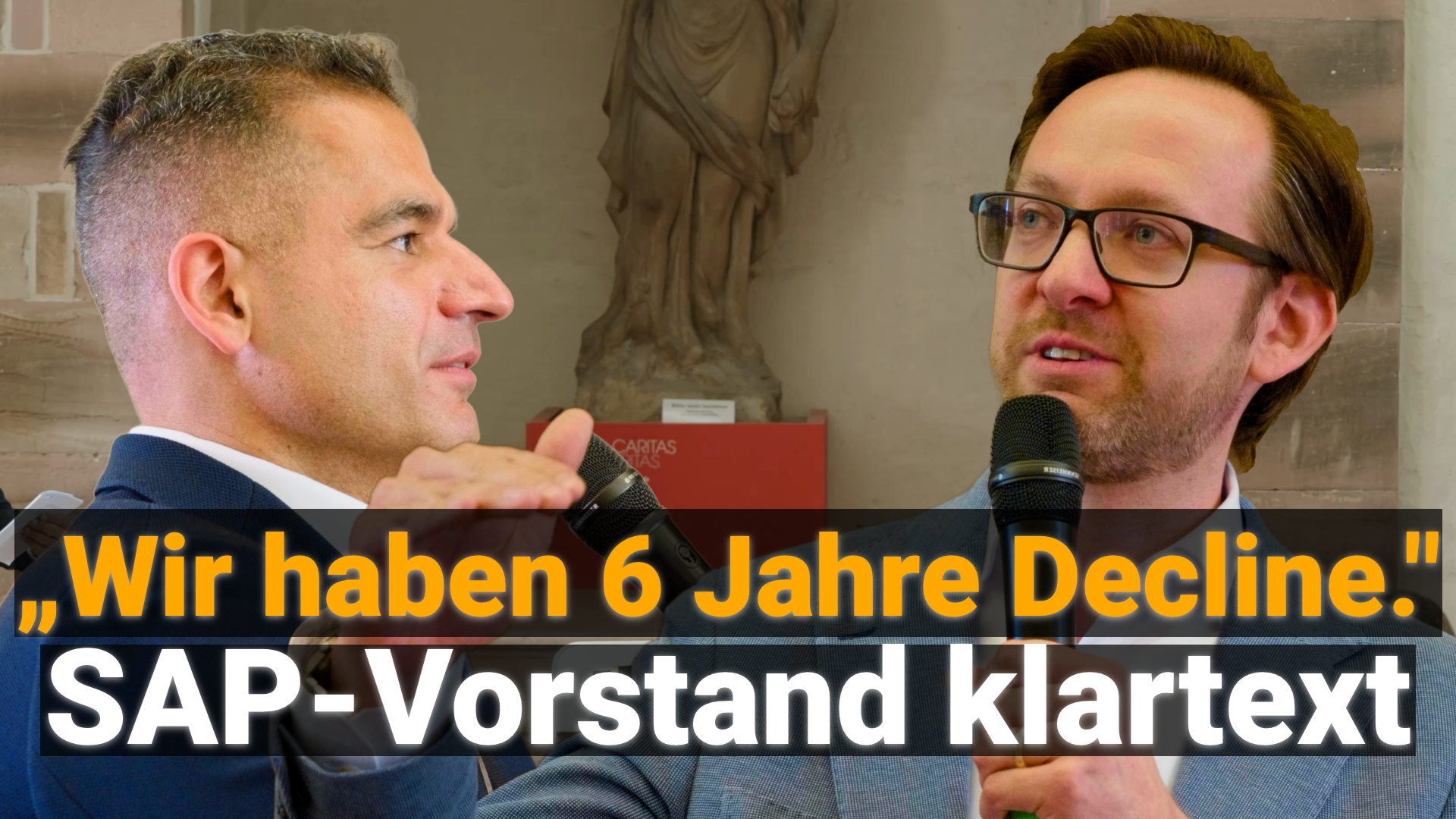

Thomas Saueressig, Christine Rittner and Aline Moser in a frank panel discussion at Dinner im Schloss 2026.
There are moments on stage when a panel shifts from a friendly exchange into a serious assessment of the situation. The fifth Dinner im Schloss at Heidelberg Castle produced one of those moments.
I was on stage with three people who put into words what many others only sense:
- Thomas Saueressig, member of SAP’s Executive Board
- Christine Rittner, former Lidl board member, now an investor and supervisory board member
- Aline Moser, adviser to Heidelberg’s mayor with responsibility for innovation
What began as a discussion about Germany as a place to do business became, within minutes, the most honest assessment I had moderated in a long time. Three statements stayed with me. They frame everything said that evening.
“We are not living in uncertain times. It is extremely certain.”
Thomas Saueressig had been in Davos at the beginning of the year. He came back with a clear diagnosis rather than a vague impression: the world we all grew up in no longer exists. Globalisation works differently. Multilateral coordination works differently. There are currently 66 conflicts running in parallel around the world.
Then came the sentence that silenced the room:
“Germany has been in economic decline for six years.” — Thomas Saueressig, SAP Executive Board member
Saueressig’s calculation was sober. Of the official growth forecast of 0.5 per cent, he attributed 0.3 percentage points to two public holidays falling on weekends and one percentage point to government investment. Organic growth, in his assessment, tends towards zero.
That was the diagnosis. Then came the demand: Germany’s business model must change. And not through compromises.
“If we have no economic growth for six consecutive years and want to maintain our prosperity, that will be a balancing act that hurts. We also need to communicate honestly about that.” — Thomas Saueressig, SAP Executive Board member
That is an unusual statement from a corporate board member, particularly in such direct terms.
“This is not simply a difference. It is a completely different league.”
Christine Rittner knows both worlds. Twenty years at Lidl, many of them at board level. Today, she invests in start-ups, sits on supervisory boards and works with others to build an ecosystem in the region.
Her message to the room had two parts.
Part one: the numbers
Germany invests around 8 to 10 billion euros in start-ups each year. In the US, the figure is 180 to 220 billion. That is not merely a multiple. It is a different world.
The difficult part is that the founding stage still works reasonably well in Germany. There are business angels, MVPs and initial investments. But when a start-up needs to grow from thirty employees to three hundred, or from a national player into an international one, the money moves west. Often, the company follows.
Part two: the appeal
Rittner spent twenty years in a corporation without working with a single start-up. Today, she wonders: what might have been possible?
“Corporations should work more with start-ups. They need each other to become more innovative and faster.” — Christine Rittner, investor and supervisory board member
Corporations are not speedboats, however much they might like to be. They are steamships. Start-ups are the opposite. Both need each other, and too rarely recognise it.
“Twenty-seven requests for sovereign clouds. How can I achieve scale if I divide it twenty-seven ways?”
At this point, Saueressig became specific. And uncomfortable for Brussels.
The European Union likes to point to its 450 million citizens. That is true. What it lacks is a unified economic space and a unified digital space. Instead, there are twenty-seven member states with their own interpretations, authorities and special approaches.
For a company such as SAP, that means:
- Eighteen different data protection commissioners in Germany alone, interpreting the GDPR differently
- Three overlapping regulatory frameworks that partly contradict each other: the EU AI Act, the EU Data Act and the GDPR
- Twenty-seven national requests for “sovereign clouds”
Saueressig gave the example of a contract with BASF, twenty kilometres from SAP. Two companies in the same federal state and economic area. The contract took six months longer because the two companies’ data protection officers could not agree on a common interpretation of European data protection law.
This is more than an anecdote. It is about the conditions for doing business.
“We are on the sunny side of life here.”
Aline Moser brought the municipal perspective into the room. As an adviser to Heidelberg’s mayor, she works at the heart of the city administration and is deeply connected to the region’s innovation community. She also introduced a term I have not been able to forget: Sandbox City.
Heidelberg consciously chose that approach years ago. Innovations are tested in the city, not merely discussed in PowerPoint presentations. Aleph Alpha was one such moment, long before ChatGPT existed. A founder arrived with an idea. The city said: try it out here.
Today, the focus includes teledriving, large language models in public administration and innovation partnerships with Tallinn. The city sees itself as a sparring partner, rather than purely as an authority that issues permits.
And it needs that approach. Heidelberg has 90 million euros less available across its two-year budget. Not because of new expenditure, but because federal grants are disappearing and business-tax revenues are falling. At that point, it becomes clear: social policy, education and culture only function when the economy functions.
Moser’s answer is Sunny Valley. Launched a year ago, this regional initiative aims to build an international start-up ecosystem with a long-term vision of two hundred start-ups in the metropolitan region. It is an invitation to help shape things, rather than a government funding programme. Academia, corporations, medium-sized businesses, investors and the city, all at one table.
Heidelberg is twinned with Palo Alto. That is no coincidence. It reflects an attitude.
AI as an accelerator rather than an apocalypse
One of the panel’s most interesting turns came when I asked Saueressig directly about the much-discussed “SaaS apocalypse”: the theory that artificial intelligence will dismantle traditional software corporations in the coming years.
His answer was calm, structured and not defensive.
SAP has 440,000 customers worldwide. They use SAP software to produce aircraft, shoes, cars and chemicals. The software runs in 160 country versions and 65 languages, incorporating local regulations. It is not a nice-to-have. It is the foundation on which these businesses operate.
And that is where his point about AI comes in:
“AI is based on data. Where is that data generated and stored? In business systems. To build high-quality AI scenarios and agents, I need the business context.” — Thomas Saueressig, SAP Executive Board member
For SAP, that means the economy’s most valuable data sits where business-critical processes run. That is exactly where SAP operates. AI therefore becomes a multiplier rather than a threat. The latest quarterly figures—27 per cent cloud growth and 25 per cent backlog growth to 22 billion euros—were his argument to the market.
You do not have to share that view. But it follows a different logic from the usual stock-market panic.
The sentence that stayed with me
At the end, I asked Saueressig the question I had not wanted to ask at the start: what have we not done so well in Germany recently?
His answer framed the entire panel.
“In Germany, we sometimes underestimate ourselves given the capabilities we have.” — Thomas Saueressig, SAP Executive Board member
Stable Diffusion, the software behind the majority of AI-generated images worldwide, was developed by Professor Ommer at LMU Munich. Black Forest Labs in Freiburg generates images circulating on X and Grok. Aleph Alpha comes from Heidelberg. SAP comes from Walldorf.
The capabilities are there. What is missing is confidence.
If I had to sum up that evening in one thought, this would be it. Germany’s economy does not have a talent problem. It has a self-image problem. And unlike a fall in GDP, that is something we can tackle ourselves.
What you can take away
Three observations have stayed with me since that evening:
- The diagnosis has reached board level. When an SAP board member speaks of “six years of decline”, it is not talk-show rhetoric. It is an assessment of the results.
- The capital exists. It is simply not being activated. Christine Rittner’s main focus is not “more money”, but better conditions for business angels, investment grants and the ability to offset losses. Policy adjustments, not miracles.
- The regional level is an underestimated source of change. Heidelberg, Tallinn and the Sunny Valley initiative are not symbolic projects. They are sandboxes where new ideas can be tested in practice before they fail.
Frequently asked questions
How does SAP board member Thomas Saueressig assess Germany’s economy in 2026?
According to Saueressig, Germany has been in economic decline for six years. He attributes much of the official 0.5 per cent growth forecast to two public holidays falling on weekends, contributing 0.3 percentage points, and government investment, contributing one percentage point. In his assessment, there is effectively no organic economic growth.
How large is the funding gap between German and US start-ups?
According to Christine Rittner, Germany invests around 8 to 10 billion euros in start-ups annually. The figures cited during the panel put US investment at around 180 to 220 billion. As a result, the scaling phase of German start-ups often moves to the United States.
What does SAP criticise about EU regulation?
Saueressig points to eighteen data protection commissioners in Germany with different interpretations of European data protection law, overlapping frameworks such as the EU AI Act, EU Data Act and GDPR, and twenty-seven fragmented national cloud requests. He argues that this creates a major scaling problem in the European single market.
What does SAP say about the so-called SaaS apocalypse caused by artificial intelligence?
SAP sees AI as an accelerator rather than a threat. High-quality AI applications and agents need business data and process context, both of which sit in SAP systems. The company therefore expects AI to strengthen its position in the long term. Recent cloud growth of 27 per cent and a backlog of 22 billion euros support that position.
What is Heidelberg’s Sunny Valley initiative?
Sunny Valley is a regional start-up initiative launched around a year ago in the Rhine-Neckar metropolitan region. It aims to build an international ecosystem with a long-term vision of around two hundred start-ups, supported by the city, academia, businesses, investors and medium-sized companies.
What does Sandbox City mean in Heidelberg?
Aline Moser, adviser to Heidelberg’s mayor, describes the city as a Sandbox City where innovations such as teledriving, AI applications and large language models are tested under real conditions. The city sees itself as an innovation partner that provides test areas and enables prototyping.
What is Dinner im Schloss?
Dinner im Schloss is an annual premium networking event at Heidelberg Castle, organised by Reza Mehman. The fifth edition took place on 28 April 2026 and brought together people from business, politics, academia and society. The sixth edition is planned for 27 April 2027.
Listen, reflect and join us
The full episode is being released this week on the Reza Mehman Podcast, on YouTube and wherever you listen to podcasts.
If you would like to attend the sixth Dinner im Schloss on 27 April 2027, early-bird tickets have recently become available on the Dinner im Schloss website.
If you enjoyed this article, subscribe to the newsletter, share it and let me know in the comments what surprised you most about the panel.
See you next week.
Reza
Tags: SAP, Thomas Saueressig, Christine Rittner, Aline Moser, Dinner im Schloss, German economy 2026, AI disruption, start-up ecosystem, EU regulation, digital sovereignty, Heidelberg, Sunny Valley, Germany as a business location, venture capital, Reza Mehman Podcast

