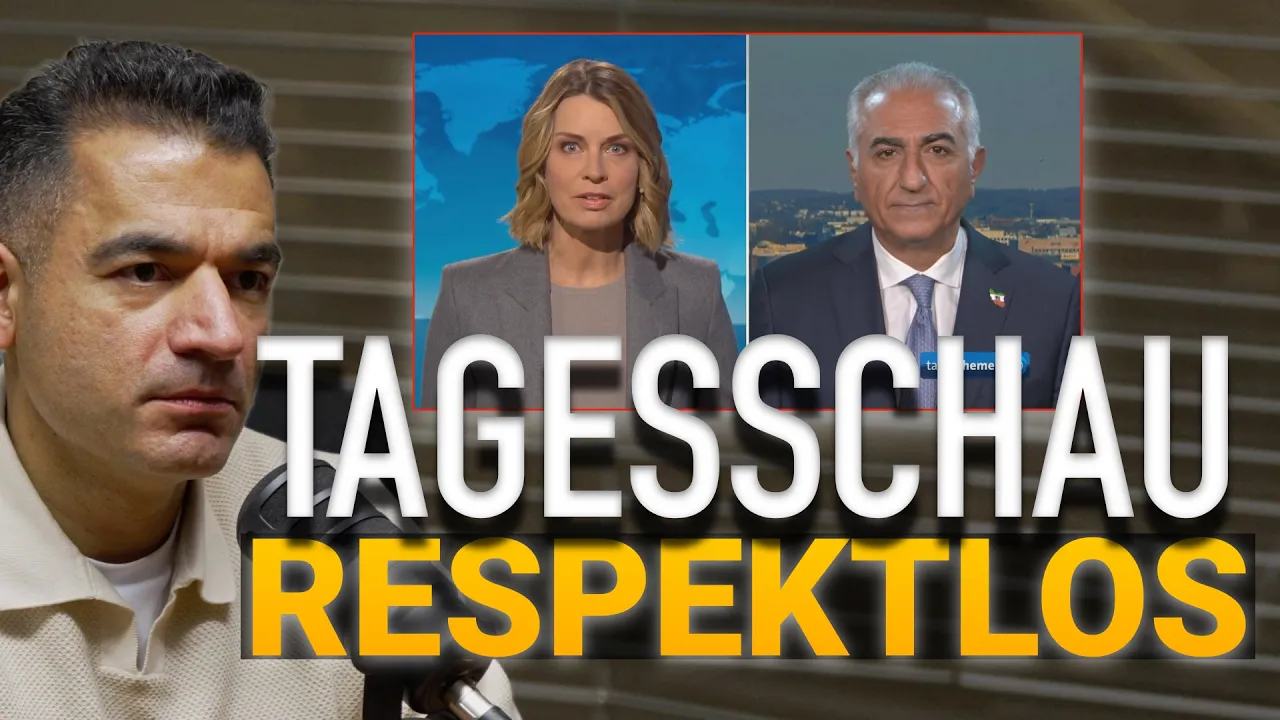

Tagesschau’s interview with Reza Pahlavi: how ARD interviewed the son of Iran’s last Shah, and why Reza Mehman questions its framing.
The original episode is in German. This is the complete English translation of the article and edited transcript. The media criticism and political assessments are Reza Mehman’s views at the time of the original publication.
Tagesschau’s interview with Reza Pahlavi: the discussion
Tagesschau’s interview with Reza Pahlavi, the son of Iran’s last Shah, generated an enormous response on social media. In this podcast episode, Reza Mehman analyses the journalist’s interviewing style and criticises its framing. Specifically, he questions leading questions that he believes imply Pahlavi shares responsibility for deaths during protests in Iran. He also asks why the current mullah regime receives so little attention. Mehman puts the situation into context and explains why he perceives the coverage as biased. The role of public-service media and their duty to report neutrally are also discussed. The episode offers a differentiated analysis that considers both sides.
Summary
One-sentence version: Reza Mehman criticises Tagesschau’s interview with Pahlavi as biased and heavily framed, because the current Iranian regime receives little attention while Pahlavi faces leading questions.
Three-sentence version: In this episode, Mehman analyses the viral Tagesschau interview with Pahlavi and explains why he considers the interviewing style biased and disrespectful. In his reading, the journalist suggested Pahlavi shared responsibility for deaths during Iranian protests and ignored his broad support worldwide. Mehman calls for neutral public-service reporting with a stronger focus on the current mullah regime.
Five-sentence version: Mehman discusses a Tagesschau interview with Pahlavi, the son of Iran’s last Shah, that went viral on social media. He criticises three central questions as leading and biased: attributing responsibility for protest deaths, asserting a lack of evidence of support, and asking Pahlavi to distance himself from his father’s style of government. Mehman argues that the current mullah regime barely featured while a negative frame was built around Pahlavi. He stresses that nobody should be forced to distance themselves from their parents simply because others demand it. He concludes by calling for neutral, fact-based public-service reporting without framing.
Context: who, what and why
Who is speaking: Reza Mehman, a podcaster and content creator born in Iran who has lived in Germany since the age of two. He analyses a Tagesschau interview with Reza Pahlavi, son of the last Iranian Shah, Mohammad Reza Pahlavi.
What it is about: A critical analysis of ARD/Tagesschau’s interview with Pahlavi. Mehman challenges its framing, leading questions and lack of context about the current Iranian regime.
Why it matters: Iran’s situation is highly topical at the time of the discussion. Protests, killings by the regime and the search for a political alternative concern millions worldwide. Public-service coverage faces particular criticism.
Three central questions:
- Why does Mehman find Tagesschau’s interview with Pahlavi problematic?
- What role does framing play in public-service coverage of Iran?
- What should public-service media do differently?
Contents
- Introduction — an overview of the discussion and criticism
- Summary — three concise versions
- Context — who is speaking, the subject and its relevance
- Themes and context — the main areas of discussion
- Key points — the central arguments
- Frequently asked questions
- Highlights in quotes — striking statements from the episode
- The full conversation — edited transcript with subheadings
- Keywords — relevant search terms
- Names and terms — a directory of important references
- A passage to quote
Themes and context
1. Media framing and criticism of journalism
An analysis of the Tagesschau journalist’s interviewing style, particularly leading questions and what Mehman sees as a biased portrayal of Pahlavi.
Keywords: Tagesschau framing, criticism of journalism, leading questions, ARD coverage
2. Iran’s protests and political opposition
The current situation in Iran, the protest movement and Pahlavi’s role as a potential political actor and agent of change.
Keywords: Iran protests, Reza Pahlavi, mullah regime, Iranian opposition
3. Public-service media and neutrality
Criticism of the funding and coverage of German public-service media, especially the demand for neutral reporting free of framing.
Keywords: public-service media, broadcasting fee, neutral reporting, criticism of ARD
4. Guilt by association and political prejudice
Whether a person should be held responsible for their parents’ actions, illustrated through Pahlavi and a comparison with German history.
Keywords: inherited guilt, political prejudice, distancing from parents, responsibility across generations
Key points
- In Mehman’s view, the interview used leading questions and problematic framing that implied Pahlavi shared responsibility for deaths during Iranian protests.
- Mehman challenges the journalist’s statement about a lack of evidence of the extent of Pahlavi’s support, pointing to videos and large demonstrations.
- He argues that the current mullah regime received little attention, despite its responsibility for killings and repression.
- Nobody should be forced to distance themselves from their parents simply because others demand it.
- Mehman cites around €10 billion in public-service broadcasting revenue and argues that it should fund neutral reporting without framing.
- Pahlavi describes himself as a “change agent” who wants to lead Iran towards democracy.
- The episode cites estimates of between 150,000 and 250,000 Iranians demonstrating for Pahlavi in Munich around the Security Conference.
- Critical journalism matters, but critical questions differ from disrespectful or biased ones.
- Mehman argues that viewers seeking a particular editorial slant can choose private broadcasters; public-service outlets should report neutrally.
Frequently asked questions
What criticism was made of Tagesschau’s interview with Pahlavi?
The main criticism concerned questions that Mehman considered leading and that he believes implied Pahlavi shared responsibility for protest deaths. He also criticised the limited attention paid to the current mullah regime and the journalist’s statement about a lack of evidence concerning popular support for Pahlavi.
Who is Reza Pahlavi?
Pahlavi is the son of Iran’s last Shah, Mohammad Reza Pahlavi. He lives in exile and advocates democratic change in Iran. He describes himself as a “change agent” who wants to lead Iran towards democracy.
What does criticism of ARD’s framing refer to?
Critics argue that the interview implicitly portrayed the last Shah as a tyrant and cast his son in a negative light through leading questions, without adequately addressing historical context or the brutality of the current regime.
How many people demonstrated for Pahlavi in Munich?
The episode cites various estimates of between 150,000 and 250,000 Iranians demonstrating for Pahlavi after the Munich Security Conference.
What does Mehman want from public-service media?
He calls for neutral reporting without framing. He argues that citizens pay a broadcasting fee and can expect an unbiased presentation in return. Anyone wanting a particular slant can choose private broadcasters.
Why does he find the question about distancing from Pahlavi’s father problematic?
Mehman argues that nobody should have to distance themselves from their parents simply because others demand it. He draws a comparison with German history: one would not assume a German person was just like their grandparents merely because those grandparents might have been implicated in National Socialism.
Does Pahlavi want to become Shah?
According to the interview as discussed in the episode, Pahlavi primarily wants to act as a “change agent” and lead Iran towards democracy. He would accept being king if that were what the people wanted, but his stated aim is democratisation.
Highlights in quotes
“It can hardly get worse than the current regime.” — Reza Mehman
“Now the journalist is acting as though Pahlavi is to blame for so many people being killed in Iran. To me that is crazy, a disrespectful attribution of blame.” — Reza Mehman
“Sharing someone’s ancestry does not mean you think the same way, behave the same way or have exactly the same characteristics.” — Reza Mehman
“If I have to pay a fee, I at least want neutral reporting.” — Reza Mehman
“The one task they truly must fulfil, and fulfil well, is to provide neutral reporting without framing.” — Reza Mehman
“I understand that journalists have to be critical, but there is a difference between critical questions and disrespectful or biased ones.” — Reza Mehman
The full conversation
Introduction: the current situation in Iran
Reza Mehman:
Because of the current situation in Iran, I am naturally discussing Iran, the current conflicts and attempts at revolution more often on this podcast. Something that surprised me on social media was this clip going viral. Let me play it briefly.
Clip (Reza Mehman):
Isn’t it crazy that the son of the last Shah says, “I want to go back”? Here is someone saying he wants to return, and something unbelievable happens here. Tagesschau spoke with the son of the Shah, with Reza Shah. I found it astonishing that ARD even used framing: your father, the last Shah, was essentially a dictator, a reign of terror, and so on. I thought: what kind of framing is this? It may be so, but I do not see it as extremely as it was presented, as a reign of terror, because I also hear the other side saying it was not like that.
I hear both sides, but the way Tagesschau presented it was also so rude towards Pahlavi. However harsh this sounds, I do not say to a native German: because your grandfather was probably in the SS, you are just the same and think like your great-grandfather. I do not use framing like that, and I found that inference outrageous.
Reactions on social media
Reza Mehman:
I will return to the Tagesschau scenes shortly. As always on social media, there are many voices for and against. What surprises me is that hardly anyone discussed how terrible the current mullah regime is compared with the former Shah or potentially with Pahlavi.
Most responses focused on how Pahlavi would become a terrible tyrant and everything would be awful. I ask myself: people, if we look specifically at the present situation, surely it can hardly get worse than the current regime.
First question: responsibility for protest deaths
Reza Mehman:
My comments in that clip refer to a Tagesschau interview in which the presenter interviewed Pahlavi, the son of the last Iranian Shah. A journalist I had not known before—I looked at her account afterwards—then commented: “Journalism has to be polite. I’ll remember that. Thanks for the advice.” Honestly, I find such sarcasm completely inappropriate in so critical a situation.
Nevertheless, I want to revisit the interview briefly to clarify why I considered it a very poor interview and its framing really unsatisfactory. Let’s play the first scene, where the journalist asks her opening question.
Journalist (Tagesschau):
“Reza Pahlavi, thank you for being our guest. Tens of thousands took to the streets, thousands of people were killed during the protests. You fueled those protests, some of the people called your name. How do you handle this responsibility?”
Reza Mehman:
Let me repeat what she asked: “Thousands of people were killed during the protests, you fueled those protests, some of the people called your name, how do you handle this responsibility?” In German: thousands were killed during the protests; you fuelled those protests; some people called your name. How do you deal with that responsibility?
Reza’s criticism of the attribution of blame
Now the journalist is acting as though Pahlavi is to blame for so many people being killed in Iran. To me that is crazy, a disrespectful attribution of blame. The current regime did that. To say that protesters called his name and thereby suggest he is responsible because he incited them to act is absolutely inappropriate in my view.
Second question: a lack of evidence of support
Journalist (Tagesschau):
“For some, you’re seen as a beacon of hope, but with all respect, there in fact there is no proof of how many people really support you. So what makes you more than a self-proclaimed future leader?”
Reza Mehman:
I will repeat the critical part: “For some, you’re seen as a beacon of hope, but with all respect, there in fact there is no proof of how many people really support you. So, what makes you more than a self-proclaimed future leader?” I will translate that into German: some see you as a beacon of hope, but with all respect, there is so far no proof of how many people actually support you. What makes you more than a self-appointed future leader?
I live in or near Heidelberg, and even here there are small protests and groups calling Pahlavi’s name. A few days ago we saw the huge Munich demonstration and rally. Different figures circulate: estimates range from 150,000 to as many as 250,000 Iranians demonstrating, where Pahlavi spoke after the Munich Security Conference.
I do not understand a journalist acting as though nobody supports Pahlavi. I have seen it myself, and I think ARD should have seen it too. There are countless videos from inside and outside Iran. As far as I can judge, these are not fake videos depicting invented crowds chanting his name. There are countless videos of protesters and other people calling his name.
The question of evidence for support
So I wonder how she arrives at: “There is no proof of how many people actually support you.” That statement, that there is no evidence. Perhaps look at the streets in Germany, the United States and Iran, look at the video footage we have, and see whether that is sufficient evidence.
Third question: distancing from his father
Journalist (Tagesschau):
“You have critics who fear that upon a possible return to Iran, you will aim at forming perhaps a new autocracy, possibly a new Pahlavi dynasty. So in what respect do you distance yourself from your father’s way of governing?”
Reza Mehman:
Let me repeat: “Let me ask you, you have critics who fear that after a possible return to Iran, you will aim at forming perhaps a new autocracy, possibly a new Pahlavi dynasty. So in what respect do you distance yourself from your father’s way of governing?” In German: critics fear that after returning to Iran you might seek to establish a new autocracy, perhaps a new Pahlavi dynasty. In what way do you distance yourself from your father’s style of government?
That generated a substantial media response. I read discussions on X and Reddit. They all centred on the journalist’s perceived bias towards Pahlavi.
Guilt by association: the comparison with German history
Reza Mehman:
What surprised me most in this context, as I said in the viral clip, is this: being the child, son or daughter of your parents does not mean you have to distance yourself from them simply because someone else wants you to.
As I said in the clip, I was born in Iran and have lived in Germany since I was two. I feel Iranian and German, and I initially approach every German positively. My approach is not to say: hold on, your grandparents were probably connected with or worked within the Nazi regime. Until you distance yourself, I will assume you are just like them.
I do not do that, and nobody should. Sharing someone’s ancestry does not mean you think the same way, behave the same way or have the same characteristics as your parents. I do not understand demanding that somebody distance themselves as an expression of good journalism.
Summing up the criticisms
Reza Mehman:
I understand that journalists have to be critical. But I tried to summarise why I think this journalist did a poor job:
Number one: I saw outright bias and leading questions.
My second point is that, personally, I found the way the questions were asked very disrespectful.
Number three: ignoring context and focusing on one side. By that I mean the negative aspects, for example. She implicitly labelled his father a tyrant without including the context of that time or of today.
To me, it showed unprofessional preparation. There is readily available evidence online of large crowds chanting his name. To act as though there is no evidence, and explicitly say so during an interview, was unacceptable in my view.
Positive aspects and distinctions
Reza Mehman:
I also want to say a few positive things about the journalist, to show this is not just one-sided criticism. I do think journalism includes asking critical and challenging questions. But we must distinguish those from disrespectful or biased questions.
I also absolutely believe Pahlavi can be perceived as controversial. His father was the last Shah; that Shah was overthrown and left the country. Anyone familiar with Iranian history knows the background. Nevertheless, even if the son is controversial, you should approach him without prejudice.
The current regime and Pahlavi’s aims
Reza Mehman:
What I found worst was that hardly a word was said about the current regime: how terrible it is and how much Pahlavi wants to help. He says in the interview that if people want him as king, he will do it. But he wants to be a “change agent”, as he calls it, to lead Iran towards a form of democracy.
Criticism of public-service media
Reza Mehman:
To conclude, I do think public-service broadcasters have a reason to exist. But I think we pay far too much. According to my latest research, they took in €10 billion. That is more than the gross domestic product of some small countries.
In my view, apart from all the pointless Instagram channels they run and so on, the one task they truly must fulfil, and fulfil well, is to provide neutral reporting without framing.
If I want framing or reporting leaning towards a particular camp, I can choose private broadcasters and listen or watch there. But if I have to pay a fee, I at least want neutral reporting, perhaps also with more focus on what could help people now, improve their situation and stop the murders and killings.
With that, thank you for listening. Until next time. Bye-bye.
Keywords
Tags: Tagesschau interview Reza Pahlavi, ARD framing Iran, Reza Pahlavi Shah, Iran protests, mullah regime, criticism of public-service media, broadcasting fee, neutral reporting, journalism criticism, leading questions Tagesschau, Reza Pahlavi democracy, Munich Security Conference Iran, Iran revolution, inherited guilt in politics, change agent Iran, who is Reza Pahlavi, why is Reza Pahlavi criticised, what does Reza Pahlavi want, how neutral is Tagesschau
Names and terms
Reza Mehman, Reza Pahlavi, Mohammad Reza Pahlavi, Shah, Iran, Tagesschau, ARD, mullah regime, Munich Security Conference, Heidelberg, change agent, autocracy, Pahlavi dynasty, broadcasting fee, public-service media, framing, guilt by association, Iran protest movement
A passage to quote
In his analysis of Tagesschau’s interview with Pahlavi, podcaster Reza Mehman criticises ARD’s journalistic framing as biased and disrespectful.
He particularly challenges what he sees as an implicit attribution of blame for protest deaths and the assertion that there is no evidence of Pahlavi’s support.
Mehman points to demonstrations attended by up to 250,000 people and numerous videos as counter-evidence.
He calls for neutral public-service reporting without framing, especially given the €10 billion in broadcasting revenue he cites.
At the same time, he emphasises that critical journalism matters, while distinguishing critical questions from biased ones.
Watch Episode 164 on YouTube. Find more conversations and background in my collection on Iran.