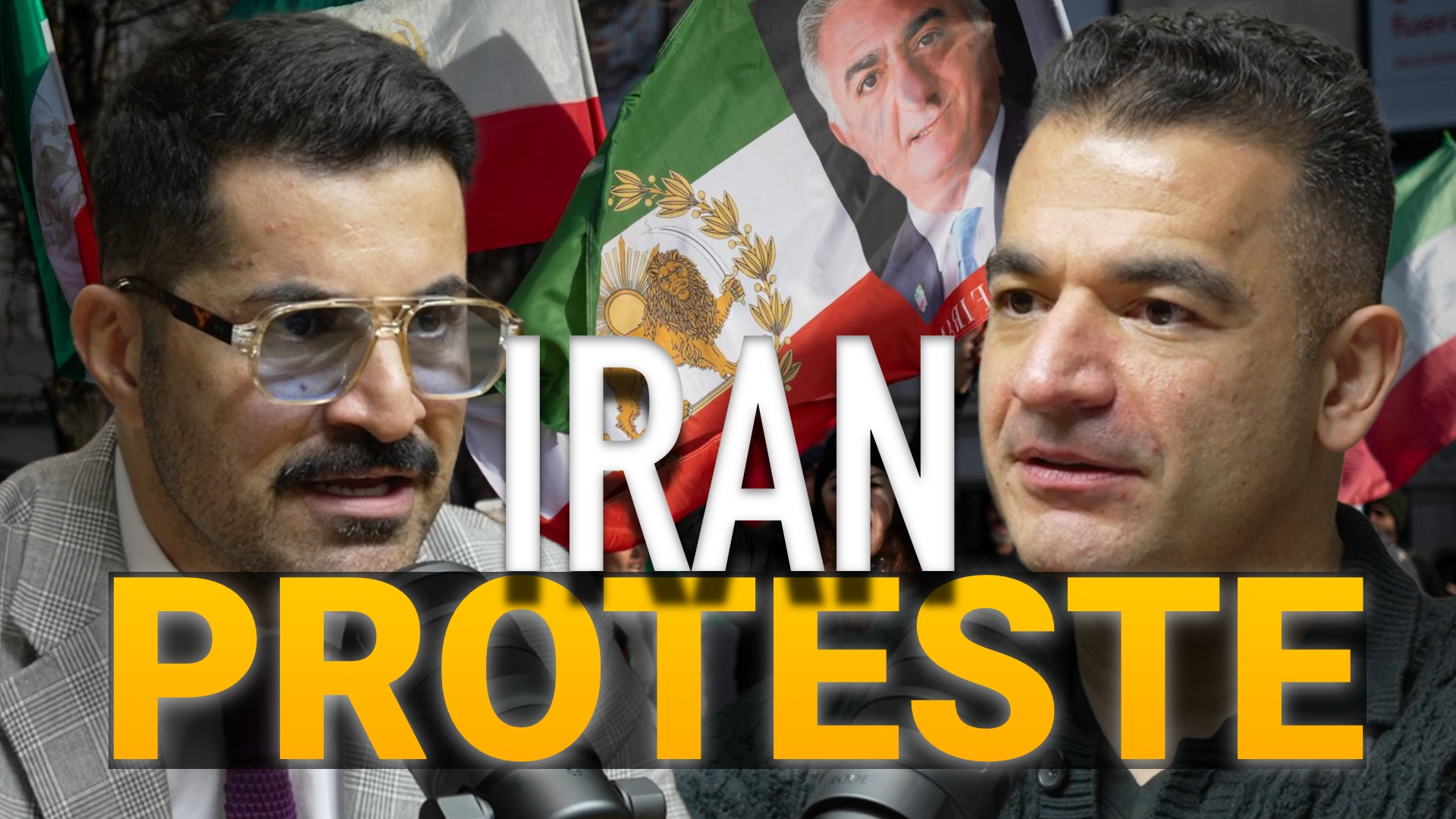

This is the complete English translation of the original article and edited German transcript. The conversation was recorded on 26 February 2026. Predictions, figures, historical assertions and political assessments reflect the speakers’ views at that time; they are not updates on subsequent events. Some names and the references to 2025 are retained from the original text.
Reza Shari in conversation: summary
Reza Shari, the owner of a well-known beauty salon in Mannheim, recounts being arrested at the airport during a business trip to Iran and imprisoned in Ward 209 of Evin Prison, the ward for political prisoners. He says a confession video was recorded under torture and deliberately used to intimidate the Iranian diaspora. After being released on bail and sentenced to more than four years in prison, he fled across the mountains to Turkey with his brother. Back in Germany, he has become a full-time activist, organising five buses to the large Munich demonstration attended by around 250,000 people, and is now planning emotional-support meetings for diaspora Iranians struggling with their mental health. He is convinced that the Iranian regime will collapse economically and politically, and regards Reza Pahlavi as the only logical leader for a transition to democracy.
A brief introduction
Reza Shari is no stranger to the public: the Mannheim entrepreneur and activist describes being arrested during a trip to Iran, tortured in Ward 209 of Evin Prison and eventually escaping across the mountains to Turkey. In this conversation with podcast host Reza Mehman, he shares his personal story, explains why he sees Reza Pahlavi as the only realistic leader and why, in his assessment, the Iranian regime cannot survive more than three months. The conversation touches on central questions about the Iranian diaspora, the role of the United States and Israel, and Persian civilisation as an indestructible force. It is a candid, emotional and politically revealing conversation between two Iranians who both support regime change.
Context
Who is speaking: Reza Mehman, podcast host, and Reza Shari, an entrepreneur and Iran activist from Mannheim.
What it is about: Reza Shari’s personal experience as a political prisoner in Iran, the current revolutionary movement, the role of Reza Pahlavi, and whether and when the Iranian regime will fall.
Why it matters: The conversation combines personal testimony with political analysis and gives a concrete, authentic voice to the Iranian diaspora’s perspective at a moment of historically heightened tensions in Iran.
Three central questions:
- What is the first-hand experience of arrest, torture and escape from Iran?
- Is Reza Pahlavi the right leader for a democratic fresh start in Iran?
- How long can the Iranian regime survive economic isolation and growing popular protests?
Contents
- Introduction and the participants
- Reza Shari’s arrest and imprisonment in Evin Prison, Ward 209
- Systematic torture and a confession video as an intimidation strategy
- Escape across the mountains to Turkey
- Attacks on the Mannheim beauty salon and victim protection
- The strength of the movement: from Mahsa Amini to the 2025 revolution
- Reza Pahlavi: leader, crown prince, democrat
- Opposition: the Mojahedin, regime trolls and public-service media
- The United States, Israel and the dollar as a weapon
- Persian civilisation as an indestructible force
- Returning home: the diaspora’s plan
- Emotional support for the diaspora and the psychological burden of activism
- Closing remarks and outlook
Main themes
1. Personal persecution and political imprisonment. Reza Shari describes his arrest at Tehran airport, conditions in Ward 209 of Evin Prison, and the psychological and physical consequences of torture.
2. The revolutionary movement and diaspora activism. The conversation explores how the diaspora becomes a voice for people facing oppression in Iran, why the participants regard the Munich demonstration of 250,000 people as a historic turning point, and how activists such as Reza Shari organise the movement.
3. Reza Pahlavi and Iran’s political future. Both participants discuss at length why they regard Reza Pahlavi, as crown prince and a democratically educated figure, as the only realistic leader for the transition, and challenge common objections.
4. Geopolitics: the United States, Israel and the regime’s economic collapse. Reza Shari explains why he sees the US dollar as America’s most important weapon, considers a military attack likely, and believes the regime cannot survive economically for much longer.
5. Persian identity, civilisation and pride in one’s roots. The conversation culminates in a powerful reflection on Persian civilisation, the historic bond with Israel since Cyrus the Great, and the difference between the Iranian people and the Islamic regime.
Key points from the conversation
- Shari says he was betrayed before entering Iran, immediately arrested and held in Ward 209 of Evin Prison, the ward for political prisoners.
- He describes the regime’s targeted arrests of diaspora activists and use of confession videos to spread fear in the exile community and suppress protests.
- The participants describe the Munich demonstration, with around 250,000 participants, as the largest Iranian exile demonstration in history, substantially exceeding Berlin’s 2022 Mahsa Amini demonstration.
- In Shari’s view, Reza Pahlavi is the only legitimate and realistic leader for a transition to democracy: he cites Pahlavi’s education in democratic institutions, lack of personal ambition for power and international network.
- Shari estimates that pressure from the US dollar, sanctions and shrinking resources will make the regime economically unsustainable within less than three months.
- Both participants view Persian civilisation, with poets such as Hafez, Saadi and Ferdowsi, as indestructible and believe it will ultimately overcome Islamist ideology.
- They believe large numbers of Iranians in exile want to return once the regime falls, partly because Europe offers less security and freedom than they had hoped.
- They describe Iranian–Israeli ties as having historical roots reaching back to Cyrus the Great: a cultural reality rather than political calculation.
- Diaspora activists see themselves as the voice of victims in Iran who cannot speak publicly, rather than as agitators.
- The psychological strain on the diaspora is immense; Shari is therefore planning emotional-support meetings in Mannheim’s Luisenpark.
Questions and answers
Question: Why was Reza Shari arrested in Iran? Answer: Shari was active in the Mahsa Amini movement and had publicly criticised Islam as a cult-like ideology. He believes someone in Germany betrayed him. He says the regime was already waiting at the airport when he arrived.
Question: What is Ward 209 in Evin Prison? Answer: The original article describes Ward 209 as the high-security section of Tehran’s Evin Prison used exclusively for political prisoners. According to Shari, people held there rarely get out and systematic torture is part of everyday life.
Question: How did Reza Shari leave Iran? Answer: He says his uncle bribed a judge to secure his release on bail. After receiving a sentence of four years and seven months, he fled across the mountains to Turkey with his brother, assisted by people smugglers, immediately before he was due to begin serving it.
Question: Why do both participants regard Reza Pahlavi as the only logical leader? Answer: They cite his education in elite democratic institutions, his training as a fighter pilot, his stated wish to lead people to the ballot box rather than govern himself, and his exceptional international network. They point to people inside Iran calling for him and see no comparable alternative.
Question: What role do the United States and Israel play in possible regime change? Answer: Shari regards the US dollar and economic sanctions as the most effective weapon. He believes military intervention would accelerate the process, considers an Israeli attack likely and sees the historic bond between Iran and Israel as a natural basis for future cooperation.
Questions about demonstrations and international support
Question: Why are Israeli flags visible at Iranian demonstrations? Answer: The original article describes deep historical ties between Iran and Israel, referring to Cyrus the Great freeing the Jews from Babylonian captivity. It also claims that Iran under the Shah had the world’s second-largest Jewish community and the most synagogues outside Israel; these historical assertions are reproduced here as claims from the source, not independently verified facts. The article argues that the Islamic regime, rather than the Iranian people, severed the relationship.
Question: How long can the Iranian regime survive? Answer: Shari estimates no more than three months on economic grounds alone. He describes the rial as practically worthless, inflation as historically high and oil exports as blocked, while militias and the state apparatus still have to be paid.
Question: What does the diaspora actually do for the revolutionary movement? Answer: It sees itself as the voice of people facing oppression in Iran. Shari and his team organised five buses to the Munich demonstration, receive hundreds of messages of thanks from Iran, and are planning support meetings for diaspora Iranians under psychological strain.
Question: Why are the windows of Shari’s salon being smashed? Answer: Shari blames people without a democratic mindset for the three attacks, without naming a specific group. He says he is under victim protection and has spoken to authorities, but cannot disclose details for legal reasons.
Question: Will Iranians in exile return after regime change? Answer: Shari is convinced that around 80 per cent will return out of love for their homeland and because, in his view, growing Islamisation and restrictions on freedom of expression make Europe less attractive. He already has concrete plans for a charter flight.
Highlights in quotes
“When brains stop working, people pick up stones.”
“I was in a death cell. My teeth were all gone, broken off, my eyes damaged.”
“We are the voice of the victims, the voice of the people fighting down there right now.”
“My homeland is my mother. You cannot choose your mother. My mother needs me.”
“The regime began spreading fear, but it had not expected people to reach a point where even fear no longer frightens them.”
“A great civilisation rises again like a phoenix from the ashes.”
“Once you end up in Ward 209, you hardly ever get out.”
“I swear, you will see: it will not be long before Germans come to us for work, as they did under the Shah.”
“You do not have to take on the role of the victim. They cannot do that to us. We are far too cultured for that.”
“He is an extraordinarily effective player who achieves a great deal without making a lot of noise.”
Keywords
Iran revolution, regime change in Iran, Reza Pahlavi, Evin Prison, Ward 209, Iranian diaspora, Mahsa Amini, political prisoners in Iran, Iran and Germany, Iranians in exile, Reza Shari, Mannheim activist, Iran demonstration in Munich, Israel–Iran history, Persian culture, torture in Iran, escape from Iran to Turkey, Iran’s economic collapse, Islamic regime in Iran, Iranian revolution 2025
Subtopics
- Arrested on arrival: the night that changed everything
- Ward 209: Evin Prison and the world of political prisoners
- A confession video under torture: intimidation as a state strategy
- Escape across the mountains: Mission Impossible on the heroin route
- Attacks on the salon: victim protection in Germany
- 250,000 people in Munich: what that number means
- Reza Pahlavi: crown prince, democrat and the only alternative
- Dollars, sanctions, hunger: why the regime must fall
- Persian civilisation versus Islamist ideology
- The diaspora and guilt: the burden of being safe
- Homecoming: the charter flight back to Iran
Names and terms
Reza Shari, Reza Mehman, Reza Pahlavi, Karsten Kammholz, Evin Prison, Ward 209, Mahsa Amini, Mojahedin (M.A.K. in the source), Cyrus the Great (Kourosh/Pürusch in the source), Munich Security Conference, Luisenpark Mannheim, Javid Shah, Shah, Pahlavi dynasty, Revolutionary Court, heroin route
A passage to quote
Reza Shari on the strength of Persian civilisation and the inevitability of change:
“You cannot destroy a great civilisation.” “We have poetry, we have Hafez, we have Saadi, we have Ferdowsi’s Shahnameh; you cannot simply erase that.” “A great civilisation rises again like a phoenix from the ashes.” “It may take longer, but it will happen.” “I promise you, as surely as I am sitting here, it will not take long before Persian civilisation brings peace back to that part of the world.”
Full transcript
Reza Mehman:
My namesake, Reza Shari. Hello, hi, I am very pleased you could make time today. I know you are very busy at the moment and probably under enormous psychological strain, as many other Iranians are. We know the situation in Iran. Just to establish the timing: today is 26 February. As of today, the United States has not yet attacked Iran. I would like to discuss many things with you, including your personal history.
You are certainly not unknown in this region: you are very well known in Mannheim and Heidelberg. I recently read your story in the newspaper, about being arrested in Iran two years ago and fortunately managing to escape. To be honest, it really moved me. I heard about it from another entrepreneur at an event and was completely shaken that something like that can happen in this day and age.
Reza Shari’s engagement for Iran
On the other hand, I know how deeply involved you are in Iran-related issues. Like me, you are a strong supporter of regime change. You are very active, almost an activist alongside being an entrepreneur. You have a wonderful, hugely well-known beauty salon in Mannheim: Reza Shari, just like your name. What also stunned me was that there have now been three attacks on it in recent months. Windows were smashed and so on, which is completely crazy. Thank you for your time today. I think this will be a really long podcast because I have so many questions. Before we go deeper, it would be great if you briefly introduced yourself. As an Iranian, naturally I also ask: when did you come to Germany, how did you get here, and what path did your life take here?
Reza Shari:
Probably copy and paste, right? The whole diaspora in the eighties, yes, but let’s not go back to that.
Reza Mehman:
Before you introduce yourself, something has just occurred to me. After university I started at Deutsche Bank as a trainee and spent a placement at the big branch in Mannheim. Once, you came up in conversation there. I spoke to a woman who had arranged financing for you, Ms Ripier, I think that was her name. Yes, a relatively young woman, a little shorter, exactly, very nice. She told me she had believed in you enormously. That just came back to me. But I have talked enough: Reza, who is Reza Shari?
Family and personal background
Reza Shari:
As you know, I am Reza, I have turned 50, and I am the son of a make-up artist and a senior military officer. My father was a high-ranking officer in Iran. As I said, like many Iranians in the eighties, we essentially fled to Germany after the revolution.
I am a refugee child. After a while I became self-employed. My business has been near Mannheim’s water tower for almost 25 years, and I work in the beauty industry. Two years ago, during a business trip to Iran, I was arrested and imprisoned in the notorious Evin Prison.
Reza Mehman:
As soon as you entered the country?
Reza Shari:
Yes. They grabbed me immediately on arrival and took everything: all the electronics, my phone, laptop, everything.
Reza Mehman:
So they knew you were on that flight.
Reza Shari:
Exactly. Someone in Germany betrayed me, and they were waiting. Unbelievable. Then the journey through hell began. I ended up in Ward 209. You can read on Wikipedia what that is. It is the end of the line. Evin has different departments and wards. Ward 209 is for political prisoners, who hardly ever get out. Even if they are released briefly, they are brought back, and then you hear that they killed themselves or became ill, depending on the case. You hardly ever escape it. Systematic torture and the whole range of things you experience in that prison.
Reza Mehman:
Why were you classified as a political prisoner?
Activism and arrest
Reza Shari:
I was quite active in the Mahsa Amini movement and made statements opposing Islamism. I often criticised Islam as potentially a kind of cult ideology, and that was, how can I put it, my death sentence in that sense.
But precisely because they tortured and imprisoned me, it confirmed that I had been right: this religion is barbaric, at least the version that rules Iran. I cannot speak about true or untrue Islam; I have not experienced that. I have only experienced the Islam I encountered in Iran, so that is all I can speak about.
Reza Mehman:
You were active on social media or at demonstrations, and somebody picked up your name and probably reported it.
Reza Shari:
More or less. Even within law enforcement, opinions diverge: some say I was betrayed; others say no, they were spying. Personally, I think I was betrayed. You always have a feeling about these things, and that is mine.
Reza Mehman:
May I ask—first of all, what happened was an absolute catastrophe. I heard about it. As an ordinary person, you can hardly begin to imagine torture.
But if we compare the Mahsa Amini uprisings with today’s protests, this is more than protest. You cannot just say there are a few demonstrators: it is almost a revolution. Why is it so much more intense now than two years ago?
Looking back at the Mahsa Amini movement
Reza Shari:
Looking back, I think the Mahsa Amini movement was actually a movement through which they could see what opposition to the regime existed. In other words, you encourage a kind of public self-identification so you can see: who are the leading figures? Who must we catch, who must we eliminate, so that we can continue to survive?
Fascist thinking often works like that. They organise a demonstration, a movement or an underground movement in a city themselves, to gather their opponents and then eliminate them. I feel that is exactly what happened.
You can see it in my case, because the diaspora was very strong during the Mahsa Amini movement. They simply captured the prominent figures, and I was one of them. They released a video in which they had extracted a confession from me under torture. It is still online; I can send you a link. The film they made with me also featured a British Iranian and an American Iranian. They used those three people as an instrument to spread fear in the diaspora, so that during the next movement or resistance, people would not even take to the streets.
And it really works: when people hear, “Reza was arrested, Reza was tortured,” far fewer go out and demonstrate.
Shari’s assessment of the protests
If it were not for what we have now, this revolution we started in January, when they really massacred 40,000 to 50,000 people—believe me, only about half as many would have taken to the streets in Munich or Los Angeles. We are so emotional. I get goosebumps saying it because we have seen the pictures showing what kind of barbarians occupy our country.
And I think it is good that we have united. It is good that we are slowly realising you can only stand up to a tyrant if you are united, rather than divided into groups as we were during Mahsa Amini: left, right, up, down. People have moved much closer together.
Reza Mehman:
I can tell you something about that word “united”. I have now made several podcasts about Iran. My impression is not that Iranians are united. Some of the comments I receive make you think…
Reza Shari:
You do not need a feeling; you only need to count. The world consists of numbers, mathematics and physics. If 250,000 people unite in Munich, that speaks for itself. That would not have happened during Mahsa Amini, and it did not. The biggest demonstration worldwide was in Berlin, with around 80,000 people, and now we are talking about 250,000. I think there were even more.
Getting through was impossible for me. I had an interview appointment, but we could not get through, even with stewards trying to guide us. It was incredible.
Experiences at the demonstration
Reza Mehman:
I saw you on your way there.
Reza Shari:
I missed my interview slot because I could not get there.
Reza Mehman:
I believe you about the numbers, but I have received so much pushback. For example, I said in a podcast that, to me, Reza Pahlavi is the most logical candidate to free us from the regime. And the first comment was: his father was the greatest dictator of all time, Reza Pahlavi is just as incapable, and so on.
Unfortunately, I really do not see unity at the moment. I do not know whether it is just a few internet trolls. Another point: I fear that the current regime is so well connected and technologically equipped, and unfortunately has so much money, that I wonder whether it can be toppled without outside help. On one side, it presents itself as immensely strong and technologically connected, able to shut down the internet. On the other, during the twelve-day war with Israel, the Israelis seemed to come in, drop a few bombs and leave, with hardly any resistance from Iran.
Reza Shari:
We are mixing several topics together, dear Reza. Let’s take them one at a time. You are talking about opposition to the revolution. First I would like to know who those people are. A headwind must have some force; otherwise it is not a wind but a little puff of air. Who are they?
Conflicts within the opposition
I can tell you exactly: the strongest opposition comes from the Mojahedin, M.A.K. Why? Because they have money, because they are a cult that exploits its members and earns money that way. That is one corner. The second is the regime itself, with internet and social-media guerrilla operators. That is all. But they can create a huge wave. Again, it is not a headwind, just a little puff, and we know that.
The real wind is what has gathered behind Reza Pahlavi, our crown prince. We have seen not merely a wind but a typhoon. We had two to three million people on the streets in a single day. Numbers speak for themselves. I wonder whether you are not seeing the videos and clips from Iran. They are all calling for him. Everyone who takes to the streets shouts “Javid Shah”. All the graffiti says, “We want the Shah.” All the voices from inside the country, even the universities, call for him, whether we like it or not.
I approached this completely neutrally until I became convinced he is the only person who can lead us there. What I particularly like is that he says he does not want power. It is even set out in his organisational document. He says: I do not want to govern, I will not run for office. I want to lead you to the ballot box because I see my country going down the drain.
Reza Mehman:
He said that at the Munich Security Conference too.
Research and different perspectives
Reza Shari:
We will come to that. On wind and headwind: I invite you to do some research together. Come to my place and see how I work, document things and proceed. Then you will see these parasites—forgive the expression—who say Pahlavi is just like his father. They ought to find out what his father was like. Iran had never been better off than under him.
The whole infrastructure! We had one of the best passports in the world and one of the most stable currencies. We had hardly any unemployment and we had industry. The biggest companies, including Mercedes; we had some of the most attractive jobs in the Middle East. Israelis, Israeli engineers and Germans worked with us. We even have areas named after Germans. We were enormously attractive, and if it had continued for another ten years, we would have been a second Singapore.
Reza Mehman:
I agree completely. I even said in a podcast that I am absolutely certain that if the Shah were still there, today’s Dubai would not exist. Tehran would be today’s Dubai.
Reza Shari:
I ask myself: what is Dubai? At the moment it is a gathering place for charlatans who steal money and go there. Yes, sorry, that is how it is. I have had production operations there too. No offence, but what is Dubai? It is a bubble.
Thoughts on Tehran’s potential
Reza Mehman:
I meant Dubai’s positive sides. I think Tehran would have the kind of appeal that Dubai has today.
Reza Shari:
We have much more depth. We cannot compare ourselves with Dubai; we must compare ourselves with other countries with great civilisations. Dubai has been created in the last 30 or 40 years. I remember first visiting around 2000: there was nothing, and it was all built from scratch.
But you cannot build culture from scratch, and culture has always triumphed over politics and finance. Why? Because you cannot destroy a great civilisation. Here is an example: when Islam conquered, or tried to conquer, Iran, people were not allowed to speak Persian. They cut out our tongues when we spoke it. Did they succeed? No. Do you know why?
Reza Mehman:
I think we have a much older culture, with such deep roots.
Reza Shari:
We have poetry, we have Hafez, we have Saadi, we have Ferdowsi’s Shahnameh; you cannot erase that. Bring as much opposition as you like: it will not work. A great civilisation rises again like a phoenix from the ashes. I promise you, as surely as I am sitting here, it will not be long before Persian civilisation restores peace down there, before certain cult ideologies—call them what you will—are pushed back by culture. We will not even need Trump for that. It may take longer, but it will happen.
Critical questions about the Shah’s history
Reza Mehman:
As I said, just to make it absolutely clear: we are on the same side. I am asking critical questions.
Reza Shari:
I am emotionally involved. Do not think that I believe you are not on my side. On the contrary, I like you asking these questions because it gives me a chance to set things straight. I think it is great.
Reza Mehman:
I really am on the same side as you; I noticed that when I saw your Instagram stories. I am asking the questions people frequently ask me. Even among people I know, some say the former Shah was a tyrant with SAVAK, that he had people killed, and so on. I am absolutely aware that a lot of false information is mixed in.
They say he lived extravagantly while poverty still existed in the country. I hear that often. I was not alive in 1979; I was born in 1983, so I cannot judge it. Sometimes I have the impression that the Shah should have—may I say something? Of course. Sometimes I think, when people accuse him of being radical towards Islamists, looking at things today, perhaps he should have been even more radical, to be honest. Then we would not have all these problems today. That is my impression.
Comparing the past and the present
But something puzzles me, and I do not want to jump too far ahead. Suppose the Persian Shah was a bad person—I do not believe that, but suppose he was. The way Reza Pahlavi presents himself today, he seems genuinely committed to regime change and to allowing people to choose what happens. I see him as an open-minded person who wants good things for people in Iran. Yet he is constantly asked to distance himself from his father. That is what I read most often.
Why do people not distance themselves—even in the news, on ARD and Tagesschau? You probably know that interview, the outrageous questions the presenter asked Pahlavi. I found it extremely rude. She also asked whether he distanced himself from his father. He did not really engage with that; he will have reasons that I cannot judge.
But what do you say to people who point out that there was also a dark side under the Shah, that he lived extravagantly? Pahlavi once acknowledged that too, saying they lived a little too far beyond their means. That was how he put it.
Reza Shari:
Dear Reza, I am surprised that, as a good researcher and podcaster, you give public broadcasters any attention at all. Honestly, it is a mystery to me that you even ask me that question.
Reza Mehman:
I pay more than €200 a year for it, so to be honest, I expect good research from them.
Shari’s criticism of media coverage
Reza Shari:
Public broadcasting, to me—forgive the expression—is like little morsels: chewed, digested, excreted, and then you get to see them. If someone starts speaking to a crown prince that way—he is a crown prince, whichever way you look at it—rudely, condescendingly, disrespectfully and with that smirk… Just because she thinks she has blue eyes and has come freshly styled from make-up, she can treat a crown prince like that? Chewed, digested, excreted: that is what the interview was to me. It had nothing to do with journalism, research or professional conduct.
The man studied political science, is a fighter pilot, and has spent half his life or more in a democracy. He learned about democracy at the best elite schools in the world. He has not been brainwashed like many people living in that country who want to follow Khamenei. No, he is a democrat through and through.
He is balanced and remarkably calm. He exercises, plays musical instruments, is extraordinarily organised and has organised the movement thoroughly. It shows how clear-headed and inwardly calm he is. I thought his appearance at the Munich Security Conference was brilliant.
Reza Mehman:
I thought the interview by Sina Amon…
The discussion about Reza Pahlavi
Reza Shari:
Incredible, how composed he was. It was obvious to me that her broadcaster would ask questions like that, bam, bam, bam. For me there is no alternative. If there are alternatives, those little puffs of opposition should name them. I would like to have somebody else I could vote for when I go to the ballot box. Then name a single person, man or woman, it makes no difference. Please name one.
My expectation is this: if somebody criticises the crown prince, bring facts and offer an alternative. He says it himself in interviews: if you want to do this, no problem; tell me who, perhaps we can work together, perhaps I can even support that person, because I do not want to govern anyway. But do you know what usually comes back? Little puffs of air. Nothing.
Reza Mehman:
We did not coordinate this, but I have already used many of your arguments in comment threads. People say Pahlavi is a fighter pilot who has never fought in a battle, and so on. I replied: hold on.
Reza Shari:
Imagine what you have to endure physically. Do you know what it means to be a fighter pilot, the reactions you need? That is why he is so cool in interviews.
Reza Mehman:
Exactly. But I find it interesting that people turn those things into accusations: he is a fighter pilot without practical experience in war.
Reza Shari:
It shows me how idiotic some people are.
Education and life in exile
Reza Mehman:
Exactly. I think: wait a moment, the training is probably still very difficult. Or they accuse him of being born with a silver spoon and inheriting millions. I say that is not true, but even if it were, why do you, dear internet troll, not get angry about clerics letting their children party on yachts in Monaco while everybody else goes hungry? You reproach someone for inheriting whatever was there, yet you do not get upset about the hundreds, perhaps thousands, of clerics, their children, families and relatives living far beyond reasonable means.
Reza Shari:
In your work I would not even let it get to the point where you have to justify yourself. Let me tell you something very simple. As soon as people come to power, there are always opportunities to line their own pockets. That is how it is. There has never been a leadership that did not. Now listen: these primitive people making that argument should also say something about the face-mask scandal. They should speak about party donations, the millions and billions flowing around. They say nothing about those.
The debate about wealth and background
But if a crown prince comes from a kingdom, where land belongs to the king and they have also earned enormous sums themselves, suddenly people are outraged? They did not take a single state jewel out of the country, only private ones. That has now been discovered: everything is still there as it was. Even so, they were wealthy. They were kings. Look at the King of England: what wealth do they have? How primitive do you have to be to say he was born with a silver spoon? Of course—they were kings, sorry. And those who say that should also open their mouths about donation scandals, mask scandals and politicians here. In Mannheim, Löbel did his own “Löbel” thing too.
That is human nature. Of course, when you come to power you first think of yourself, the people around you, perhaps your family. But his father, the whole Pahlavi dynasty, did an enormous amount for the people. Of course they lined their pockets too. But for the population—my whole family says this, close relatives, aunts, uncles, even those who took to the streets to bring him down—now they say: Reza, we regret it deeply. Why? Because now we see what he did then, and we did not see it at the time. We were brainwashed by the left. By the way, it was the left who pushed that revolution on us, really worked it into us. So if somebody tells me Reza Shah and his son enriched themselves: yes, gladly, but they also did an enormous amount for the people.
Different standards in the debate
Reza Mehman:
Exactly, that is the point. People single out certain things, and every so often I see videos of clerics’ children partying in Monaco and on yachts. I wonder why people do not talk about that.
Reza Shari:
Do not compare them. He is a crown prince; we must speak about him differently. I am a little sensitive about this because people born as princes should be treated differently. At least address them as “Your Highness” in a public-broadcasting appearance. You can be whoever you are, but it is like Baerbock trying to lecture the minister in China. I would say: what do you want from me? Who are you? In diplomacy, and at this level too, you cannot speak to a prince like that or let the people demanding it go that far. It is unacceptable.
Reza Mehman:
I do engage in those discussions. I should do that much less; I completely agree.
Something I forgot to ask earlier: those attacks on your House of Beauty—is that the name? A wonderful place, by the way; my sister has been there. What kind of people do you think carry out these attacks? It is no joke. For example, I read an article here that only came out yesterday.
Reza Shari:
It came out yesterday; that article keeps appearing.
What victim protection means for Shari
Reza Mehman:
It says quite a lot about you, but the headline is “Owner under victim protection”. First, what does that mean? Second, what kind of person do you think attacks your business?
Reza Shari:
Dear Reza, there is an old sentence we should remember: when brains stop working, people pick up stones. Full stop. What should I answer? What kind of people are they? Democrats, pro-Palestinian types, Antifa, far-right extremists? In the end it does not matter: their brains are not working.
Reza Mehman:
And what exactly does victim protection mean?
Reza Shari:
The day before yesterday I had a meeting with an authority, law enforcement. I am not allowed to talk about it.
Reza Mehman:
Understood.
Reza Shari:
I cannot speak about it.
Reza Mehman:
Understood. But that underlines the urgency of this whole issue. I first saw on your Instagram that the window had been smashed.
Reza Shari:
That was the third time.
Reza Mehman:
Exactly. I find it crazy that people resort to such methods.
Reza Shari:
As normally thinking people, we cannot understand it. Only brainless people can. If I have a problem with you as a democrat and do not share your ideology, I sit down with you and ask whether we can talk. I may or may not share your opinion, but we are still human beings and life goes on. I do not go and smash your windows.
Returning to the story of imprisonment
Reza Mehman:
I have to jump back again, sorry. I missed this earlier. So many issues are intertwined.
Reza Shari:
I know. I am a bit rough around the edges, as you can probably tell. But I have stopped speaking softly. I am provocative; only through provocation do you stay in people’s memories.
Reza Mehman:
Absolutely. May I ask again how you got out of prison? I have read the broad outline, but perhaps explain it again for viewers.
Reza Shari:
You know the country: money can make anything happen. There are cartels specifically dealing with people who live abroad: catch them, bring them in, torture them, release them on bail and perhaps bring them back. It is a business model. Around 500 people do it, and they earn millions. Depending on the person living abroad, they earn an average of one million, sometimes two or three million.
If I had not had my uncle, I would not be sitting in front of you now. A way was found to reach the religious judge, transfer land, bribe him. I learned all this afterwards. Inside, I knew nothing. I was in a death cell.
My teeth are a result of that too: they were all gone, broken off, and my eyes damaged.
Reza Mehman:
That is why you are wearing those glasses.
Reza Shari:
Yes, simply for protection. Too much brightness is uncomfortable.
Release on bail
How did I get out? They managed to persuade the judge to release me on bail until the hearing. The bail was an enormous sum, and of course a great deal had to be done for him even to permit it.
I came out on bail. At the first hearing I received four years and seven months in prison, and then you have time to appeal. We applied for an appeal. Incidentally, you can only choose certain lawyers, who are in cahoots with them too.
Looking back, it is almost absurd. The lawyer went into the building. I will never forget sitting on the ground. Imagine: I had lost seven and a half kilos, my eyes were sunken, I looked like an addict, my hair had fallen out. I have pictures I can show you. I was a wreck, dead inside, psychologically destroyed.
Reza Mehman:
Over what period? How long did it last?
Reza Shari:
Months, about eight months; I no longer remember exactly. I will never forget that scene, sitting outside what they call the Revolutionary Court.
Reza Mehman:
That sounds very impartial, to be honest.
Preparing for an uncertain future
Reza Shari:
I was sitting there with a rucksack because I thought they might catch me there. It contained the essentials I needed to run. The lawyer said to come inside with him. I said no, they might be waiting for me in the building. He said he could understand that. The fact that even the lawyer said that shows such things happen.
He went in to speak to the judge. We had no appointment; we wanted to ask whether we had a chance on appeal. Here is the thing: an appeal is heard by three judges, on the same floor, incidentally. One is the very judge who sentenced you. They are all the same people. You have no chance.
As I said, I learned all this afterwards. I need not tell you how much you have to pay the lawyer.
I sat there trembling all over. There are those channels where water runs alongside the street—in Freiburg they call them Bächle—and there was one there too. I sat there, and I think those were my worst minutes, worse than prison. Being outside can actually be worse than being inside. During flashbacks I often wanted to go back in because you feel protected there. They torture you psychologically so much that you think the cell is your safe place. It is extreme.
The route to escape
Then he came out after about three quarters of an hour and said: Reza, you have no chance. You must report to prison in a week. That was when I fled.
Reza Mehman:
Literally ran away?
Reza Shari:
No. First I went to my aunt—no, to my partner at the time; I cannot even remember, I was completely broken. I came home and said I was going to my aunt. She did not know I would then be gone. I went to my aunt, and she did not know either. The only person who knew was my uncle.
My brother came to Iran and fled with me across the mountains to Turkey for three days, with people smugglers. We had to change cars and throw away phones so they could not identify us. It was really like Mission Impossible or Jason Bourne, an extreme experience. I escaped along the heroin route.
Reza Mehman:
Absolutely crazy. Thank goodness.
Reza Shari:
The escape itself was also much worse than you might imagine.
Reza Mehman:
Of course, fearing for your life in such a stressful situation—unbelievable. I am truly sorry you went through that.
Returning to the present: does Pahlavi need US support for regime change, or can he manage without it?
Reza Shari:
That is not his job; he does not need it. I thought the senator put it very well.
Reza Mehman:
Do you mean Pahlavi, or…?
Change from within and support from outside
Reza Shari:
No, regime change happens from within. He can help because then we have leadership. A goal needs leadership. That was what I was getting at.
Reza Mehman:
Okay. Does Pahlavi, or do Iranians, need the United States for this regime change?
Reza Shari:
It is about time and speed. If we have intervention by Israel or America, which is what we want, it will happen much faster. Otherwise it will take longer, but it will happen.
Reza Mehman:
What do you think will happen? Will the United States get involved?
Reza Shari:
Trump’s policy is unpredictability, isn’t it? In American history—I must research this again—it was either Roosevelt or Nixon who did the same. They signal left and turn right, signal right and turn left. Unpredictable. Do you know how difficult unpredictability is for your enemy? That is his policy.
Reza Mehman:
Yes. I find it very interesting.
Reza Shari:
Exactly, because you asked whether he would attack. Personally, I do not think so many billions are being spent only to do nothing.
Reza Mehman:
I agree completely. I saw a very interesting clip about that. Lee, could you switch to my computer briefly?
(An English audio clip is played about the US military presence in the Middle East and readiness for war with Iran.)
Reza Mehman:
That was exactly what I was getting at.
Talks and political expectations
Reza Shari:
Absolutely. That is one thing. Secondly, today is Thursday. There were talks today; I do not think they have finished, or I have not followed the news because I came straight here. They always attack when the stock exchange is closed. The next day—crazy, but that is how it is. Why? Oil-price fluctuations.
But dear Reza, even if they do not attack, what is America’s biggest weapon apart from its military?
Reza Mehman:
America’s biggest weapon: they have the world’s reserve currency, the US dollar.
Reza Shari:
Yes, exactly, the dollar. It is America’s biggest, best, most effective weapon. What is happening in Iran? The highest inflation people have ever experienced. Dollars are being taken out of the country, not a drop of oil can be sold, resources are dwindling, and people are getting hungrier and hungrier. The rial has been devalued; at the moment it is worth less than the paper it is printed on.
What does that mean? America can simply stand there, demonstrate its power in the Gulf and up in Azerbaijan, which is now completely occupied by bombers. Just stand there and watch the economy, the money and resources decline. Believe me, they cannot last even three months. Not even three months. All the militias have to be paid, the whole apparatus kept going. One thing is certain: once you have no money, you collapse far faster than expected.
Shari’s forecast
America does not have to attack. As I said, it takes longer. Ultimately, though, I expect an attack either this weekend or the next. By now I would even say by Israel, because I notice how quiet Israel is being.
Reza Mehman:
That really surprises me too.
Reza Shari:
I find these political manoeuvres fascinating, and I feel I can see through them. I am relatively certain the regime will no longer exist in this form. The house of cards of this religious-fascist regime was standing there; now the bottom card has been pulled out, and it is only a matter of time before it falls.
Reza Mehman:
Can you see any possibility, anything that might happen, that would prevent regime change? For example, the regime says: we made a few mistakes, we will give you these freedoms. I cannot imagine people in Iran ever forgetting what happened. No Iranian will ever forget January. But is there anything that could still save the regime?
Reza Shari:
As for admitting mistakes, you are dealing with an ideology, not a government that admits errors. If you represent an ideology of tyranny, you cannot suddenly say: actually, we made mistakes. That does not work. They call themselves God’s representatives on Earth. All fascists and dictators do that: they think they are God. Gaddafi, Saddam Hussein, Hitler, who wanted to conquer the world. They are so obsessed with their own power that they call themselves God.
Claims of religious authority
Khamenei says God called to him a few years ago and told him that from now on he was God’s representative. So what mistake has he made? Put yourself in his position: what mistake has he made by killing 50,000 people? He will never admit it.
The regime’s end will come. It depends on the constellation over the next week or two: American intervention, Israeli intervention, or the dollar issue. I am relatively certain we will not see this regime for more than three months, purely because of the economy. Argentina was the same: although it was free, when the money ran out, what happened? Everybody took to the streets. Bam.
Reza Mehman:
Do you know why I asked? I recently saw a video in which I think Khamenei said it was all right if women occasionally did not wear a headscarf in the street. I do not know whether it was fake, but it looked as though they were loosening restrictions because they knew they did not control everything.
Headscarves and social change
Reza Shari:
Nothing is happening. People do not want headscarves; they do not wear them any more anyway. Loosening headscarf rules was an initiative by reformists such as Rouhani and Khatami: a pressure valve to let people breathe a little. But fundamentally this is about the colonisers and the entire system, not headscarves. People no longer want them. It is over.
Look, every family knows a victim. They are angry. This is no longer protest; it is deeply sad. Despite so many being killed, the universities are full again. Why? Because people no longer care; they are no longer afraid. I recently read a brilliant article saying that the regime began spreading fear but had not expected people to reach a point where even fear no longer frightens them. I found that fascinating.
Reza Mehman:
Absolutely. You were in Munich; of course I saw that. People are talking about 250,000, although other numbers circulate too, 100,000 or 150,000.
Reza Shari:
Confirmed by the police.
Reza Mehman:
Tagesschau gave a completely different number, which I find extremely strange.
Reza Shari:
All I will say is: public broadcasting.
Impressions from the demonstrations
Reza Mehman:
Understood: chewed and digested. People I know were there and spoke of a very special atmosphere. One acquaintance, a lovely woman a few years older than me who came to Germany only recently, said it felt as though the Iranian king, Reza Pahlavi, had truly appeared before them. At that moment she realised how much rubbish had been drummed into her while living in Iran, about how terrible the Shah was and so on. The atmosphere was so special that she still gets goosebumps thinking about it.
Reza Shari:
You want to know how I felt. When we arrived—by the way, I was with Denise; we brought five buses from Mannheim, did you know? It was a crazy feeling. And we had the most famous bus in the world, from Mannheim.
Reza Mehman:
What do you mean?
Reza Shari:
We filmed our bus with the phone lights held up and posted it as a story. I think we have 20 million views, around 280,000 or 300,000 likes.
Reza Mehman:
Someone walks down the aisle while everybody holds up lights? Then I have seen it.
Reza Shari:
Yes, among other things. Anyway, we arrived. First, I did not think it was particularly well organised. On the other hand, they had expected 100,000 people and 250,000 came. You have to give them some credit.
Comparing Berlin and Munich
It was raining, and I could compare it with Berlin during Mahsa Amini. The atmosphere in Berlin was extraordinary in a positive sense. The weather was lovely that October. People cried and embraced. For the first time, Iranians in exile were united in such large numbers.
Munich had an enormous number of people. At first, before I found my bearings, I even said I was very disappointed by the organisation, partly because of the rain. We were soaked. But then he spoke and we managed to get a little closer. Quite apart from the atmosphere, I thought his speech was great. When he was there, people calling his name and listening, I had goosebumps. As a highlight, it was perfect.
Reza Mehman:
I can completely imagine that.
Personally, I have to say that Pahlavi is a figure unlike almost anyone else in the world. Very few people have a bigger network. He can speak directly with presidents and involve people from the other side of the world.
So it surprises me when people say he is not the right person. I understand you now and will listen to fewer of those voices. Still, I find it interesting that some insist he cannot do it.
Pahlavi’s relationship with Trump
The only criticism I personally might make—and I do not mean to discredit him—is that he has a connection to Trump and should have involved him much earlier and more actively. I believe you when you say change must come from within. But if you have a friend who happens to be the US president, I think you should bring him on board much sooner. Some time ago I heard him explicitly say in an interview that Iranians did not need anybody’s help and could manage themselves. I wonder whether individual statements like that should have been worded differently. If the US president is your friend, you need to play that card. That is my impression and perhaps my only criticism.
Reza Shari:
Dear Reza, that is how politics works. If he did that, he would be America’s puppet: somebody pickled in brine and then installed in Iran as a doll.
Reza Mehman:
I love how we Iranians always speak so colourfully.
Reza Shari:
It has to come from somewhere. I am glad he did not do it. It shows how strong a man can be that he does not enlist someone even stronger. No, he waits until he says: I am going into the country; who wants to help rebuild it? I will lead you to the ballot box, and you must do the rest yourselves. Who can help? Which investors will come? Which ministers do we want?
Reza Mehman:
That is exactly what he has the network for.
Pahlavi’s visit to Israel
Reza Shari:
Let me add one thing. I will never forget it: some years ago he went to Israel and placed his hand on the Western Wall, wearing a kippah. When I saw the picture, I said: this man will come. Full stop. Because of the connection with Israel. Anyone wanting to govern Iran must be at one with Israel, historically, militarily, economically and culturally. In history, Israel and Iran are one. The Shah was also closely connected with Israel.
So when he did that, I knew. He kept quiet and pulled the right strings in the right places. He is an extraordinarily effective player who achieves a great deal without making a lot of noise. I love his approach. You can tell he studied politics.
Reza Mehman:
A friend asked me why so many Israeli flags are now present at Iranian demonstrations.
Reza Shari:
Why should we hold Palestinian flags instead? What kind of question is that? I do not understand people. Perhaps I want to hold the German flag or an African one. Is that person an antisemite? As soon as somebody asks why an Israeli flag, I ask: are you an antisemite? I can hold any flag I like; what business is it of yours? Why do you not hold an Israeli flag? That is what I would ask straight away. Then they fall silent, because I can hold thousands of flags. I choose Israel; somebody else chooses Palestine.
Responding to critical objections
I do not get on that boat. I do not let people draw me into too much discussion because I sense ulterior motives. They are thinking: Israel, child murderers. That question already reflects their prejudice. They are not democrats and do not think freely. Then I am supposed to come out defensively and explain Iran’s history and that we never had problems with Israel. I do not take on the role of the victim, dear Reza.
Reza Mehman:
I agree completely. But I wonder if you can understand this: there is an interesting term, shame about one’s origins. I first heard it from an Afghan I know, Cawa Younosi, the SAP man—yes, I know him very well. I spoke with him on the podcast. For years he told people he was Colombian because he was embarrassed to say he was from Afghanistan because of the Taliban.
Do you know what I immediately connected it with? Long ago I used to say I was Persian, not Iranian, because Persian sounded better. That shame about one’s origins, constantly explaining: look, we are not that bad; people in Iran are different.
Personal encounters and perceptions of Iran
I said in another podcast that a good friend visited Iran perhaps 23 years ago. He is a photographer and asked whether I thought he could travel there. I said absolutely: we are the friendliest, most polite people he would ever meet. He stayed with my grandmother and afterwards told me it had been exactly as I said, the nicest people. That moves me and makes me proud of my culture again.
Or when I hear that the head of the police union thanked people because it was the most peaceful demonstration he had ever experienced.
Reza Shari:
Worldwide, exactly. We did not have a single incident that day. Imagine that.
Reza Mehman:
That makes me proud to say I am Iranian again.
Reza Shari:
And now you know why we hold the Israeli flag: because we are peaceful, cultured and do not want violence.
Reza Mehman:
I always find myself defending it somehow, because the media constantly report catastrophes involving the regime.
Reza Shari:
No, dear Reza. People who can think know the difference, and we do not need the rest.
Reza Mehman:
I think we agree. Unfortunately, so many people do not think; it does not get through.
Reza Shari:
Einstein said that.
Democracy and free elections
Reza Mehman:
One more question. Pahlavi wants to take us to the ballot box so we can vote. But over all these years we have not learned how to vote democratically. Is there a risk that he tries to make democratic elections possible in Iran, but people cannot manage it because they have never learned?
Reza Shari:
I understand. First, that is a very legitimate question. There are two or three points I would like to make. First, secular voting and secularism have always existed in our society. We were a monarchy with religion kept separate. It is part of our history and always has been. Various cabals intervened from time to time, but that is another matter.
Secondly, people are now so well informed. We have one of the youngest populations in the world, and now 33 per cent of Iranians are atheists and 1.5 million have converted to Christianity. That tells you they are done with this mullah regime and the Islam it spreads. Precisely those people who have become atheists or Christians—and the unreported number is much higher—will ensure secularism. That is already an enormous step.
Forming political parties is part of our history too. Huge numbers of Iranians in exile will return. I do not know anybody around me who says they will not. Do you?
Reza Mehman:
I will definitely return, even though you have built so much here.
A connection to home
Reza Shari:
Absolutely. It is a matter of honour. My homeland is my mother. You cannot choose your mother. My mother needs me. I will return, one hundred per cent. There is a video on my Instagram account: I will charter a plane, and I have already enquired. It costs around €20,000 per flight hour, so six hours would be €120,000. No problem. It can seat 250 people. Sell the tickets, do the maths; we are all on board. Believe me.
I do not want to exaggerate: 80 per cent of Iranians in exile will return. Do you know why?
Reza Mehman:
Probably because of their homeland, as you said.
Reza Shari:
That is one reason. The second is that Europe and America are in a bad state. What am I doing in this country? I have Sharia on my doorstep. I fled a country like that to escape Sharia. They smash my shop windows. What am I doing here?
Then law enforcement sits down with me and says: Shari, really you should close your business, and then we can get you a flat in another city. What am I doing in this country? Haters write: if you do not like it, leave. Gladly. I will go back, believe me. I swear you will see Germans coming to work for us before long, just as they did under the Shah. All the unemployed engineers here, chemical engineers, mechanical engineers—they will all be in Iran.
Religion and education
Reza Mehman:
Something crazy, since you mentioned it: the news recently reported that the United Arab Emirates was no longer awarding scholarships and was even recalling students, who were no longer allowed to study at English universities because their own people were becoming radicalised into Islam there.
Reza Shari:
Exactly. That is why I ask what I am doing here. Crazy.
Reza Mehman:
At first I did not understand it. They even recalled some students.
Reza Shari:
Yes, they even called some back.
Reza Mehman:
Because they noticed people were becoming radicalised into Islam in a Christian country, then returning and causing trouble. When I heard it, I wondered why Europe is so open and receptive to extremism. There are such clear examples, as you said. Iranians fled Iran to escape that, and now we face the danger of similar radicalisation here. I find it crazy.
Reza Shari:
They have infiltrated our politics and judiciary. You cannot do anything any more. You cannot even say you do not want to celebrate Ramadan without being called Islamophobic. Someone commented under one of my videos: dear Reza, I feel for you, but if you want to be safe, put Ramadan lights in your shop windows and then you will be safe. It is crazy.
Why these issues are discussed publicly
I can imagine many radicals attacking me here too when we discuss such topics. But I simply want to spend time with and talk to people who are not violent, do not smash my windows and do not issue death threats. I do not understand the world. Having fled here, I would rather return to my homeland if this is what I encounter. I know the language and culture and can do business there.
Reza Mehman:
A question in that context of violence: do you see a real possibility of an assassination attempt on Pahlavi?
Reza Shari:
He is at serious risk, but he has protection too.
Reza Mehman:
What would happen if he were no longer there? Would the entire movement or revolution be in danger?
Reza Shari:
I do not think so. As I said earlier, he is a help. He is not our regime changer. He is the leadership towards the goal, but the journey has already begun. We are in a revolution. Historically—do you have children?
Reza Mehman:
Yes, two.
Reza Shari:
How old?
Reza Mehman:
Eight and four.
Reza Shari:
I promise you, one day they will tell their children: I was eight when that revolution happened. I picked up a little of it from my dad. Just like the revolution we experienced as children. I was about three then, I think; I remember nothing, but my siblings tell me. We are living through history.
Engagement from the diaspora
Reza Mehman:
Another thing is very emotional for me. Certain comments keep coming: why do you not get involved in your home country? It is an accusation directed at me: why not take to the streets in Iran, for example?
I do not think it is fair to urge people on. I am here in the safe harbour of Germany, relatively safe.
Reza Shari:
Well, yes and no.
Reza Mehman:
I know what you mean, but relatively safe. I can go out and demonstrate here. Why do I not do that in Iran? Take the same Reza sitting here, but in Iran, also with a family and two children. I cannot urge him from here to go out and risk his life; I do not even want to, because if he dies, he leaves a family behind. What is happening thousands of times in Iran affects me deeply. I have a problem with encouraging people to take to the streets there, not because I want to keep the regime—quite the opposite—but because a father or mother might be killed and their family left alone. That is crazy to me.
Reza Shari:
Are you asking whether we are harming people because they then die?
Reza Mehman:
First, that. And really every Iranian ought to be protesting in Iran, not abroad. I think it is wonderful that 250,000 people took to the streets in Munich. But I can hardly imagine any cleric in Iran being impressed by it.
Messages and responses from Iran
Reza Shari:
Before anything else, I can show you 200 messages from Iran saying: thank you for being our voice, thank you for standing in the streets.
Reza Mehman:
That is powerful. It really reassures me.
Reza Shari:
Not just me: as activists, we have a huge connection. You cannot imagine how much it helps them that we do this. We are the voice of the victims, of the people fighting there. Why do you think the universities have come alive again? Because they realised the diaspora is behind them.
Unfortunately, things move slowly. We do not say: take to the streets. Our slogans say: we are your voice. Now, when you are silent or have to remain silent, we are your voice. Those are the slogans. We simply hold up the victims.
Our movement came after the massacre, not before. We reacted afterwards. Telling people to go out is not what we do. We say: do what you want, if you want to take to the streets. They do it of their own accord anyway. Why? Because they are no longer afraid. They go out because they are hungry, because they want regime change, because they want the Shah, because they no longer want to live like that. And we are their voice.
Reza Mehman:
Good point. But I think you understand what I struggle with.
Between guilt and support
Reza Shari:
There is a kind of guilty conscience: I am protesting and they are dying. One slogan was: you are hit by a bullet, but we are dying here.
Do you know the problems we currently face in the diaspora? We are planning something you might help publicise: emotional support. I could play you voice messages saying: Reza, I cannot cope any more, I am seeing a psychologist, I can only function with antidepressants because my fellow human beings in Iran are being slaughtered.
Reza Mehman:
I can confirm that today. An Iranian friend in our group said exactly the same.
Reza Shari:
I have put a team together. We have all become activists of a kind, wanting only to be the voice of victims and people in Iran. We do a lot. As I said, we organised five buses with everything that involved.
Now we are planning a support meeting with exercise, stretching, breakfast, talking and sitting together, simply getting worries off our chests. We are planning it in Luisenpark in Mannheim.
Reza Mehman:
Fantastic. Please send me a link when it is ready.
Reza Shari:
I will definitely post it. We are grateful that people like you exist too, as a new press and a means of giving the population a voice.
Reza Mehman:
I can tell you it hurts me enormously to see what is happening.
Reza Shari:
On the other hand, through this work you realise you have done something, however small, and that is good.
Looking back on a long conversation
Reza Mehman:
Absolutely. Reza, I think this was my longest podcast. Lee, how long have we been recording? Ninety minutes. It really is one of the longest podcasts I have ever done, because the subject is so emotional. I would like us to speak again soon. I know you will be away for a few weeks, but at the latest when, hopefully, the United States or somebody else intervenes, or change happens by itself, perhaps we can provide another update. This conversation has genuinely helped me.
Reza Shari:
Have I given you therapy?
Reza Mehman:
I had not thought of that, but perhaps a little. What is so authentic to me is your experience. I know from social media that you are active; I do not call you an activist without reason. You were active years ago. Your experience of Iran and arrest, which was reported in the media, organising buses, mobilising people so emotionally on Instagram and elsewhere—all of that matters and is right. I could not think of anybody better to discuss this with than someone who has experienced it personally.
Reza Shari:
Incidentally, it is all voluntary, without any financial support. Whenever something is needed, I pay out of my own pocket, together with the group of course.
Reza Mehman:
I know you are a bit of an entrepreneur too.
Handling criticism of the activism
Reza Shari:
Recently a hater commented that I only cared about euros. I thought: if only you knew what I have already spent. Organising five buses—completely absurd. But I wanted to emphasise that.
Reza Mehman:
Thank you very much for this conversation. I hope we can talk about it again soon.
Reza Shari:
I am very glad you invited me. Do you know why? Two reasons. First, I have taken some worries away from a fellow Iranian. I see a different expression on your face from the beginning. I am very proud of that, even if it is only one person.
Secondly, perhaps I have helped you speak differently to idiots. You do not have to take on the role of the victim; that is wrong. They cannot do that to us. We are far too cultured for that. We are proud Persians.
Reza Mehman:
And that will remain the case; I am absolutely convinced. You are completely right. Thank you.
Watch Episode 165 with Reza Shari on YouTube. Find further perspectives in my collection on Iran.