Junior Soma: Made in Germany Podcast
Content creator Junior Soma on identity, gratitude, Black Lives Matter and his mindset
Introduction
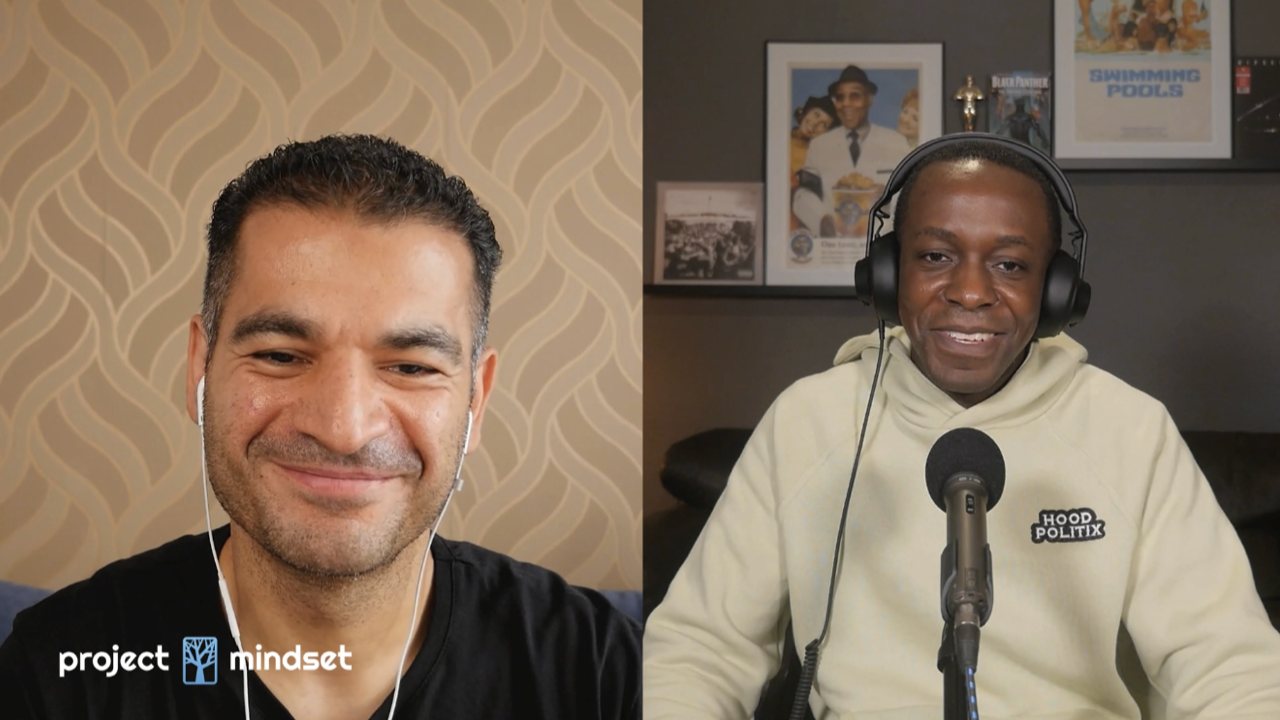
Junior Soma creates content and hosts the “Made in Germany” podcast. His guests discuss identity, society and personal stories. In this episode of Project Mindset, Reza Mehman meets Junior Soma and delves deep into topics that go far beyond typical podcasting. Together, they explore what “Made in Germany” means for people with a migration background. Their discussion also covers Black Lives Matter and diversity. Junior shares how his background in film and television production helped him launch a podcast. He uses platforms and technology to spread his message. They also discuss gratitude, personal goals, and the power of taking initiative. An honest and inspiring episode for anyone interested in exploring the themes of identity, self-realization, and social belonging.
Summary
In one sentence: Junior Soma explores identity, his path as a content creator and the importance of taking action yourself.
Short summary: Junior Soma hosts the “Made in Germany” podcast. With Reza Mehman, he shares experiences of identity, belonging and being Black in Germany. He discusses how Black Lives Matter heightened his awareness. He also explores gratitude and why brands should approach diversity more authentically. His central mindset: If you have a vision, you have to act yourself, because waiting for others won’t get you anywhere.
Detailed summary: Junior Soma is a content creator from Stuttgart who lives in Hamburg. His “Made in Germany” podcast lets guests connected to Germany share their stories. The podcast takes its name from Afrob’s album. It reflects the conviction that everyone who lives and contributes to this society belongs. Junior reflects on how Black Lives Matter changed him. He criticizes brands that use diversity solely as a marketing tool. He speaks openly about personal goals, his transition from advertising to IT, and the importance of continuous learning. His most important mindset: Don’t wait for others, but put your own vision into action.
Context: Who, What, Why
Who is speaking: Reza Mehman, host of Project Mindset, in conversation with Junior Soma, content creator and host of the “Made in Germany” podcast. Junior was born in Germany to Angolan parents, grew up near Stuttgart, and has lived in Hamburg for over five years.
What is it about: The conversation revolves around Junior’s path to podcasting, the significance of “Made in Germany” as a concept of identity, experiences with racism and Black Lives Matter, the credibility of companies regarding diversity, gratitude as a way of life, personal goals, and the mindset of independent action.
Why relevant: In a society increasingly discussing belonging, diversity, and identity, Junior’s perspective as a Black man in Germany offers authentic and nuanced insights. His experiences as a content creator and podcaster are also inspiring for anyone wanting to launch their own projects.
Three key questions of the episode:
- What does “Made in Germany” mean to people with a migration background?
- How has the Black Lives Matter movement changed the awareness and daily lives of those affected?
- What mindset helps to implement one’s own vision independently of others?
Table of contents
- Introduction – What this episode is about
- Summary – The episode in brief
- context – Background information on the speakers and topics
- Topics and classification – The central topics
- Key messages – The most important messages
- Frequently Asked Questions – Answers to key questions
- Highlight quotes – The most concise statements
- Transcript – The complete conversation
- Keywords – Relevant search terms
- Names and terms – List of important mentions
- Quotable passage – For sharing and quoting
Topics and classification
Identity and belonging in Germany
Junior reflects on what it’s like to grow up as a Black man in Germany and grapples with the question of belonging. His podcast “Made in Germany” sends a message that everyone who lives in this society belongs.
Keywords: German identity, belonging, Made in Germany
Black Lives Matter and experiences of racism
The conversation explores how the Black Lives Matter movement has raised awareness and what everyday experiences with racism have shaped Junior. He describes how the movement has changed public perception.
Keywords: Black Lives Matter Germany, experiences of racism, diversity
Content creation and podcast creation
Junior recounts how he started his podcast with existing equipment and the support of his girlfriend, Hila Strong Hijabi. He describes himself as a content creator who flexibly utilizes available platforms and technologies.
Keywords: Podcast starten, Content Creator, Video Podcast
Gratitude and personal development
Gratitude plays a central role in Junior’s life. He emphasizes the importance of acknowledging one’s own progress and not constantly comparing oneself to others.
Keywords: Gratitude, personal development, mindset
Independent action and goals
Junior’s core mindset is to not wait for others, but to implement his own vision himself. This attitude led him to start his podcast and to consistently continue it.
Keywords: Self-initiative, achieving goals, implementing a vision
Key messages
- Anyone who lives in Germany and contributes to society is “Made in Germany”, regardless of origin or place of birth.
- The Black Lives Matter movement has created a deeper awareness of one’s own identity and experienced racism among many Black people in Germany.
- Companies and brands must act authentically regarding diversity and not just jump on trends in order to be credible.
- If you have a vision, you can’t wait for someone else to share it with you. You have to take action yourself.
- Gratitude is an important tool for appreciating one’s own progress and avoiding constant comparisons.
- The name “Made in Germany” is inspired by Afrob’s album of the same name, which Junior describes as the best German rap album.
- The move from the advertising industry to IT shows that career change is possible if you don’t limit yourself to one role.
- Starting a podcast doesn’t require perfect conditions. Existing equipment and the courage to simply begin are enough.
- Belonging isn’t something you need validation from others for. It’s enough to do your own thing.
- Learning never stops, and the willingness to develop further is one of the most important qualities for personal success.
Frequently Asked Questions
Who is Junior Soma?
Junior Soma is a content creator from Germany, of Angolan descent. He grew up near Stuttgart, lives in Hamburg, and hosts the “Made in Germany” podcast. His professional background is in advertising, and he now works in IT.
What is the “Made in Germany” podcast about?
“Made in Germany” is a video podcast hosted by Junior Soma. Guests with ties to Germany discuss identity, society, personal stories and social criticism. His guests have included Gregor Gysi and Jan Delay.
Why is the podcast called “Made in Germany”?
The name is inspired, firstly, by Afrob’s album “Made in Germany” (circa 2001/2002), which Junior considers the best German rap album. Secondly, the name represents the conviction that everyone who lives in Germany and contributes to society is “Made in Germany”.
What has changed for Junior Soma since Black Lives Matter?
The Black Lives Matter movement has given Junior a deeper awareness of his own experiences with racism. He describes how many past situations have been re-evaluated and how public attention to the issue has increased significantly.
Which mindset has had the greatest influence on Junior Soma’s life?
Junior’s core mindset is the realization that one shouldn’t wait for others, but rather implement one’s own vision independently. He emphasizes that without this mindset, he would never have started his podcast and the interview with Reza Mehman would not have taken place.
How did Junior Soma get into podcasting?
Junior already had equipment at home due to his studies in film and television production. Together with his girlfriend Hila “Strong Hijabi,” he recorded the first episode. This led to the development of the “Made in Germany” podcast, which now has over 100 episodes.
What role does gratitude play for Junior Soma?
Gratitude is a central element of Junior’s personal development. He emphasizes how important it is to appreciate one’s own progress and not to constantly compare oneself with others, but to acknowledge one’s own path.
What does Junior Soma think about diversity in companies and brands?
Junior is critical of many brands’ diversity initiatives. He expects authenticity and long-term commitment, not short-term reactions to trends. Companies must truly embrace diversity and not just use it as a marketing strategy.
Highlight quotes
“At some point I learned for myself, listen, if you want to start and do something, then you have to do it yourself, because only you have the vision.”
– Junior Soma
“You can wait a long time until you find someone who shares them. If you do find someone, great, then you’ve found each other. But I’m not waiting for that now.”
– Junior Soma
“If I had been waiting for that, then you and I wouldn’t be sitting here talking today.”
– Junior Soma
“Whether you like it or not, if you live and participate in this society in some way, then you will eventually belong to it.”
– Junior Soma
“For a long time, I didn’t want to see myself as German. But then I somehow realized, you’re more German than you might want to be.”
– Junior Soma
“It doesn’t matter to me at all whether someone else wants to acknowledge it or not. I couldn’t care less. I just do my own thing.”
– Junior Soma
“I would describe myself as a content creator because I am actually someone who likes to do things that make sense.”
– Junior Soma
The full conversation
Hi everyone, it’s great to have you back! I have a small comment to make about today’s episode. I had the opportunity to conduct another interview, this time with the podcaster Junior Somer. He has his own podcast called “Made in Germany,” and we touched on a wide variety of topics. We tried to understand, or rather, I tried to understand, his mindset, what the “Made in Germany” podcast is all about, what it means to him, the Black Lives Matter movement, the topic of gratitude, his goals in life, and of course, which mindset has had the greatest influence on his life.
As always, you can listen to the entire interview directly below, or you can go to my YouTube channel and simply search for “project mindset” on YouTube or on my homepage.www.projectmindset.deI’ve also linked it again, so enough chatting. And have fun with the interview.
So, I somehow realized that I was relying too much on other people. And then at some point I learned for myself: listen, if you want to start something and do something, you have to do it yourself because you alone have the vision, and if you find someone who shares it or something, you could be waiting a long time. If you do find someone, that’s great, then you’ve found each other. But I’m not waiting for that now because, to be perfectly honest, if I had been waiting for that, then you and I wouldn’t be sitting here talking together today.
Welcome to the conversation
Junior, thank you so much for being here today. I hope you’re doing well. I can’t complain, I can’t complain. Thank you so much for letting me be here. It’s not every day that you get invited and are allowed to say something. That’s why I’d like to thank you here as well. Thanks definitely from my side for taking the time.
Junior, your “Made in Germany” podcast is really interesting. Before we discuss it, could you introduce yourself? Who are you and what do you do?
I always find it difficult to introduce myself because I rarely have to. Content creator is how I would describe myself. I mainly make podcasts and videos now. But content creator is how I introduce myself. I like doing things that make sense with the resources available to me. What technology do I have at my disposal? What platforms are there that I can use, and how can I use them to get my message across? If tomorrow’s technology means interviewing with drones, people might call us dronecasters. Then I’ll be a dronecaster for the moment, but primarily a content creator.
Origin and career path
I come from Stuttgart, originally from near Stuttgart, from Tülden to be precise, born here in Germany to Angolan parents. And that’s pretty much how I would summarize it. And where do I live now? I’m in Hamburg now, I’ve been living in Hamburg for a little over five years. I moved here for the job.
Originally, or rather, originally I was in advertising for about three years. I worked there as a junior producer, then as a producer, and then at some point I’d had enough. Now I’ve switched to a different industry, IT. I’m still doing my IT work here in Hamburg. I’m still doing my podcast stories here. So, your podcast is super exciting, and you’ve had some really great guests. Griego Gisi, for example, I think it’s always really cool to listen to him express his opinion. I think he can always argue very well. Other cool people, like Jan Lay, were also there, so really top-notch guests in a podcast.
How Made in Germany came about
Before we talk about the guests again, how did you even come to start your podcast? Number one, number two, why is the podcast called “Made in Germany”? Regarding number one, that’s because… So, how did I start? I actually just already had the equipment lying around. I studied film and television production and bought some equipment. My original plan was to get into photography and make wedding videos. That seemed like a good opportunity at the time.
Just as I was about to start, an opportunity came up to move to Hamburg for a job. The equipment stayed at home and began gathering dust. And I didn’t really know what to do with it and I honestly didn’t have any real ideas.
The first conversation partner
And then I met one of my best friends here, Hila Strong, nicknamed Hijabi. I met her at work, and we often talked about lots of things. She’s also active in social media; she has an Instagram channel and now also a YouTube channel. As the name Strong Hijabi suggests, she puts fitness into context for Muslim women. Some feel that wearing a headscarf means they don’t belong in a gym or shouldn’t exercise. She tries to break down those stereotypes. And she also talks about socially critical topics. I don’t know if she enjoys doing it, but she does.
And she’s just someone who doesn’t beat around the bush. She gets straight to the point and elicits a certain reaction from people. Most people often agree with her and understand it. Many others are against it because of how she looks, and according to her appearance, she should probably just keep her mouth shut.
A conversation with more space
But she doesn’t do that. And that’s what I find interesting, I found it interesting from day one. I always said to her, “You’re always doing these Instagram snippets, like stories. Why don’t we do something where you just talk for an hour or two straight, and then we can cut it into a few parts for you afterwards that you can continue to use, but so that people can also see you in the whole thing.”
The first long conversation
And then, as promised, we did it, recorded the first episode together, which is still one of my favorite episodes. The first episode is probably still my favorite. The bond between us gives it a special importance. I always say that without it, this podcast wouldn’t exist. That’s how we started, and 100 episodes later we’re still here, very cool. And why “Made in Germany”?
Der Name Made in Germany
I was trying to find a name for “Made in Germany” that might still have some connection to Germany. And then it came to me that it’s because, let’s say, Afrop’s album “Made in Germany,” which I think came out in 2002 or 2000, 2000 or 2001, is still the best German rap album ever for me. Other artists have certainly released individual songs I like more since then. As a complete work, though, it’s still the best album for me. It also influenced me a lot during my youth, and that’s why it made sense to name it that way.
Personally, I associate a lot with the term “made in Germany.” I believe in it because I am a native Iranian. Although I was born in Iran, “made in Germany” is what I like to say. I think that the environment and society have had an extremely strong influence on me, and I have somehow reinforced it. That I am “made in Germany” even though I was born in Iran.
Belonging and Society
What does “Made in Germany” mean to you? Does it go in the same direction, or what connects you to it? Yes, I would say so, at least for me it is. What am I trying to say? Well, I think most of the people I invite have some kind of connection to Germany. And that doesn’t have to mean that you have to have been born here or lived here for a certain number of years. But I think that no matter how long you’ve been here, whether you were born here or not, you contribute to society in some way. Whether good or bad, that’s another question, but everyone contributes to what our society is.
And that’s why for me, everything here is “Made in Germany,” and that’s something you just can’t shake. I noticed it myself when I went to England to study. I realized that the people in customer service there are a bit friendlier and more customer-oriented.
Experiences during studies in England
I remember a similar story at the bank. I wanted to open a bank account, I think it was at Barclays, and the people there couldn’t really help me with their expertise. They were super friendly, but lacked the necessary knowledge. So I’ll have to ask them again, or maybe I’ll have to look in the brochure again.
And that’s when I realized how German I actually am, because it really bothered me. I thought things like that didn’t happen at home, and I wasn’t even shocked at myself. For a long time, I didn’t really want to see myself as German or fit in. Experiences of being told I didn’t belong had shaped that feeling. Then I thought, screw it, whatever, I don’t care.
But then I somehow realized you’re more German than you might like to be. And then I thought, okay, well, I’ve now understood for myself that whether you want to or not, if you live in this society and participate in it, then you’ll eventually belong, whether you want to or not. How long did that work?
Will you ever belong whether you want to or not? How long did it take you to understand that? Good question.
Finding your own place
I think I only really started thinking about it properly when I did this podcast. Before that, there was this experience in England, and then in the meantime, I never really thought much about things like that. Starting the podcast exposed me to many more debates on social media. That led me to investigate further and question some things. Then at some point, I thought, well, that can’t have been that long ago, maybe three years or so, that I’m saying, well, whether you like it or not, I’m here and I’m doing my thing. I am German to a certain extent, whether you like it or not. That’s that.
And it’s really not about whether someone else wants to acknowledge it or not, I couldn’t care less. So I’m not chasing after any confirmation or anything else, I’m just doing my own thing.
Dealing with differing opinions
Because at the end of the day, I think it’s the same with many other topics. I don’t know, someone might watch a podcast and say, “I don’t know, yours isn’t as great as Joe Rogan’s. You should just forget it, you can’t do it anyway.” Okay, that’s someone else’s opinion, but it doesn’t necessarily have anything to do with you as long as you just do your thing. Because I think if you worry too much about what others think of you and whether they like what you’re doing or not, you’ll just stay stuck in the same place and go around in circles.
Absolutely, I really think that’s also the challenge of managing to mentally detach oneself from the opinions of other people, because I actually believe that, yes, that was often the case for me too, that my environment conveyed to me the opinion that I’m not really German. I first had to come to that conclusion myself, to come to the idea that hey, wait a minute, I am what I feel in that moment.
How language shapes belonging
And we also briefly touched on it earlier in preparation for this conversation. I find it interesting that language itself can sometimes make you feel less than completely German. For example, my children, because I also have a migration background, are defined by the Federal Statistical Office as having one too. When my children are old enough, I’ll ask them if they feel completely German or if this term has an influence on them. How do you deal with language itself? Do you think language itself can also lead to feeling like you don’t quite belong?
100 percent, so language isn’t there for nothing, it’s there, so from my point of view. So that one can communicate with each other, but also convey certain things, and of course, I think one has to consider which word one chooses or which words one uses to convey a certain message, whether you are a person, so one can now say, yes, according to the Federal Statistical Office, for example, your children or mine in the future, if I should have any, have a migration background.
Consciously question terms
But one has to ask why this is so important now, why put it so much in the foreground, why not say, okay, that was perhaps a definition once, that’s how we understood it back then, but if we are now moving in this space where we say we want inclusion and belonging and so on, one can also consider whether one really has to continue doing it this way.
And if you take, for example, in America, they of course have their own problems, but well, yes, people still say African Americans or Asian Americans, but first and foremost, people always see themselves as Americans. So if you meet an American and ask where you’re from, they will never tell you, “I am African American” or something like that. It’s quite clear that being American is the first thing they see, and everything else comes after that.
And I think if we want to go in that direction, then we’d have to reconsider whether the term “migration background” even matters anymore when referring to your children, for example, who were born here. I believe they didn’t experience migration themselves, but they do have that background through you. Yes, but do we really have to be so petty about it and get so hung up on it, or can we say, okay, they were born here, they’re here now, what happened before shouldn’t really matter anymore.
Passing on values and family history
So, if it’s important for you, or for your family, that you say, “Sure, you were born here. But I naturally want to pass on certain values from our homeland, or stories, or something like that,” then yes, that’s something you decide at home, but for the public, just let the child be German and that’s fine, hence the language issue.
To make a long story short, I somehow have the feeling that in many debates, language is sometimes used skillfully, but then when you argue against it, it’s twisted around again, and then they want to act that way again. Yes, that wouldn’t be so important or so bad, but people actually know exactly what we do, why they call us that and not that, why they put us in certain categories. It’s all deliberate; you can’t say, “I didn’t know that,” or “That wasn’t clear to me.” You know what you’re doing. That’s why language is incredibly important. You should think about what you say and what you write.
Portrayal of racism in the media
I agree with you, I think many things still happen very deliberately. There’s this well-known example, the WDR program “Die letzte Instanz” (The Last Instance). I think that’s the best example. Nobody can tell me otherwise; it was deliberately introduced that way. I don’t mean to belittle anything by having four white people talk about racism. Surely ten people are watching and thinking, “Hey, what kind of show are we recording soon? Does it make sense to record it in this format?” Do we deliberately want to bring a small shock to society? I completely agree with you.
In this context, I haven’t had the opportunity to exchange ideas on this very often. But even though we’re talking about the USA, since you just mentioned it, has anything changed for you personally since the Black Lives Matter movement? Have you seen any changes?
What has changed as a result of Black Lives Matter
Yes, I have seen changes, but for me it hasn’t really played a role. Sure, people talk about it a lot more now, and the topic is more on the surface. But what exactly is happening? Now I’ve thought about it again, a few things have come to light. So, basically, there has been more change in terms of visibility. You see a lot more Black people now, on posters from brands, in commercials, and here and there.
Visibility has increased, but then one has to ask whether this is really only because people have realized, “Hey, something has to be done here. It’s the right thing to do,” or because it’s a trend that one has to follow. I have more of a feeling it’s the latter.
Visibility and the motives of companies
There are certainly people who have good intentions, and in companies who say, “Hey, I’m now, for example, an ally – which is also a word that has come up over the years – and I think it’s right for me, as an Adidas employee, to somehow contribute to the company and say, ‘Look, we need more visibility in our advertising,’ and so on.”
But I’m not so sure if all the brands are doing this out of goodwill. But at least they’re doing something. I also noticed that it was being talked about among friends and acquaintances. But I have to say, some dark secrets were revealed because you could really see the true face of some people and how they feel about certain things.
And yes, well, I’ve had experiences with people who I thought the whole time, or actually knew, were kind of on the same page regarding this issue, but as soon as I criticized the police a little, they said, “Well, you can’t say they’re all like that.” Then I said, “Wait a minute,” and I thought to myself, “You’ve been interpreting black men your whole life. You’ve been to Africa and so on, and most of your friends were also black, and then you do something like this.”
Reactions in one’s personal environment
That showed me again where I stand with some people, but for me personally, not much else has changed. I think it’s still kind of business as usual.
The question of sustainable change
So, from the point where we all saw that—I think it’s crazy that we first need a video in which a person is executed for eight minutes somehow. That then has to go around the whole world, millions of people have to demonstrate and set fire to houses and smash police cars or something. So that people understand that something isn’t right. And then months later, or a year later, or however long ago it was, we’re still talking about certain things. Like that WDR story you talked about, for example, that should never have happened.
Editorial responsibility
Never like that. I find it interesting because I know, or believe I know, that in such institutions all the things that are filmed or made have to go through a certain process before they are even broadcast. That means somewhere in this process someone should have realized, “Oh, this is a bit risky, what we’re doing, especially given what we’ve just experienced.”
Shouldn’t we maybe reshoot it, or maybe cut out some parts or something? But it still came out. So that means for me, okay, there are probably still people sitting there who don’t look like you and me, who can decide or have a say and say, “Stop, that’s going a bit too far.”
And the sensitivity that is supposed to be there, and the empathy, isn’t there either, because otherwise this crap would never have been blurted out like that.
Attention and public debate
But you also have to ask yourself, was this calculated? Did they think, “Let’s take the risk and see how people react,” because bad press is also good press for many people. We all got upset about it. Everyone shared and posted their comments and Instagram statements. Because of this, it suddenly became a real issue for WDR, and then Hissa Mani kind of brought it to the forefront, which I think is great.
But that started a wave. And now look, I don’t know how long ago that was, but nobody really talks about it anymore, you and I right now, sure, but in the bigger picture it’s not even an issue anymore, it’s over, and yeah, in my opinion nothing has really changed much.
Brand credibility
I think you just touched on the topic of large companies using posters, for example, featuring people who look different and come from elsewhere. I believe this issue has a lot to do with credibility, specifically, to what extent do I believe the consumer whether the company is actually serious or not, whether they are simply chasing certain quotas, trends, and so on.
The topic of credibility is indeed difficult, and the question then arises: when do you believe someone, a brand, or a company is truly serious? I have another comment on this, because we were just talking about language. For a long time, I also thought that many people are currently talking about gender-inclusive language.
Use language more consciously
I wasn’t quite sure how to handle it myself. Back then, when I actually said “listeners,” I included all the female and male listeners. Then, I think it was on TV, and an interesting sentence caught my eye: “Hey, if I ask you, ‘Which musician is your favorite?’ you automatically think more about male musicians, even though you might have meant everyone using the generic masculine.”
Since I became aware of this, I’ve completely changed my language. In fact, I now have to say “musicians” so that people really know and think I mean both genders. And now, this is also the issue of credibility. I used to do it completely differently. I’d say it’s a topic I’ve internalized, but now I think I come across as more credible by saying I actually mean female and male listeners or female and male viewers.
How serious change manifests itself
But when will you believe a brand or a person that I’m really serious about it? Personally, I’ll only believe it when I feel that something is really being tried, and trying means not just putting up posters or doing photoshoots, but also within the structure that things should actually be changed.
Or that, for example, someone from a particular brand often takes a stand on something, so that then… well, there was the story with Aldi, something from Berlin, from a colleague named Prince Mik. He was shopping at Aldi; people have probably heard the story before. He wanted to point out to the customers that these chocolate kisses can no longer be called “end kisses.” And in the video, you can see that they all confronted him, and both customers and security threw him out.
It’s a crazy video, yeah, yeah, and something like some older lady in the background says, “Yeah, they’re threatening us,” but he didn’t touch anyone, he was even touched himself. So, they make a video like that, and then it goes viral all over Germany, with a few million people seeing it after a day or two.
Public reactions and responsibility
We then request some kind of statement or something, and instead of some company taking responsibility and standing there saying, “Look, we’ve messed up, something needs to be done,” instead, there’s just a letter or a statement on the company’s official website, completely along the lines of, “We’re sorry,” and so on and so forth. I never actually believe it.
Because if you were really serious about it, then someone would actually stand up and say, “Okay, I’ll take responsibility for this.” Because, for example, this is my department, or it’s my area of expertise. Or, as CEO, I should have known a bit about it. Or somehow it should have reached me. I would have had to make a decision because it’s simply a sensitive issue, or one where we can’t say on the one hand, “Yes, inclusion of this and that. We stand for this. We are against that.”
It’s not enough to just make a statement and then have someone answer certain questions that are being misrepresented, and then actually not just play the politician on some platform, but actually say that we really messed up. So yes, we definitely have to follow up on that somehow, we have to do something.
Change within the structures
And this process then has to go through the structure. Of course, one can also ask whether it’s right to hire people just for the sake of quotas or something else. I don’t know, so you can see it either way. But I definitely think it’s good that something is being done at all and that one is trying to bring about some movement in this organization and put people in positions who can actually have a say.
As I said before this WDR program comes out, whether you have a small committee there or some department—I don’t know what you want to call it—that’s put in between and says, “Look, we’re now the department for these kinds of things, the one that’s sensitized to them and looks at things beforehand.”
That would be a good thing, whether it’s credible or not. I have no idea; I think the people who work or function within this system are best placed to judge that. But it would definitely be a step in the right direction, and for us, it would mean saying, “Okay, they’re making an effort to improve things in some way.”
Gratitude and personal opportunities
Absolutely. Now, of course, we’ve examined some negative aspects. Let’s switch to the positive aspects for a moment. As I’ve already told you, he believes it’s a very important topic for me. I think it’s actually important to first name the negative aspects because they are topics that can be worked on.
But what I also keep reminding myself of, and actually do very often, is to be grateful for the things I have around me, and one thing is that I am truly very grateful to be able to be here in Germany, to be allowed to be here, and when I think about it, Germany basically paid for my high school diploma, paid for my studies, I have to put in the work. But it was simply made clear to me.
I have virtually free choice of profession here; I can develop freely and, most importantly, do all of this in safety. I am extremely grateful for that. If you now think about the topic of gratitude in this context, what are you particularly grateful for?
A personal perspective on gratitude
I’m grateful for all the points you just mentioned. But I have to be honest, they’re not really at the forefront of my mind right now. In fact, it almost never occurs to me to say how happy or lucky I am to live in Germany. I’m aware of it somehow, but…
It is what it is. So it’s definitely cool, it’s definitely a huge benefit that I get from it when you see what’s happened worldwide in the last few months, Afghanistan for example, then of course you remember again, you say wow, so when you compare that. You wouldn’t actually have to compare it to the situation to understand it. But it really brings it into sharp focus.
Then I say, wow, what a shame! My parents who came here could have gone left or right, and who knows where they would have ended up, and who knows where I would have been born. But because I am now here in Germany and have the good fortune to be able to use everything that is available here.
Freedom within one’s own mind
I am all the more grateful, I believe, for the mind I have, in the sense of having the freedom in my mind to see all these possibilities.
Because I can live in the greatest country in the world with all these resources. I mean, you know yourself, there are people who have the most incredible opportunities here. But they have no ambition to take them to a certain level. By that I don’t mean wanting to get rich or anything, but understanding that you don’t have to work in a bank to have a reasonably good life. You can pursue your hobby as a gardener, be the best gardener there is, make your living that way, and then you’ll be happy with that too.
And that’s why I’m so glad that I see all these possibilities for myself and give myself this mental space to say, “I can do this if I want to, or I can do that, or I can leave that alone, and so on.” And for that, this freedom—when I think about it now—is what I’m most grateful for, apart from my mother’s goal and so on, no question. But yes, if I were to look at it from outside Germany, considering family and all that, then I would say that’s it.
Motivation for one’s own work
Very cool statement, having freedom in your mind and also the ambition to achieve something. Where do you get the drive, let’s say, energy to put into your passion, now the topic of podcasts or content creation? You also work full-time elsewhere, and yet I believe you’ve released 100 episodes in the last twelve months.
It would be nice if it were twelve months, we’re not two and a half years, two and a half years, but yes, everything’s fine, but yes, it actually was two and a half years, where did I get that? So, I’m the kind of person who, when I start something and am convinced of it, then I just keep going and see where I end up with it. I have two ideas, of course, and thoughts about what I want to do with it and where I want to go with it.
To sit here now and say I don’t want to make money with this would be a lie, of course I do, but first and foremost it’s important for me to build this platform, and before that it’s always been important for me to do this.
Becoming visible through work
Because I think if you don’t do it, you’ll never be in a position to be seen that way. I can have the greatest ambition and say I want to be the next Opera Winfrey or the next Tyler Peri or something with my own studio, but if I don’t do it, I’ll never get there.
And I think you can also be someone who, for example, in my case, makes 1000 bad podcast episodes from the perspective of many people, but maybe you make exactly that one episode where it suddenly turns around and you suddenly become the podcast of all time because then, for example, I don’t know, Stefan Rabda did it or whoever or Angela Merkel or something, yeah.
And why do these people come to you? Maybe you don’t have the most polished podcast, but they can see, “Hey, you’ve worked hard for 1000 episodes, you’ve put in the effort.” There are also people who simply acknowledge that and say, “Maybe not everything is the best, maybe it’s not the best setup, not the coolest camera. But that’s how people do it.”
Recognition for continuous work
And I had that, for example, with Belas, the rapper from Berlin whom I had asked to speak with. Thanks again to him, I also said in the interview that I didn’t have the greatest reach, I know, not the most famous or anything. But he liked that I had done the work and that he could see that I was working hard and that I was behind the times. He probably respected that. That’s one of the reasons why he was there.
And that’s my point, where I say if you don’t do anything, you’ll never be in a position to be seen, whether it’s one episode you have to do that brings you your breakthrough or 1000 others, nobody knows, but if you give up and do nothing, then nobody sees it. That’s my drive, that I say just do it, see where you end up, and everything else will follow.
Keep trying things out
And that’s actually another point I have to add. I had this attitude because I’ve always been doing things, always trying something, whether it was a different format or a product I wanted to release. I’ve tried and done so many things in life. With some, I believed in them more, with others less. I had more faith in some, less in others. But I was always in this mode of always doing something as soon as an idea came to mind, saying how I could do it.
And now, with the podcast, for example, it was like this: I always look at what resources I have available, or rather, what I need to, for example, if I wanted to build a car—a car that can fly tomorrow—I have to consider where I am right now, where I want to go, and what I need in between to get there.
Start with existing resources
And with the podcast, for example, it was like this: my goal was to have a format where you could both see and hear people, and then I saw that on the one hand I already had the means; I already had the camera, I already had some light, now I just needed to get a microphone or two to get closer to my goal.
To make a long story short, it didn’t take much to do what I wanted to do and to keep it going. I think that’s one of the reasons why I can do this with very few resources and still maintain it without having to say, “Okay, now I have to cave in because there’s no sponsor,” or “Now I have to cave in because I have studio costs I have to cover,” or anything like that. None of those costs apply to me.
I basically just need to sit down now, like with you (in quotes), set up my equipment, turn it on, and off I go. That’s why there’s not much that should stop me or deter me from continuing like this.
Technology as access to one’s own platform
I believe technology has contributed a great deal to the fact that we can, let’s say, simply build a platform. Whether or not it then achieves reach depends, of course, on various factors. But I am also incredibly grateful, for example, to be able to learn what I actually have to do to start podcasting. And that leads to my next question on the topic of learning: you’ve already had an incredible number of guests.
Are there topics where you would say that I learned the most from them, or that I hadn’t had this viewpoint or perspective before?
New perspectives through conversations
I believe that regarding women, yes, so the perspective of women is what I learned the most from. Of course, there were also many things I didn’t know about other topics.
But I think what I’ve taken away most from all this work is, as you said, the issue of gender, for example, that you somehow have to think about it, or the position of women in the world, or in business, or wherever. I don’t want to say that I’m the one who’s now going on about all issues concerning women, I don’t stand for that. But I think I’ve become a bit more sensitive about it.
Because there are many things you don’t even have to think about. As a man, you don’t really have to think about them either.
Better understand women’s experiences
But when you hear the stories from the women you talk to, whether it’s a camera or on camera, you realize how crazy they experience some really awful stuff. I mean, we also experience crap with racism and whatever, but for them it’s compounded by the fact that they’re also women and have to put up with even more on that level.
Yeah, if you think about it, for example, if you go into some office right now, I don’t think 20 women will whistle at you on your way from the elevator to your desk. That’s not going to happen to you. Some people might wish it were that way. But I think if that happened to us, persistently every day, at first we might think it was cool or great, like, “Yeah, we’re desirable” or whatever.
I think if you have to go through that your whole life, at some point it’s not so great anymore. We don’t know that at all, but the ladies, the women, they know that. They always have to expect that someone wants something, says something, does something, or something like that. They just have to be a little more on their guard than we do. I kind of knew that already, but not like that.
Perceiving everyday experiences in a new light
And I think that’s what I took away from it the most, which was super interesting. So when I think about it in this context, sometimes I see how crudely some women are hit on. It’s a bit embarrassing for the men who then, let’s put it this way, do such things in such a low-class way. It’s truly embarrassing for me.
Why Master P is an interesting conversation partner
Regarding the podcast itself, you mentioned in another interview that you’d like to interview Merster P. Yes, I hadn’t really considered him, let’s just say he wasn’t even worth considering. Could you elaborate briefly? He’s a well-known rapper, but what exactly do you find so interesting about him?
I have to say his music was never really my thing. I knew about him, and I’d heard him here and there on features and tracks. He’d had a few hits, of course, but as a musician, he wasn’t really on my radar to the point where I’d say he’s one of my top 5 or top 10 rappers, never.
But so I started watching this format called The Breakfast Club on YouTube. They broadcast their show, except it’s a radio station in the USA, I think they’re in New York. And of course, there are the conversations they have about… I don’t know if you can hear the interviews on the radio. Or on the radio, I don’t know. But they have their YouTube channel and they constantly release interviews with people from politics to sports to business, all sorts of things.
Music as a starting point for entrepreneurship
And that’s when I saw Master P in a different light. He started talking a lot about business and mindset. And the guy is just a crazy hustler. He does everything from his music to rap noodles to rap snacks to whatever else—he has his fingers in everything.
And it’s easy to understand that his motivation was never to be the best rapper, or the top 5 or anything like that. That was never his ambition. As I understood him, rap was always a tool for him, or whatever you want to call it, to help him get from A to B. So I think he’s always had other ambitions and used rap as a springboard. And now, yeah, he still does it more or less, appearing here and there as a feature. But I don’t think he has the ambition anymore to release an album every year. He might do it when he feels like it, but he’s completely in business mode now.
Entrepreneurial perspectives from music
And then seeing him in that light and hearing him talk, I found that super interesting because, well, he has a really intense mindset. But it was super interesting to hear. He said a lot of things that I’ve always thought about too. Of course, I also got a lot of new ideas from him, but with many of them it was so intense, that’s the thing. So I’m not the only one who thinks the way I said, for example, about doing things.
The example of the musician Russ
So, for example, I know I’ve heard of him before. Do you know Russ, the musician? I know he’s from America or Canada, I think he’s American. Russ also makes hip-hop, Italian-American rapper-producer, so I’ll say. And he started releasing his music on SoundCloud.
Because we also had the question, so yes, with whom do I make the music? I need… To be able to make music, I actually need a studio, I need an engineer, I need this and that.
And he reduced it to a minimum and said, “I just have my MacBook or my laptop and I do everything myself from there because otherwise I have to wait for someone who has time or is in the mood or whatever.” And that necessity somehow led him to say, “Okay, I want to be able to release as much music as possible whenever I want.” So he taught himself how to produce, or whatever, and then he released his stuff on SoundCloud, just songs out, songs out, songs out, songs out, which practically no one heard at the time.
Continuity before the breakthrough
And then at some point he had that song, and after that, people wanted more from him and realized, wow, this guy had already made 100 or 200 songs. That helped them achieve a certain status. So that he, I don’t even know how quickly he went platinum and whatever, but anyway.
Then he realized, “Ah, so that’s the work ethic I have. It paid off because I simply did it for the sake of doing it. Not because I absolutely wanted to land a number 1 hit with every song, but I simply wanted to be constantly working. And look, now it’s paid off.”
Staying consistent in action
And that’s how I think too, and Master P was also someone who conveyed that to me in a similar way: you have to do it, whether it’s the best album or not, whether it’s the best song or not, you have to do it somehow and put the stuff out there and just be there because if you don’t do that, then people just won’t see you.
I think it’s super obvious that you appreciate hard work and therefore respect it a lot. I remember you saying in another interview that you always do everything completely yourself, meaning you set up the cameras, you set up the microphones, and so on. From my own experience, I know that’s incredibly difficult. I always have help with me when I’m on-site. A big thank you here to the videographer who always lends a huge hand.
How come the topic of hard work is so important to you? I don’t know many people who say it’s about doing, because many are more the type who want to think about doing something, doing something, having done something, or having it done by someone else, or having it done for them. But actually getting off their butts and moving forward themselves—not that many people actually do that, at least not that many I know.
What lies behind personal motivation
Despite this drive to create, I understand you want to release the content and move forward, but where exactly do you get this drive from and how do you deal with days when you might not have this drive, but still know that your goal is to move forward with your topics?
At some point, I simply realized that with all the things I tried, I was always making them a little dependent on other people. I thought to myself, okay, I want to do something, so I need this, I need that, I need that person.
And I think that’s what most of us have in our heads, that we somehow believe we always need someone to do something, and of course, you can’t do everything alone. Especially if you want to take certain things to another level, you can’t do everything alone because you only have so many days and so much time.
Possibilities and limitations of working alone
Therefore, if I were to say, for example, that I want to make a show with eight cameras (for whatever reason – it’s a silly example), and then, I don’t know, it’s probably possible somehow. But it’s a thousand times more difficult to say, “I want to be in a studio with eight cameras,” and then I have a format adapted for LinkedIn, adapted for TikTok, for Snapchat, for whatever.
Someone has to do it. But that’s why I eventually said, okay, I have ambition, and for the ambition I have, I apparently always need people I can rely on, people I have to motivate somehow, and often that doesn’t work so well because you have it in your own head and think, hey, that’s totally awesome, that’s definitely going to be it.
Transferring or implanting this ambition or image into another person’s mind is extremely difficult.
Don’t wait for others indefinitely
And I just didn’t want to be dependent on other people anymore, it always really got on my nerves. Because you rarely meet people who are willing to go down a certain path with you and say, “Look, I understand what you want to do. I also understand that you don’t have the money to do it right now, like to pay me, for example.”
And that’s why I say I try to give as much as I can. But then I also try to make deals with people, for example. I say, “Look, this is my vision, this is where I want to go. This is what I can give you right now. This is what I would want to give you right now, but I can’t. Let’s work towards that. So that I can give you what you should receive and even more. We can even put it all down on paper.”
Cooperation and mutual risk
But what I need from you now is your time, that you are willing to sacrifice time and take the risk.
Because at the end of the day, it’s always a risk. I can make promises all I want, but whether I keep them in the end or not, in the end, I don’t keep them, and then the person can think, “Yeah, wow. I worked hard with him for two years, and now he’s dumped me and found someone else.” So, that’s obviously a risk you always have to live with.
But I believe there is always a risk, no matter what you do, whether you get paid or not, there is always a risk.
To advance one’s own vision independently
Yeah, long story short, I realized that I was relying too much on other people. And then I learned for myself: if you want to start something, you have to do it yourself because you alone have the vision. And if you find someone who shares it, you could be waiting a long time. If you do find someone, that’s great, then you’ve found each other, but…
I’m not really waiting for that because, to be perfectly honest, if I had been waiting for that, then you and I wouldn’t be sitting here talking today.
That’s why my attitude is “do, do, do” because nothing else matters. I can dream, I can wish, I can complain that nobody wants to join in. But nothing will change, or it won’t change the situation I’m in.
The vision of an independent platform
You just said vision, can you tell us what your vision is? I mean, I think… What I mean is, I know that I want to have an independent platform, so an independent platform that should reach a certain size at some point.
I can take someone like Marcus Lans as an example, because it’s one of the most prominent shows, especially now because of the corona situation and all that, it’s gained even more attention. You can say what you want about him, you can like what he does or not. The questions he creates and so on and so forth.
But I still find the work being done there incredibly impressive. I also think he’s doing a great job, even if some questions are asked from time to time, like how people are portrayed when it comes to topics like racism, and the fact that you always have to invite the tenth footballer who has to talk about it again and again – that’s a different topic altogether. But I think the format and its impact are great. That’s one of my goals, for example, to create a show where people can watch, where opinions can be expressed, or where they get a platform, and then they are actually seen and heard.
A platform for diverse concerns
So that tomorrow, I don’t know, someone from the Muslim community, for example, could come with their concern and say, “Look, this is what’s happening right now in Berlin, these are the dangers we have to face every day: people wanting to set fire to our mosques, for example, or people constantly getting in our way when we want to achieve this.”
Or if someone from a community comes along and says, “Listen, we’ve started a party now, and we stand for a specific issue.” And we know, for example, that many—at least in my opinion—that many parties that were just running in the federal election don’t necessarily have our interests really in focus. It’s somewhere on the agenda, but it’s not exactly at the top.
And if a politician comes along and says, “I’ve founded a party here, this is ours, this is our plan, this is what we want to do. We need a platform to be seen,” and I believe in it myself, then I have the stage to offer them a certain audience in order to convey a certain message to the outside world.
A platform for diverse concerns
And that’s where I’d like to be, not to become the most famous showmaster or anything like that. If it happens, then so be it, but that’s not a goal for me. It’s about having a platform where you can address certain topics and they can be seen. You don’t have to have a blue checkmark first for your topic to be considered important. That would be a really cool goal.
What would have to happen, or not happen, for you to say that at some point you would give up on this goal? Perhaps to give a little context: I think many people pursue goals in their lives, but sometimes they might not have the discipline to achieve them. I get the impression that you absolutely have that discipline.
But what would be a sign for you that, “No, junior, this isn’t for you now,” or “I can’t do this anymore”? Is there something where you say that’s a sign, or do you say you completely rule something like that out? You have a goal and you’re going for it.
Why giving up is not an option right now
I don’t even know if it’s completely impossible that something like that could ever happen, but right now I don’t see it happening. Because, well, if I were to go by the numbers, then I would have had to stop already. So, I should have stopped a long time ago because not every video is as successful as the last one.
So, I have no idea, I could have made a video with a Grigory that’s a hit, then I’d make ten other videos with people that you think are interesting, but YouTube doesn’t see it that way, or the people watching it don’t see it that way.
And therefore, if I went by that logic, I would have had to quit long ago. Thank God I don’t go by that logic, which is why my perseverance remains. And even if that weren’t the topic right now…
Freedom through an independent format
No, I don’t really see any reason to give up or stop because it’s all still within the realm of possibility. So I don’t have to put a lot of money into it now, I’m not burning any money in that sense, I haven’t incurred any debts because of it.
But it’s really something I could just do tomorrow in Hawaii if I wanted to, or I don’t know, on some mountain anywhere, anywhere, as long as I have internet access. So I can actually do it anywhere. I’m not dependent on any study, not dependent on any broadcaster. There’s no obligation to hand something in to anyone at a set time.
I can say today that I won’t release a video tomorrow, just like that. I have that freedom, I can take it for myself, and as long as I have it.
Allowing breaks and further development
No, I’ll stay put and just do my own thing. If at some point I decide I want to take a break of two, three, or four months because I feel like doing something completely different—I want to go on a world trip now and record a blog instead—then I’ll just do that. But giving it up isn’t really an option for me.
So that it might somehow transform into something else, it could happen that someone says, okay, now I always do this one-on-one conversation, maybe I’ll turn it into a proper roundtable discussion where four or five people are sitting there, and the “Made in Germany” podcast is no longer the podcast but the “Made in Germany” show or something like that. That could theoretically happen. But I believe I won’t give up on this goal; it remains.
Dealing with criticism of the podcast
Do you get any negative feedback regarding the podcast? Actually, no.
Yesterday I had one or two people there who then had their opinions, for example Jasmine Poesie from Berlin. She’s a great woman, does great work, and is a great person, at least from what I’ve gotten to know.
And she stands for something, she’s a hijab-wearing woman who writes poetry and she has an opinion and she represents it, and a few months ago there was the topic about Palestine and Israel. She expressed her opinion and in the end she was called an anti-Semite.
So, I haven’t seen it, so I don’t know what you have to do or say, and I have no idea. So you can say something exactly as you say it, and at the end of the day, people will decode it and find reasons why this word and that word are supposed to prove that you are an anti-Semite.
Different interpretations of a statement
I didn’t see it, I listened to her. I had the feeling she said it from the heart and her concern was for the people.
Other people saw it differently and said things like, “How can you invite her? You can see she’s an antisemite,” and so on. I tell you, I want nothing to do with any of that. Because I go by what I hear and see, and if I feel something about what I hear and see, I say I don’t see anything wrong with it. Then I believe it for the time being. So if someone else sits down with me and says, “Listen, now I’ll explain why that was wrong,” and we can talk about this, that. That example, of course.
So if someone comes along with some common sense and says, “Let’s sit down and talk about this,” okay, but most of the time it’s always, “That’s not possible,” and “That’s completely out of the question,” and here and there. But I don’t listen to that at all. It doesn’t bother me. That was, I think, the only negative feedback I’ve actually received. And yeah, otherwise, if I get it, I don’t really care.
When comments take on a life of their own
I once had a guest on my show who was a YouTube creator. He received quite a lot of negative feedback, really harsh feedback. I think it’s not easy when you get caught in that kind of spiral where people start posting hateful comments online, because then others jump on the bandwagon. But I’m happy that didn’t happen to you.
Am I good enough to get back to your goals? Are there any points or topics that you know I still need to learn in order to achieve my goal?
So, the topic of learning is very important and ever-present for me. I think I do many things in life also to learn, as silly as it sounds. So sometimes I take on new challenges and say I simply want to learn it, for example, starting with the podcast.
Learning through practical work
I need to learn how to edit at some point, for example how to deal with microphones. There are a thousand mistakes we can make. We talked about it once, there was also a video in the video section.
Despite that, I’m not happy that I was able to learn so much there, even if it’s technical and I don’t actually want to develop in that direction. But I’m still learning something new and maybe I can apply it one day. What do you know, or what do you think you need to learn to get closer to your goals?
Good question. The thing about learning is that I don’t really think about it that much. I mean, for me, learning is something that just happens, it has to happen. With everything I do, I know that I’m learning something to a greater or lesser degree, whether good or bad.
Using experience from previous jobs
And like you said, I’ve also done many jobs and tried many things from which I’ve learned things that I can use today. I don’t really know, I did an apprenticeship in the restaurant industry, I worked in customer service, I did this and that.
And that’s why I know, for example, how to talk to people better, so simply. It was always important to me to provide good customer service, not because I wanted the most tips, but because I wanted the people I deal with, the guests, to feel as comfortable as possible.
Whether they spend 100 euros or 50 euros, it didn’t matter to me. I wasn’t like, “He only gave me one euro or anything.” Instead, come in, have a good experience, and drink whatever you want. Just have a good time, and if you want to leave something there, leave it there. If not, that’s fine too; it’s not about me.
Create a pleasant atmosphere for conversation
And that’s something I can now incorporate into my podcast work, for example. So that I can say: It’s really important to me that the people sitting with me feel comfortable.
I don’t know if I would have internalized it so much if I hadn’t done this training. But I don’t think I have this mindset or this constant need to learn. I think it just happens.
And what I might need to learn from other people’s perspective is something like how to network differently. Maybe I could improve on that. But honestly, I really don’t feel like it because networking… well, let’s just say…
Networking based on genuine sympathy
For me, things like that have to happen organically. So, for example, I could say, “You and I are sitting here talking, I like you.” And I’d say, “Resa was a cool guy, he did a great job, he was super nice.” And I don’t know, if I want to start some kind of show tomorrow and need a co-host…
Then I would like to do that with him because he was simply a great guy in this whole experience or in this whole context in which we were together.
I don’t know if I would message you. Or apparently, let’s say you had a blue checkmark on Instagram and 500,000 followers, then there are definitely people who would say, “If I want to do a show with this or that theme or that format and need a co-host or whatever, then I’d have to get someone like Resa.” And then they would message you and say, “We don’t want this or that, but I’m not like that.”
Organic compounds instead of calculation
I hate being nice in that way, like looking at who I get the most from, and trying to get close to them in some way, like pretending to be good friends or just friends. That was never my thing, I don’t blame the others for it, but it was never my thing, and then things just happen organically.
And precisely within this framework of networking, perhaps I should also be different in one or two things, in the sense of not taking things so seriously.
So, for example, in this whole context, like how we did it, or you, you wrote to me, and the way you wrote to me, as I’ve already told you, is completely different from that of many other people. I just think that many people don’t have manners, for example, or respectful interaction with each other. Well, many don’t.
Approach each other respectfully
And then there are people who say to me, “Yeah, come on, you’re taking yourself so seriously.” It’s about the issue, I say, “No, still, if you can’t behave or have no manners or don’t even know how to approach people respectfully, then I’m not interested, no matter how tall you are.”
So I think that’s something I might have to learn, but I don’t want to learn it. That’s practically non-negotiable for you, so yeah, yeah, yeah. Well, I don’t want to say that I’m perfect at it.
But if I were to do something wrong, then at least I’d have enough demeanor to say, “Look, I’ve messed up now.” Whether you want to talk to me about it again, whether you want to make another recording with me or not, is another matter. Whether you want to have anything to do with me again is one thing or another, but first of all, it would be important for me to make sure that I’m not on good terms with that person or something. But that I make it known that I’ve done something wrong and that I’m sorry about it, and then…
Admit mistakes and take responsibility
If the other person wants that, then maybe we’ll have a level playing field again; if not, then that’s it. But it’s important to me that we treat each other with respect. And that’s really negotiable for me. So, I’ve already had some people tell me, “Don’t take it so seriously,” and that I’m not exempt from it. It’s not about people not being allowed to make mistakes; that’s not the point. It’s not about people being expected to be perfect.
But if I realize that you’ve made a mistake and you actually know it but you act like it’s okay, then I’m out.
I’m totally with you on this one, there’s also the importance of tone of voice. How you speak to someone, I’m totally with you on this one too. I also find it interesting because of the topic of learning; you let it come to you, so to speak. That drive to learn carries me away, so to speak; I’ve felt it myself. I mean that both positively and negatively.
What I only understood late about networking
For example, I think I should have learned about certain topics much earlier. You just mentioned the topic of net working, and I think it’s a great topic, especially for people like us with a migration background. For years I underestimated how important net working is.
Back then, I didn’t understand why people went to private schools when public schools were actually better, or to private universities when public universities were actually better, until I finally understood: okay, he goes to a private school because if he ever wants to do an internship, he just has to ask his friend, since his father is probably the managing director of a company, and then he simply gets his internship. That took me ages to figure out.
No matter how simple this topic is, it took me ages to understand why people work so intensively, because in most cases they want to gain some kind of advantage for themselves. Yes, and that’s why I say for myself, I want to, I’m driven. Sometimes I don’t even want to do that much. But I’m driven by the need to learn, at least to teach my children the things I only learned very late.
Passing on values to the next generation
And the topic of children is a very, very important topic for me. As I understand it, do you also want to have children someday? When you think about your future children now, what is the topic you would like to pass on? What experience have you had? Which lesson would you most want them to take away?
What would I give them? I actually think… So, if I had any, I would want to give them… I think they should simply be able to learn a lot from me. So that I might not even have to bring up many things. Of course, I will still bring them up.
Let me put it another way: for example, I think I learned a lot of things from my mother simply through observation. Of course, she would say things like, “You should do this, you shouldn’t do that,” and so on. And she also questioned things I had done.
Learning by observing role models
But overall, I’ve actually learned a lot from her, like how she interacts with people, or doesn’t interact with them, how she talks to people, or doesn’t interact with them, how she deals with things like when people aren’t respectful towards her, for example. That’s something I’ve learned for myself, for example.
For example, I never really learned or noticed at home that my mother complained about people who were racist towards her in some way, for example. I have no memory of that now.
But rather that if someone was simply rude to her, she didn’t let it go unchallenged. That’s how I think, for example, regarding this topic. Someone can come at me with whatever word they like, whether it’s hazelnuts or endpoint or whatever, it’s all the same to me. That you approach me like that is completely unacceptable, and then we’ll have a problem and will have to sort it out somehow.
It was never the case that I thought, “Well, yes, I didn’t learn it that way.” I simply learned it through observation, not to let certain things slide and to stand up for something.
Leading by example instead of just talking about it
I think it’s also that I want to be a role model so my children can simply learn from me not to let things happen unnecessarily, and secondly, to see me doing it, that I don’t just talk about doing it. But that my children see, look, I always do it, I’m always doing it.
I think that’s it, and if I had to reinforce that with words, I think it would be like this: do your thing, no matter what it is, or almost no matter what it is. Do your thing and don’t let people hold you back. I think the only ones who can hold you back from moving forward are yourselves.
So. This might sound like a cliché, you could say, “Yeah, that’s all well and good, but if a kid wanted to be the boss on CDF tomorrow, it’s not as easy as you say.” True, but maybe I have a kid who finds a way to start their own channel. It doesn’t have to be CDF, it doesn’t have to be top-tier CDF, it could be a killer YouTube channel. But I think that’s what I’d like to emphasize: go for it! Don’t let anything stop you, and the only person who can stop you is yourself.
What feelings do role models convey?
The topic of role models is also very cool; I completely agree with her. Coincidentally, one of the last podcast episodes was actually about the topic of role models for me. I think that role models, or being a role model, is mainly about… When I think about my childhood, I can most clearly remember certain moments when I had certain emotions.
I think these are totally present emotions, whether positive or negative. If it’s a positive emotion, of course, and it spread to more people, then at that moment she was a great role model. She didn’t even have to say anything, but the feeling she conveyed to me, these people, that was practically this role model function. That’s why I can absolutely agree with what you just said.
Being a role model is important, I think, and you’re not just a role model by simply talking. It’s also about the feeling you convey to other people, the security you give your children, for example, or standing by them when things go wrong and still saying, “Hey, chin up, it’ll go on.” Yes, I totally agree with you, very cool attitude, junior, really cool.
Where to find Junior Soma online
So, we can slowly come to the end of the podcast. The second-to-last question I always ask is, of course, where people can find you online if they want to follow you. Perhaps you could briefly say where you’re best reached? The best place to reach you is on YouTube, of course. If you search for “Made in Germany,” I could find it out. Otherwise, just search for “Made in Germany podcast” in full. The same goes for Spotify. I don’t think Apple Podcasts is either; I’m pretty sure of that.
On TikTok, it’s also written as “made in germany podcast” as a whole. And on Instagram, it’s also written as “made in germany podcast” as a whole. Yes, very cool.
Guys, definitely follow this guy! I find it super interesting how you ask your questions. You can tell that you want to have conversations and that you give your guest the freedom to simply share their content. There are other moderators or interview partners, we’ve already talked about this, who just want to express their own opinion. But you always give your guest the freedom to simply share their opinion. That’s why guys should definitely follow this guy.
The most important mindset: Just do it.
Now we come to the last question I ask every guest: Which mindset has had the greatest impact on your life?
I’m not entirely sure what to choose, but I think… Yes, I want to come up with something really special, but actually, from my point of view, my… well, I’ll just say it like this: my mindset is really just to do it, because if you don’t do it, you won’t be seen, or if you don’t do it…
This saying “nothing comes from nothing” is really true, I would say now, because you can have dreams, you can have visions, you can have wishes, but if you don’t act on them, no matter how awful it is, I mean really, there are people who make content or music or whatever that you might think is rubbish. But you always find a taker for almost anything.
Maybe I’m not the right recipient, but there are definitely 1000 other recipients who want exactly what you want. Do it, no matter how shitty it might be from my point of view. That’s why I say just do it, stick with it, and your time will come, but only if you persevere. If you let it go, then that’s how it is, you know.
Stay persistent and remain open to opportunities.
Because your time could be in a year, but it could also be in 20 years.
So, it’s possible that someone sees you now and says, “Reza, that’s really cool. I’m 17 years old, I think a podcast is great.” And they follow a podcast. You do it too, for 20 years. You never achieve the breakthrough you wanted. But that one child or teenager who saw it…
Then, 20 years later, the biggest platform in Germany says, “Reza, you were my motivation back then, that’s why I want you sitting with me now. Let’s talk.” And that person gives you a platform on a Joe Rogan level. And then suddenly everyone knows who you are, and it took 20 years to get there.
End of the conversation
That’s why you should just do it and stick with it. Very cool mindset, junior. Thank you so much for your time. I really appreciate you taking the time on a Saturday to talk to me about it. That’s really cool of you. Super sweet, junior, and I hope we see each other in person again soon. We will, and then we’ll definitely have coffee together. That’s what we’ll do, at least that part.
And thank you again for inviting me, it’s not something to take for granted. And then, regarding the topic I’d also like to speak about: Of course, we also talked about other topics at the beginning. We naturally touched on the topic of racism a bit. But I think that’s part of our experience here in Germany.
But of course we didn’t just talk about that, and I know other formats where the focus is exclusively on that kind of thing. So, the fact that you can also talk a bit about mindset, or how you think and tick, is just super interesting to me. That’s why I would also recommend that people who might be encountering you for the first time stick around. Thanks so much, Selif. See you again soon!
This transcript was automatically generated using Whisper AI and may contain occasional errors.
Keywords
Tags: Junior Soma, Made in Germany Podcast, Content Creator, Identity Germany, Black Lives Matter, Diversity, Gratitude, Mindset, Starting a Podcast, Belonging, Racism Germany, Personal Development, Afrob, Project Mindset, Reza Mehman
Names and terms
Junior Soma, Reza Mehman, Project Mindset, Made in Germany Podcast, Hila Strong Hijabi, Gregor Gysi, Jan Delay, Afrob, Stuttgart, Tuebingen, Hamburg, England, Barclays, Angola, Iran, Black Lives Matter, Diversity, Content Creator, Film and Television Production, Advertising Industry, IT Industry, Junior Producer, Video Podcast, Instagram, YouTube, LinkedIn
Quotable passage
“I eventually learned for myself that if you want to start and do something, then you have to do it yourself, because only you have the vision.”
“Whether you like it or not, if you live in this society and participate in it, then you belong to it.”
“It’s not about whether someone else wants to acknowledge it. I’m just doing my own thing.”
“Without Hila, this podcast wouldn’t exist. The first episode is still my favorite.”
You can find more discussions and ideas on the Project Mindset Page.