Stereotypes, integration and racism with Frank Joung
Journalist and “Halbe Katoffl” podcaster Frank Joung on cultural identity, downplayed racism and open mindset.
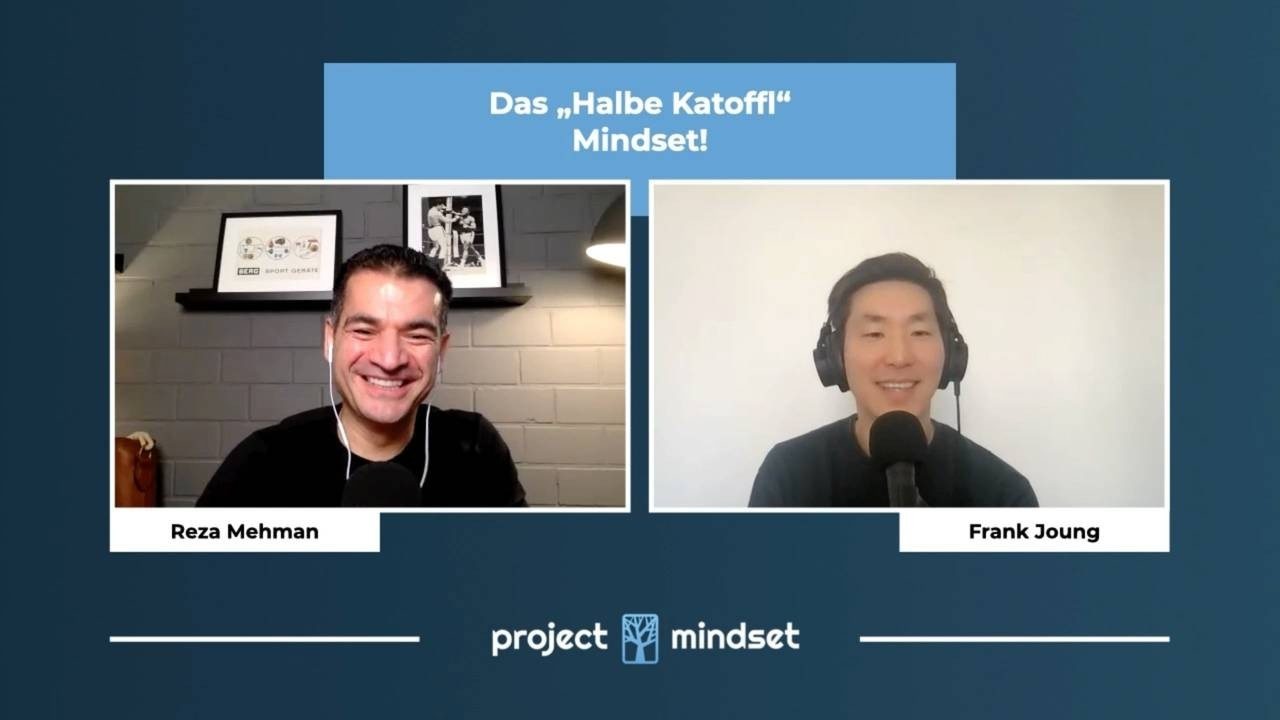
Introduction
Stereotypes, integration, and racism are topics that are often suppressed or downplayed in Germany. In this episode of Project Mindset, Reza Mehman speaks with journalist and podcaster Frank Joung, who has been running the successful podcast “Halbe Katoffl” for over five and a half years. In it, Frank interviews Germans with non-German roots about their experiences between cultures. He shares patterns and insights from hundreds of conversations: from shocking racist experiences to the positive aspects of cultural diversity. It becomes clear that integration is not a one-sided process and that an open mindset can be the key to genuine coexistence. This episode raises awareness, encourages reflection, and shows why it is so important to talk openly about these issues.
Summary
In one sentence: Frank Joung talks about the experiences of Germans with a migration background and shows how clichés, downplayed racism and the search for identity shape the lives of many people in Germany.
Short summary: Frank Joung hosts the podcast “Halbe Katoffl” (Half Potato), in which he talks to Germans who have cultural roots beyond their German heritage. From hundreds of conversations, he has learned that almost all of his guests have experienced racism, but many suppress or downplay it. At the same time, he emphasizes that cultural diversity is a strength and that an open mindset helps to overcome stereotypes and achieve genuine integration.
Detailed summary: Frank Joung is a journalist and founder of the podcast “Halbe Katoffl,” in which he has been conducting interviews with Germans of multicultural background for over five years. A recurring pattern in his interviews is that many guests repress their experiences of racism, even when these were severe. Frank describes how the search for identity between two cultures shapes many people and how the constant question “Where are you from?” can become a burden. He argues that integration must not be a one-way street and that German society must open itself up instead of expecting adaptation from only one side.At the same time, he shows that stereotypes can also be used positively and that cultural diversity represents an enormous enrichment.
Context: Who, What, Why
Who is speaking: Reza Mehman, host of Project Mindset, in conversation with Frank Joung, journalist and founder of the podcast “Halbe Katoffl”.
What is it about: It is about the experiences of people with a migration background in Germany, about clichés, everyday and structural racism, cultural identity and the question of what integration really means.
Why is this relevant? Germany is a multicultural society, yet racism is often downplayed and integration is viewed too one-sidedly. This conversation offers insights into experiences that many people have but rarely discuss publicly.
Three key questions of the episode:
- How do people with a migration background in Germany deal with stereotypes and racism?
- Why do many people repress their racist experiences, and what are the consequences?
- What does true integration mean and how can an open mindset help?
Table of contents
- Introduction – What this episode is about
- Summary – The episode in brief
- context – Background information on guests and topics
- Topics and classification – The central topics
- Key messages – The most important messages
- Frequently Asked Questions – Answers to key questions
- Highlight quotes – The most concise statements
- Transcript – The complete conversation
- Keywords – Relevant search terms
- Names and terms – People and technical terms
- Quotable passage – For sharing and quoting
Topics and classification
1. Racism and discrimination in everyday life
Frank Joung reports from his podcast conversations about the various forms of racism that Germans with a migration background experience,from open violence to subtle discrimination when looking for housing and job interviews.
Keywords: everyday racism, discrimination, structural racism
2. Cultural Identity and Belonging
Many guests on the “Halbe Katoffl” podcast describe the feeling of being caught between two cultures and not fully belonging to either. The search for one’s own identity is a central theme.
Keywords: cultural identity, belonging, migration background
3. Integration as a two-way process
The discussion questions the classical concept of integration and argues that not only immigrants must adapt, but also the receiving society must open up.
Keywords: Integration in Germany, adaptation, multicultural society
4. Clichés and stereotypes
The “cliché check” playfully demonstrates how deeply cultural stereotypes are rooted and how one can deal with them both humorously and critically.
Keywords: clichés, stereotypes, prejudices
5. Repression and psychological stress
Frank describes how many of his guests repress or downplay racist experiences and what long-term psychological effects this can have.
Keywords: Repression, psychological stress, over-conformity
Key messages
- Many Germans with a migration background repress racist experiences because they do not want to be forced into a victim role.
- Racism is not limited to overt violence, but also manifests itself in the search for housing, in job applications and in everyday microaggressions.
- The question “Where are you really from?” signals to people with a migration background that they are not perceived as fully German.
- Integration is not a one-way street: the receiving society must also open up and change.
- Cultural stereotypes can be addressed humorously, but must be considered in their context.
- Over-conformity, that is, the attempt to be particularly well-adjusted and inconspicuous, is a common reaction to experiences of discrimination.
- Many people only find their cultural identity in adulthood and are able to accept their multiple affiliations as a strength.
- An open mindset means viewing the unfamiliar not as a threat, but as an enrichment and an opportunity for growth.
- Conversations and exchanges are crucial to reducing prejudices and promoting mutual understanding.
- Negative experiences can be repressed, but never completely forgotten,which is why open conversations about them are important.
Frequently Asked Questions
What is the podcast “Halbe Katoffl”?
“Halbe Katoffl” is a podcast by journalist Frank Joung in which he talks to Germans who have cultural roots beyond their German heritage. The name is a tongue-in-cheek term for people who are “between two cultures.” The podcast has been running for over five years and has hundreds of episodes.
What does trivialized racism mean?
Trivialized racism describes the phenomenon of downplaying or repressing racist experiences. Many victims say they have not experienced racism, even though they can name specific incidents. Society also tends not to recognize subtle forms of racism, such as discrimination in housing searches or constant questions about one’s origin, as racism.
Why is the question “Where are you really from?” problematic?
The question signals to the person being questioned that their answer, “I come from Germany,” is not accepted. This implies that despite being born and raised in Germany, they are not perceived as “truly German.” Frank Joung explains that the issue is not the question itself, but the probing and the context in which it is asked.
What is overconformity in the context of migration?
Over-conformity describes the behavior of people with a migration background who strive to be particularly well-adjusted and inconspicuous in order to avoid standing out or causing friction. They try to be “more German than German,” which can be very stressful in the long run because it means suppressing parts of their own identity.
How can stereotypes be used positively?
Stereotypes can be used humorously and as conversation starters. In his podcast, Frank Joung does a “stereotype check,” playfully exploring the topic. The key is that the context is appropriate and that the person affected decides how to deal with stereotypes.
What does integration really mean?
According to Frank Joung, integration is often understood as a one-sided process in which only the immigrants have to adapt. True integration, however, means that the receiving society also opens up and changes. It’s about mutual learning and the recognition that cultural diversity enriches society.
How do people with a migration background find their identity?
Many guests of the “Halbe Katoffl” podcast report that they only begin to actively engage with their cultural identity in adulthood, often from their mid-twenties or thirties onward. Frequently, it is trips to their parents’ country of origin, conversations, or having their own children that trigger this process. The goal is to embrace both sides of their heritage as a strength and an enrichment.
Who is Frank Joung?
Frank Joung is a German-born journalist and podcaster of Korean descent. He founded the podcast “Halbe Katoffl,” where for over five years he has been conducting interviews with Germans from multicultural backgrounds. He also works as a freelance journalist and was previously editor-in-chief of an online magazine.
Highlight quotes
“There are people who repress it so strongly, or who so desperately don’t want to be in the victim role, that they say, ‘No, I haven’t experienced any racism.’ And then it turns out, ‘Well, okay, someone once wrote the N-word on our house.’ And I say, ‘Hey, sorry, but that’s racism in its purest form.'”
– Frank Joung
“How often have you been rejected, perhaps in a job interview, because of the way you look, or the name you have. How often would I have missed out on an apartment if I hadn’t had my German blonde girlfriend with me.”
– Frank Joung
“I used to be a foreigner. I was born and raised in Germany, but I was always a foreigner.”
– Frank Joung
“Growth usually happens by simply learning new and unfamiliar things. On the one hand, you can close yourself off and say, ‘I don’t want anything to do with anything unfamiliar.’ Or you can have an open mindset.”
– Reza Mehman
“We all experience negative events and try to downplay or suppress them. But the fact is that we never forget them, nor the emotions and feelings we had at the time. Carrying such a burden can, of course, be very oppressive in the long run.”
– Reza Mehman
“I wanted to somehow highlight being German, because I thought there wasn’t a word yet that really described us as people with a migration background.”
– Frank Joung
“Many people misunderstand this and say, ‘You say potato, that’s racism against white people.’ Well, I refer to myself or us as half potatoes.”
– Frank Joung
The full conversation
Hi everyone and welcome to Project Mindset.Today I have another interesting interview for you. I had the pleasure of speaking with journalist and podcaster Frank Joung. He hosts a podcast called “Half a Potato.” A funny name, and not meant to sound offensive. Of course, I asked him what exactly “Half a Potato” means and how he came up with the name. He told me the podcast revolves around conversations with Germans who don’t have German roots, who are, so to speak, caught between two cultures, and they share their experiences.
I naturally asked him if we could get some kind of summary of the experiences he’d had with his guests. And he kindly agreed, sharing many positive stories and experiences, but unfortunately also many negative ones. I was truly shocked by some of the negative stories. It’s also briefly touched upon in the podcast. It deals with some truly horrific racist incidents that really saddened me.
View diversity with humor
On the other hand, we thankfully also talked about positive things, like how you can sometimes celebrate cultural stereotypes and take certain things with humor. Of course, a lot of the conversation revolved around integration, not just cultural differences, but also integration here in Germany. And I think the issue of integration, or cultural differences, is definitely a matter of mindset. You can, on the one hand, close yourself off and say, “No, anything foreign, I don’t want anything to do with that, it’s all stupid, I’d rather stay with my own kind.”
Or you might have an open mindset and say, hey, growth usually happens by simply learning new and unfamiliar things. By the way, you can also watch the interview on YouTube; just search for “Project Mindset” on YouTube or visit my website.www.projectmindset.de,I’ve linked it again there. And there you can also see some visuals. Okay, enough talk, enjoy the interview. There are also people who repress it so strongly or who don’t want to be in this victim role, which I can totally understand, that they say, “No, I haven’t experienced any racism.”
Do not downplay racist experiences
And then it turns out, well, that once people wrote the N-word on our house, on the wall, and I say, hey, sorry, but that’s racism in its purest form. And you know, we don’t even really consider the little things. A lot of people say that when they think of racism, they only think of stories like the ones I just told. Nazis, jackboots, yeah, really awful stuff. But how often have you been rejected for a job interview because of the way you look, or because of your name, how often would I have missed out on an apartment if I hadn’t had my German blonde friend with me?
Dear Frank, thank you so much for your time today. Yes, hi, I’m happy too. Yes, very cool. So,I actually first heard about you through your podcast, which you’ve been running for a few years now. I find the content incredibly interesting, the kinds of people you talk to. The podcast is called “Half a Potato,” after all. But before I tell you much more about a podcast, perhaps you could tell us why you started one, how you even got into it? It also deals with the topic of integration, and that’s naturally a very relevant issue for me as someone born in Iran.
How Frank Joung got into podcasting
Well, I can’t say I’m not confronted with it in some form. But I’d be interested to know how you got into it. Yeah, well, I’m a journalist first and foremost, a writing journalist, and then at some point I discovered podcasts for myself and started listening to them, and I thought, ah, that’s a cool medium. That was about six, maybe even seven years ago. And I thought, yeah, I could do that sometime, or I’d be up for it. But I didn’t really know what topic to cover.
And I also worked in another job as editor-in-chief of an online magazine for running and marathons and such. We experimented with it a bit there. Then, at some point, when the Council of Europe put out a call for proposals for media, for more diversity, I thought, ah, that could be something, and I pitched my idea. That’s how I came up with the idea of talking to other people who, like me, have roots beyond their German heritage.
The name Halbe Katoffl
And yes, it was accepted. There were a few workshops about it. And that’s how it all started about five and a half years ago. The name “Half Potato.” Yeah, well, he knows the name himself. When you’re looking for a name like that, you naturally have a lot of ideas. And of course, I wanted to choose a name that sounded really cool. Something German, anything with German elements, just doesn’t sound that cool. It could go in the wrong direction or be misunderstood. And then, at some point, I came up with synonyms and then with “potato.”
Continued
And because it’s a specific term, many people misunderstand it and say, “You’re saying ‘potato,’ that’s racism against white people.” I mean, I refer to myself, or us, as “half potatoes.” And yes, I also wanted to highlight our Germanness somehow, because I thought there wasn’t really a word that truly describes us people with a migration background. Maybe you can relate. I used to be a foreigner; I was born and raised in Germany, but I was always a foreigner.
And then there were those who say that a complete foreigner isn’t really a German with a different background. So I simply created a term that can also be used for us, with a wink, of course. Yes, absolutely. So, if you first hear “potato,” you might actually think it’s a bit too offensive, but the explanation makes it clear what you mean. I’ve prepared a few questions for you today, and I really want to benefit as much as possible from your recent podcasts, episodes, and recordings.
Recurring patterns from many conversations
I hope this is okay with you, because this wealth of knowledge you’ve now accumulated—you’ve spoken with so many people about the topic of integration—is something you’ve surely discovered, perhaps even some patterns you could share with us. And before I get to the questions, I find it incredibly interesting. You always start with a passport check. That is, you read the ID card aloud. Hey, like at customs or at the border, how tall is this person?
What are you doing here? A little face comparison, you know? I think that’s extremely cool. I also got the feeling your guests always reacted really well to it. That was totally fine with you. Surprisingly, yes, exactly. There were one or two who didn’t participate, or I think one or two people maybe didn’t want to show it, which I can understand. So, totally okay. You only reveal what you’re comfortable sharing. And the other thing, which I find extremely cool, and these are the questions I want to ask you.
A personal cliché check
And you’re doing a stereotype test. Yes, exactly, I’m doing the stereotype check. Exactly, stereotype check, exactly. Yes, yes, may I ask a few questions here? Go ahead, yes, I’m glad you’re here. I’m curious to see what you have. It’s definitely not meant to be offensive. Maybe a little background. Like I said, it’s a stereotype, yes, a stereotype. Yes, exactly, I know that too… Right, exactly. I’m also confronted with stereotypes from time to time. And I was thinking, what do I associate with Koreans? Luckily, I have a few Korean friends.
And the first question is, do you like eating rice? Absolutely, 100%. Very nice. You’re good at martial arts. No, unfortunately not. Well, I’d love to be one of those Bruce Lee or Jackie Chan types, spinning kicks in the air. I tried it, simply because it annoyed me. Everyone was always saying, uh, could do carrot, could do Taekwondo, Kung Fu, Jackie Chan, Jet Li. I did Taekwondo for a few years. I made it to green belt, but I was also very late, a bit older, and I didn’t have the discipline or the desire to literally contort myself.
Talking humorously about attributions
But yeah, I’d like to be, but unfortunately I’m not. Funny that you did it for the stereotype, though. Yeah, exactly. I just wanted to be able to say, yeah, I did it. Very cool. Okay, next point. You can’t handle alcohol. Yeah, I think I can’t handle alcohol.I say “think” because I don’t drink and have only tried it maybe two or three times in my life. So I think I’ve only been drunk maybe twice, and once I did a test at a party where I downed a beer and saw what would happen, and I actually turned red, I kind of puffed up, and people were really worried, they said, “Dude, what’s wrong with you?”
I said I was doing a test, alcohol and all that, don’t do it. And then I was in the bathroom for three-quarters of an hour, hiding there, thinking, yeah, now it’s okay, come on out, and then the first guy was like, “Dude, Frank, what’s up? What’s wrong with you?” And yeah, I never really liked the taste. Every now and then I try a little bit of wine or something, but I don’t drink alcohol, it just doesn’t do anything for me. Next cliché. You’re very good at math.
When stereotypes don’t fit the person
I was very good at math until the third grade, and then it leveled off. So, unfortunately, I couldn’t rely on that stereotype. Math is really a lot of practice and learning, unfortunately. You can eat whatever you want and you won’t gain weight. 100 percent, yes. That’s totally true. Well, for example, my brother is different. But for me, it’s really true that I’ve theoretically had almost the same weight for 30 years and don’t really need to change anything much. But of course, I’m still the kind of person who pays attention to it.
Continued
So, I haven’t eaten meat since ’96. Like I said, I don’t drink alcohol. I don’t do drugs, and I only eat sweets occasionally. So, in that respect, I’m pretty healthy. You did breakdancing when you were younger. Wow, you have some good stereotypes. Wow. Absolutely. Well, when I was younger—I’m a bit older now, actually I’m 45—when I was younger, breakdancing wasn’t as big a thing in Korea as it has been in the last 20 years or so.
So I didn’t have anyone, meaning I didn’t have a role model or any kind of environment where I could have done it. But if I had, I would have absolutely gone for it. So I really regret that; I would have loved to have done it. It’s funny because pretty much every Korean I know has actually done breakdancing at some point. Funnily enough. Yeah, yeah, yeah. So, like I said, maybe a lot of people don’t know this, but Korea was, or still is, a big breakdancing community.
And yes, that unfortunately kind of slipped past me, came a bit too late. Last cliché check. You love technology. Well, anything to do with technology. Funny, I never think about that, but it’s not true. No, I mean, I think technology is cool, and especially in the podcasting world, I’m always thinking there are some cool gadgets out there, but I’m not really a tech nerd. No,you can’t say that. So I think this cliché check is extremely cool.
Raising awareness of stereotypes
I also got the impression that the people on your podcast reacted extremely calmly to it. Absolutely, yes. Like I said, it’s also about the fact that we all have clichés and stereotypes in our heads, and if you’re aware of that and if you say beforehand, “Look, here,” that’s the first thing that came to mind. And you can also clear up a few things. Some things are true, some of them naturally have some kind of backstory as to why they’re the way they are. There’s always a grain of truth in there.
So, in that sense, it’s a fun way to start, to loosen up a bit and not be like, “Am I allowed to ask this or not?” I have to admit, I also enjoy certain stereotypes about certain nations now and then. I think it’s perfectly fine to celebrate the differences a little, simply the fact that they exist at all. And I mean, I’ve noticed from your stereotypes that you’re already quite familiar with them compared to others. The fact that Korea and breakdancing have this connection for you is something many people don’t know.
And that already shows that you know more about it than someone else. But if someone says something like, “I don’t know,” makes some kind of kimchi comparison, or makes a joke, then I think, “Hey, okay, at least it’s in the right direction and not something like, ‘I don’t know,’ or ‘China’ or whatever.” So, in that sense, there are also gradations. Okay, maybe a question that just occurred to me. So, among us Iranians, or rather, I’m often asked, “Aren’t Iranians also Arabs?”
Which attributions are disruptive?
Absolutely not. It’s completely unrelated. Is there a stereotype that’s just totally wrong for you or for you? Well, there’s one stereotype that always really annoys me, this idea that all Asians are so polite and humble. And that’s just a misunderstanding. Koreans, in particular, are often perceived that way compared to Italians, meaning they’re very temperamental. And of course, there are different levels of politeness than in Germany, but they’re simply different codes.
And it’s similar to how it annoys me when people say Americans are too superficial. Just because it’s a different code and a different way of interacting, and things people say mean different things, doesn’t mean that one nation is somehow more superficial, or that the other is somehow totally humble and has no opinions and is just conformist and all that. That’s what annoys me. Very interesting. You also interviewed some Iranians in a podcast.
Experiences from the podcast discussions
Yes, a few.I’ll have to think about it. Definitely one that I remember, I’m not entirely sure. I think I’ve come across two, I believe, but I’m not certain right now. Two or three, even. What I’d also be interested in now, perhaps for purely selfish reasons, is what comes to mind when you think of Iranians? What I’ve noticed in the last five years, whenever I’ve come across people of Iranian or Iranian descent, in quotation marks, it’s always been that they seem to be very academically inclined.
Continued
That’s how I would put it. And I’ve come to understand, though this might not be entirely accurate, that those who came earlier were mostly people who were opposed to the regime in Iran or had political problems. They were generally very educated and politically active people, to put it simply. And when they have children in Germany, they naturally place great emphasis on education. That means many Iranians I meet here, get to know, or research have academic professions, representing a wide range of careers.
And yes, that makes sense to me. At first, of course, it was the stereotype, or the question, hey, why is that, or is that how it is? And then I sort of pieced it together myself. Well, okay, sure, it makes sense somehow. These weren’t people who came for guest work, for low-level jobs in quotation marks, just for that reason, but these were people who had to come or had to leave their country and who actually had an educational background.
And I think that’s still noticeable today in the second or third generation. Yes, super interesting. I have to say, my parents always expected me to at least pursue an academic path, to study something. And strangely enough, I have exactly the same expectation for my children. It seems to be passed on somehow. Yes, definitely. Exactly, which is what I’m particularly interested in now.
What we understand by integration
You talk a lot about integration, and have been doing so for several years now. Where is the debate currently headed when it comes to integration? Well, to be precise, the word “integration” is just a hook for me, because it’s a word I find incredibly annoying these days, because it doesn’t apply to me and never has. I didn’t come here from another country; I was born and raised here. That means I don’t have to integrate into society any differently than anyone else.
For a while, people simply expect me to be different based on my appearance. “Oh, you’re Asian or a foreigner. You have to integrate here.” And if you do something good, then that’s OK, great integration. But if you do something bad, then he’s the foreigner or the Asian. That’s why the word “integration” feels very outdated to me. Of course,there are people who need to be integrated or who need to integrate. Everyone has to integrate into something. But this attitude, which has existed for a long time and is still very, very widespread, is this wait-and-see attitude of, “OK, you’re new, you’re foreign.”
Adaptation and belonging
This is how we do things here. You have to adapt and do things exactly like we do. Having a say in the matter is not an option. You’re not allowed to criticize anything. I still get that today when I criticize something publicly, people write to me and say things like, “Well, then go back. Go back to your homeland. Go back to China. If you don’t like it here.” Yeah, right. I had that happen just recently because I criticized the existence of racist children’s songs, like “Three Chinese Men with a Double Bass.”
Then I received emails saying, “Just go back if you don’t like it.” Okay, fine. So, one is allowed to have their own opinion. Yes, like that. And what I already see, and also now in comparison to other nations, I think many people who travel and have traveled a lot have noticed, is that Germany isn’t exactly the world champion of welcoming people. We aren’t. We Germans aren’t great hosts. Yes, that’s true. We’re not the ones who say, after three minutes of meeting someone on the street, “Come to my house.”
Openness instead of constant scrutiny
I’ll make you something to eat. Nobody does that. And that’s why this attitude, this crossed arms, like standing there saying, “Yes, now we’ll see if you’re worth staying here. Or if you’re going to abuse the system, then you can leave again.” Instead, we only need people who will somehow help us. That’s an attitude that repulses me. And yes, I think integration has two sides, and especially the side that’s already there. If you’re new to a group, you go to a dance class, or you join a new football club, it’s the responsibility of the football club, the players, the people in the dance class, to integrate you.
They know, ah, he’s new, he doesn’t know any of us. He knows neither how the hierarchy works nor where to clean his boots or find the balls. We have to show him. Of course, we could also stand there and say, yeah, you’re new, so go for it. Let’s see if you can play football. If so, then we’re ready to take you on. And if you’re rubbish, if you play badly, then you can go back to the other club, please. But we’re not going to tell you where the balls are.
Continued
And we don’t tell you where anything is. For example, I’ve spoken with many older people, and they said that’s how it used to be. They used to say, “Okay, you’re different here,you’re a stranger. Yes, we’d like you to do things the way we do. But we’ll show you. This is how we do things here. Like this.” And then they show you, and then the other person might say, “Well, look, we do it like this.” And then they might say, “Aha, okay, well.” But the older people who experienced that say things have changed today.
These days, people often don’t even bother to check anymore. They just assume you’ve done your research, that you know where the balls are. Like, you know? And yeah, I think Germany could loosen up a bit and be a better host, say something like, “Look, okay, you don’t speak our language. Yes, you’ll learn it. But we’ll help you.” You say “cup” here. “Microphone.” Just be a bit more helpful, a bit more hospitable, and not immediately jump to, “Hmm, are you using us or not?”
Integration from different perspectives
That’s what bothers me about this whole concept of integration, and especially the attitude behind it. That’s what bothers me. I completely understand. I always look at this topic from two perspectives, because I’m thinking about it in a completely non-judgmental way. When I join a new group, the first thing I do is check things out. Hey, what’s the atmosphere like in the group? How can I fit in? I completely agree with you. The group itself also needs to acknowledge the situation.
That’s how we behave here, and so on. On the other hand, it’s also partly my responsibility, of course, depending on what I intend to do, not to make a big effort to integrate into the group. So, for us Iranians, that’s perhaps also a bit of a cultural thing. There are definitely cultural differences, which I’ve also noticed. The Germans—and I consider myself German—have definitely changed a lot in recent years, including culturally.
Cultural habits are changing
What struck me back then was that we Iranians always greet each other with kisses. It hardly matters whether it’s a man or a woman, it’s just something you do. And that was totally unusual in Germany 30 years ago, I’d say. I didn’t know anyone back then. And now, quite funnily enough, just recently in the gym changing room, there were two German teenagers—they looked very German—and they greeted each other with kisses. I found that so funny because it was completely unheard of 30 years ago.
And now, in a certain way, it’s become somewhat established. Which leads to the next question. How far do you think this kind of convergence will go? I mean, I don’t know if it’s a good thing to simply maintain certain cultural aspects. There’s this kind of, well, I’ll call it a stereotype, German punctuality, which I actually find very good.But I’ve noticed here and there that my Iranian fellow citizens are sometimes less punctual than Germans.
I don’t think there’s anything wrong with saying, okay, I’ll adapt. That means, even if I’m told how things work around here, I’ll still adapt. What do you think? Yeah, it’s hard to say. I mean, of course, everything we do and everything we create, and the whole world, is constantly changing. It’s in flux. It’s always a process. So you’re not the same person today as you were ten years ago. Of course, the core of you is probably still the same.
Identity and personal development
People will recognize you and say, “Yes, that’s Riese, I know him from before. He’s exactly the same as he is now. He’s changed a lot.” Of course, but hopefully you’ve still developed in some way. So it’s always about development in some way. And I think that kind of culture, or what people always say, “Yes, it has to be maintained, or it has to be exactly like it used to be.” That’s also a utopia, because everything develops a little bit on its own. I don’t know, if you look at something like Christmas.
So, back then, you never really knew what you were eating. And now things vary a bit. Is that so bad? No, I don’t think it’s so bad. I think we should be less attached to things that have always been a certain way. Instead, we should be open to new things, or if you want to do something that way, then go for it. That doesn’t mean everyone has to do it that way. Or, I mean, if you remember, there used to be a midday rest.
Continued
So, there used to be shops that closed between 1 and 3 pm. That’s very rare in larger cities these days. You still find it in smaller ones. Or the shops were only open until 6 pm. Now, if someone, like Rewe or EDK, says, “We’re only open until 6 pm,” there’s a huge outcry. And that’s how it all developed. Just look at how it was with smoking back then—what an uproar there was! No more smoking in clubs, no more smoking in restaurants, and so on.
And today, I don’t know if anyone still misses that. Driving without a seatbelt, for example. It was normal to drive without a seatbelt. Or to smoke in the car with children in the back. I think you shouldn’t cling to it so much or be afraid that the culture will be lost or that something will be lost; you can maintain it for yourself in some way. But I think you always have to be open to new developments. And something new can develop from this old culture that is just as wonderful and beautiful.
Typical questions between two cultures
Okay. I’m less worried about anything getting lost. I see. Very interesting. Let’s get back to your podcast guests.What are some of the typical challenges they face? Are they also kind of like half-baked ideas, so to speak? What are they struggling with? When I started, I thought they were all a bit like me and had similar stories. But that’s not true at all. For one thing, sometimes you have parents from different cultures, sometimes like me.
Both my parents are from Korea, but I was born here. Some people, like you, moved here very early. Some came very late. So there are such big differences. Sometimes one parent is missing, sometimes both. You might be adopted or something. So there are very different starting points, and what everyone always struggles with, in a way, is the issue of identity. But that’s also a human story. Everyone who grows up has identity issues.
Yes, so who am I? What am I? Where do I belong? It’s simply part of becoming an adult, of growing up. But I always say, people who have an additional background carry this extra burden. And sometimes, yes, some are still carrying it, even at 40, and say, “Ah, I don’t dare go there, I don’t want to go there.” Some opened it at 20 and said, “Yes, I’ll just take a look inside and see what’s in there.” But everyone carries it, and everyone knows they carry it.
Connection to one’s own origins
And even those who say, “Yes, I can’t really connect with my other culture—not the German one, but the other culture that’s still ingrained in me.” Or, “I don’t speak the language, or I don’t know my father, who comes from such-and-such a place.” And then some of them don’t even dare to appear on the podcasts because they think, “I have nothing to say about the country and my background.” And then I say, “Yes, but that’s exactly what many struggle with: the feeling that they’re not enough, or that they now have to know something about France just because their father came from France, even though he wasn’t around the whole time.”
So, it’s part of it, having that feeling that you should be doing something, but you haven’t, and you can’t. That feeling of not being good enough, or not knowing if you belong there, or if you’re even allowed to do something. A lot of people have that feeling. And yes, it’s something that needs to be resolved somehow. Some people resolve it, and some are still working on it. It’s funny that you say that, because I used to get asked about it regularly when gas prices skyrocketed. Mr. Reza, why is gas so expensive right now?
Expectations regarding cultural identity
You guys extract so much oil. I was like, hey, I don’t know, honestly. Okay, that’s a bit of a stretch. But it actually happened several times, which is why I remember it so well. And regarding the question of identity,how do your guests typically find their identity? Good question. Well, my wife, for example, always says that, I think, it comes from yoga: in is the only way out. So you always have to, I don’t want to say, go inside yourself. But it certainly has to do with you going on a kind of search for clues, in whatever form that may take.
So, whether you talk to your parents, some then search for their father who wasn’t there, or their mother who wasn’t there. Or some simply start dealing with the topic now, at some point, because they hadn’t before, simply because they had other things to do. Some travel back to those countries. So somewhere inside you sense there’s a barrier, some kind of boundary, something, some kind of door you don’t want to open, where you say, ah, I’d rather not go there. Like sometimes with death.
Continued
We all know we’re going to die someday, but we don’t think about it every second or minute, about everything that could happen, because it would drive us crazy. So sometimes, if something bad happens, we open the door, go inside for a bit, and think, “Oh, it’s dark in here, I don’t feel like going out.” And with these things, everyone has a kind of “door” where they say, “Ha, I don’t know, can I go there or not?” So sometimes it’s really like this: I travel to my father’s country or something, looking for him, and then you have all these emotions, or think you have them, and then you’re there and you’re completely different, in some ways.
Or sometimes it’s overwhelming and it’s like, wow. But I think it’s an important step to always try to see, so to speak, where my taboos lie? And then to look at why they’re there and then slowly dare to approach them. Interestingly, it’s also a question of age. Most people tend to deal with it later. Like, I don’t know, puberty, you’re dealing with other things then, you want to be popular, you want to play your sport, you want to go to school, listen to music, something like that.
When origins become important with age
In your twenties, you’re busy figuring out a career and all that. Later on, and at the very latest, you can’t really escape it when you have children. Then you start thinking, should they learn the language? Should they take anything away with them? Should I sing songs to them? How do I deal with this with my children? At some point, you can’t run away from it anymore. As I said, I’m 45 now, and I have the feeling that around 35, most people, whether they’re complete slackers or not, start grappling with these issues.
And like it or not. For some, it goes in a certain direction, yes, they develop physical symptoms or they really start having problems in other areas. But at some point,you can’t run away from your own personal issues anymore. Yes, it was absolutely as you said. I also felt like there were different phases in my life where I dealt with the topic of identity in different ways. And now, definitely, since I have children, I’ve naturally also thought about what I’m giving them.
Passing on values to children
Let me elaborate on this from the perspective of my cultural identity. On the one hand, as an Iranian, I’m very much about hospitality. I have a funny story about this. When I was a child, for example, if we had someone visiting and my mother cooked something—I love my mother’s cooking—the guest, or my friend at the time, would say, “Yeah, it’s not bad.” And for us Iranians, saying “it’s not bad” is, of course, a grave insult. It wasn’t about saying “it’s good,” it was simply “it’s not bad.”
But here, of course, it’s like this: yes, “not bad” actually means “it’s pretty good.” Yes, yes. And that makes me wonder, how do I teach that to my children? Hey, it’s okay to say “it’s not bad,” and by that you mean something good. But when you’re at Grandma’s, please say, “It tastes very good,” and say, “It’s not bad.” Yes, so that’s really interesting. You can see how people give feedback in different cultures. In one culture, it might be like this: no matter how you like it, say that it was good for the other person.
Different forms of directness
Yes, in Germany it’s perhaps like this: say what you think. You’re free. Yes. Or, I always notice this with Americans, for example, where you always think, well, the West and all that, everything’s the same. But the way they give feedback, whether it’s personal at work or just generally speaking, is very, very different than in Germany. So, to put it very simply, it’s a stereotype. But yes, Germany is also less emotional in that respect. That’s not a bad thing, it’s just the way it is.
Not bad means not bad, so it’s not bad. Okay, it’s not quite there yet, a three is about right. That’s satisfactory. They see it so factually, and you think, yeah, okay, maybe that’s not necessarily what it’s about. Maybe it’s also about appreciation and so on. But yeah, interesting, yeah. How do you handle that with your children? I’m really asking out of personal interest because I also struggle with this, I question things now. A few cultural things, to be quite honest.
So, for example, we have this thing: you’re not allowed, or rather, you shouldn’t sit with your back to a guest. It’s considered a kind of insult by Iranians. But I questioned this once. Like… how does one sit with their back to a guest? For example,you’re sitting with the guest there, but you’re sitting with your back to them because you’re talking to someone else. Oh, you don’t mean not while eating, do you? Not while eating, exactly. While eating, I’d say it’s better to look at them.
Continued
Yeah, absolutely, exactly. Sorry, I need to give a little more context. Right, I need to give a little more context. So, for example, you’re having a short conversation, two or three minutes, with someone else. But you’re sitting with your back to the guest—we are a very hospitable nation, I would say. And especially at the beginning of our relationship with my wife, I explained, hey, it would be great if you couldn’t sit with your back to my parents if this or that were the case.
They said, “Why?” I said, “Yeah, that’s just how we do things here.” They said, “Why?” Then I actually have to think about it for a moment. Is it really so bad if you do that for just a little while? Your mind is simply elsewhere. And since then, I’ve been questioning certain things. Yes. How do you do it? Yes, I also think that general rules, like rules that don’t really make sense or that… Well, I think it’s good to ask yourself that. And I believe, without knowing the specifics, that if you turn your back on the guest, so to speak, then it means you’re not being attentive to them.
Attention for guests
So, it’s not about his needs, but you should always be attentive to what the guest requires or needs. That’s why… it’s like, “I don’t care.” Like, “I’m not in control.” Yeah, like a referee in a football match who’s somehow lost control. If he glances at the spectators and gets caught on camera, then it means, “Ref, you’re not doing your job.” Because you have to be looking where the ball is. And I think that’s what it’s all about.
And when you understand the underlying principle, you can say, okay, that’s what it’s about . It’s about being hospitable and paying attention to the guest, who is more important than me, so to speak. And I find the underlying principle quite good. Whether that means always being like, well, always keeping an eye on things, like in man-to-man marking, always keeping an eye on things. Peripheral vision or something like that. If it happens once, someone comes out of the restroom and then, oops, there’s their back.
I find that a bit too dogmatic. But yes, I think it’s quite good to question what you’ve learned, see the meaning behind it, and then say, okay, that makes sense to me. And then you can contribute. Yes, I definitely agree with you. With the guests, there were some striking observations when it came to the topic of identity,that their background or past was simply uncomfortable for them, and they would prefer to somehow block it out.
Persians or Iranians: Words and self-image
Let me give you a little context here. I think I went through a phase in my life where I at least occasionally said I was Persian instead of Iranian. Unfortunately, Iran doesn’t have a very good reputation in the media these days. It’s usually all bad and terrible when you hear anything about Iran. And for a while, when I was younger, I thought it made sense to say, hey, Persian just sounds a bit better; everyone knows about friendly Persian cats and Persian rugs.
That way I can just come across as a bit friendlier. Of course, I think differently about it now. But there was a phase where I felt, I think, perhaps uncomfortable, but at least I wanted to correct the image a little. Let’s put it that way. Did you see that with your guests in any way? Yes, absolutely. I’d say if not all, then almost all of them went through a phase where the whole thing got on their nerves, especially the reaction to what they represented or were supposed to represent.
Shame of origin and belonging
Where people have found their place, where people said, “I just want to be me. I just want to be a woman, a man, a girl, a boy.” And many were ashamed in the past. Because what was associated with your other heritage besides your German heritage wasn’t positive. For Asians, it’s often the food. Or like their parents’ accent, which was embarrassing. For people with an Arab background, I don’t know, it’s this kind of negative image. Or some just think, “Ha, all you have is war and poverty.”
They didn’t want to be associated with that. Or skin color, hair—especially with Black hair, it’s always an issue. People would just touch their hair without asking. Black people often straighten it. So women say, “I just want to look good.” Especially when you’re young, you just want to be like everyone else. You don’t want to be anything special. And most of them eventually come back and say, “Ah, okay, no, it’s me, I am me, and accept me as I am.”
Continued
It shouldn’t just be okay for me to say I’m Persian, but it should also be okay for someone to say I’m from Iran. And if Iran doesn’t have a good image, then you can adapt now. You’ll know me and my family. You can include that in your evaluation, too. And then maybe there’ll be a different picture. But what you’re saying is quite typical, and it’s relatively common for people to eventually say, “I’m German, period.” Some even just say, “I’m German, period.”
I’m not Iranian; I’m German. Nor am I Korean; I’m German. There.They don’t want anything to do with it anymore. Sure, they’ll come back eventually, in quotation marks. But this stems from a rebellion. It’s also a reaction to people saying, “This is who you are, and we don’t like this part of you, we don’t want it.” I just think that’s stupid. We’d rather you didn’t have that. That’s the message that often gets through. And that’s what makes people do it in the first place. Mhm.
Were there any particularly, let’s say, crazy stories from your guests that really stuck with you, that completely blew you away because they were so intense? Yes, well, I always try to maintain a positive spirit. And it shouldn’t always be just about racism and disadvantages, because it’s also about food. It’s about family. It’s about funny stories. I’d say that not-so-tragic and funny are very closely related. But of course, there are also some crazy stories.
Reports of racist attacks
So there’s one by Jasmin Hillebrand, who’s also Black, or half-Black, if you want to call it that. And Chemnitz, who I think grew up in Chemnitz, was at the village festival, and then, to give you a brief heads-up—trigger warning, violence, so to speak—Nazis tried to set her on fire. They doused her with gasoline. And she was 15, a 15-year-old girl. And her grandmother even screamed something like, “Girl, they want to set you on fire!” or something like that.
The gasoline or something. And then the lighter didn’t work at all. And that, of course, is like, wow, you ask yourself, humanity asks itself, who would do such a thing? Who, I mean, who must hate to do something like that to a 15-year-old girl, three of them or so, as men. The worst part, and this is unfortunately very typical, is that she then went to the police and to people who were supposed to help her, and they didn’t believe her.
So it wasn’t like they got their punishment or anything, but, girl, you probably won’t believe this yourself. And that, well, that’s what I think is worse, isn’t it? But then you really don’t believe in the police or any institutions anymore. When you get there, you can smell it, you can see it, you can smell it. You even have a witness and everything. And they say, “No, no, no. It wasn’t anything serious.” Unbelievable. Yeah, that’s it, I’d say that’s the craziest story off the top of my head.
How those affected categorize their experiences
But there’s another story, where Shiasu, I think she’s Taiwanese with Chinese roots, was walking along an open field when she was hit by a car, deliberately. It wasn’t a big deal, like when someone was pulling out of a parking space or parking or turning or whatever, but she was with her family, with kids in the car, and they were hit.So, yeah, there are some really awful stories, but many people don’t even talk about it.
Many people say things like, “Sure, racism happened, but I don’t want to talk about it right now.” Like, because I don’t want to be a victim after the car incident. Hmm, that’s really intense. I’m just speechless. Yeah. So, thank God, I’ve experienced racism very, very rarely, and I mean really very rarely. I’m very grateful for that. I know for sure that not everyone is in that position. And the few times it did happen, I actually tried to suppress it.
Yes, of course. But if you look closely, you’ll remember that. I mean, that’s how it is. Definitely. That’s so good. I still remember those stories. Exactly, everyone, everyone still knows those stories, and there are also people who repress it so strongly or who don’t want to be in that victim role, which I can totally understand, that they say, no, I haven’t experienced any racism. And then it turns out, well, yes, that once people wrote the N-word on our house, on the house wall.
Continued
And I say, hey, sorry, but that’s racism in its purest form. And you know, we don’t even really consider the little things. A lot of people say that when they think of racism, they only think of stories like the ones I just told. Nazis, jackboots, yeah, really awful stuff. But how often have you been rejected for a job interview because of the way you look, or because of your name? How often would I have missed out on an apartment if I hadn’t had my German blonde friend with me?
That’s real. So, quite clearly, I wouldn’t have gotten one or two apartments. How often have you gotten a lower grade because of how you look or your name? How many people simply couldn’t have a complete education because they’re foreigners, go to secondary school, special needs school, or whatever. There are so many systemic things we almost take for granted because that’s just how it is. I think every German, white Germans and every half-German, would say that if your name is Andreas Müller, you simply have a better chance of getting a job or an apartment than if your name is something like Qian Fan.
Names and social attributions
Or something like that, or yes, like that. And I also know that if I weren’t called Frank Yong, but had used my first name, Yu Jin, and I am called Yu Jin Yong, my life would have turned out differently. And you don’t even have to drive for that to happen. Just the name, and suddenly you have a different life, more or less, possibly. Or think about women who wear headscarves. How big the difference is in how people are perceived with and without a headscarf. It’s like night and day. So these are all things that constitute racism,which we usually don’t consider in that way; instead, we think about these individual, extreme stories.
But these little things, they often just happen, oh yeah, they’re just incidental. But if you really think about it, I mean, you have darker skin, black skin, or different hair. And suddenly your perception is completely different. Or grow a beard, a really nice long beard. Then you’ll be perceived differently. Absolutely. Of course, it’s all connected. Sure, if I wear different clothes, if I only wear a suit, if I’m bald, of course I’ll be seen differently.
Pressure to adapt in work and everyday life
That’s clear. But some things, like the name or something, you just have some misconceptions. Absolutely. It was always a struggle in different phases of my life, wondering how uniform I should be. I mean, job-wise or in my personal life. It was always a struggle, to be honest. Yes, exactly. You have to think about how you come across. And you know you’re carrying this baggage, and you have to counteract it. That means you have to be overly friendly.
You have to be overly polite. You have to think, OK, if I go in there now, they might think I’m one of those guys. So I have to act like that from the start, so they don’t think that. It has to be someone—I don’t know, Klaus, Hans, Wolfgang, maybe not. He just goes in there and says, “I’m Wolfgang.” Yes, and I mean, you can always translate that to women, for example. Like when women go into a room where there are men or something. They have to think about that too.
Should I, for example, make a business contact now? Can I wear a dress? Maybe I’ll look too feminine? Then they won’t take me seriously. Yes, short women say I have to wear big shoes, like high heels or stilettos, so I look taller, so they see me at eye level. Yes, or I have to wear a pantsuit, or something. Well, we don’t have to. We’re a bit free from that. And I think you always have to consider that and simply factor it into the whole equation.
Question your own expectations of others
Even for myself, and say, OK, this isn’t really how it should be, that I have to think like this. Hmm, hmm, hmm. I actually think like that quite often, unfortunately, I’ll say. I recently had a case. Someone in a car sped past me in a 30 km/h zone at 70 km/h. So, their voice was 70, 80 km/h, 100 percent. And I was like, wow, that’s really antisocial. And then the person got out a few hundred meters away. I thought, OK, if I catch them, I’ll confront them about it.
I was there, and it turned out to be a woman. And then I thought, oh no, if I speak to her in a rude way, people will say, “The dark-haired one,” and so on and so forth. So I was overly cautious. But the person actually did something wrong,because my children, for example, also play on that street. And that’s the tricky part. And I can absolutely agree with what you’re saying, this overly politeness or holding back because you don’t want to fall into a certain stereotype.
Continued
Yes, the dark-haired guy, he’s got something against women, even though that’s not true at all. Yes, to other passersby it might look quite clear. Two people are arguing in the street. One looks like you and the other is a woman. For them, it’s obvious, oh, we have to protect the woman now, because he knows. And it’s really difficult in situations like that, because you’re someone who anticipates this kind of thing beforehand. And you’re also ready to say, OK, then I’ll step back, because I don’t want that to happen.
But there are many who say, “No, that woman did something wrong,” and then they go in, and then they might be seen differently by others, and then things escalate. Then someone else comes along and says, “Leave that woman alone.” And you think, “Hey, why are you getting involved? I don’t want to go in there.” Then the police come and say something like, “Why are you being so aggressive? What did she do?” “Why is a perfectly ordinary citizen here with you? Do you even have a residence permit?”
When conflicts become racist
What? And then, you know, things escalate. It’s not that uncommon for something like that to happen. And then, yes, that’s not to say that all people with black hair are victims. No, no, absolutely not. And the others are the bad guys, and we’re always the ones being wrong. Sure, there are good and bad people in every group, in quotes. But I think it’s something you have to acknowledge, that there are simply prejudices in this area. Absolutely. I think that example is also very interchangeable.
It doesn’t necessarily have to be an example with me, for instance, with a woman. Or it’s completely interchangeable. There are also many other situations where I’ve adapted my behavior so that I don’t stand out or fit a typical stereotype, for example. Even the topic of waxing my bathroom is relevant; I don’t wax my head. Because I do get the impression that it has a negative connotation somehow. Or it just comes across as odd when a fully-fledged person is sitting in some business meeting.
That’s at least my impression. The thing is, it’s turned on its head. Meaning, if you were to wax your hair and people saw you differently and said, “Hey, terrorist,” and so on, and you were stopped by the police and all that, then you’d be accused of something else, as if they must know what kind of impression it makes and what kind of message it sends.And then it’s twisted as if you were intentionally sending that message. And that’s why it’s considered perfectly clear that you deserve this reaction.
Visible differences and prejudices
That means it’s like with women who wear a headscarf. That’s quite clear. Many people see it as an insult or an attempt to impose something on you. Yes, that’s how they treat me. If it weren’t so visible, most people wouldn’t care. Sure, pray to whomever you want, whenever you want. But I don’t want to be confronted with it. That’s the attitude behind it. And if you do it, even though you know the disadvantages it has for you, then you only have yourself to blame.
Instead of saying, okay, maybe I just need to learn to accept that, maybe I just need to learn to accept that somehow. Because these are still personalities and people, and they’re funny and they are this and that. So it’s not just about headscarves. But… I think there are thousands of examples. For instance, the issue of when someone, a woman, dresses in a way that makes her feel comfortable, and then some men say, “Yeah, she’s being provocative in that way.”
Freedom and responsibility in our interactions
That’s just unacceptable. When I think about it, I have a little daughter now, and I’m very happy about that. Just because she might wear a skirt someday, and then someone else gets the idea to say, “Well, she’s practically inviting being hit on,” or whatever. I find that really awful, I have to say. Yes, of course, it also stems from the perspective that she’s only doing it for us, for the men. That she’s only doing it for herself—that idea never even occurs to them.
She thinks, well, sure, she dresses sexy for the men, so she can’t be upset if the men find her sexy. But maybe it’s just, I simply feel like wearing very little because it’s hot. That’s the “you know what you can trigger with that” thing. So if you do it anyway, then you deserve it. Phew, we’ve talked a lot about, let’s say, some tough stuff. Let’s also talk about some positive experiences you’ve had with your podcast.
Continued
What were some of the most positive things you took away from your podcast with the guests? Well, I think that almost always, or I would even say maybe always, there’s a kind of sense of relief or a really good vibe from having talked about it. Because I’ve noticed that when I approach people now and ask them about it—these are sometimes very personal stories—I get the feeling that everyone is willing to talk about it, because we haven’t talked about it much in the past, and many then say, “Yeah, I don’t know, I’ve heard things like that before, like one of my best friends or I know him very well,but I didn’t know any of that.”
So, and I mean, maybe you also remember your own children or your youth. You don’t go to your parents and say, “I experienced racism again today.” Yes, even the parents often don’t know what their children have experienced and what they’ve been through. And because you often encounter it on both sides. It’s not just the German side that’s always so nasty, dangerous, and mean, but the other side might also say, “No, you’re not Iranian. You’ve been in Iran for two years, you were in Iran for two years, and then, to me, you’re like, you can’t even speak proper Iranian, you can’t even speak the right language.”
Between the expectations of different cultures
Or don’t you know that you shouldn’t sit with your back to the guest? What kind of Iranian are you? Or you get that kind of thing on the side, too. It means you’re caught in the middle and you think, yeah, they don’t want me and they don’t want me. So who or what am I then? Where do I fit in? Am I all alone here or what? And that’s why I opened it up, so to speak, to all sorts of people, because I didn’t want to make it into just the Asian thing. And here are the Afro-Germans, and I think everything here is totally legitimate and good.
But I wanted to do something so comprehensive, something that says, OK, we all have similar problems, just framed differently. But it’s also incredibly interesting and fascinating to see. Why is it that Asian parents are always so strict and focused on education? Or why are certain things always important in Turkish families, while others aren’t? And where do stereotypes hold true and where don’t they? And where do we need to make distinctions, and so on? It’s all incredibly interesting.
Speaking openly about difficult topics
So I think that afterwards everyone always has the feeling that it was fun and that it was done in such a lighthearted way. We did talk about serious topics, too. Of course, there are serious topics. But I think because of the vibe and because you hopefully feel comfortable, you just feel like you can laugh about things that aren’t actually funny. But you think, it’s so absurd, really. You have to laugh again at some strange questions or incidents.
And I think that just feels good. And that’s also the reaction of many who can identify with it, that they listen and say, “I can relate to that, even though I come from a completely different background, have a different story. But I can totally understand it, or I can totally relate.” And it feels good to hear that and get the feeling that you’re not alone in it. Super interesting. Now we’ve talked a lot about your guests and the lessons you learned from them.
Was there anything you learned or discovered from your listeners, or anything that you found particularly interesting? Well, I get reactions from people who aren’t exactly new to this, saying things like, “Finally, something like this exists! I can relate to it,” and “Thank you, you’re speaking my mind!” And then there are those who describe themselves as “complete beginners” who say, “Wow, I had no idea about this whole world.” It really made me happy that we’re finally reaching out to them.
Making experiences understandable for others
And at the same time, it’s a reminder. There are simply many people who don’t know about it. They might go to their local kebab shop, and those shops might have friends or colleagues who come from a similar background. But it’s not something people talk about. It’s like, you don’t know what to ask. And yes, many people have no connection to it or say, “I don’t know anyone who isn’t white and German.” That surprises me, on the one hand. I think, wow, that still exists. But on the other hand, there are also many people who say, “I have no contact with other people who aren’t German because there aren’t any, or very few, where I live.”
And that’s what surprised me a little, I think, even though I kind of expected it. But I keep thinking, ah yes, it’s good that we have media where we can listen to stories like that. Because you don’t often hear about that in everyday life. Yes, thank you from me too for doing a podcast. I find it super interesting. I hope you keep doing it for a long time. Yes, I hope so too.
Continued
Yes, exactly. And we’re slowly coming to the end of the podcast. And before I ask you my last question, where can people find you online if they want to follow you? Well, either at halbe Kartoffel.de, that is, without the R and without the E. It’s always misspelled. It was another great move of mine to spell it in such a weird way. So, Kartoffel without the R and without the E. Which is something a lot of people do wrong. They spell it correctly, but they misspell the name, because this “Kartoffel” without the R, in particular, is difficult for many people.
That looks strange. Otherwise, yes, Spotify, Apple Podcasts, basically anywhere you can listen to podcasts, you can also listen to “Half a Potato.” I’m on Instagram, LinkedIn, a little bit on Facebook, and a little bit on Twitter. So I can recommend following Frank to everyone if that’s what you’re interested in. Super exciting. And I’ll even say intimate stories about “Half a Potato.” I can recommend following Frank to everyone. Thanks. So, now we’ve talked a lot about integration, about being a foreigner, and so on.
What mindset shapes conversations?
We haven’t talked much about your mindset. I already mentioned beforehand that the podcast isn’t called “Mindset” for nothing. So, I’d like to ask you one last question: which mindset has had the biggest and most positive influence on your life? Perhaps to give you a little context. I think what makes you who you are, personally, is that you, let’s say, get to the bottom of things. And the topic of identity is, I believe, one of the most important issues one faces in life.
And I think that talking to you on the podcast makes you think, “Hey, who am I, really?” I think many people, your listeners and guests, got the impression that they really delved into that question. Who am I, anyway? And my first thought was that your mindset has a lot to do with that. But before I ramble on any further, I’ll leave the question to you. Maybe you can explain better what my mindset actually is.
Yeah, so maybe I can briefly explain my mindset for the podcast. I thought about what the vibe, as I always say, the atmosphere should be like. And it should be a conversation on equal footing, an “I’m okay, you’re okay” kind of thing. So, empathetic listening, active listening, no judgment. Huh, how did you do that? That’s totally stupid. Huh, that’s racism. You didn’t get it, you know? Then you just shut down immediately. You just shut down right away.
Curiosity instead of defensiveness
Then you feel like you’re on the defensive. But it’s not like that. Normally, as a journalist, you’re supposed to be critical, critical, ask critical questions, probe further, probe further. But I’m not talking to a politician who says one thing and does another; I’m talking to people about their stories. And what I think about it isn’t what matters. It’s not about whether it’s right or wrong; what matters to me is the story they tell themselves.
And so I think that’s something I often notice, and I think the guests do too, and I get a lot of feedback, that there’s an empathetic attitude and also an attitude of protection, yes. It’s not about sensationalizing everything and tugging at the heartstrings, asking how much it hurt us. It’s also about looking at it, okay, out of respect I have to step back a bit, even though I’m really interested in what happened to the father who wasn’t there.
Respect personal boundaries in conversation
But I realize, okay, there’s a boundary, and I respect that. So, in that sense, it’s really about a conversation that’s meant to be a safe space, a protected space. And then maybe I can come back to what I think the podcast and the whole thing has reinforced my mindset,which I had before but which I don’t think I could articulate. I find the English term for this quite good: “do you,” meaning not just being yourself, but also trying to figure out who you are or what makes you who you are.
So, when people constantly look at others, like, “Ah, why is Tom Hanks so successful?” or “Why is so-and-so so popular?” and then say, “Yeah, I want to do exactly what they do,” that just doesn’t work. You can always learn from others, but I think it’s much more important to look at your own strengths and weaknesses and honestly evaluate them. It’s not as easy as it sounds. You first have to figure out what you’re good at and what you actually want to do.
Continued
I always say, when someone starts a podcast, what do you want to do? What are you passionate about, and what are you really excited about? Because if you’re really passionate about something, then there’s a good chance you’ll dedicate a lot of time and energy to it. And if you dedicate a lot of time to it, for fun, out of sheer enjoyment, then you’ll also get better at what you do. When you improve, things progress. And then to say, “Yeah, I have to start a podcast now, everyone has to do one,” or “I have to become an actor so I’m popular, so I get the same kind of love and recognition as so-and-so,” is a different story.
That’s usually not how it works. Or you just don’t find happiness in it. There are also many people who have achieved what they wanted and then realize it wasn’t for them. Yes, but I think it’s really important to look at yourself and ask, what am I capable of? Because you’re successful because of your strengths, but you can also become unsuccessful again precisely because of those same strengths, which in turn can somehow become weaknesses. Do you know what I mean? It’s always two sides of the same coin.
Looking at the same property differently
There are people who say, “Oh, he’s so temperamental, he has so much energy, and he’s so lively.” You can say the exact same person, “Ugh, so annoying, so loud, so attention-seeking.” But it’s basically the same skill. Just two different sides. Perspective, yes. Exactly. And I think you have to try to balance that and see where your strengths lie. And I figured that out for myself with the podcast. You know, at the beginning you always think, “I can’t speak very clearly.”
I’m not a trained radio presenter. What if people say you ask stupid questions or that the sound isn’t right because you’re not a technician, and so on and so forth? You’re always thinking about what you can’t do. And honestly, all that feedback and what people say reinforces that perception,because especially in Germany, it’s very deficit-oriented. People always focus on what you can’t do instead of celebrating what you can.
Consciously promote strengths
And the other thing, yeah, OK, you’ll get there, you’ll learn it somehow. But that’s your standout feature. You’re really good at that. Empowering others. Keep working on that, because you can build something from it. And I’ve realized that this empathy, this listening, this ability to connect with everyone, I think. And also, how should I put it? I believe that I can ask questions in a way that’s accessible to as many people as possible, thanks to my job, being a journalist.
Using a totally highfalutin style is not my aim. I’m not trying to do all that buddy-buddy stuff that nobody gets. Like, inside jokes, haha, we both get it, but the others don’t. So, maintaining that balance, that’s what it’s about… That’s why I kept it open to everyone. I didn’t want to do some kind of migrant thing. Like, hey, come on, let’s rant about white Germans. You too, me too, yeah, them… Instead, it should be something where everyone benefits.
Recognizing one’s own strengths
And… Yes, well… Like I said, I think I need to summarize this briefly again. I believe it’s important to be self-confident enough to say, okay, I have this strength, and I know it, and that’s okay. That’s not arrogance, and it’s not conceit; it’s an honest self-assessment. I still have work to do. I don’t have a natural talent for that; I really need to work on it. But what ultimately defines me, what makes me successful—that strength—I can stand by that.
I would also like to empower those people to do that, and not think, “Oh yeah, then it’ll come across as conceited or something.” That’s the vibe we always get in Germany. And no, do n’t say anything. Don’t say that, then others will think you’re doing something better. No, but I do think it’s good and important to realize for yourself, “I can do that too.” And even if 100 people say, “No, you can’t?” Yes, I can. I believe I can. And yes, I think that’s important.
Finding your own path
So, try to get to the core of who you are. Do you? And do it your way. Then it can work out, no matter what you’re planning. I’ll definitely take that on board. I’m thinking of getting a shirt like that now. Do you? I mean, I’ve already secured the domain name. Just kidding. So, Frank, thank you so much for those inspiring closing words. I can now endorse everything you just said about yourself in that short conversation. I think you have an incredible, incredible capacity for empathy, I’d say.
Continued
That’s fantastic, absolutely wonderful. Thank you. Thank you so much for your time, Frank. Yes, thanks to you. I’ll definitely get back to you sometime. Yes, of course. Maybe in a year or two, I’d be really interested in an interim report on how you’ve continued. I hope that’s okay. Yes, of course, go ahead. Thank you so much, Frank. Yes, thanks to you too. See you then. See you then. Bye, bye. Bye.
This transcript was automatically generated using Whisper AI and may contain occasional errors.
Keywords
Tags: clichés, integration, racism, Frank Joung, half a potato, migration background, cultural identity, everyday racism, discrimination, prejudice, stereotypes, over-conformity, mindset, diversity, multicultural society, Germany, podcast
Names and terms
Frank Joung, Reza Mehman, Project Mindset, Half Potato, Council of Europe, Korea, Germany, Iran, Taekwondo, Bruce Lee, Jackie Chan, Jet Li, N-word, migration background, everyday racism, structural racism, over-conformity, stereotype check, passport control, diversity, integration, cultural identity, breakdancing
Quotable passage
Racism is not limited to jackboots and open violence, but also manifests itself in rejected job applications, denied apartments, and the constant questioning about one’s “real” origin.
Many victims repress their experiences to avoid being forced into a victim role, but the emotional burden remains.
Integration is not a one-sided process of adaptation, but requires openness and a willingness to change on all sides.
An open mindset means understanding cultural diversity not as a threat, but as an opportunity for personal and societal growth.
You can find more discussions about identity and coexistence at Project Mindset.