World handball player Henning Fritz: Highs, lows, burnout
Henning Fritz speaks openly about his journey from world handball player to burnout and what he learned from it.
Introduction
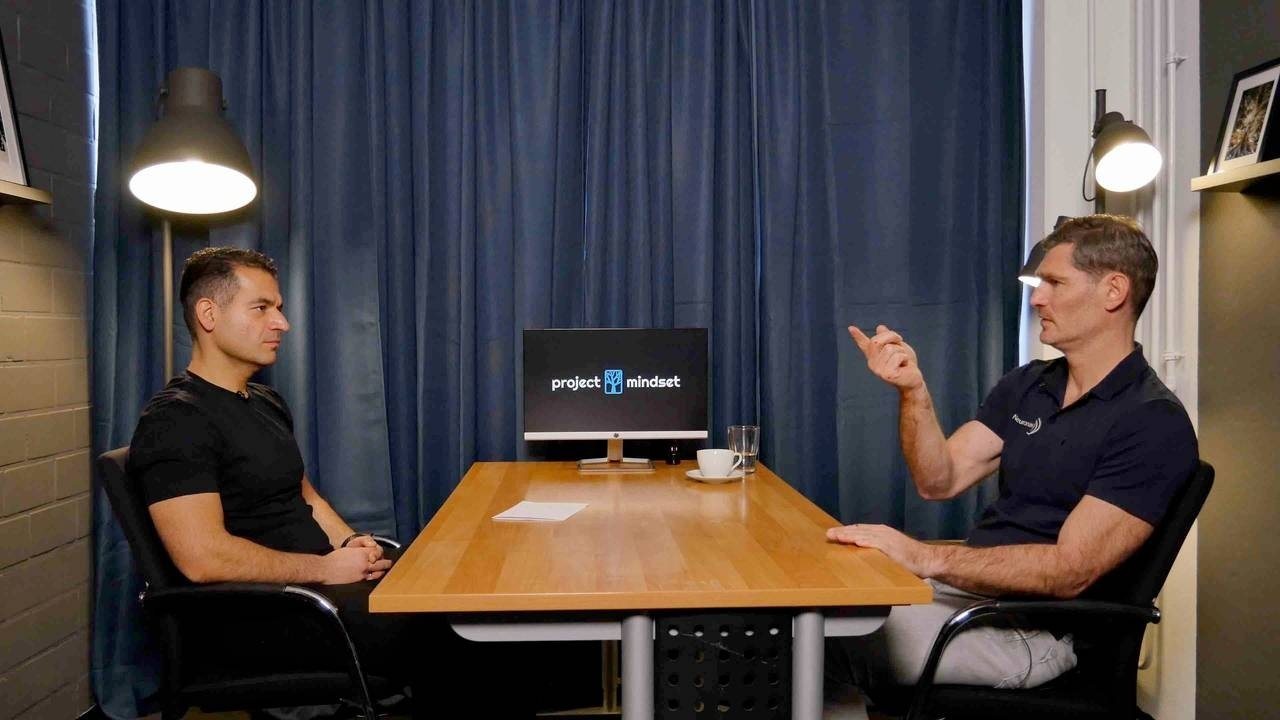
Henning Fritz was World Handball Player of the Year in 2004, European Champion, and Olympic silver medalist. Just one year later, he was struggling with burnout symptoms and unable to perform at his best. In this episode of Project Mindset, Reza Mehman talks with the former professional goalkeeper about the dark side of elite sports, emotional distress, and the mental turmoil that follows success. Henning Fritz speaks candidly about why chasing first place was easier than defending it. The conversation touches on topics such as gratitude, mindfulness, frequency modulation, and what comes after a successful sports career. An honest discussion about mental health in competitive sports that extends far beyond handball.
Summary
In one sentence: World handball player Henning Fritz talks about his fall from the absolute top to burnout and his way back to inner strength.
Short summary: Henning Fritz experienced the most successful year of his career in 2004, winning the European Championship, an Olympic silver medal, and being named World Handball Player of the Year. Just one year later, his performance level plummeted, and he struggled with burnout symptoms because he focused on maintaining his status instead of striving for further growth. Today, he works as an entrepreneur in the field of frequency modulation and has found a new approach to mental well-being through mindfulness and self-reflection.
Detailed summary: Henning Fritz looks back on an outstanding handball career, the highlight of which was 2004 with the European Championship title, an Olympic silver medal, and the award for World Handball Player of the Year. However, his attempt to defend this status instead of striving for further progress led to burnout and a massive drop in performance in 2005. Fritz openly describes how he lost his reflexes, his emotional range, and his inner drive, and was demoted from first-choice goalkeeper to third-choice. After retiring from professional handball, he found a new path in life as an entrepreneur through mindfulness, gratitude, and the topic of frequency modulation. In conversation with Reza Mehman, he demonstrates that mental health should not be taboo in elite sports and that personal growth never ends.
Context: Who, What, Why
Who is speaking: Reza Mehman, host of the Project Mindset podcast, in conversation with Henning Fritz, former professional handball goalkeeper, World Handball Player of the Year 2004 and current entrepreneur in the field of frequency technology.
What is it about: It’s about the fine line between absolute success and mental collapse in elite sports. Henning Fritz tells his personal story from the summit to burnout and back, talks about gratitude, mindfulness, and his entrepreneurial fresh start.
Why is this relevant? Mental health in competitive sports is an increasingly important topic. Fritz’s story shows that even the most successful athletes struggle with psychological stress and offers valuable insights for anyone under pressure to perform.
Three key questions of the episode:
- Why was Henning Fritz unable to replicate his previous success after his most successful year?
- How does a top athlete cope with the loss of their identity as a high performer?
- What role do gratitude and mindfulness play in coping with burnout?
Table of contents
- Introduction – What this episode is about
- Summary – The episode in brief
- context – Background information on Henning Fritz and the conversation
- Topics and classification – The central topics
- Key messages – The most important findings
- Frequently Asked Questions – Answers to the most pressing questions
- Highlight quotes – The strongest statements from the conversation
- Transcript – The full interview to read
- Keywords – Relevant search terms for the episode
- Names and terms – Key references at a glance
- quotable passage – For sharing and quoting
Topics and classification
1. Burnout in elite sports
Henning Fritz describes how the transition from hunter to hunted destroyed his mental health. The drop in performance after the most successful year of his career illustrates the psychological dangers of peak performance without sufficient recovery.
Keywords: Burnout in elite sports, decline in handball performance, athletes’ mental health
2. Identity and self-esteem in competitive sports
The conversation highlights how closely a professional athlete’s identity is linked to their performance. Fritz experienced his demotion from first-choice goalkeeper to third-choice as a profound emotional blow.
Keywords: Athlete identity, self-esteem, competitive sports, emotional distress
3. Gratitude and mindfulness as tools
Fritz reflects on how he was not grateful enough for his successes during his active career and how mindfulness helped him find a new way to connect with himself.
Keywords: Gratitude, Success, Mindfulness, Mindset, Self-Reflection
4. From Hunter to Defender: The Psychology of Success
One of the episode’s key insights: It’s psychologically easier to strive for something than to defend it. This shift in perspective cost Fritz his effectiveness.
Keywords: Psychology, Success, Mindset, Defense, Striving vs. Defending
5. Second career and entrepreneurship after sports
Fritz talks about his journey as an entrepreneur in the field of frequency modulation and the challenges of reinventing himself professionally after a sports career.
Keywords: Career after professional sports, entrepreneurial athlete, frequency modulation
Key messages
- Henning Fritz’s drop in performance after 2004 was not due to a lack of talent, but to a mental shift from striving to defending.
- In his own estimation, the attempt to defend the title of “World Handball Player” instead of continuing to improve individually was a crucial error in thinking.
- Fritz’s burnout symptoms manifested as a loss of reflexes, focus, and emotional energy during play.
- Fritz perceived his demotion from first-choice goalkeeper to number three as an emotional affront, which further accelerated his downward spiral.
- During his active career, Fritz was not grateful enough for his successes because he was constantly chasing after the next goal.
- The environment surrounding an athlete often reacts to a decline in performance with distance, which further increases the psychological stress.
- According to Fritz, mindfulness and recognizing one’s own emotional patterns are crucial tools for breaking out of destructive spirals.
- Fritz sees personal growth in being able to react to setbacks faster and more calmly than before.
- As an entrepreneur in the field of frequency modulation, Fritz now combines his sporting experiences with new scientific findings.
- Fritz emphasizes that life is not just about peak performance, but about the ability to stay true to oneself even in difficult phases.
Frequently Asked Questions
Why did Henning Fritz experience burnout symptoms after 2004?
After the most successful year of his career, with a European Championship title, Olympic silver, and being named World Handball Player of the Year, Fritz mentally shifted from striving to defending. This change in perspective, combined with insufficient recovery and high pressure to perform, led to a decline in his performance and symptoms of burnout.
What was Henning Fritz’s greatest success in handball?
Henning Fritz was the first goalkeeper ever to be named World Handball Player of the Year in 2004. That same year, he became European Champion and won the silver medal at the Olympic Games in Athens. In 2007, he also won the World Championship with the German national team.
What does Henning Fritz mean by “it was easier to hunt than to defend”?
Fritz describes how he constantly strived to improve throughout his career and always had a next goal. After reaching the pinnacle as World Handball Player of the Year, he suddenly focused on defending that status instead of continuing to grow. This defensive mindset stifled his natural potential.
What does Henning Fritz do for a living today?
Henning Fritz is an entrepreneur working in the field of frequency modulation. He focuses on technologies that use frequencies to positively influence human well-being and performance, combining his experience in elite sports with new scientific approaches.
How did Henning Fritz overcome his burnout?
Fritz describes his journey out of burnout as a process characterized by self-reflection, mindfulness, and a new understanding of gratitude. He learned to recognize his own emotional patterns and break destructive thought spirals, instead of defining himself solely through athletic performance.
What role does mindfulness play in Henning Fritz’s mindset?
For Fritz, mindfulness is now a key tool for recognizing early on when something is out of balance. He emphasizes that it’s about consciously perceiving one’s own emotions and thoughts, instead of blindly following them, and thus being able to react more quickly to challenges.
What is frequency modulation in the context of Henning Fritz’s work?
In Fritz’s business context, frequency modulation refers to the use of specific frequencies to improve physical and mental well-being. The idea is based on the fact that the human body reacts to different frequencies and that these can be used specifically to enhance performance and promote regeneration.
According to Henning Fritz, how can you tell that you have developed mentally?
According to Fritz, mental development is demonstrated by reacting to setbacks and difficult situations more quickly and calmly than before. The measure is not whether one still has problems, but how one deals with them and how quickly one regains a positive balance.
Selected statements from Henning Fritz
“Until then, I had always strived to improve. And this honor made me feel like I was now at the very top. And in my mind, I now had something to defend.”
“From my point of view, the mistake was even having the idea of having to defend anything. Because that’s nonsense.”
“I lacked the inner energy to perform. What distinguished me back then was that I could really dig in and immerse myself in a game like that. Suddenly, that was no longer possible.”
“Not playing anymore, that’s your praise or what you long for. To show what you can do, to thrill the audience, who applaud. That’s your satisfaction.”
“You’re caught in a cycle of thoughts that is no longer optimistic and positive, but rather paralyzes you.”
“I am of course very grateful that I was able to have such a career.”
“From my current perspective, I would approach it by asking myself how I can further improve individually in order to be as efficient as possible.”
The full conversation
Hi everyone and welcome to Project Mindset. I have a little something for you about today’s episode. I had the opportunity to conduct another interview, this time with professional handball player, or rather, former professional handball player Henning Fritz. An incredibly interesting person. I really have to say. In 2004 alone, for example, he was World Handball Player of the Year, European Champion, won a silver medal at the Olympics, and much more. And then, interestingly, 2005 was a rather dark period for him, marked by, well, let’s just say a decline in performance and burnout symptoms.
For me, the question was naturally how someone could be so outstanding one year and then suddenly unable to replicate that performance the following year. His answer was incredibly open and transparent. He said, essentially, that it was easier for him to chase first place than to defend it. So, a really interesting podcast today. If you want, you can watch the whole thing on YouTube or just stay here in the podcast. Okay, enough talk, enjoy the interview.
And six months later, I became the first goalkeeper to receive the World Handball Player of the Year award, and I felt like I was at the absolute top. Up until then, I’d always strived to improve, and so on, and this award made me feel like I was now at the very pinnacle. And in my mind, I now had something to defend. So, mentally, I might have made a small mistake there, because I thought, okay, now I have to defend a perceived title, instead of continuing to strive for something more.
A look back at an extraordinary career
Henning, thank you so much for taking the time to talk to me about your mindset today. Thank you for being here. Yes, Reza, I’m happy too. Thank you for the invitation. Yes, thank you. Well, I think I already mentioned it earlier. It felt like I already knew you. Of course, I googled you earlier. Anyone who’s into sports knows you. I think there are very few people in Germany who have won as many titles as you. You were European Champion in 2004.
You were World Handball Player of the Year, the first goalkeeper ever to receive that honor. That’s quite interesting. You were a World Champion in 2007. German Champion, Cup Winner – you’ve experienced it all. So, thank you very much for being here today. The first question I have is, what does one actually do after such a fantastic career? Well, first of all, I’m incredibly grateful that I was able to have such a career. And yes, I did give it a lot of thought after this career.
Some things just fall into place. I initially wanted to stay involved in sports. It wasn’t possible for me to continue playing handball directly. I tried to move into the fitness industry, but realized that, on the one hand, as an entrepreneur, I might not be ready yet, and on the other hand, I need to gain some more qualifications. So I’ve tried a lot of things and am using this current situation to really think things through.
Goals during and after handball
I’m 47 now, and I’m wondering how the next few years of my life and career should unfold. Perhaps the question is, have you actually achieved everything you wanted to in handball? Well, those desires usually develop during your career. When I was 18, I didn’t yet know that I would be playing in the Bundesliga. And then, when you win your first title—which I did at 22, winning the cup in Magdeburg—you get a real sense of excitement and anticipation, and you realize, okay, you’re not just playing in the Bundesliga now, but you can actually win titles, and then, of course, you want more.
That brought corresponding desires. And when I succeeded in winning titles at the national and international level, then of course everything was open to further achievements, and unfortunately, the Olympic gold medal eluded me. In 2004, we were in the lead for 35 minutes against the Croatians, and yes, then perhaps we lost a bit of conviction, that conviction, to turn the game around for us. So, the Olympic gold medal eluded me, but otherwise, I believe I was able to achieve everything.
The successful year 2004
I’d still say, though, that’s nitpicking at a very high level. 2004 was such a, let’s say, incredibly exciting year for you. Of course, I could only observe it from afar. But what I also find incredibly admirable about you is that you’ve always been very transparent, speaking not only about the highs but also about the lows. For example, in 2005 you said you had burnout symptoms. I was aware of that. How is it that someone is so successful in 2004 and then, a year later, has symptoms of burnout?
Continued
I’m not even sure if I’m expressing this correctly. Perhaps you could elaborate on how it all came about. Well, I wasn’t exactly the kind of goalkeeper who was already the top goalkeeper at 18 or 19, but I had talent and, of course, a great interest and ambition to always be the best. And when I look back on my career, I’ve actually developed gradually, in small steps, year after year. I had coaches who gave me the opportunity to play at a high level and get plenty of playing time.
And 2004 was ultimately the peak. I was playing for THW Kiel back then, a very successful club where expectations were also very high, where recovery wasn’t necessarily a priority. I simply got a lot of playing time and played a lot, had few breaks, but was carried along by the success, by the euphoria. You ride that wave of success and then you don’t need any of that recovery stuff because you just want to keep going and going and going.
You mentioned it, the 2004 European Championship. I was honored as the best goalkeeper in that tournament. Six months later, the Olympics in Athens, where we won the silver medal in the final. I was also honored as the best goalkeeper there. And then, six months after that, I became the first goalkeeper to receive the World Handball Player of the Year award. I felt like I was at the absolute top. Up until then, I had always strived to improve, and so on and so forth. This award put me right at the very pinnacle.
Wanting to defend one’s own status
And in my mind, I now had something to defend. So, mentally, I might have made a small mistake there, because I said, okay, now I have to defend a perceived title, instead of striving for something else. And that could be a factor. So it’s pointless to say what the cause was, because it’s a very complex issue. And then it actually came to the point where I was no longer able to deliver that performance. I lacked the inner energy to perform.
What distinguished me back then was my ability to really dig in and get into a game. My ability to focus on the ball. My ability to stay on my feet for a long time and then parry the ball with a quick, sharp movement. I think your reflexes were… Exactly. Yes, the reflexes. And all of that was suddenly lost. Agility, focus, the emotions. I was someone who could really dig in and get into a game. And then I’d have those little verbal duels with the other team’s top players – that was what defined my game.
Suddenly, that was no longer possible. And with that, what had made me strong up until then was taken away. The quality that remained wasn’t enough to play at the absolute top level. And that’s what I was measured against. Well, not just me, but the public as well. And they said, “Yes, now he has these titles. And suddenly that’s no longer the case, he doesn’t want it anymore.” Or then, I don’t know how the public thinks then.
When thoughts race before training
At least that’s how I thought, how would it come across in public, and so on. And then you’re caught in a mental whirlwind that’s no longer optimistic and positive, but paralyzes you. My thoughts just kept circling before every training session. Remember today, give it your all, be positive, and so on. Which, until then, had been a given. I don’t think I was doing it for every single training session. I gave it my all. Some days were good, some maybe not so positive, but you had your level. And then I lost that.
And that meant that absolute top performance was simply no longer possible. That, of course, hurt me. And the spiral I was just talking about, from 18 or 19-year-old to successful goalkeeper, that spiral slowly went downwards. And that was, of course, very depressing. Because, as I said, I’d been carrying a lot of baggage. These successes were becoming more manageable. And the club also recognized, well, Henning can’t replicate that level of performance anymore. So we’ll bring in a third goalkeeper on short notice.
Suddenly I was only number 3. Which intensified the feeling that I couldn’t perform at that level anymore. First of all, you get very little playing time. Then, and I think this is a crucial point, there’s the emotional aspect. It’s an insult to be only number 3 now. Not just to be substituted, but not to play at all. And basically just to train and so on. And that was a very, very tough time. Were you hurt by being dropped?
Continued
Yes, that was an emotional blow. That’s how I felt. Because not playing anymore—that’s your reward, what you crave. Showing what you can do, thrilling the audience, the applause. Ideally, you win, and so on. That’s your satisfaction. Yes, of course it’s a job, and we certainly earned good money back then. No question about it. But that’s not what motivates you to go to training every day, to the game, and so on. You might do that if we’re talking about the normal cycle, three-year contracts.
It’s about this contract, and once that’s settled, it’s just about how I can improve to be successful. Did I understand you correctly that it was basically easier for you, mentally speaking, to say, “I want to be the best I can be,” and then, once you’d achieved it, it was difficult to defend that. It was easier. From my perspective, the mistake was even having the idea that you needed to defend anything. Because that’s nonsense.
Individual development instead of title defense
From my perspective today, I would approach it by looking at how I can further improve individually to be as effective as possible. Because, of course, I was also getting to an age, my early 30s, the prime age for a goalkeeper. But back then, my awareness and knowledge weren’t as advanced, as I was driven by ambition and spent almost all my time in goal. Now I would say, pay more attention to your basics. I mean basic endurance, which you inevitably lose over the course of a season playing in goal.
And because we mostly just stood in goal during regular training sessions, certain basics simply get lost. You’re certainly good in goal, but you still need your basic endurance, strength, and so on. And I didn’t have that knowledge back then. Like I said, I think I’m a bit wiser now and would advise young goalkeepers or young athletes to pay more attention to the basics. Because you know the terminology like the foundation of a house.
If the foundation isn’t solid, if pressure is applied at the top, then it collapses. And I think I would do some things differently today. I don’t want to rub salt in the wound, but you also mentioned—and I understand it was—that it was also uncomfortable to suddenly be the third-choice goalkeeper. Were you, so to speak, embarrassed by that? Were you worried that your family and friends would see you differently?
Ego and personal grievances
No, not that, but I do think it has a bit to do with ego. I mean, you need a certain amount of ego to even get there. And that ego was, maybe that ego was bruised. Little Henning, sitting in there, he was hurt. How can this be? I mean, I’m Henning Fritz, national goalkeeper, I’ve achieved this and that, and now I’m only number three. World Handball Player of the Year. Exactly, from the perspective of those in charge. In hindsight. Well, how they handled it is debatable, but the fact that they had to make decisions is completely understandable.
But back then, I had no solution for how to get out of that situation, how to perform again. I was more or less trapped in this emotional prison. Little Henning was sulking, my ego was bruised, and those aren’t mental states that give you renewed strength. Instead, you get stuck in this cycle of negative thoughts, and as I said, I had no idea how to get out of it quickly. I hadn’t forgotten how to play goalkeeping, but perhaps, if you had analyzed it, what would have been necessary was to say, okay, maybe not six months off, but just slow down, regenerate, strengthen the basics again, rebuild yourself mentally, put the successes you’d had so far behind you, and move forward.
Starting again with small steps
How do I get back to that point? I mean, not how to become world champion again, but how to start again in small steps? You know, the immediate thought was, “How do I become world champion? It’s impossible.” You have to take the small steps again, the basics, to get back to that point. Like I said, our knowledge is much more advanced today. I completely understand what you’re saying. I didn’t reach the same level as you, but I also had a company back then that was doing pretty well at the beginning, and then a few, let’s say, not-so-good decisions were made, and suddenly I was facing a complete mess, so to speak.
And it was really difficult for me too, to get out of that spiral of thoughts, to pull myself together, to realize, okay, hey, I have to move forward step by step again. And I find it very interesting that you said you didn’t have it in your head to immediately become world champion again, but that you wanted to build it up again in a structured, slow way. Yes, maybe I didn’t have that in mind back then, because today I would say it that way, and I think it’s simply part of life; up until then, my sporting progress had always been gradual, always progressing in small steps.
Continued
You know? Well, I wasn’t used to dealing with, let’s say, a personal defeat. As a little boy, you were used to it; you didn’t have the ambition to be up there, you didn’t even know what it was like to get there. But because the path to success came step by step, and then suddenly it hit you like a ton of bricks, you were used to it, because you’re not prepared for it. And that’s why I think, whether in sports or business, the basics are what matter; it’s about developing further, improving the product, and so on.
So, if I had a year where things went exceptionally well, I couldn’t expect the next one to be the same. We’re dependent on so many things, whether as an entrepreneur or, in my case, as an athlete—as an athlete, you get older. We know that the body changes, I think, roughly every seven years. I wasn’t aware of that back then; it’s a continuous process. And these are things that are simply part of life, and that’s why I appreciate them differently now than I did back then.
Becoming more aware of one’s own body
Back then, I took it for granted that my body would function properly. Today, I see things differently and say, okay, we need to get back into shape a bit more, either to preserve and maintain a certain level of performance or to slow down the decline that comes with age. Yes, you just made a very important point: appreciating things. Now, looking at it from the outside—I’ve followed your career a bit, of course, and even looked up when and where you were—it struck me that you need to slow down a bit at your age.
I’ve been following your career a bit lately, reading up on where you were and when, and it struck me—or rather, I asked myself—back in 2005, when you were experiencing the first symptoms of burnout, were you still grateful for the career you had already achieved? Gratitude is extremely important to me in my project mindset; I consider it a core principle. That’s why I wondered how you reconsidered your approach to gratitude back then.
Gratitude after a career
Because you’ve already achieved so much. So, naturally, you’re initially grateful that you even had that opportunity, that perspective on something. I think during my time as a professional handball player, I perhaps wasn’t mature enough, and emotionally not ready, to feel that gratitude. It was more about wanting to go further, more and more and more. Today, with some distance, I’m naturally incredibly grateful that I was able to live my dream, that I was able to turn my hobby into my profession, and not just into a profession, but that I was also able to be so successful at it—to be in the public eye, to have a certain level of recognition, to become a Grand Prix. I mean, that’s a truly wonderful thing and a dream come true.
I feel immense gratitude for that today, and that’s why it’s important to me to talk about these things that might be hidden in public, like burnout symptoms or similar things. They’re part of life, and that’s why I speak openly about them, because I believe there are many who have similar symptoms, but often say, “Oh God, maybe I’m wrong,” or “That’s not true.”.
Talking about personal experiences
There are many people who have similar experiences, everyone deals with it differently, and it’s about raising awareness and helping people get an idea of where to start with themselves. Because we’re always quick to focus on external factors, blaming others for some personal situation. I was like that back then too; it was the coach, or this or that, or the defense wasn’t good enough, or whatever. No, we always have to start with ourselves, no matter the topic, and my awareness today, even with distance from handball, is different than it was back then.
I also believe that in handball, the pressure at that moment, because you’re in the public eye, with the media and so on, is so intense that you’re always quick to go on the defensive. Now that I no longer have that pressure or that feeling, I can handle it much more calmly than I could back then. There may be athletes who are much more reflective during their active careers, and that’s certainly beneficial, no question about it. I wasn’t like that back then.
What becomes clearer in retrospect
I think I only became more aware of many things after my career ended, and that’s why I like to talk about it, ideally as a preventative measure, so that many people think about it beforehand and become more aware, and also so that people in regular working life say, “Hey, athletes go through the same thing.” I can understand the feeling quite well, and I feel it myself, but there are solutions. There are always solutions. And I think the important thing is simply to have conversations.
That’s why we’re talking about how it’s a normal state of affairs, that sometimes, you notice time and again, that people who are at a certain stage of life—if you talk to a 20-year-old about this topic, they’ll ask you, “What’s that old man talking about?” Are you talking to someone, let’s say, in their early to mid-30s, who has perhaps already worked for 10 years, has a family, and so on? These are all things that pull us towards ourselves. Responsibility, pressure, I mean, having to earn money to pay off loans and this and that.
Continued
That’s responsibility, which makes life not as easy as it was when you were 20. And we have to face up to that responsibility and find solutions, and perhaps also find solutions within ourselves, so that we’re not always just running in this rut, but that we also need to find some peace. And that’s the big challenge. Absolutely. Speaking of finding peace, you continued directly into entrepreneurship, so to speak. I’ll get to that in a moment. But before I get to that, you played again this season.
How did it come about that you said, “I’ll give it another try”? Well, the Flensburg coach, Mike Machula, is my brother-in-law on one hand, and on the other. Yes, they had a goalkeeping problem, and at some point he asked me how fit I was. And that hint surprised me a bit. Yes, and he asked me if I could imagine playing again. I knew it was about a month, about playing again for a month. And I’ve kept myself fit over the last few years.
Another sporting adventure
That was the basic prerequisite for me to even embark on this adventure. And of course, given the circumstances, I said, okay, if the situation is like this, then I can imagine doing it again. Yes, it was very exciting. I’m incredibly grateful today that I was given this opportunity again. And what’s interesting is that I played for THW Kiel for six years. There’s a strong rivalry between Flensburg and Kiel, for which I’m very grateful that the fans actually gave me a standing ovation at my farewell.
And that against our biggest rivals. So that’s a really great gesture from the fans and everyone involved. The way I was received there was fantastic. And that’s why I think it was such a great experience. It definitely speaks volumes about Henning as a person. I have to say, the opposing fans totally respect that. Amazing. Now let’s talk about the business side of things. You’re doing some really exciting things right now. I think you’re basically doing the things you probably wished you had back then, in terms of information about performing.
The idea behind NeuroNavi
So what do I need to do, or what can I do, to perform better? You’re involved with regeneration, that was one aspect, but perhaps this is the best approach. Yes, the startup is called NeuroNavi. And I already used the idea behind NeuroNavi back then, in the lead-up to the 2007 World Cup, to regain my performance level. Essentially, at NeuroNavi, we work with frequency modulation. We trigger the autonomic nervous system and thus have the ability to activate areas that are necessary for regaining peak performance.
In short, we essentially support the body’s own regeneration process. This system is, after all, very complex. And we trigger this process through music. There are various ways to do this with music. Ultimately, we know that everything is based on frequencies. Just as light has a frequency, sound also has a certain frequency. And we now have over 25 years of experience in this field, giving us excellent opportunities to tailor the process to individual needs.
And the symptoms range from burnout, tinnitus, and migraines to so many more. These are all everyday symptoms. And there are ways to support the body’s self-healing abilities. I find that very interesting because it’s a topic that cuts across all sectors of society. It encompasses everything related to stress, including learning difficulties in children. We’ve talked about business: managers driven by deadlines, revenue, pressure, and so on. And then there’s the housewife who manages the household—that’s not a six-hour day, it’s full-time.
Henning Fritz on his entrepreneurial approach
The medical field, meaning what the doctor ultimately does with their hands, supports the body’s self-healing process. We, on the other hand, do this through our ears. And I believe that doctors appreciate what helps them with regeneration, or rather, what accelerates regeneration. So, ultimately, the need is across all sectors of society. The challenge is to individualize it. That’s what we’re working on. And that’s why I find this topic so incredibly exciting.
I can imagine it. Headphones. Exactly. So, headphones—at the moment, we have the option of using hardware to store this large amount of data. We’re working on offering this digitally, of course, since most people already have a playback device and their own headphones. Headphones should naturally be high quality and over-ear to optimally develop the sound within the ear. Exactly. That’s how it works.
Continued
But we now also have systems that can fill a room with sound. So, the room is essentially measured with a small microphone to see how the sound develops within it, in order to create a speaker system that is precisely tuned to that space. Could you elaborate on the topic of frequencies? Because I’ve never considered it from that perspective before. Yes. Yes, frequency is ultimately the frequency we play that ultimately reaches the eardrum.
The eardrum has an autonomic nervous system via muscles and fibers. And that’s how the stimulation works. Exactly. And as I said, we can perceive frequencies through light. We know that certain light frequencies can either activate us or calm us down. And we do the same thing with these sound frequencies, which ideally can be played through music. So, music—if we have music that calms you down, some people like classical music.
I find nature sounds amazing. They all emit a frequency, a fundamental frequency, which is often in the limbic system. That means it addresses our emotions. But the frequency we ultimately incorporate is specifically targeted at the autonomic nervous system. And that’s where the challenge lies, in differentiating between factors like gender, age, and pre-existing medical conditions. And sleep was a problem for me back then, too. I needed a lot of sleep, but it wasn’t restful.
Sleep and regeneration in conversation
So he wasn’t in that deep sleep phase. I couldn’t get into that deep sleep phase either. And that was the problem, the reason I couldn’t regenerate. With NeuroNavi, we have these frequencies that help bring someone into that deep sleep phase, simply to improve their sleep quality. When deep sleep is reached, for example, these self-healing powers are activated, hormones are released, which, I don’t know, affect the liver. This is about digestion and so on and so forth, which are necessary to make us perform well.
So, on the one hand, it’s about allowing us to regenerate properly and then be productive again the next day. Anyone who’s productive one day knows how much they miss out on good sleep, especially if they don’t get enough rest. And that’s the area we want to work in. So, you’ve basically won me over as a customer. I also sometimes have, let’s say, sleep problems. It’s probably not just because of the two children I have, but I sometimes notice that it’s a problem.
I know I need time to wind down after going to sleep, of course, but I’ve actually never thought about the topic of frequencies. I’d like to try it out sometime. Frequencies affect us all day long. Electronics, electricity—that’s all a form of frequency, Wi-Fi, too. They affect us all day. And in our modern electronic world, we can take, for example, the rolling noise of a tire. That’s a frequency that comes in waves.
Frequencies as the topic of the interview
We don’t perceive it here in a building like this, for example. But this sound, this frequency, passes through and affects your body. And there are low-frequency frequencies that tend to impair our performance. For example, engaging with positive or creative things takes us to a very different level. And that’s where the challenge lies, because we also fall asleep, of course, we’re stuck in thought patterns.
So, I have activities, maybe a job, that don’t fulfill me, I get annoyed by the stress, I get annoyed in my personal life, but am I fulfilled by what I do? Of course, children are wonderful and they give you so much. But they also take a lot of energy. Then there’s regular sleep. That’s also rhythm. I believe humans are creatures of habit who need rhythm. Sometimes it’s good for us not to always do the same thing. But especially when it comes to sleep, ideally we should all have the same sleep rhythm.
This can be compensated for much better than if we’ve been dealing with this issue for 10 or 15 years. Because then, due to this persistent, persistent imbalance, the body eventually becomes unable to compensate. And there are different approaches. One, for example, as you mentioned earlier, and I’m trying to bring this up, is to simply stop consuming media, whether it’s a smartphone, laptop, or television, for a certain amount of time before going to bed.
Continued
And that you process and confront things that might be weighing on your mind. The confrontation can involve asking yourself what’s bothering you most right now. Is it the anger you feel about the issue, not condemning or complaining, but saying, okay, maybe just let it be. The confrontation is about how you deal with it. It’s about finding a solution, because otherwise you’ll just get emotionally stuck in the anger again. We want to find a solution. We want to resolve this. And confronting it means finding a solution.
So, with my superior, or with my superior. And most of the time, we push away precisely these unpleasant things. We might not be consciously aware of them right now, but our subconscious knows they’re there. And in order for the subconscious to let go, we have to confront it. So, each of us actually has issues. Whether it’s, as I said, it could be many things, the opportunity lies in writing things down and being able to let them go. I believe that’s the great challenge we face in life: being able to overcome them.
Because I believe this letting go, because we live in a very materialistic world where we like to accumulate and hold on to things, is difficult, especially when we feel almost completely alone with ourselves. But I think that’s the great challenge: to improve ourselves in our own areas with the little we have, in order to find contentment. That’s a form of happiness, even if that sounds a bit silly. No, I’m absolutely with you. I’m also thinking a lot about the topic of mindfulness; it’s something we haven’t talked about enough.
Talk about self-care early on
That’s why I say we’re not adequately prepared for it. For me, this should really be a school issue, that children are confronted with such things early on. There are also many people who have the need to help others, which is good. But I believe that if everyone first takes care of themselves—and this has nothing to do with being very strong or very good at something—then they will help the weaker ones. That’s perfectly fine. But only when I am strong myself can I help others.
But if I only help others and become weak myself, then I’ll eventually break down. I believe it’s important that we maintain this curiosity, especially now—which is why the topic of school is important to me—even as adults. It gives us satisfaction. When I’m curious and have my hobby, time flies. When we have unpleasant topics, things that are also part of life, then we think, “How much longer?” and “Oh God,” and so on.
And from my perspective, schools need to better prepare us for these aspirations. That’s actually my wish, that we better prepare our children for life. Because, as you can see from our conversation, we have the same problems with many issues that then occupy us from a certain age and almost become a permanent fixture if we don’t find a solution. Ideally, we’d be well-prepared so that either these problems—or, as I’m trying to say in this conversation, to raise awareness and help people find solutions—are resolved.
Recognizing your own warning signs
May I ask you again? You just mentioned recognition. How do I recognize that something’s going wrong? I’m asking deliberately because we’re usually so caught up in our routines, so tunnel-visioned, so to speak, but I’m not really aware of my situation. I can’t perform as well as I used to. But I haven’t noticed what else is going on around me. I mean, reflecting on the current situation. Yes, I’ve basically been basing my life solely on how I’m performing in that tunnel.
Yes, it’s actually quite crazy. It’s not really natural, is it? It’s true in all aspects of human life. I’m still working on that myself. So maybe I don’t have the 100% perfect solution yet, but I think the concept of reflection is working, and the more regularly I do it—just what we were just talking about, lying down in bed at night and saying, okay, what happened today? The relevant things. I don’t have to do anything more, and maybe not judge. We’re always so quick to judge—good, right, I want more of this and that—but rather just to let it all sink in.
Taking a break from the fast pace of everyday life
And I believe that we as human beings have the capacity to find solutions, but because of the fast pace of life and the things around us, we’re often driven by the need to increase revenue and profit, so this numbers-driven approach shapes us more than our gut feeling. And I believe that if we manage to find this balance and this inner peace, then we can regain access to that inner strength when confronted with certain issues. This is, of course, also very much connected to the topic of mindset.
Continued
That’s why I also do the podcast to learn from other people. When it comes to mindset, I always ask myself one thing: how do I know if I’ve made progress in that area? It’s super easy: as an entrepreneur, you can look at your revenue, and as an athlete, you’re actually not supposed to make any progress in this area because you simply can’t track mindset. You have to go with your gut feeling to know if you’ve made progress or not. But if I ask you now, Henning, how do I know that I’m mentally healthier today than I was a year ago?
If you’re saying that with all this tracking and stuff, then we actually have to find a way to understand what satisfaction is. There we are again, driven by the desire for more revenue, more of this and that. I have nothing against that, quite the contrary; making money, making good money, is perfectly legitimate. I think the challenge is that not everyone has the opportunity to say, “Okay, I’ve made money,” because many are simply in professions where they say, “Okay, I haven’t really thought about it yet, but I simply have to earn money to pay my rent, my car, and all my other expenses.”
Balance and time for oneself
I think it’s simply about balance in life, about what I said earlier: taking care of myself first, which I call, and describe as, exercise. Everyone can interpret that however they want—whether it’s running, weight training, or boxing. There are various ways to keep myself healthy and fit. Of course, mindset is also part of it, confronting everyday problems regularly, ideally. Companies usually take stock and so on, and I look at how the year went, where we want to go next, and when I regularly review my own progress, ask myself if I’m satisfied, and where I want to go.
I think that’s one of life’s challenges we face, and having time for something like that early on, and a different perspective on the whole thing than at 27, 35, or 42—that’s the process, after all—but confronting myself with these things in the first place, that’s the challenge, and that would be my wish, that schools actually make this playful from an early age, because quite honestly, if we both agree that it’s important, that it should be a kind of natural part of life…
To come to terms with one’s own situation
That would be my wish, and I believe that’s an important point. I hope that I’ve now answered the question to some extent. There’s no 100% solution, I think, this confrontation. I believe that being reflective is very important because I think there are many people who say, “This is a good job, this is a good job.” And if I don’t feel that way and only value myself because I have the best numbers, but five people below me are totally unhappy because I’m driven by the pressure to meet numbers and do this and that, if we look at this picture, he’s doing everyone a good job or ensuring they have a good job.
I believe this is also a process that can be passed on. That’s actually what I would like to see. With all the talk of making money and so on, which is perfectly legitimate, if someone has a good product and regularly improves it, then they should earn good money. That’s part of it. That’s why I think there’s a certain dissatisfaction among many people; they simply sense that something has gotten a bit mixed up. They feel like they’re working hard and doing everything they can, and yet they’re still not getting anywhere.
Performance and appreciation
We need to get back to the point where good work, good performance, is recognized when someone strongly identifies with something and not with something else. Thank you so much. That was incredibly interesting for me. We just learned how you dealt with setbacks back then, how you reacted, what you did to cope and overcome them. How do you deal with the topic of failure today? Has your perspective changed? I’m no longer in a professional setting. Let’s take my startup as an example.
Of course, I would like us to reach our goals more quickly at times. But it’s a very complex issue, and I believe it simply takes time before we can take the next steps. I’m used to having to evaluate myself in this way, as so much is changing emotionally. And so my approach right now is to differentiate very carefully where I will invest my energy in the near future. Because I’m also at a certain stage in my life now; I’m 47.
If I delve deeply into a topic now, it will shape the next few years. That’s why I’m currently thinking a lot about things that bring about change. As I said, I believe it’s simply essential. Things that people truly need for the foundation of life. My focus is on health, sports, getting people active, getting them moving again. Many people have no access to sports at all and then they admire themselves. “Oh, I’m in pain,” and then they always say, “There’s always a solution.”
Continued
We need to regain mobility, the natural mobility the body needs to free up a joint. Then I can get you pain-free and improve your quality of life. This isn’t about performance, but about the everyday things I’m currently working on for people, which is why I’m currently seeking contacts and networks with like-minded individuals who develop high-quality products that either restore or maintain their ability to function.
I find that a very interesting topic. Perhaps a slightly unfair question, because if you’re an athlete, I think you’re very strongly driven by ego, and it’s simply a different world. Looking back, I don’t think I was really aware of much of what went on around me. I was in a hall when we traveled—airport, bus, hotel, sports hall. That world was very comfortable for me because, on the one hand, I had the time, but on the other hand, I also naturally wanted to orient myself, to know where I was headed, and I wanted to engage with things that would improve my own life, as well as the lives of others.
Entrepreneurial perspectives and personal happiness
That’s important to me, and I’m confident that there are suitable solutions there in which I, as an entrepreneur, can also be involved. What always interests me about my guests is what makes them happy. May I ask you, what made you happy back then versus what makes you happy today? Back then, success made me happy. Winning titles, contributing my part, of course, but success itself was a bit too hectic, and it was those everyday things that made me happy.
If you have teams where you play games with people who think alike, then that might not be the approach you’d expect as a professional athlete, but I remember, especially in Kiel, in my first year at THW with Magnus Wislander, the legendary Swedish handball player, Stefan Löfgren, Nicola Schöner, we would always sit together two days before the game, there would be a crate of beer in the locker room and we would drink beer and I found that so relaxing, the old Swedes would tell old stories and I enjoyed that moment, so in that group or also with the national team when we were on the road, there was of course also the social aspect, surrounding myself with people who think alike.
But I’m no longer so ego-driven, so focused on success, but rather on content, on networking with like-minded people to bring together good products or services. Everyone has their skills, and I believe that the cooperation of different skills within society or a group is always strong in nature; no one can do everything, that doesn’t make sense anyway. Recognizing one’s skills and contributing them to a group—those are things I can easily imagine.
A look back at the conversation
Henning, that was a really interesting conversation for me. I’ll definitely get in touch with you again when I’ve had a long print run where I had to work really hard for a while. I’d like to talk to you about the need for regeneration, and that’s something you shouldn’t forget. Before I get to my last question, where can people find you online if they want more information about you and your company?
Yes, on Instagram, Henning Fritz. I think those are the two most common platforms where I’m easily reachable. Very cool, definitely follow this guy, super interesting person. Thanks so much for being here. But now for the last question I ask every guest, which is of course super interesting to me personally—the podcast is even called that—to find a solution. I don’t know if this is a form of mindset, but when I look back, when I was young and had my ideals and my view of the world, which then changed when I started professional handball, and which then changed during the good phases when everything was rosy, and during the phase when things weren’t going so well, I think adapting to oneself is the right thing to do. There’s no right or wrong, it’s completely individual.
Seek solutions within one’s own sphere of influence
I believe this search for solutions, and not looking externally but within oneself, is crucial: Okay, what’s going on right now? I’m stressed, why? Let me put it this way, wife: Okay, where do I begin with myself? Where do I start within myself to find solutions to the situation? With the business partner, with so-and-so. To find solutions, we need oases of calm, because we can only make good decisions when we’re calm. Of course, that’s not always easy. I know, if you have managers who listen to you, that calm, I work twelve-hour days, I have to travel on weekends—find those moments.
This is absolutely crucial because you want to continue performing well as a manager. Yes, trusting your gut feeling. I believe that’s very important because there isn’t one single formula; everyone has to find their own solution. And if I find the solution for myself, then I can also apply it to my closest family members, partners, and then to my circle of friends, and so on. But I believe that making decisions calmly is essential. Today I have significantly more peace of mind and try to use this time to calmly consider crucial decisions, whether personal or business-related, to communicate, and to hear other opinions.
Awareness as a personal attitude
I don’t know if it’s a form of mindset, but I think it’s consciousness. I believe it’s a form of consciousness because otherwise we’re so driven by external people, my heart, however emotionally free, not by sales, not by this “what’s the right path?” And there, I believe that’s a good way for everyone to find their own way. Great, so the topic of finding peace is, I think, incredibly important, especially in today’s stressful times. Yes, I think that’s the comparison: if you look at the last 100 years, we’ve really had to work hard.
Continued
In today’s world, there’s so much going on—sales, marketing, IT, and so on—and it feels like we’re not really built for it. We’re actually creatures that thrive on physical activity. A good example is the caveman. The caveman goes outside, engages in a short burst of activity, a bit of nervousness, and then our systems are activated for regeneration. I go back into the cave for safety. And there I can calm down, discuss how we can proceed next, but I’d say the vast majority of our time is spent resting, with only physical work involved.
But the strain we’re under today from computers and the internet, which feels like an overwhelming amount, is something we’re completely unprepared for. That’s why it’s so important to take breaks, especially breaks from these electronic devices, to give our brains a bit of a rest and reconnect with ourselves. Thank you so much. Dear Henning, thank you also for your time and for making the effort today. I think I can…
This transcript was automatically generated using Whisper AI and may contain occasional errors.
Keywords
Tags: Henning Fritz, World Handball Player of the Year, Burnout in Elite Sports, Mental Health in Athletes, Handball, Mindset, Gratitude, Mindfulness, Frequency Modulation, Competitive Sports, Project Mindset, Reza Mehman, THW Kiel, European Handball Champion, 2004 Olympics
Names and terms
Henning Fritz, Reza Mehman, Project Mindset, THW Kiel, SC Magdeburg, World Handball Player of the Year, European Championship 2004, Olympic Games Athens 2004, World Championship 2007, Burnout, Frequency Modulation, Mindfulness, Gratitude, Croatia (Olympic Final), Bundesliga Handball, German National Handball Team
quotable passage
“Henning Fritz was the best handball goalkeeper in the world in 2004, European champion and Olympic silver medalist.
Just one year later, he was no longer able to perform at his previous level and was struggling with burnout symptoms.
His crucial mistake: He tried to defend his status instead of striving to move forward.
In his interview with Project Mindset, Fritz shows that even the greatest athletes are not immune to mental challenges and that mindfulness and gratitude can be ways out of a crisis.
You can find more personal interviews about sports and everyday life at Project Mindset.