
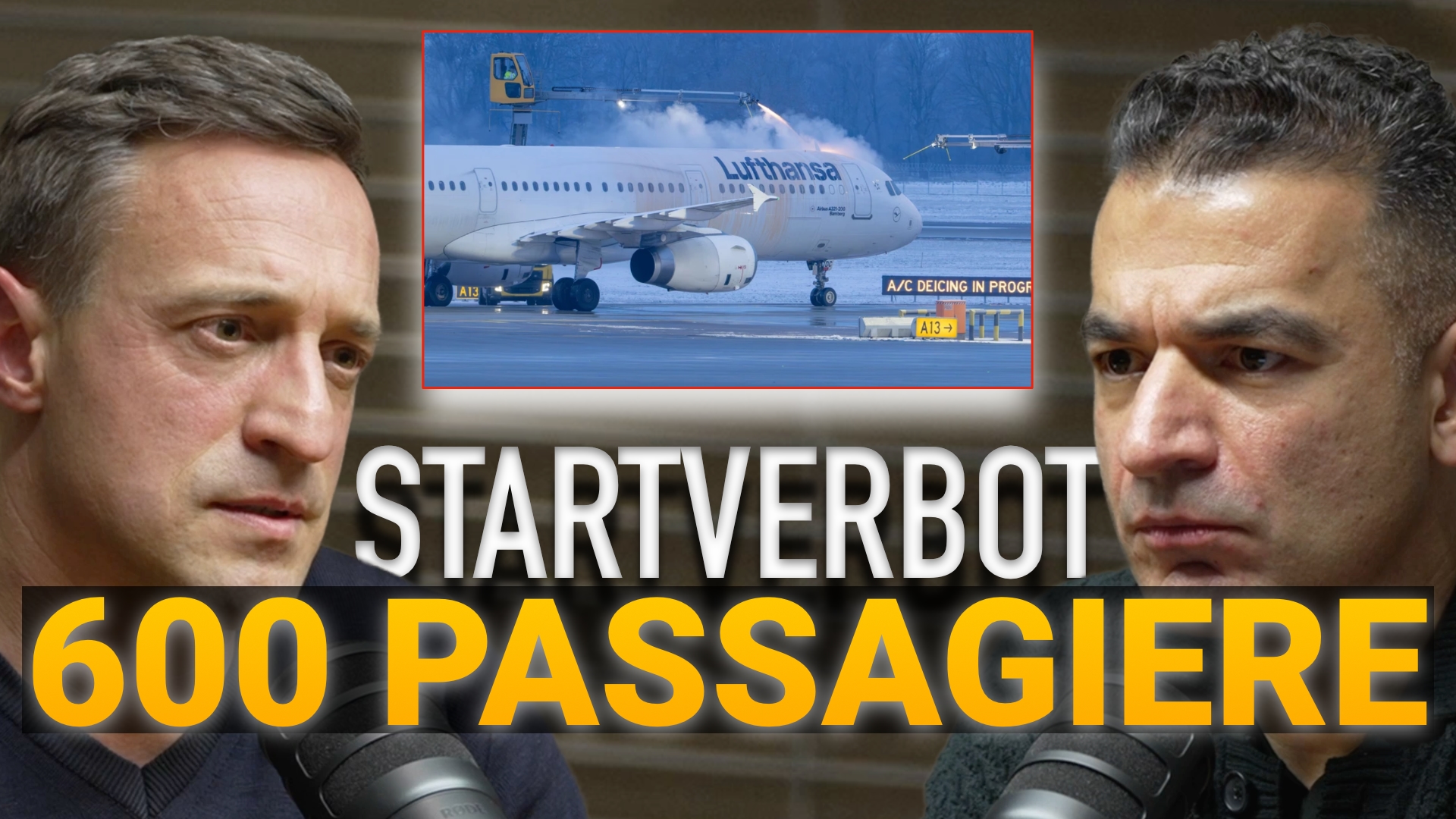

Stranded overnight at Munich Airport: how could hundreds of passengers be kept inside aircraft for hours?
The original conversation is in German. This is the complete English translation of the article and edited transcript. The speakers discuss the information available at the time, including allegations under investigation; their legal assessments are not a finding of guilt.
Stranded overnight at Munich Airport: the incident
Being stranded overnight at Munich Airport became one of the most extraordinary incidents in recent German aviation history. On a winter night, around 600 passengers in six aircraft were unable to disembark for hours, although the planes were on the ground. Most of the affected airlines belonged to the Lufthansa Group; another aircraft was operated by Air Arabia. Munich Airport, supposedly Central Europe’s best according to the Skytrax ranking, now faces intense criticism. Prosecutors are investigating, and the crucial questions remain unanswered: who made the decision, and why was there no functioning emergency plan?
Summary
One-sentence version: Hundreds of passengers were stranded for hours in six aircraft at Munich Airport on a winter night because no gates or means of disembarking were organised after take-off was prohibited under the night-flight restrictions.
Three-sentence version: Six aircraft ready to depart Munich Airport were stopped at short notice because of the night-flight restrictions. Passengers nevertheless could not disembark because no return to the gates was organised. Prosecutors are investigating suspected unlawful deprivation of liberty, while those responsible have so far remained silent.
Five-sentence version: On a winter evening, six aircraft were taxiing towards the runway at Munich Airport when the tower prohibited take-off. Instead of being allowed to leave at the gates, passengers remained confined to the aircraft for hours. Economy-class seat pitch ranges from 71 to 79 centimetres, hardly comfortable conditions for an involuntary overnight stay. According to the discussion, neither the airport fire service nor police were called, and not one passenger is said to have dialled 110 or 112. Prosecutors are now investigating, and Reza Mehman and Karsten Kammholz publicly call for consequences for those responsible.
Context: who, what and why
Who is speaking: Reza Mehman, a podcast host and entrepreneur from Heidelberg, speaks with Karsten Kammholz, an experienced journalist focusing on politics and social issues.
What it is about: The incident at Munich Airport in which six aircraft carrying around 600 passengers remained on the apron for hours after a last-minute take-off ban, without passengers being able to leave.
Why it matters: The incident raises fundamental questions about emergency protocols, responsibility and passengers’ basic rights on German soil. Prosecutors have opened an investigation.
Three key questions:
- Why could passengers not disembark even though the planes were on the ground?
- Who was responsible, and why did no emergency protocol take effect?
- What are the legal consequences, and does this constitute unlawful deprivation of liberty?
Contents
- Introduction — The incident and why it was so extraordinary
- Summary — The key points in one, three and five sentences
- Context — Who is speaking and why the case matters
- Topics and context — The conversation’s main themes
- Key points — The most important statements at a glance
- Frequently asked questions — Answers to the most pressing questions
- Highlighted quotes — Standout statements
- The complete conversation — The edited transcript with subheadings
- Keywords — Relevant search terms
- Names and terms — Important names and specialist terms
- Passage for quotation — A ready-to-use text
Topics and context
1. Passenger rights and unlawful deprivation of liberty
The incident directly raises the question of whether passengers may be kept against their will inside an aircraft on the ground.
Keywords: unlawful deprivation of liberty, passenger rights, aircraft emergency exit
2. Failure of emergency protocols
Neither the airport nor the airlines appear to have activated a functioning emergency response chain.
Keywords: airport emergency protocol, aircraft evacuation, airport safety
3. Responsibility and consequences
Personal and legal responsibility are central questions while those responsible remain silent.
Keywords: Munich prosecutors, airport responsibility, personnel consequences
4. Munich Airport’s reputation
The airport, described as Central Europe’s best, faces intense reputational pressure because of the incident.
Keywords: Munich Airport Skytrax, Germany’s best airport, Munich night-flight restrictions
Key points from the discussion
- Six aircraft at Munich Airport were prohibited from taking off shortly before departure because of night-flight restrictions, then could not return to the gates.
- Around 600 passengers had to remain in the aircraft on the apron for hours, unable to disembark.
- Prosecutors are investigating suspected unlawful deprivation of liberty.
- According to the episode, neither the airport fire service nor the police were alerted that night.
- Economy-class seat pitch of 71–79 centimetres makes an involuntary overnight stay particularly unreasonable.
- Munich Airport, described as Skytrax’s best airport in Central Europe, nevertheless had no functioning emergency protocol for this situation.
- Karsten Kammholz sees the primary failure at Munich Airport itself: the tower prohibited departure without providing an alternative.
- Both speakers consider personnel consequences likely.
- Cabin crews apparently did remarkable work to keep the situation calm.
- Those responsible have so far offered no explanation.
Frequently asked questions
What happened at Munich Airport?
On a winter evening, six aircraft ready to depart Munich Airport were stopped shortly before take-off because of night-flight restrictions. With no gates available, around 600 passengers could not leave and had to spend the night on board.
Are prosecutors investigating the forced overnight stay in Munich?
Yes. Prosecutors have opened an investigation. The allegation under examination is unlawful deprivation of liberty, because passengers were prevented from leaving the aircraft for hours without an apparent legal basis.
Is it legal to keep passengers inside an aircraft on the ground?
The original episode argues that restrictions on movement on German soil are generally a matter for police, and that an airline or airport operator holding passengers without a police order could constitute unlawful deprivation of liberty. This is the legal view presented in the discussion; the actual circumstances and applicable exceptions require examination.
Which airlines were affected?
Five of the six aircraft belonged to the Lufthansa Group; another was operated by Air Arabia.
Why were neither the police nor the fire service called?
That is one of the central unanswered questions. According to the account discussed, neither crews nor passengers dialled 110 or 112, and the airport fire service was not alerted either. The reasons remain unclear.
Who bears primary responsibility?
Journalist Karsten Kammholz sees the primary failure at Munich Airport itself. The tower prohibited take-off without providing an alternative place to park the aircraft or let passengers disembark. At the same time, pilots and crews should have tried everything to return passengers to the terminal.
What do Munich Airport’s night-flight restrictions mean?
Munich Airport has night-flight restrictions. The episode states that an exemption can permit departures until 1 a.m. On the night discussed, the restrictions were apparently enforced at short notice without an emergency plan being activated for the affected aircraft and passengers.
Highlighted quotes
“The case still leaves me completely speechless. What makes me even more speechless is that we’re hearing nothing from those responsible that would help clarify what happened.” — Karsten Kammholz
“Munich Airport is supposedly the most popular and best airport in Central Europe. Yet an airport like that allows itself a policy like this.” — Karsten Kammholz
“To me, that’s unlawful deprivation of liberty: being forced to spend the night somewhere when there’s no need, because there’s a door I could open.” — Reza Mehman
“If 600 people have to spend the night in aircraft on airport grounds, the airport boss isn’t woken up. Why not?” — Karsten Kammholz
“Not one passenger called 110 or 112 and asked what was going on. None of that happened.” — Karsten Kammholz
“This is Bavaria. This is Munich. We still expect law and order there, don’t we?” — Karsten Kammholz
The complete conversation
Reza introduces the case: a forced overnight stay in Germany
Reza Mehman:
Now to a case that honestly knocks me sideways. Prosecutors are investigating a forced overnight stay on an aircraft. Just to be clear, we’re talking about Munich Airport, in Germany. We’re not talking about a developing country, harsh as that may sound; we’re talking about the First World, so to speak. Honestly, Karsten, I was surprised to hear something like this: an investigation into people being forced to stay overnight, and of course the questions of why they weren’t let out, why nobody could organise it. Please explain it to us.
What happened that winter night
Karsten Kammholz:
The case still leaves me completely speechless. What makes me even more speechless is that we’re hearing nothing from those responsible that would help clarify what happened.
So what happened? A winter night, late evening, Munich Airport. Six aircraft have been processed for departure. All passengers are there. Some flights were bound for destinations within Europe, others intercontinental. Five aircraft belonged to the Lufthansa Group, one to Air Arabia. They head towards the runway and suddenly hear from the tower: you aren’t departing today. Take-off is prohibited.
With an exemption, it is possible to depart Munich until 1 a.m. The exact times the aircraft intended to leave are still unknown. When they were finally told not to depart is still unknown. All we know is that there was apparently no way for them to return to the gates, no way for passengers to disembark. They were forced to spend the night inside these aircraft.
At least the aircraft had power, and there was food on board. But…
Reza Mehman:
Were there children on board? Do you happen to know?
Karsten Kammholz:
I don’t know. But I do know the economy-class seat pitch on those aircraft: somewhere between 71 and 79 centimetres. You don’t want to spend the night there.
Unanswered questions about the airport’s response
I wonder how this could happen on such a scale at all. Munich Airport is supposedly the most popular and best airport in Central Europe. There’s an organisation called Skytrax that regularly ranks the world’s best airports. Munich is always in the top ten: supposedly by far Germany’s best airport, and the best in Central Europe. Yet an airport like that allows itself a policy like this. How little regard for people can those responsible show? I finally want to know who made sure these people couldn’t get out of the planes by any means.
Unlawful deprivation of liberty and failed emergency procedures
Reza Mehman:
As I understand it, or as it says here, the airline apologised for the unacceptable situation. My first question was: is anyone even allowed to keep me overnight if I can’t leave? I understand that when you’re in the air, you can’t get out. But if I’m on the ground and say I want to leave…
Karsten Kammholz:
I wouldn’t have been surprised if a passenger or two had simply gone out through the doors and down the emergency slides that night. I imagine that at some point the mood would become aggressive, absolutely. What the crews may have achieved in keeping people calm is genuinely impressive. As a normally thinking person, you have to consider: okay, there’s no gate available; I can’t get back into the terminal. As a crew, you have to think about how to deal with that situation.
I wonder why the airport fire service wasn’t informed. Surely it could help.
Reza Mehman:
Evacuation, yes. There are emergency plans.
Karsten Kammholz:
Not one passenger called 110 or 112 and asked what was going on. None of that happened. That means the cabin crews in particular must have acted very carefully and, in terms of managing people, in an exemplary way to keep everyone calm and give them hope. But in the end, everyone spent hours in those aircraft. I wonder why common sense didn’t prevail. I don’t understand it.
The pilots’ role and emergency response chains
The pilots must surely have tried everything to get people back into the terminal and accommodated in hotels. Was that attempted? Why couldn’t six cabin crews and six cockpit crews get these people out of the aircraft? It’s completely baffling. Who was being so obstructive?
First and foremost, I see a failure by Munich Airport. The tower says you can’t depart; it’s prohibited. The night-flight restrictions apply from now. At the same time, the tower says: sorry, I don’t have anywhere you can park your aircraft and let passengers off. That’s a matter of responsibility. Somewhere there must be a sense of responsibility and an emergency response chain.
If an aircraft had an accident at Munich Airport, the airport boss would be woken in the middle of the night. If 600 people have to spend the night in aircraft on airport grounds, the airport boss isn’t woken up. Why not?
What Reza would have done, and the legal question
Reza Mehman:
I’ve thought about it too. Do you know what I would have done? Called the police.
Karsten Kammholz:
As a passenger.
Reza Mehman:
I would have, yes. I wonder about that too. I’d have called the police. There must be a protocol that says to evacuate an aircraft, and it should work quickly. You shouldn’t have to spend ages considering whom to call or whether you have permission. An incident happens, such as ice or snow, and the aircraft need to be evacuated. It should actually be straightforward. The only people allowed to detain me are the police. Anything else is…
Karsten Kammholz:
We’ve already used the term unlawful deprivation of liberty. Exactly, one hundred per cent.
Reza Mehman:
To me, that’s unlawful deprivation of liberty: being forced to spend the night somewhere when there’s no need, because there’s a door I could open, and then emergency steps could be there.
Conclusion: overwhelmed officials and possible consequences
Karsten Kammholz:
Do you know what makes the case particularly serious for me? Something happens that those responsible at this airport apparently haven’t experienced before, and they’re completely overwhelmed. Completely overwhelmed.
Reza Mehman:
Yes, that’s why I said it happened in Germany. This wasn’t a developing country without emergency protocols and so on. It happened in Germany. That’s what surprises me. I’m interested to see what happens.
Karsten Kammholz:
There will definitely be a fairly lengthy investigation, and I think it will lead to personnel consequences. This is Bavaria. This is Munich. We still expect law and order there, don’t we?
Reza Mehman:
Exactly. As with the possible inside job at Sparkasse Gelsenkirchen, we’ll give another update on this too. Definitely. Thank you.
Keywords
Tags: stranded overnight at Munich Airport, Munich prosecutors aircraft, unlawful deprivation of liberty passengers, Munich night-flight restrictions, Lufthansa take-off ban, Air Arabia Munich, passenger rights Germany, Skytrax best airport, Munich Airport emergency protocol, economy-class seat pitch, airport fire service evacuation, Munich Airport responsibility, forced overnight stay investigation, Munich night-flight exemption, aircraft take-off ban
Names and terms
Reza Mehman, Karsten Kammholz, Munich Airport, Lufthansa Group, Air Arabia, Skytrax, Munich prosecutors, night-flight restrictions, economy class, airport fire service, unlawful deprivation of liberty, emergency response chain, control tower, take-off ban, cabin crews, cockpit crews, emergency slides, evacuation
Passage for quotation
At Munich Airport, described by Skytrax as Central Europe’s best airport, around 600 passengers had to remain in six aircraft for hours on a winter night.
The tower imposed a last-minute take-off ban under night-flight restrictions, without a way for the aircraft to return to the gates.
According to the account discussed, neither the airport fire service nor police were alerted, and no passenger called 110 or 112.
Prosecutors are investigating suspected unlawful deprivation of liberty.
Journalist Karsten Kammholz sees the primary failure at the airport itself: whoever prohibits departure must also provide a solution for the affected passengers.
Watch Episode 166 on YouTube. Find more conversations on my podcast page.

