
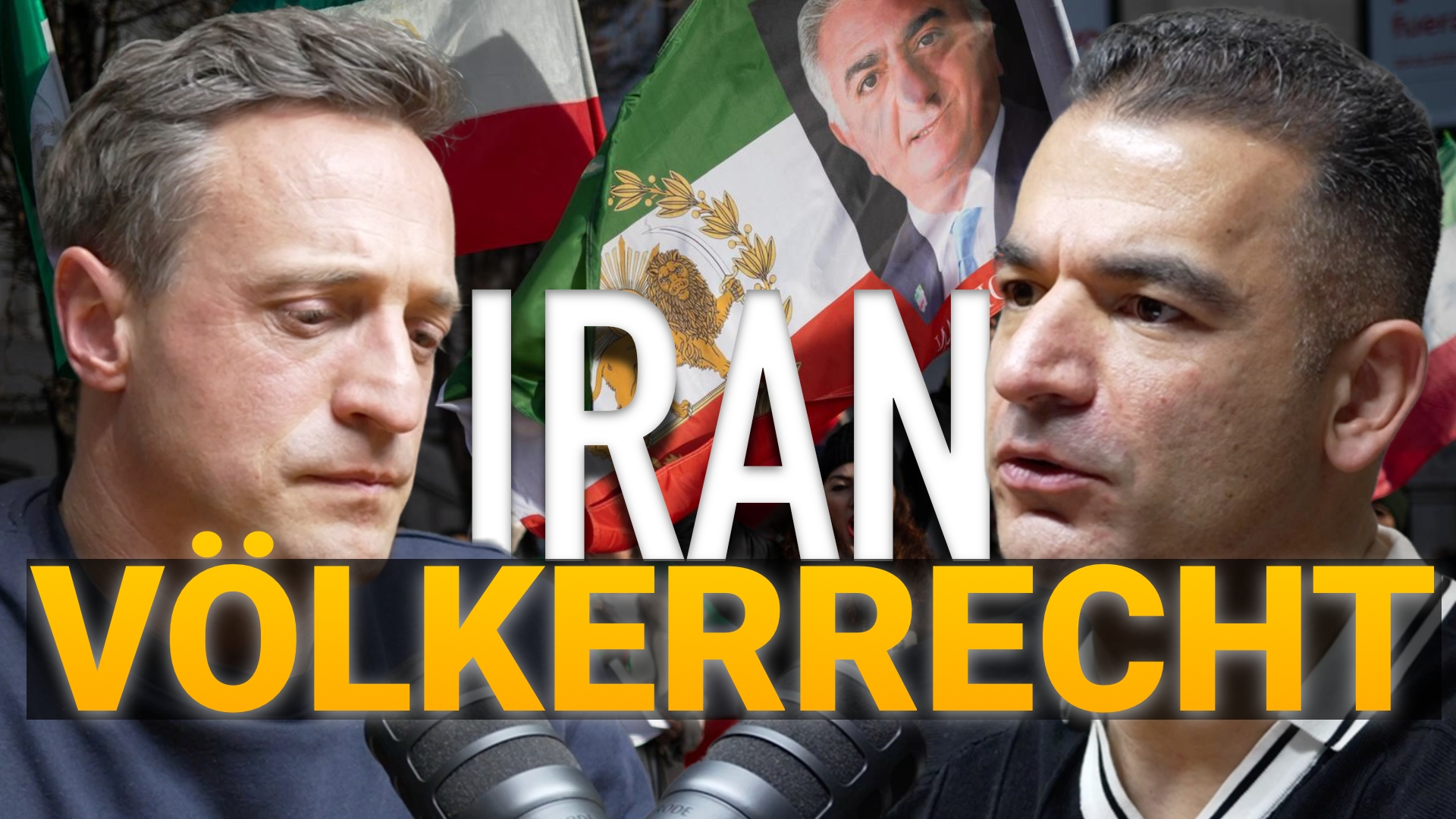

International law and human rights: Reza Mehman and Karsten Kammholz discuss the conflict between state sovereignty and protecting people in Iran.
The original conversation is in German. This page contains the complete English translation of the article and edited transcript. Legal interpretations, reported events and opinions reflect the original conversation and remain attributed to the speakers.
Discussing international law and human rights
In the case of Iran, international law and human rights are in fundamental tension. In this podcast episode, Reza Mehman and Karsten Kammholz discuss why the Iranian regime violates fundamental human rights and how the international community should respond. The conversation shows how emotional and contentious the debate over international law versus human rights has become, particularly among Iranians in exile and in German online comment sections. Both conclude that international law urgently needs reform if it protects regimes that systematically violate human rights. They openly discuss whether military interventions such as the US and Israeli attacks on Iranian infrastructure are justified, as well as the lack of a strategy behind those attacks.
Summary
One-sentence version: Reza Mehman and Karsten Kammholz argue that human rights must take precedence over international law in Iran’s case, and call for reform of the international legal framework.
Three-sentence version: The Iranian regime systematically violates fundamental human rights: the right to life, freedom of expression, freedom of religion, protection from torture and equality before the law. Yet many critics invoke international law to oppose military intervention against the regime. Reza Mehman and Karsten Kammholz see a contradiction and call for international law to be redefined.
Five-sentence version: In this episode, Reza Mehman and Karsten Kammholz discuss the conflict between international law and human rights using Iran as an example. The Iranian regime systematically violates the five core United Nations human rights highlighted in the conversation, from torture and the oppression of women to the killing of political opponents. Nevertheless, public debate, particularly in Germany, frequently invokes international law as an argument against military intervention. Russian and Chinese obstruction in the UN Security Council also prevents intervention authorised under international law. Both speakers advocate reforming international law so that people living in inhumane conditions can be protected.
Context: who, what and why
Who is speaking: Reza Mehman, a podcaster born in Iran who holds German citizenship, speaks with Karsten Kammholz, a journalist and regular guest on the podcast.
What it is about: Whether international law should protect regimes that systematically violate human rights, and whether military intervention in Iran can be morally and legally justified.
Why it matters: Following US and Israeli attacks on Iranian infrastructure, the debate over international law versus human rights has become particularly pressing. Reactions on social media reveal how divided opinions are.
Three key questions:
- Why do international law and human rights appear to be in an irreconcilable conflict in Iran’s case?
- How do Iranians in exile and the German public assess attacks on the Iranian regime differently?
- Does international law need reform to make humanitarian intervention more feasible?
Contents
- Introduction — An overview of the conversation and why it matters
- Summary — The main points in three versions
- Context — Who is speaking and why the topic matters
- Topics and context — The conversation’s main themes
- Key points — The central positions at a glance
- Frequently asked questions — Questions and answers on the subject
- Highlighted quotes — Standout statements from the conversation
- The complete conversation — An edited transcript with subheadings
- Keywords — Relevant search terms
- Names and terms — A directory of important terms and people
- Passage for quotation — A concise paragraph to quote
Topics and context
1. International law and its limits
The 1945 UN Charter guarantees state sovereignty and prohibits the use of force. But what happens when a state abuses that order to legitimise human rights violations?
Keywords: international law, UN Charter, sovereignty, prohibition on the use of force
2. Human rights in Iran
The Iranian regime systematically violates core human rights. The consequences affect women, political prisoners and the entire civilian population.
Keywords: human rights in Iran, torture in Iran, women’s rights in Iran, political prisoners
3. The role of the United States and Israel
Many Iranians in exile see the attacks on Iranian infrastructure as assistance. At the same time, there is no clear strategy for regime change.
Keywords: United States and Iran, Israel and Iran, regime change in Iran, pre-emptive strike
4. The German debate
The international-law question is debated particularly intensely in Germany. Politicians, especially from the SPD, emphasise international law, while those affected call for human rights to be protected.
Keywords: SPD and international law, German Iran policy, online debate
5. The culture of online discussion
Anonymity and polemics undermine the quality of debate on social media. Constructive discussion is more likely to happen in person.
Keywords: online debate, comment culture, social media discussion
Key points from the conversation
- The Iranian regime violates all five core United Nations human rights discussed here: the right to life, freedom of expression, freedom of religion, protection from torture and equality before the law.
- Many Iranians in exile see US and Israeli attacks on Iranian infrastructure as urgently needed help for people on the ground.
- Invoking international law seems contradictory when it protects a regime that systematically violates human rights.
- The UN Security Council cannot act in Iran’s case because Russia and China, allies of the regime, block every resolution.
- Russian President Putin criticises attacks on Iran as violations of international law, even though Russia itself has been bombing Ukraine for years.
- Israel justified the attacks as a pre-emptive strike, which the conversation describes as permissible under international law only where a threat is imminent.
- Both speakers believe international law must be reformed to allow people to be freed from inhumane conditions.
- Despite the attacks, regime change in Iran is not yet in sight, and people still do not dare take to the streets.
- Discussion on social media is highly polarised and made more difficult by anonymity and a lack of reasoned debate.
- North Korea also illustrates that international law alone does not protect people living under totalitarian systems.
Frequently asked questions
What is the difference between international law and human rights?
In the conversation’s explanation, international law governs relations between states and rests on the 1945 UN Charter. It protects state sovereignty, prohibits force between states and guarantees territorial integrity. Human rights, by contrast, protect individuals and include the right to life, freedom of expression, freedom of religion, protection from torture and equality before the law.
Why is the debate over international law versus human rights so relevant to Iran?
The Iranian regime systematically violates fundamental human rights. At the same time, international law protects Iran’s sovereignty. The speakers frame the dilemma this way: when the United States or Israel intervenes militarily, it formally violates international law while acting in the interests of human rights. This contradiction makes the debate so contentious.
Which human rights does the Iranian regime violate?
The conversation identifies violations of all five core rights discussed: the right to life through mass killings, freedom of expression through bans on protest, freedom of religion, protection from torture, especially for political prisoners, and equality before the law through systematic discrimination against women.
Why can the UN Security Council not act against Iran?
As the speakers explain it, military intervention under international law requires UN Security Council approval. Russia and China, however, are allies and business partners of the Iranian regime and block every resolution. This makes an intervention authorised under international law practically impossible in their assessment.
How do Iranians in exile view the attacks on Iran?
Many Iranians in exile see US and Israeli attacks as help for the Iranian population. They understand that the United States is not acting out of altruism, but hope for the regime’s overthrow and an end to the oppression of their families and friends in Iran.
Does international law need reform?
According to Reza Mehman and Karsten Kammholz, reform is urgently needed. They argue that international law must redefine what should be permitted in cases like Iran. Freeing people from inhumane conditions should be more firmly embedded in international law.
Did Israel justify its attacks on Iran under international law?
Israel used the argument of a pre-emptive strike. In the conversation, Kammholz explains that such a strike is only permissible under international law if an attack by the other side is imminent. He considers the argument understandable but legally weak in certain respects.
Is regime change happening in Iran?
At the time of the conversation, despite the attacks, regime change is not yet in sight. People still do not dare take to the streets, and a successor is already in power after Ali Khamenei’s death. The episode criticises the Americans for launching the attack without a clear strategy.
Highlighted quotes
“How morally superior are you if you insist on international law that protects those who disregard human rights?” — A commenter, quoted by Reza Mehman
“When I see the United States and Israel attacking the regime’s infrastructure, I see that as help for Iranians on the ground.” — Reza Mehman
“Isn’t freeing people from inhumane conditions something that really matters under international law?” — Karsten Kammholz
“I think we need to redefine international law now.” — Karsten Kammholz
“How absurd is it to bomb another country for four years and then say that what’s happening in Iran isn’t acceptable under international law?” — Reza Mehman on Putin’s criticism
“Equality before the law — I think Iranian women could tell us a thing or two about that.” — Reza Mehman
“At the moment there is still no effect, and it’s worrying that the Americans essentially launched this attack without a real plan.” — Karsten Kammholz
The complete conversation
Opening: the community’s response to the Iran episode
Reza Mehman:
Karsten, I recently released a podcast episode about Iran where I raised the issue of international law versus human rights. You wouldn’t believe the comments that came in. We don’t need to go into detail, but I’d be interested in how you see international law versus human rights.
I’d also like to define it very briefly. Before I do that, I want to read a quote from a commenter who, in my view, really put it brilliantly. I even wrote to the commenter: thank you so much for your comment. Reading it like that was genuinely mind-blowing for me.
He wrote: “How morally superior are you if you insist on international law that protects those who disregard human rights? International law versus human rights — some people make up their minds very quickly.”
A personal perspective as someone born in Iran
For me as an Iranian, as someone born in Iran — I’m German and I’m Iranian — it’s important that the regime is overthrown. People are suffering. We speak to our families, friends and relatives on the phone, and they’re suffering.
To break it down in very simple terms: when I see the United States and Israel attacking the regime’s infrastructure, I see that as help for Iranians on the ground. I said that in the podcast too. I’m fully aware that the United States isn’t doing this out of love for Iranians. I’m fully aware that they have their own reasons. They’re not hoping to get free saffron rice with joojeh kebab and koobideh from us. I understand that perfectly well.
I also wonder when I read all those comments: you don’t know what the Americans want. Yes, I know. Nobody knows what they want. But at least they might bring the regime down.
Karsten Kammholz:
How were those comments divided? Were most people saying international law doesn’t matter at all in this case? Or were there more people saying: hold on, the Americans and Israelis can’t do this — international law has been violated?
Different reactions to the Iran debate
Reza Mehman:
They were actually very mixed. Many invoked international law. My impression was that native Iranians, Iranians living in exile, tended more towards human rights and the idea that international law didn’t matter at all. Judging by the names, people who might have been of German origin — as far as you could tell from usernames — tended more to say: “Hey, international law matters, but we understand why Iranians want it to be attacked.” So it varied a lot. Many immediately turned the discussion towards Israel and poured out their hate there. I don’t particularly want to go into that now.
Defining international law and human rights
So it was very mixed. In that episode, I also briefly defined the terms so we’d all know what we were talking about. International law isn’t a single code of laws; it comes from several sources. I’ll touch on it very briefly. Its most important foundation is the United Nations Charter of 1945. It includes state sovereignty, the prohibition on force between states, territorial integrity and peoples’ right to self-determination. All right, I understand. That was created after 1945. We know what happened in Germany in 1945.
But then there’s that comment I thought was so good: how morally superior are you if you insist on international law that protects those who disregard human rights? That’s obviously the question. And then, of course, the question is: what are human rights?
Human rights were adopted by the United Nations after the Second World War. They include fundamental rights. I’ll quickly read out the five: the right to life, freedom of expression, freedom of religion, protection from torture and equality before the law.
Human rights violations in Iran
All five of those rights have been completely violated by the Iranian regime — not just a little, but severely. The right to life: how many tens of thousands died in three days? Freedom of expression: please, go out onto a street in Iran and protest against the government. Freedom of religion: who chants “Death to Israel, death to Israel, death to America” from morning to night? Protection from torture: some of the political prisoners currently in Iranian prisons would probably laugh very bitterly at that. Equality before the law: I think Iranian women could tell us a thing or two about it.
All these human rights are being violated in very concrete and severe ways. Then someone attacks, such as the United States, and the first thing the vast majority here say is: hold on, international law! I can’t get my head around international law being placed above fundamental human rights. Of the five I mentioned, take the right to life. If we no longer have that, the whole thing is a joke. You can see I’m getting emotional about it.
Karsten Kammholz:
I can completely understand that. With Iran, you could see it coming and almost wished for the Iranian population finally to be freed. Morally, you felt that human rights ranked above international law, and that we should act on human rights grounds.
That’s why so many people felt something like relief, and of course a degree of approval, when the Israelis and Americans carried out that bombardment.
Israel’s argument: a pre-emptive strike
The Israelis did actually argue in terms of international law: a pre-emptive strike. That’s a little tricky because, from an international-law perspective, a strike like that is essentially only permitted if you’re genuinely on the brink of an attack by the other side. That attack wasn’t immediately foreseeable at that point. We knew the Iranians were working on a nuclear bomb, and last year missiles were fired from Iran towards Israel. All of that is known. So the argument is understandable, but we have to be quite clear that it has weaknesses too.
Reforming international law
I also find the current international-law debate a little odd when it’s politicians conducting it. I can understand it from legal theorists. But I would find it useful if we said: I think we need to redefine international law now. We need to redefine what we should actually allow ourselves under international law in a case like Iran. Isn’t freeing people from inhumane conditions something that really matters under international law?
Reza Mehman:
Very well put, very well put. I absolutely see a need for reform in international law. I also looked into when the UN Charter allows intervention under international law. It requires Security Council approval, and Russia is on that council, as is China.
Putin’s absurd criticism
I really have to read you a quote from the Russian president. What I’m getting at is that, of course, we won’t get Security Council approval, because Russia and China do a lot of business with the mullah regime. Russian President Vladimir Putin criticised the killing of Iran’s religious leader Ali Khamenei as a cynical violation of all norms of human morality and international law.
Karsten Kammholz:
That’s rich, coming from him.
Reza Mehman:
How absurd is it to bomb another country for four years and then say that what’s happening in Iran isn’t acceptable under international law?
Karsten Kammholz:
Yes, yes, but that’s Putin.
The SPD and the international-law debate
Of course, I wonder why some politicians, especially the SPD, are making such a big issue of international law right now. What other fears might be involved? There’s also the question of what else the United States might do outside international law. I mean, they took Maduro out of Venezuela without calling the UN first. They just did it. You can invoke international law there too, and some people did.
But where does it go next? I think that’s why the international-law issue is being debated a little more widely now. Do you perhaps go to North Korea next? I mean, wouldn’t we also wish for North Koreans finally to be freed?
Reza Mehman:
Yes, I completely agree with you. Exactly. Unfortunately, I have to admit I’m wrongly ignorant on that particular subject right now. I don’t really know exactly what’s happening in North Korea. Of course, I know…
North Korea: an isolated state of terror
Karsten Kammholz:
The state is completely sealed off. We’re not supposed to know. Young people there are killed by the state if they get hold of pirated copies of Netflix series such as Squid Game, which comes from South Korea. You hear about things like that indirectly. You only ever learn the tiniest fragments of the terror inflicted on the population in that country.
Reza Mehman:
Another catastrophe. In exactly that context, a commenter wrote: if Iran had a nuclear bomb like North Korea, it wouldn’t have been attacked either. Do you think that’s true too?
Karsten Kammholz:
That’s a good question. It could be. It really could be. It’s always a question of weighing things up.
Regime change: where do things stand?
What we’re seeing now is that the attack was relatively uncoordinated. At the moment, it’s unclear how much longer these attacks will continue. What has happened so far is this: Khamenei is dead, but the next Khamenei is already there. What has actually happened in the two weeks since these attacks began? Do we have regime change?
Reza Mehman:
Not by a long way.
Karsten Kammholz:
Do people now dare take to the streets? No. At the moment there is still no effect, and it’s worrying that the Americans essentially launched this attack without a real plan.
Reza Mehman:
Exactly. I’m very curious to see what happens next. I said this in the last podcast too, where I talked about the subject on my own: I’m not an Iran expert. I was born in Iran, but I’m not an Iran expert. And suddenly there are so many Iran experts, at least on YouTube and podcasts and so on. So many, and everyone has an opinion.
Debate culture: online versus real life
Then I get attacked if I say, for example: hey, I think the Iranian population needs support right now. People then bring up that girls’ school and so on. What happened there is terrible, of course. But accusing someone — it doesn’t personally upset me, but I find the line of thought interesting — accusing me, for example, as though I didn’t care, or as though a thousand other Iranians with family and friends there didn’t care. No, we do care.
I find it interesting, though, at what level Iranians and non-Iranians are discussing things with one another right now. You can also assume that 20 or 30 per cent immediately bring up Palestine, which is terrible too, of course. You can support one thing and at the same time say that what is happening elsewhere is terrible as well. I think we sometimes forget how to discuss things with each other. I’m happy that discussions in real life are relatively normal. Online, though, it’s on a completely different level, in my experience.
Karsten Kammholz:
That’s true. Because we appear on YouTube, where there is no requirement to use your real name, we’re dealing with “Idiot X. Y. 123” commenting underneath, and there’s nothing you can do. There’s absolute licence for fools — and idiots — to say whatever they like.
Reza Mehman:
All right, but first of all, thank you for your assessment. It really was important to me to understand how you see international law versus human rights. Thank you, Karsten.
Karsten Kammholz:
My pleasure, Reza.
Keywords
Tags: international law, human rights, Iran, international law versus human rights, human rights in Iran, UN Charter, regime change in Iran, Iranians in exile, Israeli pre-emptive strike, SPD and international law, Ali Khamenei, Putin and Iran, human rights in North Korea, Security Council, women’s rights in Iran, torture in Iran, why international law is criticised, what human rights are, whether international law needs reform
Names and terms
Reza Mehman, Karsten Kammholz, Ali Khamenei, Vladimir Putin, Nicolás Maduro, Iran, North Korea, Israel, United States, Venezuela, Palestine, Ukraine, South Korea, United Nations, UN Charter (1945), UN Security Council, international law, human rights, Universal Declaration of Human Rights, mullah regime, pre-emptive strike, regime change, nuclear bomb, SPD, Squid Game, YouTube
Passage for quotation
In the debate over international law versus human rights, Iran’s case reveals a fundamental contradiction.
The Iranian regime systematically violates core human rights, yet international law protects its sovereignty.
Iranians in exile see US and Israeli attacks as urgently needed help for a suffering population.
Podcaster Reza Mehman and journalist Karsten Kammholz therefore call for reform of international law that places the protection of people above the protection of regimes.
As long as Russia and China block the UN Security Council, an intervention authorised under international law remains impossible in their assessment.
Watch episode 173 on YouTube. My collection of sources and clips about Iran offers more conversations and background.

