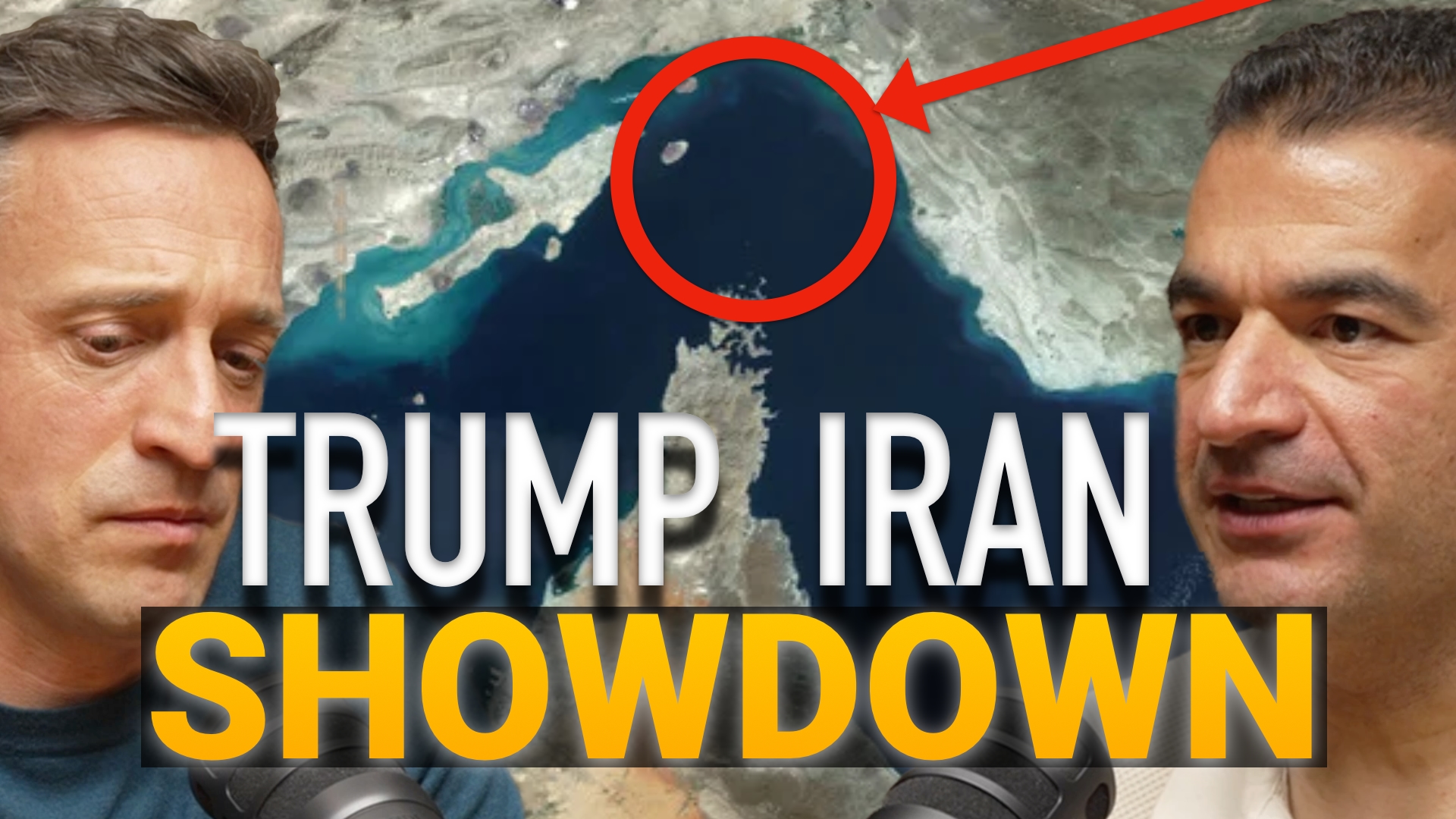

Strait of Hormuz: the Iran war, NATO collective defence and AI warfare. Reza Mehman and Karsten Kammholz discuss Trump’s strategy.
The original conversation is in German. This page contains the complete English translation of the article and edited transcript. The speakers’ assessments, reported information and speculation reflect the original conversation.
Strait of Hormuz: introduction
The Strait of Hormuz has become a geopolitical flashpoint in the ongoing Iran war. US President Donald Trump, who initially presented the war as a joint undertaking with Israel alone, is now asking NATO countries to help secure this vital trade route. In this podcast, Reza Mehman and Karsten Kammholz discuss why Trump suddenly needs help and whether there is a hidden strategy behind the request. They also ask whether the Iran war could serve as a pretext for the United States to leave NATO. Greenland, AI-assisted warfare and US military superiority are also part of the discussion. A conversation about geopolitics, strategy and the possible consequences for the world order.
Summary
One-sentence version: Trump is asking NATO to help secure the Strait of Hormuz, even though he launched the Iran war as a joint undertaking with Israel alone, raising questions about a hidden strategy.
Three-sentence version: After weeks of war in Iran, Trump is turning to NATO to secure the Strait of Hormuz, although he initially said he needed no help. Reza Mehman suspects a deliberate strategy: if NATO does not help, Trump could use that to justify leaving the alliance and then lay claim to Greenland. Karsten Kammholz remains sceptical and instead sees a president without a clear strategy who has not achieved his war aims.
Five-sentence version: The US president initially presented the Iran war as a joint undertaking with Israel alone, but is now asking NATO to assist in the Strait of Hormuz. Reza Mehman sees a calculated move: Trump could use a NATO refusal as a pretext to leave the alliance and then claim Greenland. Karsten Kammholz doubts this theory and points to Trump’s unmet war aims and Iran’s continuing resistance. Both discuss the role of AI in modern warfare and the intelligence advantage of the United States and Israel. The conversation highlights uncertainty about Trump’s actual geopolitical intentions and the possible consequences for the international order.
Context: who, what and why
Who is speaking: Reza Mehman, a podcast host born in Iran with a personal connection to the conflict, speaks with Karsten Kammholz, an analyst and regular guest on the podcast.
What it is about: Trump’s shift from “We’ll do this alone” to asking NATO to secure the Strait of Hormuz, and whether a strategy to leave NATO lies behind it.
Why it matters: The Iran war affects global energy routes, the NATO alliance and the question of how the world order is changing under an increasingly isolationist US president.
Three key questions explored:
- Why is Trump asking NATO for help in the Strait of Hormuz?
- Is there a strategy to leave NATO behind the request?
- How is AI-assisted warfare changing the military balance of power?
Contents
- Introduction — An overview of the conversation and why it matters
- Summary — The main points in three versions
- Context — Who is speaking, what it is about and why now
- Topics and context — An overview of the main themes
- Key points — The central arguments from the conversation
- Frequently asked questions — Specific questions and answers
- Highlighted quotes — Standout statements
- The complete conversation — The edited transcript
- Keywords — Relevant search terms
- Names and terms — A directory of important terms
- Passage for quotation — A ready-to-use text
Topics and context
1. The Strait of Hormuz and energy security
The strait’s importance for global oil and gas trade, and why Trump is requesting NATO support there.
Keywords: Strait of Hormuz, oil transport, naval blockade
2. NATO and scenarios for a US withdrawal
The theory that Trump could use his request to NATO as a pretext for a later withdrawal.
Keywords: NATO collective defence, US withdrawal from NATO, Article 5
3. The Iran war and military strategy
The length of the conflict, the Iranian regime’s resilience and the question of an endgame.
Keywords: Iran war, regime change, US military strategy
4. AI and modern warfare
How artificial intelligence and an intelligence advantage change warfare and strengthen US dominance.
Keywords: AI warfare, intelligence, precision strikes
5. Greenland and geopolitical expansion
The possible link between leaving NATO and renewed US claims to Greenland.
Keywords: Greenland and the US, Arctic geopolitics, Trump and Greenland
Key points from the conversation
- Trump launched the Iran war as a joint undertaking with Israel alone, but is now asking NATO for help in the Strait of Hormuz.
- Iran’s arsenal is considerably larger than many military strategists expected, and the war is lasting longer than planned.
- The United States has provided insurance cover for ships in the Strait of Hormuz, yet is still calling for NATO support.
- Invoking NATO collective defence would not be an appropriate approach, as the Strait of Hormuz is far from US territory.
- The United States could use a NATO refusal as a pretext for leaving the alliance.
- After a possible NATO withdrawal, the United States could renew its claims to Greenland.
- The United States and Israel killed 50 senior Iranian regime figures on the first day of the war, demonstrating an enormous intelligence advantage.
- AI-assisted warfare could make the United States militarily invulnerable.
- The United States has not demonstrated sound military strategy in previous wars, including Vietnam, Iraq and Afghanistan.
- In wartime, the US president has special powers that allow far-reaching decisions.
Frequently asked questions
Why is Trump asking NATO for help in the Strait of Hormuz?
Trump has asked NATO countries to help secure the Strait of Hormuz, although he initially presented the Iran war as a joint undertaking with Israel alone. The conversation explores speculation that he either wants to share the costs or could use a NATO refusal as a pretext for leaving.
What is the Strait of Hormuz and why is it important?
The Strait of Hormuz is a strait south of Iran and one of the world’s most important commercial passages. A large share of global oil and gas trade passes through it. A blockade would have a massive impact on the world economy.
Could Trump invoke NATO collective defence over the Strait of Hormuz?
According to Karsten Kammholz, that would not be an appropriate approach: NATO as a whole must determine whether collective defence applies, and the Strait of Hormuz is far from US territory. In his view, the logic of collective defence does not apply here.
Is Trump planning to take the United States out of NATO?
Reza Mehman suspects Trump could use a NATO refusal as a pretext for leaving, which would also clear the way for claims to Greenland. Karsten Kammholz considers this unlikely because Trump has not achieved his war aims and will not put further allies at risk.
How long has the Iran war lasted, and why longer than planned?
At the time of the conversation, the war has already lasted several weeks, longer than the US administration announced. Iran’s arsenal has proved considerably larger than expected. Iranian missiles are still landing, including in Dubai. The mullah regime has not been overthrown.
What role does AI play in the Iran war?
Reza Mehman argues that AI-assisted warfare and intelligence give the United States and Israel an enormous advantage. He says 50 senior Iranian figures were targeted and killed on the first day, pointing to superior reconnaissance capabilities. In his assessment, the combination of AI and intelligence services makes the United States almost militarily invulnerable.
What does Greenland have to do with the Iran war?
Reza Mehman sees a possible connection: if Trump leaves NATO, he could renew his claims to Greenland without regard for NATO partners. He argues that the US president’s special wartime powers could make such steps easier.
How is Germany responding to Trump’s request for NATO support?
The German government has clearly stated that the Iran war is not Germany’s war. Reza Mehman doubts that Germany or other NATO countries would really stand in the way of a US attack on Greenland.
Highlighted quotes
“Were they so naive that they didn’t plan for this — that they would need a strategy for the Strait of Hormuz too?” — Karsten Kammholz
“He actually threatened to attack NATO territory. What madness.” — Karsten Kammholz
“The question isn’t whether they are, but whether they think they are.” — Reza Mehman
“I think AI will make the United States so invulnerable — not just its military power and the sheer force of its munitions, but AI as well will put it beyond anyone’s reach.” — Reza Mehman
“We’ve always concluded that Donald Trump has no strategy.” — Karsten Kammholz
“The United States has always withdrawn and left chaos behind. That’s the truth.” — Karsten Kammholz
“This isn’t coming at the wrong time. The timing is exactly right.” — Reza Mehman
The complete conversation
Trump’s change of course: from going it alone to asking NATO
Reza Mehman:
Karsten, as someone born in Iran, I’m naturally following the news about the Iran war very closely. I follow quite a lot, sometimes even a little too much. But something very interesting has come up, and I’d like to hear your opinion.
When the war started, my impression of the US president — the way he spoke — was: we’re doing this completely on our own, together with Israel, but the two of us are doing it entirely alone. We don’t need anyone for this, absolutely no one. That was the message, I thought.
And now I’m reading that the US president is asking NATO countries to get involved, specifically in securing the Strait of Hormuz. That’s his concrete request. I even think he asked China as well, and I believe he wanted to make a meeting with the Chinese conditional on whether they were willing to get involved in the Strait of Hormuz.
I have two questions for you straight away. First: why was the United States so confident at the beginning? We don’t need help, people — what could you do? That’s the first question. The second is: could it even get to the point where he invokes NATO collective defence and says, “Dear NATO, we’ve got a problem here now, I’m a very large contributor and I expect your help”? Not necessarily because he needs the help, but perhaps because he has a plan to say, “Wait a moment, I’ve invoked NATO collective defence, but nobody is helping me. So I’m leaving NATO.”
The logic of collective defence and Trump’s dilemma
Karsten Kammholz:
Well, NATO as a whole has to determine that a collective-defence situation has arisen, and the Strait of Hormuz is a long way from American territory. So that logic of collective defence isn’t really appropriate to begin with. It would certainly be odd if Trump tried to persuade NATO states to join in using precisely that wording.
I feel the same as you. I’ve also reached a point where I’m puzzled and ask: well, what now? Wasn’t the war only supposed to last about two weeks? Wasn’t the regime supposed to be overthrown? How do we proceed now? I keep hearing in the news: the next strike will be truly devastating. And now we’ve carried out a very important strategic strike. Hey, we’ve been bombing Iran for weeks, and the Iranians’ arsenal is considerably larger than many military strategists probably thought. Missiles are still landing, some of them in Dubai.
So we’re still in a situation where Iran is fighting back fiercely. We have a new leader in that country, and the mullah system hasn’t come close to being destroyed. Yet that was the objective. At the moment, I have absolutely no idea how this is supposed to proceed.
The strategy behind the Strait of Hormuz
Reza Mehman:
And now the specific case: what strategy is Trump pursuing in the Strait of Hormuz? Why is he suddenly asking other people to join in?
Karsten Kammholz:
I don’t understand it at all. You attack a country like Iran together with Israel, then realise: oh, wait a moment, south of Iran there’s this incredibly important commercial passage for us, handling worldwide gas and oil shipments. Oops, suddenly there’s a blockade — what do we do now? Were they so naive that they didn’t plan for this — that they would need a strategy for the Strait of Hormuz too?
Reza Mehman:
I don’t believe they were that naive. My impression is that it was arranged strategically so they might be able to say: NATO isn’t helping you, so we want out of NATO, we want to leave NATO. In recent weeks and months, the US president has also decided that the United States should withdraw from certain organisations, global organisations. I think NATO is next on the list of things they want to stop being part of. I have the feeling, the impression, that this is a pretext being put forward.
Leaving NATO as a strategic move?
Karsten Kammholz:
So you think the US move is to say: NATO isn’t helping us now, so we don’t need NATO at all any more and we’re leaving?
Reza Mehman:
That’s my impression. As I understood it, they even provided insurance policies — I don’t know how to put it precisely or correctly — but they assured ships passing through that they would receive special protection. The problem was that many insurers had said: hey, we’re no longer insuring ships. And the United States provided that insurance cover. That means they’re so confident that nothing will happen, yet they’re still calling for support. If they really mean what they’re saying, that doesn’t make sense to me at first glance either.
Karsten Kammholz:
You’re absolutely right. I imagine how the government in Copenhagen, for example, might react when Donald Trump says, “Hey, NATO, listen — Denmark, you’re in NATO too, could you give us a quick hand?” And just two months ago he wanted to take Greenland away from the Danes. That’s the strategic dilemma Donald Trump is in anyway. He actually threatened to attack NATO territory. What madness. Only to say two months later: dear NATO, now I need you somewhere completely different, where all the NATO states say: no.
Reza Mehman:
The German government is also saying this isn’t our war. I read something about that today. But yes, I’m probably getting caught up in speculation here. Still, that’s the impression it gives me.
Trump’s lack of strategy and historical parallels
Karsten Kammholz:
We’ve always concluded that Donald Trump has no strategy. At least in the Iran war, he will certainly be noticing by now that it’s taking longer than he imagined. And the United States hasn’t always shown the best military-strategic judgement. Let’s start with the war in Vietnam — what a disaster. We can talk about Iraq, about Afghanistan. The United States has always withdrawn and left chaos behind. That’s the truth.
Reza Mehman:
Not in Germany.
Karsten Kammholz:
Not in Germany, definitely. But they weren’t on their own there either. All right, they weren’t alone in Afghanistan either, and the Germans eventually withdrew too. But I don’t think the United States and Israel really thought through the endgame in this case.
The Greenland scenario
Reza Mehman:
No strategy like the one I just hinted at — somehow leaving NATO and then perhaps going for Greenland after all, because they would no longer be in NATO?
Karsten Kammholz:
Taking Greenland somehow? After the attack on Iran, there is even less of a basis for Trump to do that now. He won’t get support in his own country for starting something with Greenland as well. Where else does he want to get involved?
Reza Mehman:
He’s manoeuvred himself into a state of war, and in wartime the US president has additional special powers. Honestly, I don’t think it’s that far-fetched.
Karsten Kammholz:
All right, take that thought further.
Reza Mehman:
If he’s now in wartime and perhaps invokes NATO collective defence, calls for support and nobody comes, nobody helps him, then he can say: hey, I don’t even know how much they contribute — I think NATO’s budget is something like 34 billion and the United States makes the biggest contribution. On top of that contribution, of course, there’s the manpower, which isn’t even captured in that figure, but the manpower counts too. Then they say: hey, we’re stopping our contribution. And by the way, now we’re not in NATO and we need Greenland. We’re at war, we don’t know what’s happening on that side of the world, we have to have it now. And we’re not in NATO anyway, so we don’t care what you think about it.
Political powers in wartime
So to me — and the midterms are coming up too — the US president has special powers, just as in Israel when there’s a war. The timing somehow all fits together. There’s still a little time until November.
The risk of a world war?
Karsten Kammholz:
But if you take it further, Trump is then risking a kind of world war, because NATO will fight back.
Reza Mehman:
I can’t imagine that at all. As proud as I am of us Germans, I can’t imagine Germany saying, “Hey, United States, we won’t allow that.” I can’t picture it.
Karsten Kammholz:
You think they’ll hand Greenland over to the United States without a fight?
Reza Mehman:
I think if the United States wants it, yes, definitely, 100 per cent. We’ve already sent our 13 soldiers on a reconnaissance mission. I just can’t imagine that… And I also think — we talked about AI in one of the recent podcasts — that the United States is developing so quickly in warfare combined with AI. I don’t think any other country will catch up any time soon, not the Chinese, not the Russians and so on.
AI and military superiority
Reza Mehman:
I think AI will make the United States so invulnerable — not just its military power and the sheer force of its munitions, but AI as well will put it beyond anyone’s reach. I don’t think any country in the world would dare to do anything against the United States.
Karsten Kammholz:
Hmm, I hope you’re wrong. I’m trying to imagine it: if the United States leaves every alliance and is truly isolated on its own, wouldn’t it actually be more vulnerable than before?
Reza Mehman:
The question isn’t whether they are, but whether they think they are. I think that’s the question. From my perspective, if I think about it at length: where is the safest place on earth, where I probably won’t be hit by bombs? Somewhere in the central United States. There probably won’t be any enemy bombs heading towards me there. I can’t think of another place in the world like that. So Americans probably have a sense of maximum security, and that may be what matters to them. Florida and so on, places by the sea — I admit they might not be the safest. But in the central United States, before a bomb could fly in, it would already have been intercepted ten times by defence systems and jets.
9/11 and intelligence
Karsten Kammholz:
Maybe, but don’t forget 9/11. It doesn’t have to be bombs and missiles.
Reza Mehman:
I completely agree about the coast. On the coast, it’s a different matter.
Karsten Kammholz:
But no, 9/11 was an attack from within.
Reza Mehman:
Yes, but do you think 9/11 could happen again so easily? That’s what I mean by intelligence too — AI and intelligence. I think America is on another level in that respect. Just the fact that, together with Israel, they killed 50 senior Iranian regime figures in one go on the first day. And Khamenei’s son is reportedly completely disfigured too. I read that he’s probably even in Moscow for surgery. Did you hear about that?
Exactly, there’s intelligence involved on a scale you can barely imagine, in terms of how much information they have. And today two important figures — the head of one of the militias was killed as well. Two important officials were killed again today. The information they have is just incredible. And these people aren’t just extremely well guarded. The way they communicate… What do most people do when they’re at war? Avoid technology. Why? Because technology can be intercepted or attacked through cybersecurity and so on. And even what the Iranians are doing now — no outside communication and so forth — the Americans and Israelis have broken through that too.
So I’ve cast the net very wide there.
Is the length of the war intentional?
Karsten Kammholz:
Yes, but at the same time this attack has already lasted longer than they wanted.
Reza Mehman:
It almost feels intentional to me. That’s my impression: almost as though they want it that way. As an Iranian, I’m also quite happy. My greatest hope is that the regime will be removed. What happened with that Iranian girls’ school is a catastrophe. Something went terribly wrong, and it makes me very, very sad too.
But from what I’m hearing, elsewhere they aren’t destroying important infrastructure — water, energy and so on — but buildings connected to the regime and so forth. They’re trying to do it with precision.
As an Iranian, I’m happy that the regime is being weakened. Still, I think there’s a strategy behind it. We’re all thinking right now that there’s no strategy, but the US president must have had something in mind. The Israeli prime minister must have had something in mind too. Elections are coming up there as well, and things have become a little tight for him. I think this isn’t coming at the wrong time. The timing is exactly right. That’s my impression, but I really have to admit it’s all speculative.
Conclusion: a strategy, or no strategy at all?
Karsten Kammholz:
Yes, I’m tempted to say I’d be glad if the US president had a strategy. I don’t think he does.
Reza Mehman:
All right, and you also don’t think NATO collective defence will be invoked and Trump will then use that as a reason to leave?
Karsten Kammholz:
Trump is someone who tests boundaries too. But in this case, I don’t think NATO membership will come anywhere close to being affected again. I don’t think this is the trigger point where he says: I’m leaving. He’s vulnerable because he hasn’t achieved his war aims yet. At the moment, he isn’t delivering what he promised. I don’t think he’ll now put all the remaining supposed allies he still has completely at risk as well.
Reza Mehman:
All right. As always, we’ll keep watching. Karsten, thank you very much for your time.
Karsten Kammholz:
Thank you.
Keywords
Tags: Strait of Hormuz, NATO, Trump, Iran war, geopolitics, collective defence, NATO withdrawal, Greenland, AI warfare, Israel, military strategy, Iran, mullah regime, US president, midterms, intelligence, cybersecurity, Dubai, regime change, Denmark
Names and terms
Reza Mehman, Karsten Kammholz, Strait of Hormuz, NATO, Donald Trump, Iran, Israel, Greenland, Denmark, Copenhagen, Khamenei, mullah regime, Dubai, Moscow, Vietnam, Iraq, Afghanistan, 9/11, midterms, AI (artificial intelligence), cybersecurity, German government
Passage for quotation
In the podcast, Reza Mehman and Karsten Kammholz analyse the US administration’s surprising change of course in the Iran war.
Although Trump launched the war as a joint undertaking with Israel alone, he is now asking NATO for support in the Strait of Hormuz.
Mehman suspects a calculated strategy: a NATO refusal could serve as a pretext for the United States to leave.
Kammholz remains sceptical and sees a president who has not achieved his war aims and will not put further allies at risk.
Both agree that the situation remains highly dynamic and that the consequences for the world order are impossible to predict.
Watch episode 175 on YouTube. Find more background in my collection of sources and clips about Iran.