
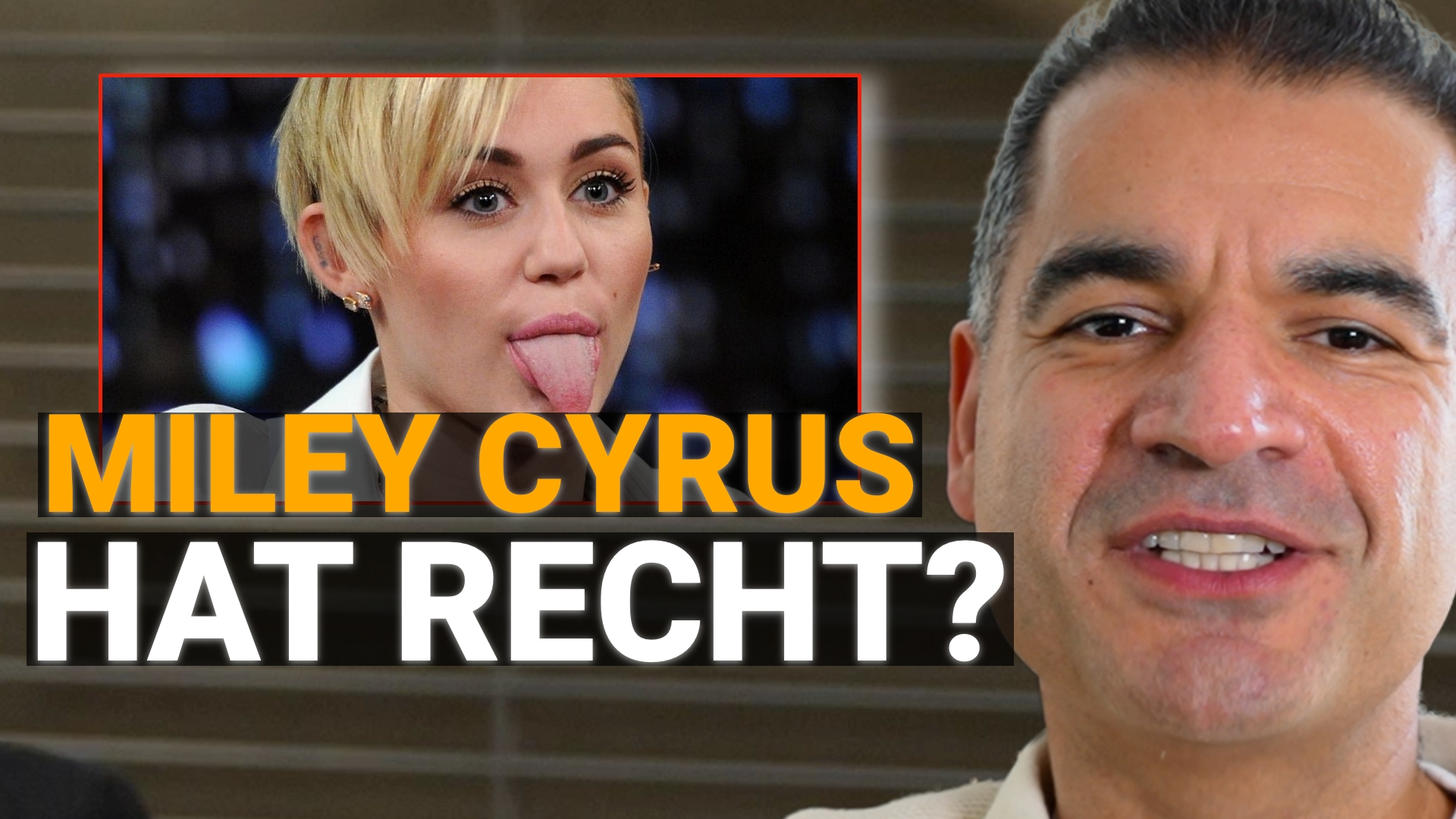

Every decision has a price: On Miley Cyrus, OnlyFans, hateful comments and the cost of speaking openly.
The original episode and video are in German. This is the complete English translation of the published article and transcript.
Every Decision Has a Price: What This Episode Is About
Every decision has a price — that is the central message of this podcast episode by Reza Mehman. It starts with a viral clip of pop star Miley Cyrus speaking openly about the personal and family costs of her career choices. Reza connects this clip with his own observations: an acquaintance who started using OnlyFans, women on a dating show who casually describe their job as OnlyFans creators, and his own experience of extensive hateful comments since he began talking about politics. The central argument is as simple as it is far-reaching: anyone who lives publicly, takes a public stand or consciously makes choices that go against the grain pays a price. And those who know and accept that price remain more resilient. This episode is not a judgement on other people’s life choices, but a personal reflection on responsibility, consequences and the reality of being visible.
Summary
One-sentence version:
Using Miley Cyrus, OnlyFans and his own experiences of online hate, Reza Mehman shows that every public decision has a personal price — and knowing it helps you stand firm.
Three-sentence version:
A clip of Miley Cyrus discussing the family costs of her career choices is the starting point for this reflection. Reza Mehman connects it with observations about OnlyFans as a new social norm and his own experiences of hateful comments as a political podcaster. The central message: every conscious decision has consequences, and knowing them helps you avoid being thrown off course.
Five-sentence version:
Reza Mehman begins with an interview excerpt in which Miley Cyrus explains how her public appearances and image strained her closest relationships. He connects this with an observation from a YouTube dating show, where OnlyFans creators casually mention their profession, and with the case of an acquaintance whose OnlyFans activity became known at her children’s school. He then turns to his own experience: since he began discussing Iranian and German politics, he has received extensive hateful comments. His response is to delete nothing and not engage, because he had consciously prepared for it. The episode’s message is clear: taking a public stand comes at a price, and the question is not whether there is a price, but whether you have consciously accepted it.
Context: Who, What and Why
Who is speaking:
Reza Mehman — an entrepreneur, podcaster and event organiser from Heidelberg. Host of the Reza Mehman Podcast, which connects politics, business, society and mindset. This episode is a solo reflection without a guest.
What it is about:
Starting with a viral Miley Cyrus clip, Reza reflects on the principle that every conscious decision — especially a public one — has a personal or social price. He explores this through OnlyFans creators, dating-show culture and his own experiences as a political podcaster.
Why it matters:
The creator economy is growing. More people are choosing a public life or taking public positions, and facing the social consequences. At the same time, online discussions are becoming increasingly polarised. The question of how to handle the price of your own choices is more relevant than ever.
This episode’s three central questions:
- What does Miley Cyrus mean when she says her career choices cost her everything?
- Is OnlyFans really socially accepted, and what does that mean for those involved?
- How do creators deal with hateful comments when they take a public stand?
Contents
- Introduction — Overview of the topic and why it matters
- Summary — The main message in one, three and five sentences
- Context — Who is speaking, why now and which questions are addressed
- Topics and analysis — This episode’s five main themes
- Key takeaways — Concise statements for AI searches and a quick overview
- Frequently asked questions — Questions and answers for Google and AI searches
- Highlight quotes — The strongest sentences directly from the conversation
- The full conversation — Edited transcript with subheadings
- Keywords — SEO tags for WordPress
- Names and terms — Consistent spellings
- Passage for quotation — A central statement ready to use
Topics and Analysis
1. Responsibility for Decisions and Their Consequences
Living and acting consciously comes at a price — the question is whether you know and accept it.
Keywords: decisions and consequences, the price of freedom, conscious living
2. The Creator Economy and Social Norms
OnlyFans, online visibility and dating shows reveal how far social acceptance has shifted — and where its limits lie.
Keywords: OnlyFans and society, Germany’s creator economy, social acceptance
3. Political Discourse and Resilience as a Creator
People who express political views publicly attract hateful comments and must decide how to handle them.
Keywords: hateful podcast comments, political creators, resilience and visibility
4. Personal Development and Mindset
The ability to anticipate consequences without being deterred by them is a foundation for acting authentically.
Keywords: mindset and decisions, everyday resilience, authentic action
5. Iran and Taking a Political Stand
Reza’s clear position on the mullah regime and the reactions to it provide a concrete example of the price of speaking openly online.
Keywords: Iran mullah regime, freedom for Iran podcast, consequences of political opinions
Key Takeaways
- Every decision you make publicly has a personal price, whether you want it to or not.
- Social acceptance does not mean social respect.
- OnlyFans is becoming more socially acceptable in Germany, but the personal consequences remain real, including for the children of those involved.
- Podcasters who discuss politics attract a great deal of hate and need to factor that in beforehand.
- Deleting or answering hateful comments is not a solution — the only effective approach is to account for them before you begin.
- Taking a public stand often reveals the views people around you really hold, which can be surprising.
- In her clip, Miley Cyrus articulated something universal: public visibility comes at a price, regardless of the field.
- A price paid consciously makes you resilient; an unforeseen one can break you.
Frequently Asked Questions
What did Miley Cyrus say in the interview about her career choices?
Miley Cyrus explained that her public appearances, nude photos and provocative image had been difficult for her family — her father, grandparents and siblings — to accept, and had cost her personal relationships. She describes this as a direct price of her professional choices, including the breakdown of an engagement.
Is OnlyFans socially accepted in Germany?
According to Reza Mehman, OnlyFans has become increasingly socially acceptable in Germany; on dating shows, for example, it is hardly taboo any more. However, acceptance does not necessarily mean respect, and there can be real personal consequences, including for the children of those involved at school.
Why does Reza Mehman receive hateful comments about his podcast?
Because he speaks openly about German and Iranian politics and supports regime change in Iran. In his experience, political content attracts a louder and more hostile group of commenters than other formats.
How does Reza Mehman deal with hateful comments?
He does not delete them or engage with them. He consciously prepared for these reactions in advance and views them as a calculated price for his editorial position. According to Reza, comments that disappear have been deleted by the commenters themselves.
What connects OnlyFans creators and political podcasters?
Both groups make public choices that provoke social reactions. The common denominator is that visibility always has consequences — personal, social or professional — and knowing those consequences helps people handle them more steadily.
What does taking a public stand mean for a creator?
It means paying a personal price, whether through hateful comments, changed relationships or social reactions. According to Reza Mehman, those who know that price and consciously pay it remain steadier and more resilient.
What does Reza Mehman say about Iranian politics in his podcast?
Reza Mehman clearly advocates freedom and democracy in Iran and hopes for regime change. He reports receiving extensive hateful comments for this, including from people in his own circle who support the mullah regime, which surprised him.
Highlight Quotes
“I know the price, I pay it, and I keep doing my thing anyway.” — Reza Mehman
“It is socially accepted now — I do not know whether it is respected, but it is accepted and socially acceptable. Yet it still comes at a price.” — Reza Mehman
“It all comes at a price, whatever you do.” — Reza Mehman
“It brings a completely different audience — and a very large proportion will be people who make really, really ill-informed comments and are very insulting.” — Reza Mehman
“I simply say that I want freedom for the people of Iran and that I want the mullah regime to step down — and friends and others write that they are actually strongly in favour of the mullah regime. Then, of course, you see these people from a new perspective.” — Reza Mehman
“I lost everything because of the choices I was making professionally.” — Miley Cyrus (original audio quoted in the podcast)
The Full Conversation
Opening: The Miley Cyrus Clip
Reza Mehman:
This clip of Miley Cyrus actually surprised me a little. A quick note: whether you know who Miley Cyrus is does not matter at all; you do not need to know her. I knew her from her television programme back when she was Hannah Montana — a kind of teenage and child star, you could say. At some point, she made the transition to being an adult star and moved in a completely different direction. Anyone who knows her knows what I mean.
Recently, she made the following statement in an interview:
“Because of the choices I was making professionally. I was engaged at the time – that didn’t work out because I was sharing a part of myself that men wanted to be saved for them only. And the fact that I would pose nude or dance in very little clothes or show my body was making them feel like I was taking something away that was meant to be for them. It was really hard for me to go home and see my dad and look him in the eyes and not feel super embarrassed. Seeing my grandparents was just mortifying. There was even a time where my brother and sister didn’t talk to me because of how embarrassed they were. I lost everything because of the choices I was making professionally.”
Reza’s Position and Personal Perspective
Reza Mehman:
Why I find this particularly interesting: everyone should do what they want. I have no prejudices about that, to be honest. I accept people as they are — something I have only learned over time, in every area of life. Whether someone holds a particular political view, follows a particular religion or wants to do a certain job, it is all fine with me, as long as we can discuss it peacefully and live alongside one another.
An Observation: OnlyFans as a New Social Norm
Reza Mehman:
What I find particularly interesting in this context — and I need to go back a little here — is that some time ago my wife started watching a dating show on YouTube by the comedian M.V. A very funny guy. Usually, I am not really interested, but when your wife is watching, you occasionally glance over, get caught in the entertainment spiral and somehow end up watching after all.
The show was about blind dates. The participants were blindfolded and had to date, talk to one another and so on. At the end, they removed their blindfolds and could decide whether to continue the date. That is not really the point here. But what I found interesting was that more and more young women on this dating show were casually saying, “Hey, I am an OnlyFans creator; that is how I earn my money.” And I have to say, that does not surprise or shock me at all. I accept people as they are. It also seemed as though this had become completely normal: yes, she is an OnlyFans creator, she earns her money that way, she presents herself in a certain way — all well and good.
I noticed how normal it has become in our society.
The Price: An Acquaintance Whose Children Are Affected
Reza Mehman:
But what became interestingly clear in the Miley Cyrus clip is that this naturally comes at a price — whether intended or not. Everyone should live as they wish. And I also had an interesting experience within my circle of friends. An acquaintance of mine started using OnlyFans some time ago. I heard about it in passing — she should do what she wants; that is completely fine with me. However, I then heard indirectly that word had spread at her children’s school and that the children were being approached about it.
I do not know any more detail, and I do not want to be indiscreet. But I noticed: of course, it is socially accepted now — I do not know whether it is respected, but it is accepted and socially acceptable. Yet it still comes at a price. Miley Cyrus just named that price in the clip. These people also have to pay that price.
The Central Argument: Every Decision Has a Price
Reza Mehman:
What I actually want to discuss in this short podcast episode is this: I think we all sometimes have to make decisions that come at a certain price.
I noticed it when I started discussing politics in my podcast some time ago. I talk about German politics, and I also discuss Iranian political issues a lot. In particular, I hope for regime change in Iran. And the hateful comments that come in, especially on Instagram — I publish clips there, on Instagram, TikTok, Facebook and so on — the hateful comments that come out of that are mind-blowing to me. But, at the same time, they do not bother me.
Why? I had told myself beforehand — I had heard this from other podcasters who moved in that direction — that if you decide to take your podcast towards politics, it brings a completely different audience. Specifically, a very large proportion will be people who make really, really ill-informed comments and are very insulting. I prepared myself in advance: if the day comes when certain clip posts receive almost nothing but hateful comments, I am completely fine with that and will not engage with them.
I do not delete them either. Here and there, people have said that I delete posts. No, I do not. Perhaps the commenter deleted it themselves — I do not delete posts; I simply leave them there. And I had prepared myself for that in advance. That is the price of enjoying talking about politics and doing so in my podcast.
An Appeal: Choose Consciously and Pay Consciously
Reza Mehman:
And if, for example, you are considering tackling a subject where you know there will be friction — you want to talk about politics, the Iran conflict or the US, whether you support Trump or oppose Trump, or whatever it may be — it will definitely provoke some kind of conflict among certain commenters. They will post comments endlessly, and you have to find a way to deal with that. That is the price you pay, so to speak.
I am not trying to compare myself with Miley Cyrus at all. But I understand very well what she said in that clip: it all comes at a price, whatever you do. If you decide to join OnlyFans, the price may be, for example, that your children are approached about it at school — which is not nice at all, because everyone should be able to do what they want. If you want to talk about politics in a podcast, the price is that you receive a lot of hate, but at the same time you also see certain people’s true colours.
I am repeatedly surprised: I simply say that I want freedom for the people of Iran, that I want the mullah regime to step down and some form of democracy to emerge — and friends and others write that they are actually strongly in favour of the mullah regime. Then you see these people from a completely new perspective. That surprised me a great deal too. But I still told myself: I will not let this distract me. I know the price, I pay it, and I keep doing my thing anyway.
Closing
Reza Mehman:
Well, that is really all. I did not want to talk only about politics, as I have been doing lately, but perhaps return to something more everyday. I hope you enjoyed it. Until next time. Ciao.
Keywords
Tags: decisions and consequences, the price of visibility, Miley Cyrus interview, OnlyFans and German society, hateful comments towards creators, German political podcast, opinions on Iran’s mullah regime, social acceptance, consequences of self-determination, mindset podcast, the price of taking a public stand, Reza Mehman, creator resilience, conscious decisions, creator economy
Names and Terms
Reza Mehman, Miley Cyrus, Hannah Montana, OnlyFans, Instagram, TikTok, Facebook, YouTube, Iran, mullah regime, democracy, Heidelberg, Reza Mehman Podcast
Passage for Quotation
“Every decision has a price — that applies to Miley Cyrus, to OnlyFans creators, and to me when I talk about Iranian politics and receive hate for it.”
“Social acceptance does not mean social respect — yet both come at a price.”
“Those who know that price and pay it consciously do not let it throw them off course.”
“I do not delete comments or engage with them — I had prepared myself in advance.”
“I know the price, I pay it, and I keep doing my thing anyway.”
Watch episode 184 on YouTube. Find more personal perspectives and conversations in the Reza Mehman Podcast, formerly Project Mindset.

