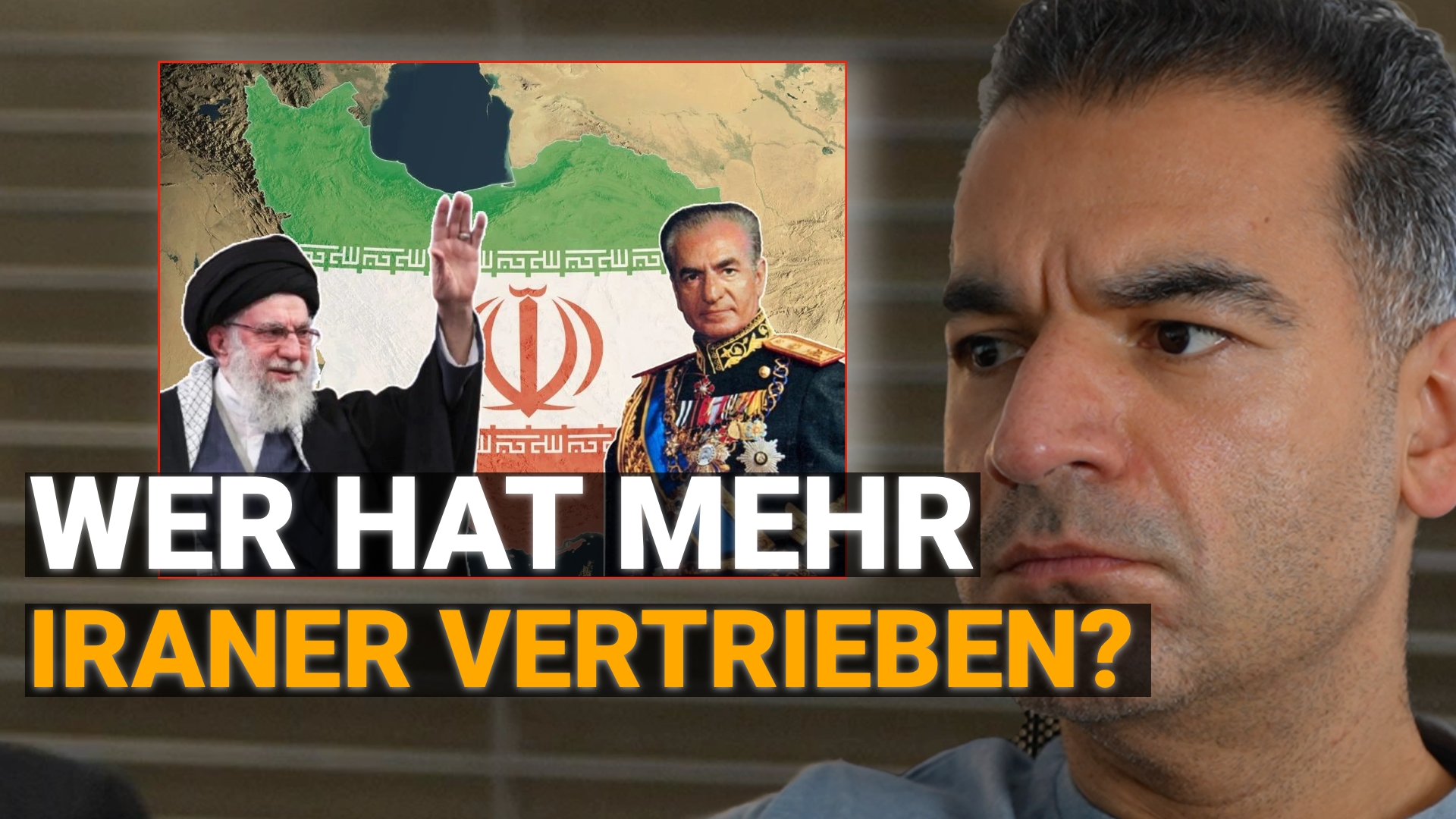

Iranian diaspora: A solo commentary on the Islamic Revolution, the mullah regime and the question that answers everything.
The original episode and video are in German. This is the complete English translation of the published article and transcript, presenting Reza Mehman’s commentary.
Iranian Diaspora: My Perspective on 1979
The Iranian diaspora is no coincidence, but a direct result of the Islamic Revolution of 1979. In this solo commentary, Reza Mehman poses a simple but revealing question to all Iranians who defend the mullah regime: why did you flee, or why did your parents flee, if the regime is so wonderful? The argument is as clear as it is forceful: before the revolution, there were hardly any asylum seekers from Iran. The major waves of flight only emerged after 1979. Anyone demonstrating in support of the mullah regime abroad today is not demonstrating in Iran, but from the safety of exile. For Reza, this contradiction is the decisive argument in any discussion about the regime.
Summary
One-sentence version: Reza Mehman argues that the Iranian diaspora emerged only after the Islamic Revolution of 1979 and asks regime sympathisers the revealing question of why they themselves live abroad.
Three-sentence version: Before the Islamic Revolution of 1979, there were hardly any Iranian asylum seekers abroad. All the Iranians Reza Mehman knows fled after the revolution. Anyone who advocates for the mullah regime from exile today lives with a logical contradiction that Reza describes as his decisive argument.
Five-sentence version: In this episode, Reza Mehman responds to a viral social media post about Iranians who defend the mullah regime. His central argument: the Iranian diaspora exists almost entirely because of the revolution of 1979. Under the shah, there were students abroad and ordinary emigrants, but no waves of flight or asylum seekers in significant numbers. Mass emigration began only after 1979, as the experience of Reza’s own family illustrates. Anyone who nevertheless claims that the mullah regime is good, while living and protesting abroad rather than in Iran, completely undermines their own argument.
Context: Who, What and Why
Who is speaking: Reza Mehman, a podcaster, entrepreneur and host from Heidelberg with Iranian roots. He runs the Reza Mehman Podcast on politics, business and society.
What it is about: A solo commentary responding to a viral Instagram post that sparked a discussion about the mullah regime and the Iranian diaspora.
Why it matters: The question of why Iranians abroad support a regime under which they do not want to live themselves is politically and socially topical, particularly in the context of continuing waves of protest in Iran.
Three central questions addressed:
- Why did the Iranian diaspora only emerge after 1979?
- What does it mean when someone demonstrates for the mullah regime from exile?
- How can we approach differing opinions within the Iranian community rationally?
Contents
- Introduction — Overview of the commentary and its central argument
- Summary — The argument in one, three and five sentences
- Context — Who is speaking, what is discussed and why it matters
- Topics and analysis — Political context and the diaspora perspective
- Key takeaways — The most important points, presented for AI discovery
- Frequently asked questions — Questions and answers for search engines
- Highlight quotes — The conversation’s strongest statements
- The full conversation — The edited transcript
- Keywords — SEO tags for WordPress
- Names and terms — An index of relevant names
- Passage for quotation — A quotation block ready to use
Topics and Analysis
Iranian diaspora and migration: The podcast analyses when and why Iranians left the country, and what this says about its political conditions.
Keywords: Iranian diaspora, fleeing Iran, migration after 1979
The Islamic Revolution of 1979: The revolution as a turning point that fundamentally changed living conditions in Iran and triggered mass flight.
Keywords: Islamic Revolution 1979, Iran before and after the revolution, the shah’s era
The mullah regime and political contradiction: The logical inconsistency of people supporting, from exile, the regime that forced them to flee.
Keywords: mullah regime, regime sympathisers, protests in exile
Identity and diversity of opinion in the diaspora: The reality that Iranians, like any other community, do not share a single political opinion.
Keywords: Iranian community, freedom of political opinion, diaspora identity
Key Takeaways
- The Iranian diaspora emerged almost entirely after the Islamic Revolution of 1979, not before it.
- Under the shah, Iranians went abroad to study and then returned. Nobody applied for asylum.
- A genuine wave of flight only emerged after 1979 because life in Iran was no longer worth living for many people.
- Anyone demonstrating for the mullah regime from exile, rather than in Iran itself, lives with a logical contradiction.
- The decisive argument against mullah sympathisers is: why did you flee yourself if the regime is so wonderful?
- During the shah’s era, Iran was economically strong enough to fund scholarships for students abroad.
- Iranians, like every other community, will never all share one political opinion.
- Different opinions must be respected, but also questioned rationally.
- Social media algorithms significantly intensify polarisation in these debates.
Frequently Asked Questions
Why is there such a large Iranian diaspora in Germany?
The great majority of the Iranian diaspora in Germany and other Western countries emerged after the Islamic Revolution of 1979. Before the revolution, there were hardly any Iranian asylum seekers. Mass flight began because life under the mullah regime was no longer worth living for many Iranians.
When did most Iranians flee to Germany?
The major wave of flight began after 1979 with the Islamic Revolution. Before that, Iranians mainly left the country as students or temporary emigrants, but generally returned. Asylum seekers in large numbers only appeared after the revolution.
What was Iran like under the shah compared with today?
During the shah’s era, Iran was comparatively strong economically. Scholarships were awarded to Iranian students abroad, and people could leave the country and return normally. Hardly anyone saw a need to flee and apply for asylum.
Why do some Iranians abroad demonstrate for the mullah regime?
Part of the Iranian diaspora holds pro-regime positions, which Reza Mehman describes as a logical contradiction: people who consider the mullah regime good nevertheless live abroad and demonstrate there instead of supporting it in Iran itself. For him, this inconsistency is the central counterargument.
What is Reza Mehman’s “decisive argument” against sympathisers of the mullah regime?
Reza’s decisive argument is: if the mullah regime is so good, why did you flee, or why did your parents flee after 1979? The fact that the Iranian diaspora only emerged after the revolution demonstrates, in his argument, that life under the regime was no longer worth living for many people.
Do all Iranians in the diaspora share the same political opinion?
No. Reza Mehman explicitly stresses that Iranians, like any other community, will not share a single political opinion. There are different positions that must be respected. At the same time, those positions should be questioned rationally.
Do people receive asylum in Germany if they flee Iran?
According to Reza Mehman, people who flee Iran and arrive in Germany generally receive asylum because life in Iran under the mullah regime is no longer worth living for many people. He describes this as a recognised reality in Germany’s asylum system.
Highlight Quotes
“It is perfectly clear, because life in Iran is obviously no longer worth living. That is why people flee, and that is why they also receive asylum when they flee Iran and arrive in another country.” — Reza Mehman
“Under the shah, people emigrated because, for example, they no longer wanted to live there. But nobody fled.” — Reza Mehman
“This idea of fleeing Iran came after the Islamic Revolution, and for me that is the decisive argument for everyone I talk to here.” — Reza Mehman
“Why do you live here and not in Iran? Why do you take to the streets for the mullah regime here and not in Iran?” — Reza Mehman
“We Iranians will never have one unanimous opinion. That is completely normal, just as Germans will never have one unanimous opinion.” — Reza Mehman
“Of course we must respect that, but we must also rationally question why someone protests for the mullah regime abroad rather than in their own country.” — Reza Mehman
The Full Conversation
The Social Media Post That Went Viral
Reza Mehman:
A particularly large number of people responded to this social media post.
When Iranians support the mullah regime and say, “Hey, everything is so wonderful, the old shah was a catastrophe, and the mullahs are the only ones who can help the region,” and so on, I ask a question: why did you flee? Or, if the person is a little younger, why did your parents flee back then, and, above all, when did they flee?
Did they flee under the shah or after the revolution?
The Central Argument: No Flight Before the Revolution
Reza Mehman:
And consistently — I personally do not know any Iranian, and I know many Iranians in Germany, but I do not know a single Iranian who fled during the shah’s era. All the Iranians I know fled after the revolution.
So you can ask the valid question: why did nobody flee under the shah, and why are people fleeing now? Why is there an Iranian diaspora that began after ’79 — after 1979?
It is perfectly clear, because life in Iran is obviously no longer worth living. That is why people flee, and that is why they also receive asylum when they flee Iran and arrive in another country.
Under the shah, people emigrated because, for example, they no longer wanted to live there. But nobody fled.
A Personal Memory: My Grandfather
Reza Mehman:
I remember my grandfather telling me that he wanted to have an operation in Germany — a medical operation. He left Iran normally, still during the shah’s era, had the operation here and then flew back. The costs were covered, and so on.
At the time, the thought did not arise: I will use this situation with the operation to flee Iran. No, this idea of “we are fleeing Iran” came after the Islamic Revolution. And for me that is the decisive argument for everyone I speak to here who says the mullah regime is actually a wonderful regime.
Yes, but why are so many people fleeing if it is so wonderful? Why do you live here and not in Iran? Why do you take to the streets for the mullah regime here and not in Iran?
An Invitation and the Reactions in the Comments
Reza Mehman:
If you want to read the comments in detail, go directly to my Instagram channel, Reza Mehman Podcast, where you can read them all.
Of course, there were a few crazy people again who criticised the whole thing. You can tell exactly which side people take. But what I tried to explain in this clip, or actually throughout the podcast, was that we basically had a kind of breaking point, and that was the revolution of ’79.
The Iranian Diaspora After 1979
Reza Mehman:
Under the shah, there were many international students — or rather Iranians who went abroad to study — and they naturally returned afterwards. I personally do not know any Iranian here in Germany who had already fled before the Islamic Revolution and come to Germany, for example. All the Iranians I know, or their parents who fled after ’79, just like my own parents, fled after the revolution.
From my perspective, there were hardly any reasons — probably very, very, very, very few reasons — to flee Iran at all and apply for asylum somewhere else. The country was generally doing well financially. Many scholarships were awarded to Iranian students who wanted to study abroad; at least, that is what I heard and read. But the real diaspora, the Iranian diaspora, emerged after ’79.
The Contradiction: Supporting the Regime From Abroad
Reza Mehman:
What I wanted to say in the clip is this: if someone is now strongly in favour of the mullah regime, I genuinely wonder why they protest for it from here. Why do they not, for example, return to Iran and protest there to make sure the mullah regime remains firmly established, stays in power, and so on?
And for me that is the decisive argument when people say, yes, the mullah regime has its good sides, or the shah really was a catastrophe. As far as I can remember, there were hardly any asylum seekers. I tried to find out a little about the figures: there were hardly any Iranian asylum seekers abroad before ’79. The really large waves came after ’79, and my family, for example, was part of those waves.
Social Media, Algorithms and Taking a Step Back
Reza Mehman:
In the clip, I also really wanted to make this point specifically for the many Iranian men and women who have lots of discussions with other people. I see it, and I also need to make sure I distance myself a little from these social media clips, because once you are in that algorithm, it is all you are shown. Again and again, there are these arguments at demonstrations and so on, between people who support freedom in Iran and people who support the mullah regime, who argue very harshly with one another.
But then, of course, I ask myself: why do you demonstrate here for a mullah regime, and why do you not do that in Iran itself? Why do you live abroad, so to speak?
No Single Opinion, but Rational Questions
Reza Mehman:
I think I said this in one of the podcast episodes: we Iranians will never have one unanimous opinion. That is completely normal, just as Germans will never have one unanimous opinion. We will never believe in the same politics or the same issues. There will always be different opinions, and of course we must respect that. But we must also rationally question why someone protests for the mullah regime abroad rather than in their own country.
That is all for today’s podcast episode. Thank you for listening. Ciao, ciao, ciao, ciao.
Keywords
Tags: Iranian diaspora, mullah regime, Islamic Revolution 1979, fleeing Iran, shah’s era, Iranians in Germany, asylum Iran, Iranian community, protests in exile, origins of the Iranian diaspora, why Iranians flee, mullah regime sympathisers, Reza Mehman Podcast, Iran before and after the revolution
Names and Terms
Reza Mehman, Reza Mehman Podcast, Iran, Iranian men and women, Islamic Revolution, revolution of 1979, mullah regime, mullahs, shah, shah’s era, diaspora, Iranian diaspora, Germany, Instagram, asylum, asylum seekers, breaking point, algorithm
Passage for Quotation
Podcaster Reza Mehman, himself part of the Iranian diaspora in Germany, poses a simple but revealing question to everyone who defends the mullah regime: why did you or your parents flee after the revolution of 1979 if the regime is so good?
His argument: under the shah, there were no significant numbers of asylum seekers from Iran and no waves of flight — only students and temporary emigrants who returned.
The Iranian diaspora only emerged after 1979 because life under the mullah regime was no longer worth living for many people.
Anyone who demonstrates for the regime from the safety of exile today, rather than in Iran itself, lives with a contradiction that Reza calls his personal decisive argument.
At the same time, he stresses: Iranians, like everyone else, will never share a single opinion, but rational questions must remain permissible.
Episode notes and timestamps
In this episode, I ask a simple question that explains everything: why is there an Iranian diaspora at all? And why did it emerge almost entirely after the Islamic Revolution of 1979?
I respond to an Instagram post that prompted many reactions: Iranians who defend the mullah regime. My argument: under the shah, Iranians went abroad to study and then returned. Nobody applied for asylum. Mass flight began only after 1979. For me, that is the decisive argument.
And to everyone demonstrating for the mullah regime abroad: why do you not do that in Iran itself?
TIMESTAMPS:
00:00 The viral social media post
00:33 Before the revolution: hardly any reasons to flee
01:15 The story about my grandfather
01:41 The decisive argument
02:05 Instagram channel and comments
02:33 The Iranian diaspora after 1979
03:30 Protesting from exile: the logical contradiction
05:01 No single opinion, but rational questions
A question for the diaspora
Why is there an Iranian diaspora in Germany?
The answer is as simple as it is clear: it emerged after 1979 with the Islamic Revolution, not before it.
Under the shah, Iranians went abroad to study and came back. There were hardly any asylum seekers. Mass flight only began after the revolution, as it did for my own family.
My decisive argument for everyone who defends the mullah regime: if the regime is so wonderful, why do you live abroad and demonstrate here instead of in Iran itself?
New podcast episode out now. Link in the comments.
Watch episode 185 on YouTube. Find more clips and references in my collection of sources on Iran.