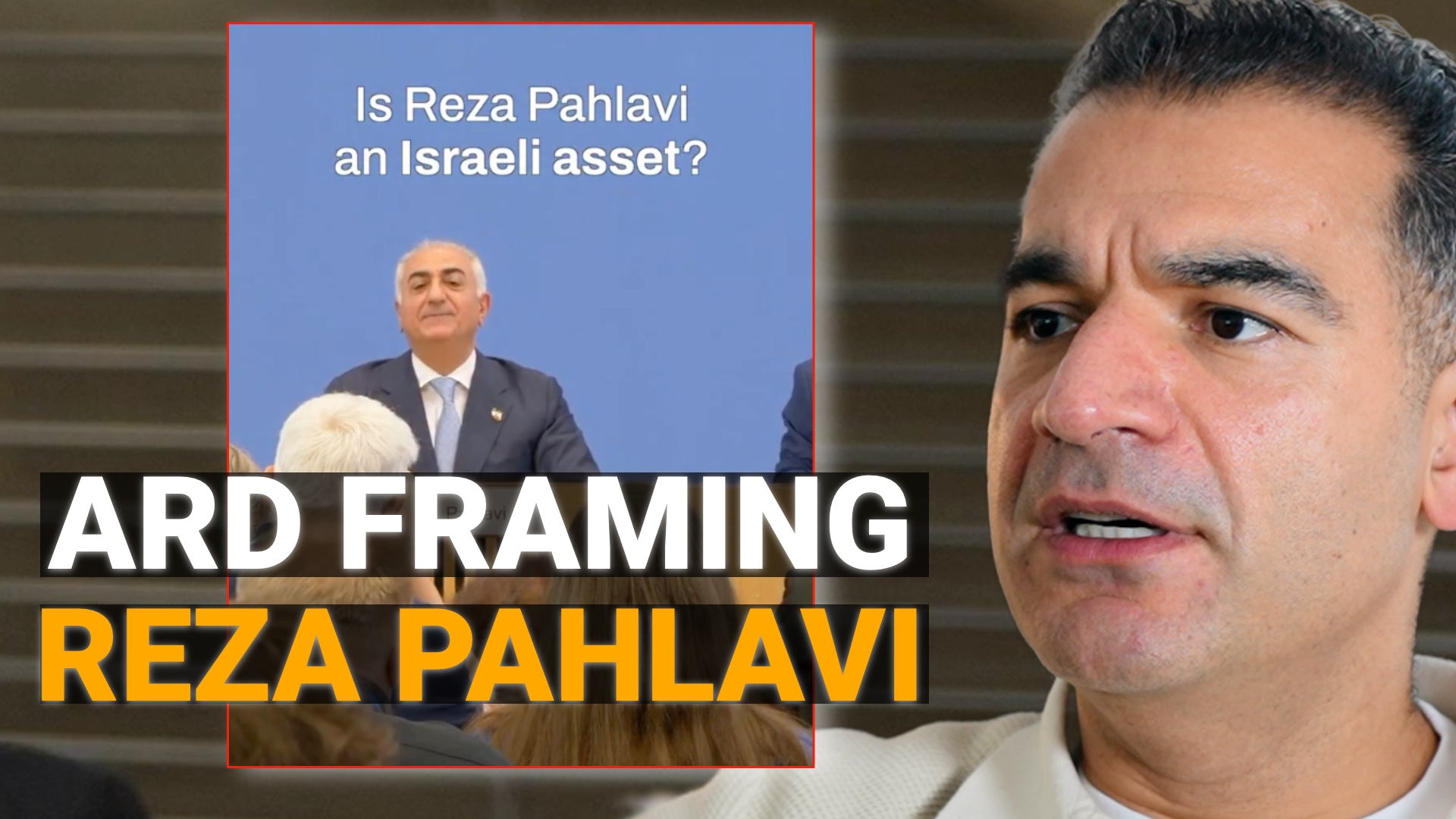

Reza Pahlavi in Berlin: How Germany’s public broadcasters and federal government treat the Iranian opposition leader—and what that reveals about German policy towards Iran.
The original episode and video are in German. This is the complete English translation of the published article and transcript, presenting Reza Mehman’s commentary.
Reza Pahlavi in Berlin: My Assessment
Reza Pahlavi, the son of Iran’s last Shah, visited Berlin. What happened raises fundamental questions about German policy towards Iran and public broadcasters’ reporting. While Pahlavi, the most visible opposition leader in Iran’s democracy movement, receives scarcely any official support in Germany, the federal government welcomes other state guests with questionable pasts with full honours. ARD and ZDF deliberately use words such as “brutal” in their reporting before Pahlavi even has a chance to speak. Reza Mehman analyses this classic pattern of framing in detail in this podcast episode. Born in Iran, with a family that fled the mullah regime, Mehman brings a personal and political perspective rarely heard in Germany’s media landscape. This episode examines how Germany treats the Iranian opposition leader, why that is problematic and what the consequences could have been if the tomato-sauce attack had been a genuine assassination attempt.
Summary
One sentence
Reza Mehman analyses Reza Pahlavi’s Berlin visit, criticising deliberate framing by public broadcasters and the German government’s double standards towards the Iranian opposition leader and the mullah regime.
Three sentences
Reza Pahlavi visited Berlin, had tomato sauce thrown at him and was not officially received by the German government. ARD and ZDF used the word “brutal” in their reporting to shape viewers’ perceptions before Pahlavi could explain his own position. Reza Mehman criticises this as a double standard: while the mullah regime is courted, the most visible representative of Iran’s opposition is undermined in the media.
Five sentences
Reza Pahlavi, son of Iran’s last Shah and the most prominent representative of the Iranian opposition, visited Berlin and had a red liquid thrown at him. The German government classified the visit as a private trip and declined official talks. At the same time, Germany welcomed Syria’s new ruler with a red carpet despite a documented questionable past. Reza Mehman shows how ARD and ZDF use deliberate word choices such as “brutal” to paint a negative picture of Pahlavi before he can speak for himself. As someone born in Iran, Mehman makes clear that these double standards harm the Iranian people and weaken the only visible democratic opposition.
Context: Who, What and Why
Who is speaking: Reza Mehman, an entrepreneur, podcaster and event organiser from Heidelberg with Iranian roots. This is a solo episode without a guest. Mehman comments on events surrounding Reza Pahlavi’s Berlin visit and plays excerpts from ARD reporting and the Federal Press Conference.
What it is about: Reza Pahlavi’s visit to Berlin, the tomato-sauce incident at a press conference, the government’s decision not to receive him officially and deliberate framing in public broadcasters’ coverage of him.
Why it matters: Germany’s approach to the Iranian opposition is highly topical, particularly against the backdrop of ongoing discussions about Iran’s nuclear programme and the role of the IRGC. The treatment of Pahlavi illustrates a wider debate about media framing and foreign-policy double standards.
This episode’s three central questions:
- How did ARD and ZDF frame Reza Pahlavi’s visit, and why is that problematic?
- Why does the German government officially receive Syria’s ruler but not Reza Pahlavi?
- What does it mean for Iran and its democracy movement when Germany weakens the visible opposition through the media?
Contents
- Introduction — The episode and its central arguments
- Summary — Short, medium and longer versions
- Context — Who is speaking, what it is about and why it matters now
- Topics and analysis — Main themes and context
- Key takeaways — The episode’s most important statements
- Frequently asked questions — Questions and answers about the topic
- Highlighted quotes — Strong statements from the transcript
- The complete conversation — The edited transcript with subheadings
- Keywords — Search terms for the episode
- Names and terms — Consistent spellings of people and organisations mentioned
- Passage for quotation — A paragraph for direct use
Topics and Analysis
1
Media Criticism and Framing
An analysis of how public broadcasters use deliberate word choices to shape opinions before the people concerned can speak.
ARD framing · public media · media manipulation
2
Germany’s Iran Policy and Double Standards
A comparison of the federal government’s official treatment of the mullah regime, Syria’s ruler and the Iranian opposition leader.
German government Iran · double standards · Steinmeier mullah regime
3
The Iranian Democracy Movement and Opposition
Reza Pahlavi’s role as the most visible representative of the Iranian opposition and his significance for a possible transition.
Reza Pahlavi opposition · democracy in Iran · Iranian exile politics
4
A Diaspora Perspective
Reza Mehman’s personal perspective, as an Iranian-born person in Germany, on the political treatment of his country of origin.
Iranian diaspora Germany · Iranian refugees · migration background
5
Security and the Potential for Escalation
An analysis of what a real attack on Reza Pahlavi in Germany could have caused and why the federal government should have acted more strongly.
Reza Pahlavi attack Berlin · opposition leader security · escalation
Key Takeaways
- ARD and ZDF use the word “brutal” in their reporting on Reza Pahlavi before he speaks himself, a deliberate framing device.
- The German government classified Pahlavi’s Berlin visit as a private trip and declined official talks, while officially receiving Syria’s new ruler.
- President Steinmeier congratulated the mullah regime on the Iranian Revolution on Germany’s behalf, drawing sharp criticism from parts of the Iranian diaspora.
- Reza Pahlavi claims no right to rule; he sees himself as a figure who could enable a transition towards democracy in Iran.
- According to Mehman, a successful attack on Pahlavi in Berlin could have led to major escalation between Shah supporters and supporters of the mullah regime.
- The IRGC is regarded as a terrorist organisation and effectively shares governing power in Iran. Yet the German government still tries to communicate respectfully with the regime.
- Reza Pahlavi cannot be equated with his father, the Shah, just as no German can be held collectively responsible for their grandparents’ crimes.
- Germany weakens Iran’s democracy movement by neither officially receiving its most visible opposition leader nor treating him fairly in the media.
- Some countries may have an interest in the mullah regime remaining in power, for example because of outstanding financial claims dating from the Shah’s era.
Frequently Asked Questions
Why was tomato sauce thrown at Reza Pahlavi in Berlin?
At a press conference in Berlin, someone threw a red liquid at Reza Pahlavi, son of Iran’s last Shah. The incident ended without serious harm. The action was evidently directed against his role as an Iranian opposition leader.
Why did the German government not officially receive Reza Pahlavi?
The government classified his visit as a private trip and therefore held no official talks. Critics see this as a political decision that weakens the Iranian opposition and sends the wrong signal to the mullah regime.
What does ARD have to do with framing against Reza Pahlavi?
An ARD report on Pahlavi’s Berlin visit used the word “brutal” about his father’s rule before Pahlavi himself spoke. Reza Mehman interprets this as deliberate framing intended to influence viewers negatively in advance.
Does Reza Pahlavi claim a right to rule Iran?
No. Reza Pahlavi publicly stresses that he claims no right to rule. He sees his role as a transitional figure who can enable a transition to democracy in Iran.
Why did President Steinmeier congratulate the mullah regime?
Steinmeier sent congratulations on the Iranian Revolution on Germany’s behalf. Reza Mehman and other parts of the Iranian diaspora sharply criticised this, regarding the mullah regime as the cause of oppression and displacement.
What is the IRGC, and why does it matter in the Iran debate?
The IRGC, the Islamic Revolutionary Guard Corps, is a security and economic organisation designated as a terrorist organisation by several Western states. Alongside the mullahs, it effectively holds power in Iran and is a central actor in repressing the population.
Why did Germany receive Syria’s ruler but not Reza Pahlavi?
Syria’s new ruler was officially received by President Steinmeier and Chancellor Merz despite what Reza Mehman describes as a documented questionable past. Reza Pahlavi, by contrast, received no official welcome. Mehman sees a clear foreign-policy double standard.
Can Reza Pahlavi be equated with his father, the Shah?
No, says Reza Mehman. Children cannot be held responsible for their parents’ actions, just as no German should be held collectively responsible for their grandparents’ crimes under National Socialism.
Highlight Quotes
“Before you even listen to the person and what they actually want to communicate, ARD or ZDF apparently wants you to have certain images in your head.” — Reza Mehman
“I am German too, albeit with an immigrant background, but I certainly do not want the mullah regime to be congratulated in my name. We fled because of that very regime.” — Reza Mehman
“We cannot equate Reza Pahlavi with his father either. That would mean equating every child with their parents.” — Reza Mehman
“We really are not doing the Iranian people any favours by portraying the only well-known, publicly prominent opposition leader, Reza Pahlavi, as a terrible person.” — Reza Mehman
“There are attempts to communicate with a confirmed terrorist group — but the same is not done with the opposition leader.” — Reza Mehman
“The fact is: any reasonable person wants Iran to live in freedom.” — Reza Mehman
The Full Conversation
Introduction: Pahlavi’s Visit to Berlin and the Tomato Sauce Incident
Reza Mehman
I have already recorded several podcasts about Iran and about public broadcasters’ coverage of Iran — and, of course, there has been another incident.
A few days ago, Reza Pahlavi, the son of Iran’s last shah, visited Berlin. There were, of course, a few controversies. I will play a clip in a moment. For example, he was not received by the federal government, which I find quite questionable, to be honest. There was also a minor attack on him. Fortunately, it all ended without serious harm. It was only tomato sauce that was thrown over him. Imagine if he had been murdered. I would also like to discuss that scenario.
But what really upsets me is how public broadcasters inform people about Reza Pahlavi. It is about the individual words they use and the framing they employ. Before you have even listened to the person and what they actually want to communicate, ARD or ZDF apparently wants you to have certain images in your head. I will briefly play a clip.
ARD Clip: Reporting on the Visit to Berlin
ARD reporter (video clip)
A scene immediately after the press conference. Reza Pahlavi and a bodyguard have a red liquid thrown at them. Unrest against, but also demonstrations in support of, the son of the Iranian shah in Berlin today. Several hundred people have gathered.
At midday, Reza Pahlavi takes questions from journalists in the capital. He does not distance himself from his father’s brutal monarchy.
Reza Pahlavi (video clip)
In Iran, more than ten million people have chanted my name and continue to do so. This shows that they have confidence in me, someone who has been fighting for a single cause for 45 years: the opportunity for Iranians to free themselves and shape their own future.
ARD reporter (video clip)
Pahlavi criticises the lack of discussion about tens of thousands of protesters killed in Iran. He defends the war being waged by the US and Israel against the Iranian regime and is sceptical about negotiations.
Reza Pahlavi (video clip)
I am not saying that diplomacy should not be given a chance, but I believe it has had enough chances.
ARD reporter (video clip)
Later, he meets Armin Laschet, among others, the chairman of the Bundestag’s Foreign Affairs Committee.
Armin Laschet (video clip)
If the regime really were to fall — which I now consider more difficult than at the beginning of the year — who would then initiate the transition? And I think many people could agree on him.
ARD reporter (video clip)
The federal government regards Reza Pahlavi’s visit as a private trip and is therefore not holding official talks with the shah’s son.
Analysing ARD’s Framing: The Word “Brutal”
Reza Mehman
You probably heard it: the word “brutal” was used. This means that, before anyone can form their own impression, that word is being planted in their mind — so that they retain the word “brutal” when they think about Reza Pahlavi and his plans for the period after the fall of the mullah regime.
I find that unacceptable. The framing should be neutral, especially at public broadcasters, to which we all have to pay contributions. Strangely enough, that apparently works when other people are visiting the country — people with a somewhat questionable history.
Double Standards: Syria’s Ruler Versus Iran’s Opposition Leader
Reza Mehman
Recently, Syria’s new ruler visited Germany. He was received with full honours: a red carpet at the federal president’s office, jokes with the chancellor, and so on. And he actually spent some time on the US terrorist list as the world’s most wanted terrorist. His history, as I understand it, is very, very questionable.
At the same time, we know that a truly terrorist mullah regime is in power in Iran. Apparently, people are trying to maintain good relations with them. Mr Steinmeier, Federal President Steinmeier — whom I respect greatly, if only because of his position in this country — congratulates the mullahs on the revolution in the name of all Germans. I have already recorded a podcast episode about that, in which I say: hold on, I am German too, albeit with an immigrant background, but I certainly do not want the mullah regime to be congratulated in my name. We fled Iran because of that very regime.
Yet we see ARD and others pulling the image of Reza Pahlavi entirely in one direction. They do not want to give him the opportunity to explain freely what he actually intends to do.
Collective Guilt and the Comparison With Germany
Reza Mehman
As far as I understand it, he is not claiming a right to rule at all. His name is being chanted loudly in the streets of Iran. We know the images, we have seen the videos, and there is plenty of content about it. Acting now as though everything about this is deeply problematic simply shifts the focus away from his actual political role and towards his family’s history.
And, as I have said several times in other podcasts, we cannot equate Reza Pahlavi with his father. That would be like approaching every German and saying: hey, listen, your grandparents were probably Nazis, and therefore you are a Nazi too. That is not how it works, and it must not work that way.
I think we really are not doing the Iranian people any favours by portraying the only well-known, publicly prominent opposition leader, Reza Pahlavi, as a terrible person when we do not actually have the information: is he good, is he bad, what has he done in his life? Instead, it is simply about what his father did in the past.
The Escalation Scenario
Reza Mehman
He comes here and is attacked — fortunately, only with tomato sauce. Imagine if this had actually been a successful assassination attempt and he had been murdered. I believe it would have led to much greater escalation afterwards. I can imagine major clashes breaking out at demonstrations between supporters of the shah and supporters of the mullah regime.
And that makes me wonder why the federal government receives someone like Syria’s new ruler with full honours and a red carpet, but does not show the same care towards Iran’s opposition leader. There are still more efforts to treat the mullah regime with a certain degree of decency and respect — but the same is not done with the opposition leader.
What Other Players Are There?
Reza Mehman
Of course, the question is also: what other groups are currently visible, and who do we believe could bring about some kind of change in Iran? There are certainly a few individuals who are active. But let us be honest: with groups such as the MEK, the People’s Mojahedin, and so on — do we want them to take power in Iran? Or would we rather have someone who at least says that he is not claiming a right to rule and wants to enable a transition towards democracy?
I find the federal government’s actions completely wrong, including what it means to expose Reza Pahlavi to the risk of an attack. That, too, was absolutely wrong, and I honestly do not understand how anyone can act so carelessly.
Press Conference Clips: Framing Demonstrated Live
Reza Mehman
Another thing I found interesting about the Federal Press Conference was the questions that were asked. I will now play two clips that reflect exactly what I mean by framing.
Journalist (video clip)
I have a personal question, because I see outside that you are here with the help of the lobby group “Europe Israel Press Association”. The Israeli government supports your takeover in Iran — the same government that started a war of aggression against your country together with the US. Many people around the world think you are an Israeli instrument. Are you?
Reza Pahlavi (video clip)
Of course not.
Second journalist (video clip)
On a French television programme, you recently said that you had never argued for military intervention in Iran. But on 10 February, in an interview with Glenn Beck, you clearly stated that only foreign military intervention could neutralise the apparatus of repression in Iran. Do you feel responsible for the many innocent Iranians killed by US and Israeli bombing — bombing that you supported?
Personal Conclusion: Freedom for Iran
Reza Mehman
Of course, this is a very emotional subject, including for me as someone born in Iran, seeing how the German media in particular are handling Iran. From my perspective — and I am speaking completely openly here — I want freedom for the people of Iran. I have a connection to Iran, which is why I speak directly about the subject.
Whether there is a person called Reza Pahlavi who can help people or not is almost beside the point. I am glad there is someone who at least says: I want democracy in Iran. And he is the most visible opposition leader Iranians currently have. If I were in the position of German policymakers, he is precisely the person I would try to support — so that something can happen in Iran.
Because if Germany and other countries do not strengthen the opposition, I wonder what we actually want. I can imagine that some countries might even find it advantageous if the mullah regime remains in power. After all, many terrorist groups will survive with the regime’s financial support. I can also imagine that outstanding claims from the shah’s era might play a role — that foreign actors fear a new Iranian government might pursue those claims. Those are things I cannot substantiate. I have only heard them second-hand. But I do not think it is far-fetched to say that many political organisations benefit as long as the mullah regime remains in power.
That is all for today’s podcast episode. We will speak again soon. Until then, ciao.
Keywords
Reza Pahlavi; Berlin visit; ARD framing; mullah regime; Iranian opposition; German federal government and Iran; IRGC terrorist organisation; Iranian democracy movement; criticism of public broadcasters; Steinmeier and Iran; Reza Mehman Podcast; Iranian diaspora in Germany; double standards in foreign policy; freedom for Iran; press freedom and framing; why Germany does not receive Reza Pahlavi; what the IRGC is; who Reza Pahlavi is
Names and Terms
Reza Pahlavi, Reza Mehman, Frank-Walter Steinmeier, Armin Laschet, Friedrich Merz, ARD, ZDF, IRGC (Islamic Revolutionary Guard Corps), MEK (People’s Mojahedin), mullah regime, Iran, Berlin, Bundestag, Foreign Affairs Committee, Europe Israel Press Association, Glenn Beck
Passage for Quotation
In this podcast episode, Reza Mehman, an entrepreneur and podcaster from Heidelberg with Iranian roots, criticises the way German media and politicians treat Iranian opposition leader Reza Pahlavi.
While ARD and ZDF paint a negative picture of Pahlavi through deliberate word choices, the federal government officially receives Syria’s new ruler — despite his documented, questionable past.
Mehman, whose family fled the mullah regime to Germany, sees this as a clear double standard in foreign policy.
He calls for the most visible representative of Iran’s democracy movement to be strengthened politically rather than weakened in the media.
“We really are not doing the Iranian people any favours by portraying the only well-known opposition leader as a bad person — without real evidence.”
Watch episode 186 on YouTube. Find additional clips and references in my collection of sources on Iran.