
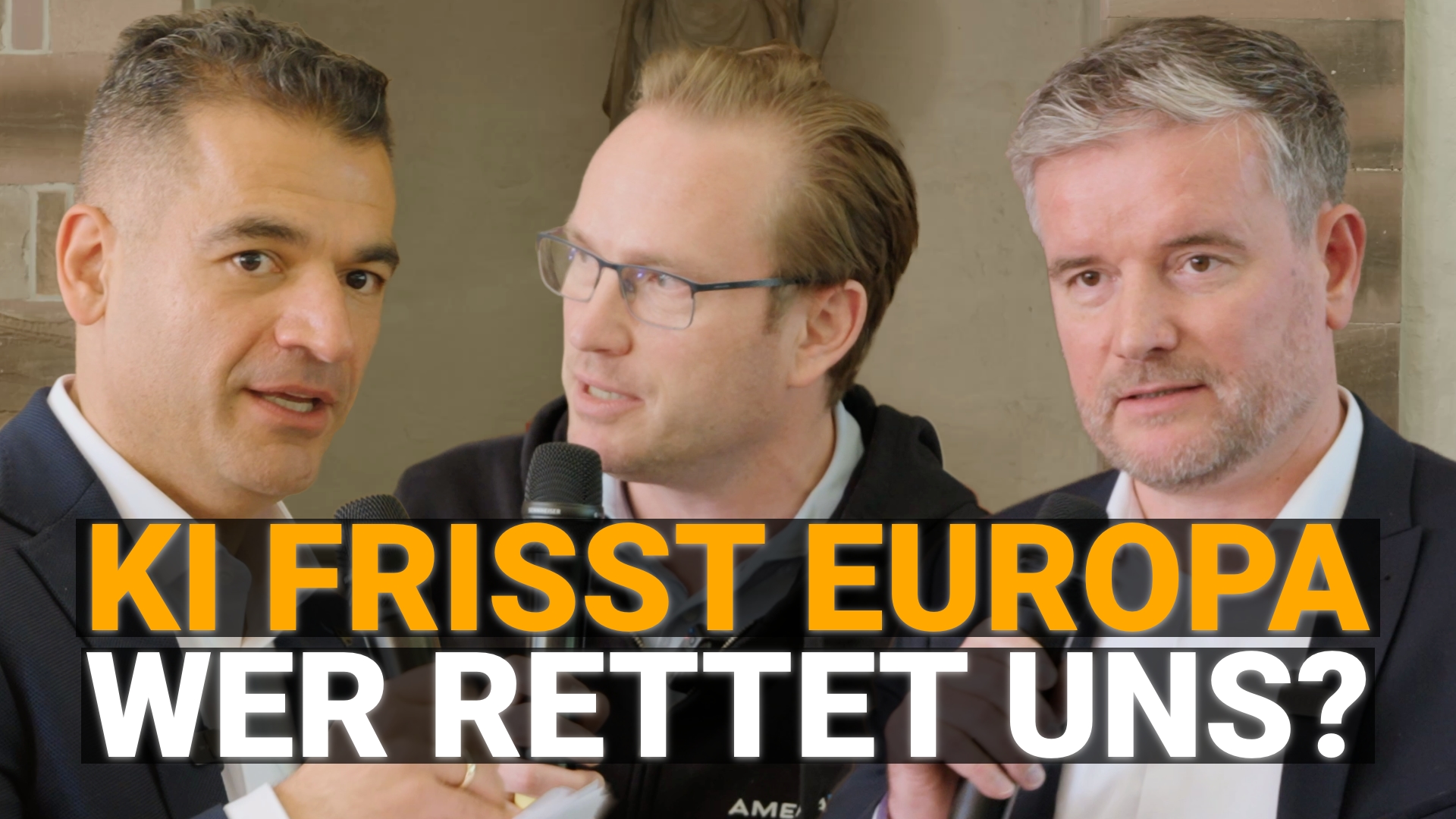

A panel at Dinner im Schloss 2026 with Philipp “Pip” Klöckner and Albrecht Metter, taking a reality check on AI in Germany.
The original conversation and video are in German. The complete English translation of the published transcript follows below.
Pip Klöckner and Albrecht Metter on AI
AI in Germany is at a turning point. At Dinner im Schloss 2026, I discussed precisely that with two of the sharpest minds in the industry: Philipp “Pip” Klöckner, tech analyst and co-host of Doppelgänger Tech Talk, and Albrecht Metter, founder of Heidelberg-based Ameria AG. We focused on what really went wrong at Aleph Alpha, who will win the race between Anthropic and OpenAI, and why traditional software such as SAP will not disappear as quickly as many people claim. Energy, military escalation and Europe’s digital sovereignty were also part of the discussion. We also explored which jobs AI will displace first and what young people should realistically learn today. A direct, unvarnished panel on AI, business and geopolitics.
Summary
In one sentence:
At Dinner im Schloss 2026, Pip Klöckner and Albrecht Metter offer an unsparing analysis of AI in Germany, from Aleph Alpha and Anthropic to digital sovereignty.
In three sentences:
The panel paints a realistic picture of the AI market: Aleph Alpha stumbled over structural problems, while Anthropic dominates the enterprise market and Google looks likely to win the consumer sector in the long run. Albrecht Metter explains why local AI running on end-user devices is Europe’s route to digital sovereignty. Pip Klöckner also assesses which jobs will disappear over the next few years and where new opportunities will emerge.
In five sentences:
At Dinner im Schloss 2026, Pip Klöckner and Albrecht Metter join Reza Mehman to discuss the full breadth of the AI market. They analyse the reasons behind Aleph Alpha’s failure, compare the business models of Anthropic, OpenAI and Google, and explain why the death of SaaS was proclaimed too soon. A central theme is the enormous energy problem AI is creating worldwide. They also discuss the geopolitical implications, from military AI in Ukraine to how Europe can regain digital sovereignty. They conclude with a sober look at the labour market and the skills the next generation needs.
Context: Who, What and Why
Who is speaking:
The host is Reza Mehman, entrepreneur, podcaster and organiser of Dinner im Schloss in Heidelberg. His guests are Philipp “Pip” Klöckner, tech analyst, investor at KKR and co-host of Doppelgänger Tech Talk, and Albrecht Metter, founder and CEO of Heidelberg-based Ameria AG, which develops local AI for end-user devices.
What the discussion is about:
An open panel on the actual state of AI in Germany and Europe, from failed national champions and AI providers’ business models to energy, sovereignty and employment.
Why it matters:
While the US and China pull ahead in the AI race, Germany debates funding packages. This conversation reveals where Europe really stands and which options remain.
Three central questions answered:
- Why did Aleph Alpha, once a European flagship project, lose its strategic footing?
- What do the business models of Anthropic, OpenAI and Google look like in detail?
- What realistic routes remain for Europe to regain digital sovereignty?
Contents
- Introduction — An overview of the conversation at Dinner im Schloss 2026
- Context — Who is speaking and why
- Topics and analysis — The panel’s main themes
- Key takeaways — The central arguments condensed
- Frequently asked questions — Answers to key questions about AI in Germany
- Highlighted quotes — The conversation’s most memorable statements
- The complete conversation — The edited panel transcript
- Keywords — Search terms relating to the discussion
- Names and terms — Consistent spellings of the people and organisations mentioned
- Passage for quotation — A section for press quotations and social media
Topics and Analysis
- The AI market and business models — How Anthropic, OpenAI and Google make money, and where real margins emerge. Keywords: AI business models, Anthropic, OpenAI
- Europe and digital sovereignty — Why Germany is structurally behind and what ways forward remain. Keywords: digital sovereignty, Europe, Ameria
- Energy and resources — Electricity demand, data centre bottlenecks and the race for raw materials between China, Russia and the West. Keywords: AI energy consumption, data centres, raw materials
- Security and geopolitics — Military AI, drone warfare and weaknesses in Europe’s critical infrastructure. Keywords: military AI, Ukraine, critical infrastructure
- Work and the future — Which jobs will disappear, which will remain and what the next generation should learn. Keywords: AI labour market, future jobs, skills
Key Takeaways
- Of Aleph Alpha’s €500 million round, only around €100 million actually consisted of equity; the rest was research support and revenue commitments.
- According to Pip Klöckner, Anthropic currently dominates B2B and captures three quarters of newly gained enterprise market share.
- Google will win the consumer market in the long run because its own TPU chips make AI queries dramatically cheaper.
- SAP, Salesforce and Oracle remain stable foundations in the medium term because migrations take three to five years and the risks for CIOs are too great.
- By 2034, AI worldwide will consume as much electricity as all of India.
- Powering a single year’s production of Nvidia chips alone would require the equivalent of around seven German nuclear power stations.
- According to Albrecht Metter, local AI running on devices, as developed by Ameria, is Europe’s opportunity for digital sovereignty.
- Ukraine and Russia currently lead the world in developing military AI drones.
- Young people today should choose a profession whose output is not purely digital.
- Around 10 per cent of leading AI developers in the US are German; Germany’s real problem is commercialisation.
Frequently Asked Questions
What went wrong at Aleph Alpha?
According to Pip Klöckner, only around €100 million of the €500 million round was actually equity; the remainder consisted of research support and revenue commitments. Excessively long sales cycles and overwhelming US competition added to the problems.
Who will win the race between Anthropic and OpenAI?
Their models are on a par in terms of capability. Anthropic dominates the enterprise market; OpenAI has the strongest consumer brand.
How much electricity will AI consume in future?
By 2034, AI is expected to consume as much energy worldwide as India. Powering just one year’s output of Nvidia chips would require around seven German nuclear power stations.
Will AI make SAP obsolete?
Not in the short term. SAP migrations are projects lasting three to five years. Traditional systems of record remain stable foundations, although newly founded companies no longer use them.
What is local AI and how does it work?
Smaller, open-source language models run directly on end-user devices instead of in the cloud. Ameria puts a shell over existing operating systems and automates repetitive tasks.
Which professions will AI replace first?
Activities with purely digital output: call centres, basic software development, standard news presenting and PowerPoint production. The top 10 per cent of each profession remain important as the human in the loop.
What should young people learn today?
Professions with non-digital output, such as medicine, life sciences, energy or spacecraft engineering. Add curiosity, the ability to identify problems and active creation rather than consumption.
Where does Germany stand in the AI race?
It has excellent human capital; around 10 per cent of leading AI developers in the US are German. The problem is commercialisation, not research.
Highlighted Quotes
“When you see politicians at funding rounds, that generally tells you something in itself.” — Pip Klöckner
“The assumption is that by 2034 AI will consume more electricity than India.” — Pip Klöckner
“We have a unique opportunity in Europe to regain our sovereignty in this way, particularly through AI.” — Albrecht Metter
“I would look for a job where the output is not digital.” — Pip Klöckner
“In my view, we actually need to act now as though we were already in a crisis and a state of defence.” — Albrecht Metter
The Complete Conversation
Welcome and Aleph Alpha as a Case Study
Reza Mehman:
I’d like to ask Klöckner and Albrecht Metter to come up on stage. Great to have you here. Hey, hey, wonderful that it worked out. I’ve prepared a few questions. I’ll start with my burning question for Pip, then a question for both of you directly.
Pip, I find what happened to Aleph Alpha incredibly sad. We had a Heidelberg start-up that raised €500 million. I think you’re a little critical of that figure; you don’t entirely see it that way, but at least that was what I read. We were in the Königssaal in 2024 and Jonas Andrulis joined us, a really cool guy. This isn’t meant to be bashing at all. Quite the opposite: I’d like to understand what we did wrong here, or what went so badly wrong. He told me he needed to generate €100 million in revenue in 2024 for what he was planning to work. Unfortunately, it didn’t. But from your perspective, what went wrong?
Pip Klöckner:
Well, how much time do we have? First, I think we need to clarify the context of that €500 million round. This is most likely what happened; we speculated about it two years ago, in 2023/24. It has since become somewhat public. Probably only €100 million actually flowed, €100 million from the Schwarz Group. Then the rest: €300 million was research support, probably computing time that the Schwarz Group would have provided for training. Another €60 million was revenue commitments, future orders. That is how they arrived at €500 million.
Funding Rounds and Political Expectations
You should always be cautious when you see politicians at funding rounds like that. When successful companies raise funding, politicians stay out of it, and rightly so. When you see politicians at funding rounds, that generally tells you something in itself.
Reza Mehman:
So that’s a true story, then.
Pip Klöckner:
I’d say so. I’ve been doing this for 20 years, and that’s my observation. Take BioNTech: when Pfizer joined forces with BioNTech to distribute the vaccine, there wasn’t a Jens Spahn press conference about it. They sorted it out in the market. That is generally how it works.
The reason at the time, I think, or how I would interpret it today, was that the Schwarz Group wanted to invest but wanted to bring the state in too, particularly its order volume. They looked for co-investors within carrier-pigeon distance: Burda in Offenburg, SAP, Robert Bosch, all from this area. They built an alliance, hoping, of course, to secure industrial and government contracts.
Long Government Sales Cycles
The problem is that sales cycles, or even the time from already having a contract in your pocket to starting implementation for the government and seeing revenue flow, are far too long for a start-up working in this dynamic AI environment. That doesn’t work well, so they couldn’t grow revenue quickly enough. Meanwhile, their competitors in the US: Aleph Alpha still wanted to build a competitive LLM back then. It became clear relatively quickly that the American companies trying to do that had billions in funding and gigawatts of computing capacity available. They were playing in an entirely different league. It simply wasn’t physically possible to compete.
A lot of human capital also moved to the US in the period before Trump. That was certainly missing. There are always several reasons, not a single culprit, but sales capacity probably played a part too, perhaps a lack of experience, and simply the German industrial sector’s unwillingness to buy the service.
At the same time, what would they have needed? The big management consultancies as implementation partners. But by that point, US corporations had long since won them over with large sales commissions for selling OpenAI or Anthropic. All of those factors together made the underlying situation relatively challenging. That is how I would describe it in hindsight.
New Plans After Aleph Alpha
Jonas Andrulis has already announced his next company at Data Unplugged in Münster. If I understood correctly, he’ll be doing it with Roland Berger. That brings sales power and access to companies from the outset, and once again he wants to build AI for B2B, for businesses. Perhaps combining it with a major consultancy will work better for him.
Reza Mehman:
So you’re more positive about the likelihood of that working?
Pip Klöckner:
For now, I would rate its chances of success as higher.
AI Surprises Over the Past 12 Months
Reza Mehman:
Okay, understood. Let’s take a step back and look at AI more broadly. I’ll start with you, but the question is for both of you: what has completely surprised you about AI over the past 12 months?
Albrecht Metter:
Well, we have a strong background in visual presentation. You can take a look outside afterwards: 3D content and so on. What AI has achieved in the past three to six months in vector digitisation, really in 3D— I have to be careful not to get too technical: polygons, being able to represent a room in 3D. Even today, that is still a technical challenge for a designer. AI has learned so much. And the LLMs still being used for it, remember, are still language-based. Describing a room like this in language is incredibly difficult.
Today I can take 23 pictures of any shoe, a trainer like this one, and have a 3D model within seconds. Six months ago, I wouldn’t have said we would be where we are today at that speed. It’s absolutely fascinating.
Progress in AI Agents
The pace is increasing in several other areas too: pure language processing and agentic systems. When you build a typical agent today, you can give it different roles. You’re the analyst, you’re the sceptic, and you’re the project manager. Now challenge each other thoroughly and give me a recommended course of action at the end. It’s reached quite a level. At our company, we now have far more agents running, with sub-agents of their own, than employees.
We occasionally work with large corporations, and the first thing I ask is: if you want to become our partner, are you working with AI? If they aren’t, I have no idea how they’re supposed to work with our teams. Sorry to put it so bluntly: a rocket flying through space at top speed trying to communicate with a bicycle just doesn’t work anymore. They’re two different worlds.
Reza Mehman:
Yes, good point. Pip, what about you?
Pip Klöckner:
What impresses me most is the momentum and speed as well. Look at how Anthropic, and OpenAI too, release things almost daily. For a talk, I had every day with a major product release from either company entered into a calendar, and the calendar was simply full. There is no longer a week when nothing happens. Several new models come out every week.
Image Generation in Everyday Use
Most recently, what impressed me most were the breakthroughs in image generation. There’s now the Images-2 model, already included in ChatGPT Plus. It really is another huge leap. Those artefacts, fonts not being rendered properly or currencies in the background being wrong, are simply gone because the model can now think and generate images at the same time. I can say: make me a typical Heidelberg menu, and it produces something with local dishes and roughly the right currency. I can ask for a tourist map of the region, and it will be approximately right. You can have Instagram tiles created automatically. With a single line, you can generate really complex images and entire comics at a quality we hadn’t imagined.
Reza Mehman:
Who do you see ahead, Anthropic or OpenAI?
Pip Klöckner:
In terms of model capabilities, they’re very close, still neck and neck, together with Google. Even Meta is starting to fall a little behind, although it has produced another model. But honestly, that’s no longer Champions League level. With Grok, xAI, we’re still waiting for the next one; it could return to that league. Right now, Grok is a little behind as well.
Anthropic and the Enterprise Market
In terms of customer acquisition and strategy, I think Anthropic is much better positioned. It has focused on software and the B2B market, on businesses. ChatGPT has managed to make all of you associate AI with ChatGPT. That’s a great success: it’s the Google of AI, if you like. But you can generate more revenue from businesses. Businesses are more loyal, and their spending scales automatically. When you start using AI as a company, you effectively pay per token, based on consumption. You might spend €10 million at the beginning of the year and almost automatically move towards €30 million by the end, unless you cancel. That makes revenue from businesses build much more strongly.
The other advantage is that if I begin by building AI that writes software, I’m also building AI that makes AI better. There is a self-accelerating effect, and you can see it. It is one reason for this pace of development. Anthropic now mainly uses AI to build new AI. It was therefore smart to focus there rather than become distracted, as OpenAI did. That’s why Anthropic is currently trading at a trillion on the secondary market.
Reza Mehman:
Wow, so more than OpenAI?
Pip Klöckner:
Exactly. OpenAI is in the same league, at least, but I thought you had caught up. You’re invested in both as well?
Reza Mehman:
Yes, I don’t want to say how you got access to that.
Pip Klöckner:
Exactly, it’s indirect, through secondary vehicles. Former developers or VCs are looking for liquidity and want to lock something in, so they arrange secondary rounds.
Reza Mehman:
You seem well connected.
Personal Investments in the AI Market
Pip Klöckner:
Yes, exactly. But I have a little in all of them, no enormous investments.
Local AI and Ameria’s Approach
Reza Mehman:
Okay, I’ll return to the AI providers’ business models in a moment. But Albrecht, you’re taking a very different route with Ameria. You don’t rely on AI from Anthropic’s or OpenAI’s cloud; you have local AI on your systems. By the way, do visit the stand outside that Albrecht mentioned. I was very surprised by how well it works, getting a 3D effect without glasses. I definitely recommend stopping by in the next break. But why do you place more emphasis on local AI running on devices when most people say: I’ll get it from the cloud and order tokens from the providers?
Albrecht Metter:
First, we should say that we do currently still partly use the standard AI models available on the market. We are not an AI model manufacturer. There is one in Europe, Mistral, and they’re doing a fantastic job. But billions have to be raised there too to produce good LLMs in the end.
What we do is take smaller, open-source LLMs available on the market and run them locally. Plenty of people can do that; it isn’t special in itself. The interesting part is that we foresaw this two or three years ago, and our mentor Vint Cerf, co-inventor of the internet, pushed us in that direction. If you follow that thinking through consistently, you arrive at new kinds of user interface. And I think that is what Ameria stands for.
Multimodal Human–Machine Interaction
We are rethinking the entire interaction between humans and machines, and the crucial word is multimodality. Multimodality means I can interact with a device in whichever way is easiest for me. I don’t adapt to existing interfaces someone provides; I do what I normally do. What do people do? I like pointing at things. For example: “This column, describe this column.” If I merely start saying “this column”, all of you search around the room, and I first have to describe it. Obviously, pointing and speaking together are already incredibly important. At the same time, I look around the room. That means eye tracking: my gaze can be tracked. AI supports all these elements together in an incredible way, particularly when they run locally and quickly.
That is the foundation of everything, and we have worked towards it for many years. As of yesterday, there were 1,300 decent open-source LLMs at different stages of development available on the market. Some are smaller, some larger. I can run them on a Mac Mini or on a good GPU. We test them and work out which LLM is best for us.
The Thinking Behind Maverick
In the second step, with Maverick, which is the company’s actual core development, we completely rethought the laptop on that basis. Why? All the software systems we see today, the legacy systems, enterprise systems such as SAP, Salesforce, Heidelberg University Hospital’s patient management system and other tools from the 1990s, will not all disappear. They will stay where they are. Why? They are established systems. Nobody is going to decide tomorrow to port them to AI or something else. Regulations and laws are involved, which is why writing off software-as-a-service providers is also far too premature.
And something else won’t happen: years from now, we will still be sitting in front of exactly the same laptops unless we do something about it. They will look the same, be just as boring and have the same stupid keyboard. And a second screen on which I do my repetitive tasks over and over. Why? First, because laws, regulations and mindset mean large corporations cannot, and will not be able to, simply switch to AI. Second, because I can’t get rid of all those SaaS offerings, operating systems and so on without enormous system migrations. Ask a CTO or CIO at a big company whether they would go along with that. They will all say no, for logical reasons: we don’t know whether the company will still work tomorrow.
A Local Language Model on the Laptop
That’s why our offering is different. We say: we have a local AI laptop with a local LLM that watches what I do all day. Because the LLM is local and stores my activities locally too, I can teach the program simply by pointing and speaking, as I would a new employee. I always do this: first I create the new customer, then I go into SAP and prepare the quote, then I open PowerPoint and replace the customer logo, then enter the discount, and so on. Then I look at the email. Now you do it. And it works. You can see it outside. That is the difference.
Technically speaking, we put a shell over the existing operating system, Microsoft Windows in our case. Rather than approaching from above through the thousands of systems used by companies such as Schwarz and all the others, we come from below, from the user, and look at what that person does.
This idea is so fundamentally good that Big Tech in the US really liked it over the past two weeks. But they didn’t only like it, because they want to sell cloud services. Then we turn up and say: suddenly, it can work differently. I think that is the revolution. We have a unique opportunity in Europe to regain our sovereignty in this way, particularly through AI.
Connected Devices and Local AI
Taking it further, the next step is what our R&D department is doing now: thinking about connecting all these computers. The cloud needs an enormous amount of energy, mainly for training on data, but also for operation. Today, roughly 80 to 90 per cent of cloud server costs, those hundreds of billions being invested in the US, go into training, but increasingly also into operating all these services. Estimates suggest that in two or three years, 30 to 40 per cent of those trillions in investment, capital expenditure and new large cloud farms, will already go towards operation. But we can do that locally too. We save energy and run these things locally.
The most important thing I need for AI’s continued development, new input and new data, comes from our users. But with the promise that it stays local to you, and with post-quantum encryption, we can connect these computers securely so that they exchange information safely at very low energy cost. Interestingly, some highly interesting start-ups here in southern Germany are already doing this very securely over fibre. We are working with them to explore whether we can refine even the training of another LLM using user data from particular professions, lawyers, doctors and so on, with small LLMs, to the point that we no longer need cloud training. That is our overall approach.
Starting With the User Experience
To sum up again, we start with user experience. Steve Jobs said: “First the user experience matters and you develop the technology backwards.” You can all see it outside: the user experience is phenomenal. Simply point, speak, do something, then work backwards and consider what you can do. Because I am not selling a local cloud system; we would never succeed with that. None of you will say: hooray, now I have my own thing here. Data protection and so on sound nice on panels like this, but ultimately they do not decide whether someone buys. In short, we want to develop something cooler than everyone else and do it from Germany for as long as possible.
Is SaaS Dying? SAP’s Role
Reza Mehman:
You said something very interesting about software providers. Of course, we have a very, very big one in this area, SAP in Walldorf, whose share price has slipped somewhat in recent months. Picking up on that, Pip: does a company like SAP, and we have Thomas Saueressig here later, whom I’ll ask too, really have problems so big that such a sharp fall in its share price is justified?
Pip Klöckner:
Well, the latest quarter was considerably better again. Cloud revenue rose 27 per cent; I think it went up about five to six per cent. So things improved a little. I very much agree with Albrecht that we always underestimate organisational inertia. AI technology will be able to do all this in a year or two, replace large categories of software. It will be able to do that. In one or two years, yes, SAP modules, for example. But an SAP migration at a DAX company is a three-to-five-year project. CTOs change in the meantime or lose their jobs if it fails. So, A: nobody wants to touch it for fear of their own job. B: it’s an enormous project.
I think those so-called systems of record, where a company’s data is stored, SAP, Salesforce, Oracle, perhaps typically IBM, or Google and Microsoft at smaller companies, have a very strong foundation because AI will increasingly work on top of them. Or those companies will integrate AI agents into their own products, which is what the market expects. Most people say they don’t want to buy AI from new start-ups; they want it from vendors they already work with. They want Microsoft to give them Copilot or Salesforce to provide its agents.
Why Enterprise Software Will Remain
So I completely agree with Albrecht that the “SaaS apocalypse”, as it’s called, the death of the software industry, is being proclaimed too early. What is nevertheless true is that we will have a kind of parallel economy. Medium-sized, older companies and public bodies will develop as Albrecht rightly described. Yet companies founded within the past two years will never start using SAP. Even if they grow to that scale, they won’t touch SAP at least until an IPO. You can already see companies reaching a billion in value with far fewer employees. They never create many roles in the first place. They need far fewer support functions, HR: if I have fewer people, I need less HR. I need fewer managers and have more contributors who actually work and produce output.
It was the same with digitalisation. Large companies have spent 20 years, and are still working on it today, sorting out their data structures. That’s interesting too: anyone implementing AI first needs to get their data structure in order. That will be excellent business for Snowflake and Databricks. They were punished alongside the others, which is actually completely absurd, even though I think they will experience a flood of orders. We’ve seen it before with digitalisation: big companies take 20 to 30 years to become fully digital, if such a thing exists. Meanwhile, start-ups founded in 2005 or 2010 were digital-first from the beginning and used paper only where it was unavoidable. That analogy will apply very strongly to AI as well.
AI Providers’ Business Models
Reza Mehman:
Turning to the AI providers’ business models, primarily OpenAI and Anthropic. You once described your AI matrix on a podcast: the B2B segment, B2B users, professionals and consumers, free for all, what people might use privately to write emails. Where is money actually being made at the moment?
Pip Klöckner:
Mainly in B2B, where billing is per token or per unit of work. We should explain what a token is. These AI models work by taking what you type, words, and converting it into tokens. Tokens are strings of four or five characters. The words are broken down into these token sequences and sent into the model. Then, with a certain statistical probability, another token sequence emerges that ideally makes sense and often forms a sentence that now sounds relatively logical. You are often charged per generated token.
I would estimate that gross margins, gross profits, are now around 50 per cent there. The problem is that reaching that profitable business model requires developing a leading model, and that costs billions. That is why the companies overall are deeply in the red. But selling tokens itself is profitable. If they all stopped researching today, they would all be printing money. Then there is the consumer business.
Reza Mehman:
So research is the expensive part, rather than providing their services right now.
AI Providers’ Costs and Revenue
Pip Klöckner:
There is a narrative that they lose money on every user, as sometimes happened in other industries pursuing scale. I wouldn’t agree with that; I don’t see it either. What does exist is in the professional segment. We have consumers, ordinary people, then people who work with it professionally, and businesses. With professionals such as web designers or SEO people building tools, it is a blended calculation. Some pay $20 a month but use it only once and don’t consume their tokens. Others overuse it and are now being upsold to more expensive tiers. Eventually they have to pay per token because they become loss-making individual users. But for now, it is still a blended calculation, and on average that segment makes money too.
Consumers are a subsidised business, which is why I am very certain Google will win. It is the only company that can serve them so cheaply, because it has its own chips. Google started building its own AI chips 12 years ago. Twelve years ago, before we had ever heard of ChatGPT, Google knew it understood natural language processing, language recognition, very well in the AI race. It knew Google could become an answer engine, but AI made it so expensive that it could not have offered it to anyone under an advertising model. That’s why it developed chips called TPUs, optimised for AI, which can do it 10 to 20 times more cheaply because they do just that one use case well.
Comparing Google’s Business Model
That is why Google will be able to offer it most cheaply. At the same time, its advertising model generates enough to cover the cost. OpenAI, with a relatively weak advertising business, won’t get there yet, particularly while using Nvidia chips supplied by someone else.
The free consumer market will most likely go to Google, perhaps Meta, which has similar advantages, now makes its own chips too and has a good advertising model behind it. The professional market is partly a matter of taste. Some people will say Claude is best for them, others like Grok, others think ChatGPT is great. So far, the enterprise market looks almost dominated by Anthropic. At least three quarters of newly gained market share is currently going to Anthropic.
The Energy Problem and the Capital Expenditure Boom
Reza Mehman:
What I find interesting is that using AI makes me feel almost like a mercenary. I can go somewhere else overnight and use it however suits me. My tools have included ChatGPT, Claude and sometimes Meta’s Manus. I don’t feel tied to using any particular tool intensively. But what I actually wanted to ask was: you just said R&D investment is essentially the largest area. Until now I’d always thought electricity, energy supply, was the main issue. Could you briefly explain the figures: how much of the cost is energy, how much R&D, what is actually being invested? And another question: have I understood correctly that when a new LLM is built, the old one becomes virtually worthless overnight?
Pip Klöckner:
Yes, people call it the fastest-depreciating asset. You can write it off within months.
Reza Mehman:
When ChatGPT goes from 5.0 to 5.1, 5.0 is worth nothing anymore.
Pip Klöckner:
It is sometimes still used, sometimes because it’s cheaper, but fairly rarely. Although, if you want the cheapest option, you would use an open-source model, as Ameria does among other things. But you can tell your tax adviser there are good reasons to write it off within a year, even though you invested billions.
Data Centres and Research Spending
Returning to research spending: it includes creating computing capacity. For that, I need data centres, which run on energy and water. There is a whole supply chain behind them: switches, cables, people who can build them, planning permission and energy. And energy is currently extremely scarce in every country outside China.
We heard earlier that China is expanding renewables so much that it is building redundancy into its grid. It has surplus energy, and the grid can carry more than it currently needs to. The US has about five separate grids rather than one unified electricity grid, and it is fragile or dilapidated. The same applies to Germany. All our consumers are in the south and west. Electricity is free up in my home region of Mecklenburg-Western Pomerania, where the sun constantly shines and the wind turbines turn. Our grid is overloaded too. You can’t currently build any more data centres in Frankfurt. That’s where the major internet exchange is, so everyone wants a data centre there, but you can’t get a grid connection. You cannot simply plug a 200-megawatt data centre into a socket. You need grid access and a commitment to supply the energy, and that isn’t working.
What the US is doing now is building so-called off-grid islands. It sounds nice, but it essentially means putting 30 gas turbines there to burn natural gas. They are basically emergency generators, like the ones hospitals used to have in their basements. Siemens Energy and GE Vernova, everyone building gas turbines, are fully booked until 2030. You could say AI is currently powered by natural gas.
The Power Demands of New Chips
I once calculated it to illustrate the scale. To power this year’s production of Nvidia chips, and Nvidia now only makes half the chips, with Google, AMD and Amazon making the rest, you would need five to seven new German-style nuclear power stations, like Emsland or Neckarwestheim, at around 1.4 gigawatts each. You would need 10 gigawatts to operate all the chips Nvidia produces in this year alone. Next year Nvidia will probably want to grow another 40 per cent, and then you would need 10 nuclear power stations. The assumption is that by 2034 AI will consume more electricity than India. India has a fifth of the world’s population. In 2034, AI will consume as much energy as a fifth of the world’s population.
Reza Mehman:
Capital isn’t the problem; energy is.
Pip Klöckner:
At the moment, everything is creaking. Capital: the latest funding round, with some tricks and clever arrangements involved again, was nominally $122 billion. You have to understand how much venture capital there is in the world at all. In the US, it is roughly $200 billion a year. If you subtract only what Anthropic and OpenAI raised, no other start-up in the US can receive funding anymore. The money is already gone.
That is why participants in these rounds are now essentially Amazon, which wants to sell its AWS servers, or Microsoft and Nvidia. Nvidia can always invest blindly because the money flows straight back into its chips as revenue anyway. Revenue is valued at 30 times on the stock market. Giving a start-up money to buy Nvidia chips is a no-brainer. It is effectively printing money, what you might call a money glitch.
Capital and International Investors
The Gulf states were always investors of last resort, but they’re out now too. Selling oil is becoming increasingly difficult, and they have other major projects they want to pursue. That is one reason these companies are going public now: to get your ETF money. If you have an MSCI World or Nasdaq ETF, the IPO will put two or three per cent SpaceX in there too, and xAI, then perhaps OpenAI and Anthropic later, because the money has simply run out.
There is also the energy bottleneck. Of those planned data centres we keep hearing about, at least 40 per cent are currently being delayed, if not cancelled, at the planning-permission stage. Some US states are trying to ban them altogether. Against that backdrop, perhaps in 10 years, the vision of building data centres in space may start to appear. From today’s perspective, it is complete economic nonsense and technically challenging. But if you assume virtually no energy remains available on Earth and nobody wants a data centre on their doorstep, eventually building them in space could appear attractive.
Reza Mehman:
But Albrecht, local AI as you’re developing it could be an answer to the energy problem, couldn’t it?
Local AI as a Possible Alternative
Albrecht Metter:
Absolutely. From our perspective, I think it is the only sensible answer. There are always certain drivers, and Big Tech has enormous inertia too. To give you an example: when you present something at Google, and we showed it there just two weeks ago, with no NDA so I can speak openly about it, this was in the hardware department. We showed what we were doing, and the managers standing there said: “Ah, now we understand why management keeps telling us this will save jobs, because it’s so much easier.” So even at Google, what one department is doing with its development resources hasn’t reached all of Google’s own employees.
We need to realise that we are at the beginning of an unbelievable revolution, probably one of the greatest in human history. Of course, printing, and how within decades Gutenberg was suddenly everywhere. My last company was on Gutenbergstraße in Heidelberg’s Neuenheim district. Gutenberg is always an incredibly good example for me because the entire communications landscape in Europe, and then the rest of the world, changed within decades. But it took decades. Half a century had passed before a library was eventually set up in London. Here, we are seeing it happen in months. And we cannot keep up. Technology cannot keep up, people cannot keep up, decision-makers cannot keep up.
AI and Military Applications
We are building weapons with AI. An extreme development is taking place, evidently at OpenAI too. One of OpenAI’s exit strategies now is autonomous weapons development. We have absolutely no idea where all this will lead. I no longer dare predict whether our local AI is the answer or whether a third or fourth approach will be. At the speed we’re seeing: Yann LeCun is developing a world model in Paris. These are the next big things coming our way. Experts say it could take three or four years.
What if there is a breakthrough in a year, and I no longer describe this room in text, but through gravity, the weight of this stone, and things we humans cannot even think in ourselves? I can’t think in gravity. I can think the word “gravity”, but gravitational acceleration, 9.8, is where my physics knowledge stops. That is the next step.
Military AI and the Race Between Major Powers
Reza Mehman:
You’ve just mentioned weapons and AI. Pip, I have a question. Recently, in the news or on a podcast, I heard that the US is advancing its AI weapons capability so quickly that probably no nation will ever come remotely close to the power the US military will then possess. That’s a very broad description, and we didn’t discuss it beforehand. But hearing about AI being used for warfare, do you also see a danger that a player such as the US becomes completely beyond the rest of the world’s reach?
Pip Klöckner:
Well, I’m not known for talking about exponential curves, and I don’t have that 10X DNA. But in this case you’re probably referring to [term unclear in the original transcript]. This is the one case where what I described earlier applies: if you build software with AI, eventually AI builds even better AI, and there will probably be an acceleration moment. There is a kind of lift towards the point when AI eventually becomes autonomous, you might say, and kills us. There are quite different dangers before that, such as the one you mention. But if you reach that point first, it could leave everyone else behind.
China in the Technological Competition
I would agree that the US is trying to do that. I wouldn’t say it is completely clear that it will win, because China is incredibly close. These models, the open-source models being discussed, can be distilled very quickly from commercial models. You can extract the knowledge and probably get 98 per cent of the performance at less than 10 per cent of the cost. Open-source models are getting closer all the time. The disadvantage is that 99 per cent of them, at least the most successful ones, come from China. Still, if you install it locally, it is local. Ideally, you also need to understand how it was trained. Then it is safe and, above all, cheap to use, and it is our only chance in Germany anyway.
We have to rely on open source. The hope is that it will be like many other software products: databases, server software, mobile phone masts all run open source; phones, Android is open source; the Chromium browser is open source. These LLMs could simply become a commoditised technology, a basic component of the software stack where there is no longer so much money to be made. That is the opportunity.
Europe Between the Major Powers
Unfortunately, even though the US is not the most reliable partner right now, we can only hope, and probably would rather see, the US get this than China. But whoever ends up holding this powerful technology, a great deal will ultimately depend on raw materials. Think 10 or 20 years ahead, with AI and robotics. It essentially comes down to two things: who has the most energy to run AI, and who has the most raw materials for robots to build themselves? The two most resource-rich countries in the world are Russia and China. Those are not good prospects. It is a huge long-term problem.
We have to hope that the relatively resource-poor Western world achieves a significant lead. Otherwise, we must expect China and Russia to become considerably more powerful than they already are.
Why Germany Struggles Structurally
Reza Mehman:
Okay, so far I haven’t heard Germany mentioned among the leaders. You once said on the podcast that you’re a professional optimist, but not necessarily optimistic about AI. What surprises me is a figure I read: apparently around 10 per cent of all top AI developers in the US are German. That’s crazy, 10 per cent. Yet from Germany, it feels as though we’re simply watching what is happening. Please explain why we aren’t doing it here.
Pip Klöckner:
By the way, 50 per cent are Chinese. If you look at the product managers or researchers at xAI or OpenAI, a great many are Chinese. The good thing is that we have the human capital. We have excellent educational institutions: Karlsruhe, Aachen, Berlin and, of course, Munich. They produce outstanding machine learning engineers, and we fail to keep them here.
What we need is precisely what has happened here. We conduct research like mad in Germany, with relatively high government research spending, but fail to commercialise the technology. Flexo is a good example here. They took an existing technology that emerged from research already funded by the state and made something out of it. You raise a little money, get an injection of capital and try to commercialise it. Unfortunately, we succeed at that far too rarely.
Incentives for Founders in Germany
In the past, of course, that was because life here was so good. If I can get a starting salary of €85,000 at Porsche, why would I? In the US, half the population isn’t food-secure. Of course they try to start a business when someone gives them $500,000. We have poverty here too, but the overwhelming majority of university graduates choose between SAP, Porsche or the public sector. Exactly, perhaps that’s another problem. It is a great achievement that previous generations created prosperity, but we cannot rest on it. We have to keep increasing it, including to fund social insurance and pensions for the people who created it. Hopefully, we will have the new generation of founders we need.
Digital Sovereignty and Defence
Reza Mehman:
Digital sovereignty is one of your themes, Albrecht. Could you briefly explain what it means, perhaps for listeners who don’t know exactly? Something I’m interested in: your company is growing strongly. Would you sell to Americans at some point? Perhaps that’s a little too personal, but on one hand I know you place great value on digital sovereignty and Europe being a little more independent. On the other, you naturally have discussions with global players. Would you sell to Americans, Chinese or anyone else if that point came?
Albrecht Metter:
Let’s start with the first question, because that lets me explain the rest. Digital sovereignty, and sovereignty in the true sense of the word, means being responsible for our own destiny. Unfortunately, digitalisation and technological progress have caused us to lose that ability. In everything we do all day, we depend enormously, every day, particularly on American software technology. And on Chinese hardware. I would almost say that from getting up to going to bed, every private consumer, the state, every company and the Bundeswehr, everyone depends on it. We have hardly any autonomous solutions, very few. We are at 99-point-something per cent.
Digital and National Sovereignty
Let’s think a step further. We must discuss not only digital sovereignty but actual national sovereignty. Can we defend ourselves? What happens if we suffer more attacks than we already are? How would we cope if our electricity grid collapsed? What happens if more bombs explode at critical infrastructure? And if Shahed drones appeared over Germany, what then? Do we have the capabilities to tackle that problem independently today? Unfortunately, the answer is no. We cannot. I also work extensively on these issues in the security sector, and that is a bitter admission.
Unfortunately, I think we need an enormous kick up the backside, sorry to put it that way, to get moving again in Germany and address all these things.
Reza Mehman:
What exactly do you mean?
Albrecht Metter:
I think there will be an escalation. That is my honest opinion. Unfortunately, I believe there will be an escalation between the EU, NATO and Russia. I think it has been foreseeable for a long time. Only when something happens here, in whatever form, cyberattacks, attacks on our infrastructure or other things, will we really recognise it again.
The Panel’s View of the Security Situation
The threat is so great. I’m amazed millions of people aren’t on the streets demanding rearmament. Every single one of us is affected. That is what should be happening, and the threat is so clear. Anyone who wants to know should listen to Russian evening news translated into German with AI. After an hour at the latest, you’ll know what is going on. It strongly reminds me of Europe in 1938 and 1939, particularly what the British, Winston Churchill and many others had to endure when the mass of the population could not imagine what was coming.
Also in terms of AI and weapons development: no country in the world is as far ahead at this moment as Ukraine, and Russia too. People there are tinkering and developing by far the best weapons technology, well ahead of the Americans. Americans themselves are telling us that right now. We must not underestimate what is happening. Tens of thousands of Chinese people are in Moscow helping the Russians develop these weapons. An entire supply industry has emerged where things used to be do-it-yourself. Today it is a proper pipeline. The Chinese are testing their innovative weapons in Ukraine just as the West is. A huge testing ground has emerged, as bitter as that is, setting all the moral considerations aside for a moment.
Geographical Proximity and European Security
That is the situation we have now, and it is on our doorstep. Germany’s eastern border is 430 kilometres from Russian territory in Kaliningrad. Anyone can watch the news and see what is happening there. So yes, I believe we must think about sovereignty, and digital sovereignty is an essential part of it. This must stop being a matter of lofty speeches. All bureaucracy simply has to go. In my view, we actually need to act now as though we were already in a crisis and a state of defence. That is my opinion.
But with the composition of the Bundestag and the general attitude of the German population, looking forward to the next holiday, “When’s my flight to Mallorca?” That’s what we’re thinking about here. Of course, we can’t all panic, but we have to acknowledge reality. Reality is bitter. Look at the map around Europe and how the wars have moved closer. We believe we will be spared.
And the digital aspect: the US has already begun intervening in that sphere. So far, these are isolated cases involving judges at the court in The Hague. They will not remain isolated. We also know that EU politicians have already been threatened with this behind closed doors, and there will be more. Trump won’t go away. The prevailing attitude there, evidently wanting to shape the world differently, will continue to be forcefully represented by a JD Vance or whoever comes to power afterwards. We need a plan.
Entrepreneurship and the Political Framework
Perhaps that is the crucial point: we don’t actually need a plan. We should simply let businesses and entrepreneurs like me get on with it and make plenty of money available as quickly as possible in a fiercely competitive system. That is precisely the generation of founders we need now. We need young founders enabled as quickly as possible, through simpler capital markets and the deductibility of potential losses from money invested in start-ups. That is where the master plan needs to be, not the thousandth chamber of commerce package or funding and support scheme. Recently, I spoke with Nicole Huber, who is responsible for this in our area, and chamber of commerce representatives. They said clearly: we have far too many funding packages; we’ve lost track of them ourselves. We need a market that tackles this, entrepreneurs willing to invest and entrepreneurs who address the issue.
The Labour Market and the Future of Professions
Reza Mehman:
Still, I agree that we need a push in that direction. But honestly, I think a lot about my children’s future. Perhaps we can turn towards the market, the labour market. Pip, you once talked about the bullshit economy, jobs that AI could rationalise away immediately, creating PowerPoint slides, copying Excel tables and so on. Could you briefly explain how large that economy actually is, how much of it AI could replace over the next few years, and what you would recommend my children learn for the future? Admittedly, they’re still very young.
But I can’t in good conscience tell them: do something with software. My impression, from what I’ve heard from you, is that many more people will write code in future, but they won’t be software developers. They might be product managers who quickly need a few extra lines. What would you recommend children learn for the future?
Pip Klöckner:
Fundamentally, whatever they are passionate about. I still think it matters to do something not just because it looks successful, but because it suits you. Not everyone has that luxury, but if you have the choice, you should. The top one, two or ten per cent will remain in every profession. They will be the human in the loop who checks things. We need experts to assess AI’s work. Even fields with fewer and fewer people will still need the best or most capable people.
How Quickly Professions Could Change
Jobs will not disappear overnight. Depending on the job, AI will gain the capability within the next two to five years. The premise is that the output is digital: slides, documents, questionnaires, Excel spreadsheets. That is what I mean by the bullshit economy, things that do not contribute to real, tangible value creation. Look at real, inflation-adjusted GDP over the past 300 years: it correlates very strongly with resource consumption. People actually built things. That then also supports the value of the financial industry and consulting industry, which essentially optimise things. I think AI will take over most of that.
That is also why it is an enormous problem for the US. Its service sector accounts for 70 to 80 per cent of the economy. That is why it wants to reindustrialise, partly to become self-sufficient, which is right, and partly because those who live from services will increasingly be rationalised away by AI over time.
I would look for a job where the output is not digital. Machines can do that better today, or at the latest the day after tomorrow. It is only a matter of time. We can always debate the timing. That it will happen is a fact; the only question is when.
Medicine and Demographic Change
I find medicine interesting. The population is ageing, and we can afford ever better medicine unless demographics force us to make cuts. Fundamentally, we will have more patients in future. Life sciences and biology depend on human capital. It is not just technology; it is research and the best people. That is interesting. Someone asked me today who already knows they will study at TUM in Munich. Anything involving space engineering, spacecraft engineering, could be interesting, I imagine. Energy solutions remain incredibly interesting.
Reza Mehman:
You said everything produced digitally will probably not be relevant in future.
Pip Klöckner:
To put it very cheekily, less relevant.
Reza Mehman:
A very cheeky question, then: what does your own role look like in future? You’re a podcaster with enormous reach. I know, a very cheeky question, sorry, but you have a huge audience and produce a lot of digital content. Does that mean your profession might…?
AI in Podcasts and Newsletters
Pip Klöckner:
The truth is that what I typically do, a newsletter, a talk or a podcast, could already be done today. You could put an avatar of me here. It would give very similar answers if I told it to be a little provocative. You can achieve that. In the end, at least for now, it would still feel a bit soulless. I think authenticity matters: humans are social animals. They want to hear certain things from another human. That will become more important. But the actual content could be delivered digitally. There are already digital influencers on Reddit or Substack. In certain areas, 20 per cent of content is already AI-generated, and people no longer notice.
There are fully automated examples. Mathes Schrader, a major advertising figure from Hamburg, has just written a fully automated newsletter that I would say is already good quality. It lacks the personal touch, and people want that. So I think there will always be people with their own audiences, or whom people follow for their personality. But here too, the bottom 50 per cent, and in the medium term 80 to 90 per cent, will probably be replaced by AI. TV anchors, something like Welt TV: they won’t put a person there anymore.
Reza Mehman:
Really?
Journalism in Transition
Pip Klöckner:
That isn’t exactly the cutting edge of journalism, if we’re honest. In future—Springer itself would say that. Matthias would applaud me for saying it. A news anchor delivering 24-hour TV programming shown at airports and petrol stations: of course AI will do that. But for some time, you will still need a Ronzheimer interviewing soldiers in the trenches, establishing ground truth. AI does not know the truth. Someone still has to tell the model what is happening in the world. A soldier won’t let a drone interview him when you send it there, even if its expense claims are lower.
Every profession will have oracles or experts who establish truth and expertise, scientists in the broadest sense. That is why I wouldn’t become a call-centre agent now, or a software developer who writes code. But the ability to identify problems and remain curious: we will have an abundance of solutions and no longer enough problems, looking about 10 years ahead, I would say.
Curiosity and Problem-Solving as Skills
We need people who recognise new problems and can at least describe or suggest a solution. Those are the skills: staying curious. The most important thing, I think, is to be a builder rather than a consumer. In future, you can let AI content wash over you 24/7, and it will be massively addictive. If you give your biology free rein, there will no longer be any reason to put down your phone. The only way out is to participate actively yourself, to build something instead of consuming. Actively shape Europe’s political and economic future as well as your own creative capacity and sense of agency. That is the skill you should teach your children, in my opinion, if I may presume to say so.
Reza Mehman:
A very good point. I’ll pass your phone number to the little one, and he’ll give you another call.
Looking Ahead: What Will We Discuss in 2027?
Reza Mehman:
Perhaps a final question, then I have one more comment. Looking specifically ahead to Dinner im Schloss 2027, what do you think our topic will be in 2027? Naturally, in the context of AI and related things.
Pip Klöckner:
You started with hype. I think we are in a hype cycle, but it is one that will not go away. There may be another trough of disappointment, perhaps another small crash, but by next year we will have seen one or two of those big IPOs. We will have a massive stock market boom. These betting markets, prediction markets, are both dangerous and growing incredibly quickly.
Reza Mehman:
They’re very big in the US, yes.
Pip Klöckner:
Exactly. They are 90 per cent sports betting. The other 10 per cent sometimes has positive effects, but it is another area where people merely waste time and, in this case, money. Naturally, nobody makes money except the bank, the platform or people who know the truth. There are now plenty of examples of that too.
I could imagine us discussing a new stock market boom, more implementation, and more job losses that aren’t directly related to AI. More companies will use AI as an excuse for letting people go when the real reason is a weak economy.
Reza Mehman:
I didn’t understand that. Could you explain it again?
Job Cuts and AI’s Influence
Pip Klöckner:
AI isn’t replacing jobs today in the sense that when Meta or Microsoft lets 10,000 people go, AI is now doing their jobs. It is because they hired too many people, and AI is the perfect excuse. If you announce restructuring, your share price underperforms by seven per cent over the next year. If you say it is a technological gain, it falls by only two per cent. So everyone says it is AI, not restructuring. More companies in Germany will say that too, probably in Walldorf as well. They have already offered severance packages to older employees. We will see much more use of AI as a pretext to improve a company’s financial position by letting people go.
Reza Mehman:
Okay, wow. Albrecht, what do you think we’ll be talking about here in 2027?
Albrecht Metter:
We have been completely in tune so far, but I disagree there. As I said earlier, I genuinely believe we always depend on what happens politically around the world. I think we will see an even harder struggle for resources and increasing military escalation in Eastern Europe. I believe the question will be much more about implementing AI in hardware and, above all, using AI both to counter threats and, unfortunately, for direct attacks.
Security Questions Looking Ahead
We had several conversations with people in the security sector in the US, and they see it too. We also just spoke with people around OpenAI who are working on this very intensively. I simply fear we will be dealing with much more “down-to-earth” problems. Hopefully not as soon as I fear, but they will keep us on our toes every day.
The question is: what happens if 50 essential hubs in Germany are attacked? How do we keep electricity, news, the internet and so on running at all? Germany has such fundamental problems with critical infrastructure that we will be thinking about how to use AI on the hardware side to protect ourselves better.
It starts with machine-vision chips, for example, allowing critical infrastructure to be monitored very effectively with the simplest cameras, without needing human resources. It extends to drone reconnaissance and manufacturing basic things. Unfortunately, I think we will be torn out of the cosy world we’ve lived in for many years. That is my personal opinion, and I would like to add briefly that I am an absolute optimist.
Closing the Panel
Reza Mehman:
Honestly, that doesn’t quite come across. Okay, looking at the time, let’s do this. First, thank you both very much. Your Ameria stand is over there; please visit. Hi Carver, good to see you. Your stand is over there, and the 3D effect really is excellent. Thank you, Albrecht, also for the stand you have set up. Pip, you’re kindly staying until about 8 pm, for the first course. So everyone here: make use of that, approach him and ask your questions. For me, Pip is one of Germany’s most important and biggest tech and AI influencers. Three years ago at the OMR Festival—do you know the OMR Festival? Exactly, next week. Will you be there, Christine?
Great, then we’ll see each other there. He regularly fills the big halls at OMR. I’ve heard it’s only the second-largest hall because the main sponsor gets the largest. I’ve been trying to get him to Heidelberg for three years, and this year it worked. Thank you, Pip, for coming and accepting the invitation.
Pip Klöckner:
Absolutely. So you’re staying a little longer, then you have to leave for two hours and come back to record a podcast. Afterwards, I’m happy to be available.
Reza Mehman:
Exactly, and afterwards you’ll stay for the first course in the Schlossweinstube.
Pip Klöckner:
Honestly, I prefer the term tech analyst to influencer.
Reza Mehman:
Okay, but I don’t hold that against you. I think you have over 70,000 followers on LinkedIn alone.
Pip Klöckner:
Of course I influence people, but I prefer the word analysis.
The Doppelgänger Podcast and OMR
Reza Mehman:
Also the AI and tech podcast with the biggest reach, I believe, the Doppelgänger Podcast. Impressive. Are you at OMR again this year?
Pip Klöckner:
Yes, probably on the second-biggest stage again. But I have been on the biggest one before too.
Reza Mehman:
Great. I really recommend making use of the opportunity. I know we have a very promising start-up here, Accelerate with Arthur Oswald. Perhaps approach him directly and ask what you could do better or differently. Thank you both for your time. Thank you very much.
Keywords
Tags: AI in Germany, Pip Klöckner, Albrecht Metter, Aleph Alpha, Anthropic, OpenAI, digital sovereignty, local AI, Ameria, SAP, AI energy consumption, Doppelgänger Podcast, AI labour market, AI business models, data centres in Germany, military AI, Dinner im Schloss, Heidelberg, Reza Mehman, what happened to Aleph Alpha, how AI makes money, which jobs AI replaces
Names and Terms
Reza Mehman, Philipp “Pip” Klöckner, Albrecht Metter, Jonas Andrulis, Aleph Alpha, Ameria AG, Schwarz Group, BioNTech, Jens Spahn, Pfizer, SAP, Walldorf, Thomas Saueressig, Burda, Robert Bosch, Anthropic, OpenAI, Google, Meta, Grok, xAI, Claude, ChatGPT, Microsoft, Salesforce, Oracle, IBM, Snowflake, Databricks, Mistral, Nvidia, AMD, Amazon, AWS, Vint Cerf, Steve Jobs, Yann LeCun, Roland Berger, Heidelberg University Hospital, Maverick, TPU, LLM, open source, Doppelgänger Tech Talk, OMR Festival, Mathes Schrader, Paul Ronzheimer, Matthias Döpfner, KKR, JD Vance, Donald Trump, Winston Churchill, NATO, EU, Ukraine, Russia, Kaliningrad, Mecklenburg-Western Pomerania, Heidelberg, Neuenheim, Karlsruhe, Aachen, Berlin, Munich, TUM, Porsche, Siemens Energy, GE Vernova, Nicole Huber, IHK, Arthur Oswald, Accelerate, Dinner im Schloss, Schlossweinstube, Königssaal, Data Unplugged Münster
Passage for Quotation
“When you see politicians at funding rounds, that generally tells you something in itself,” Pip Klöckner said at Dinner im Schloss 2026, referring to Aleph Alpha.
Of the supposed €500 million, only around €100 million actually flowed as equity; the rest consisted of research support and revenue commitments.
According to Klöckner, by 2034 AI will consume as much electricity as all of India.
Albrecht Metter sees local AI running on devices as Europe’s only realistic chance of digital sovereignty.
Both share the diagnosis: Germany has excellent research but structural weaknesses in commercialisation.
At Dinner im Schloss 2026, Reza Mehman met two of the sharpest minds in Germany’s tech scene for an open AI reality check: Philipp “Pip” Klöckner, tech analyst and co-host of Doppelgänger Tech Talk, and Albrecht Metter, founder of Heidelberg-based Ameria AG.
The panel explores the hard reality behind the AI hype: what really went wrong at Aleph Alpha, why Anthropic currently dominates the enterprise market, why SAP won’t die as quickly as many claim, and why Google will ultimately win the consumer AI market.
We also discuss the underestimated energy problem: by 2034, AI worldwide will consume as much electricity as India. Albrecht Metter shows how local AI on end-user devices becomes a question of European sovereignty, while Pip Klöckner assesses which jobs will disappear over the next few years and which skills the next generation really needs.
Chapters of the Conversation
Chapter markers:
- 00:00 Welcome and opening the panel
- 01:00 Aleph Alpha: What really lies behind the €500 million round
- 04:50 AI surprises over the past 12 months
- 09:00 Anthropic vs OpenAI: Who dominates which market
- 10:30 Local AI and Ameria’s approach
- 18:40 SAP, Salesforce and the SaaS apocalypse
- 27:00 The energy problem behind the AI boom
- 34:30 Digital sovereignty and military escalation
- 47:30 What our children should learn
- 55:00 Looking ahead to 2027
Links:
More from the Reza Mehman Podcast: https://www.youtube.com/@rezamehman
More about Dinner im Schloss: https://www.dinnerimschloss.de/
Pip Klöckner on LinkedIn: https://www.linkedin.com/in/kloeckner/
Ameria AG: https://ameria.de/de
#ArtificialIntelligence #AI #PipKlöckner #AlephAlpha #Anthropic #OpenAI #DigitalSovereignty #Ameria #TechPodcast #Heidelberg #DinnerImSchloss #RezaMehman #SAP #AIinGermany
€500 million in funding. In the end, only €100 million was actually equity.
At Dinner im Schloss 2026, I spoke with Philipp “Pip” Klöckner and Albrecht Metter about the hard reality behind AI hype. Three points that stayed with me:
1. Aleph Alpha failed not because of a lack of talent, but because of sales cycles, US competitors with billions in funding and German industry buying too slowly.
2. Anthropic is winning B2B, Google will dominate the consumer sector, and SAP will survive longer than the prophets of the SaaS apocalypse expect.
3. By 2034, AI worldwide will consume as much electricity as India. Energy becomes the real bottleneck, not capital.
Albrecht Metter’s response: local AI on end-user devices. Pip Klöckner’s advice to the next generation: look for a job whose output is not purely digital.
The full conversation is now available on the Reza Mehman Podcast and YouTube. Link in the comments.
#ArtificialIntelligence #DigitalSovereignty #TechAnalysis #Heidelberg #DinnerImSchloss

