
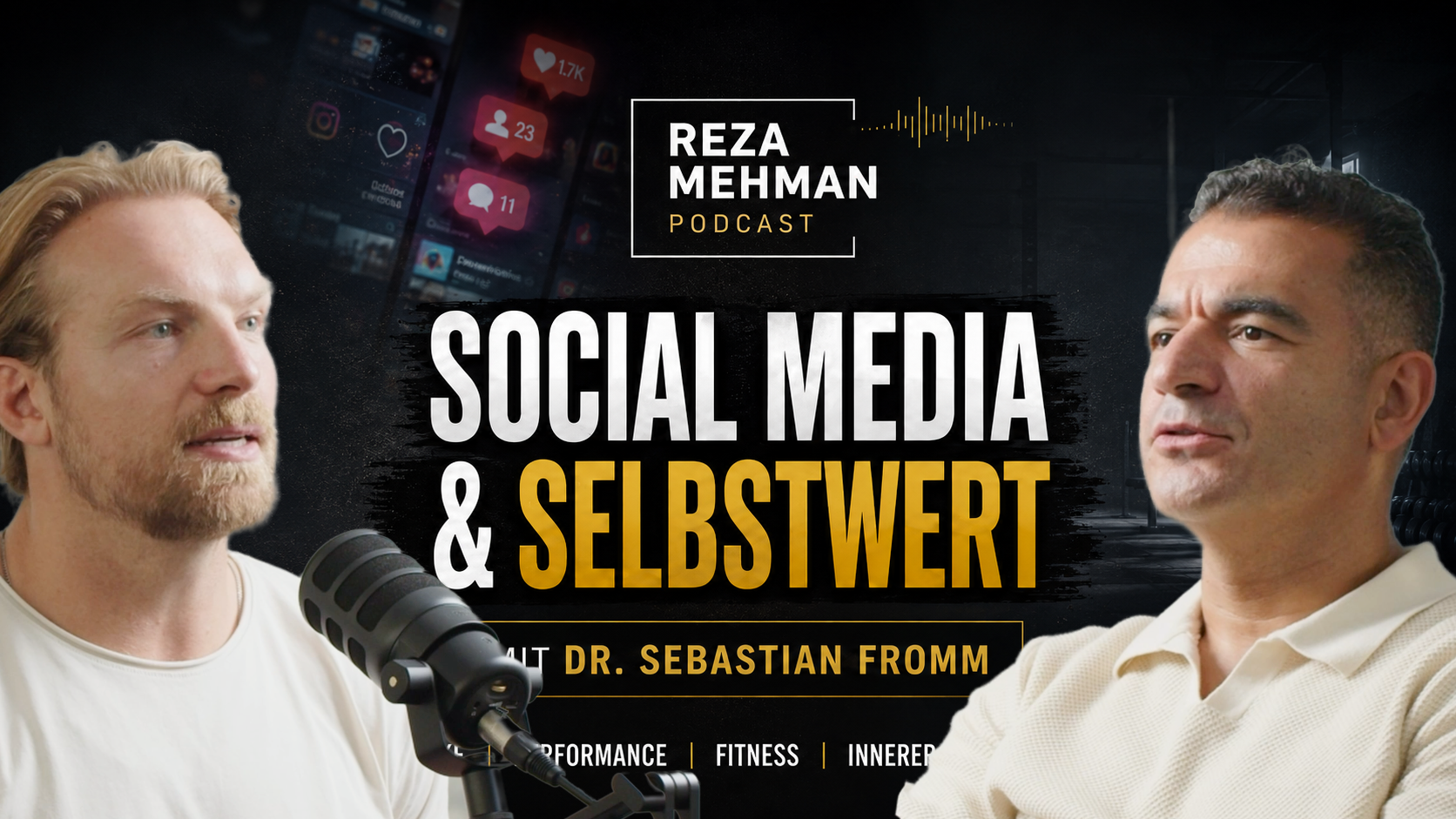

This is the complete English translation of the edited conversation. The original podcast and video are in German.
Rugby, self-worth, mental health, training, body fat, testosterone and responsibility: a conversation with Sebastian Fromm.
Sebastian Fromm on performance and self-worth
Sebastian Fromm joins Reza Mehman for this in-depth conversation about performance, health, mindset and what an ambitious life can look like without constantly tying your self-worth to results. The doctor, former national rugby player and former sports model talks about his time at a sports boarding school in Ireland, competitive sport and pushing his physical limits on Aconcagua. A central part of the conversation concerns social media, comparison, external validation and the inner pressure many high achievers experience. They also discuss training routines, supplements, meditation, cortisol, body fat, testosterone and aesthetic medicine. Sebastian explains why process goals, self-acceptance, social connection and mental health now matter more to him than performance goals alone. Towards the end, they discuss information overload, responsibility, gratitude and the ability to remain capable of taking action in your own surroundings.
Summary
One-sentence version: Sebastian Fromm talks to Reza Mehman about his journey from competitive rugby to medicine, and how performance, self-worth, health, social media and mental strength are connected.
Three-sentence version: Sebastian Fromm discusses rugby, boarding school, the national team, studying medicine, modelling jobs and his current responsibilities at Reha Med. The focus is on his changing approach to pressure to perform, comparison, social media, physical limits and mental health. They also discuss training, supplements, meditation, cortisol, body fat, testosterone, aesthetic medicine and personal responsibility in practical terms.
Five-sentence version: Sebastian Fromm is a doctor, a former national rugby player and part of the management team at Reha Med in Heidelberg. He describes how sport and performance became central to his identity early in life. He explains why he temporarily left social media and why external validation and constant comparison can undermine self-worth. Reza Mehman and Sebastian also discuss training, nutrition, supplements, meditation, belly fat, testosterone and aesthetic medicine. Finally, they explore mental resilience, information overload, gratitude and the decision to take responsibility for your own life.
Context: who, what and why
Who is speaking: Reza Mehman interviews Dr Sebastian Fromm. Sebastian Fromm is a doctor, a former competitive rugby player and a member of the management team at Reha Med Heidelberg.
What it is about: The connections between physical performance, mental health, self-worth, training, medicine and personal development.
Why it matters: This deeply personal conversation explores how ambitious people can pursue performance without deriving their entire worth from it, and the role of health, recovery and psychological stability.
Three central questions:
- How does motivation change when performance no longer comes from a sense of inadequacy?
- How can we develop a healthier relationship with social media, comparison and external validation?
- What roles do training, sleep, nutrition, meditation and personal responsibility play in physical and mental health?
Contents
- Introduction: an overview of Sebastian Fromm, performance, health and mindset
- Summary: the conversation in one, three and five statements
- Context: who is speaking and the central questions
- Themes and context: the conversation’s main topic areas
- Key takeaways: concise points about performance, self-worth and health
- Frequently asked questions: answers about Sebastian Fromm, social media, training and health
- Selected quotes: memorable statements from the conversation
- The full conversation: the complete edited podcast transcript
- Keywords: relevant SEO terms and search phrases
- Names and terms: people, places, organisations and technical terms
- Passage for quotation: a concise passage for references and quotations
- Social media snippets: YouTube, LinkedIn and newsletter
- Continue exploring: the podcast and original video
Themes and context
Performance, self-worth and identity
The conversation explores when performance comes from joy and identity, and when it becomes an attempt to prove your worth.
Keywords: pressure to perform, self-worth, high achievers
Social media and comparison
Sebastian describes how external validation shaped his experience of events, and why he left social media for several years.
Keywords: social media, comparison, external validation
Training, nutrition and physical health
They discuss rugby, HYROX, strength training, recovery, supplements, cortisol, body fat and age-related changes.
Keywords: training, supplements, body fat
Mental health and resilience
Meditation, social connection, periods of poor mental health, news consumption and dealing with distressing impressions form another focus.
Keywords: mental health, meditation, resilience
Medicine, aesthetics and responsibility
The conversation touches on aesthetic medicine, Botox, hyaluronic acid, testosterone and when medical interventions should be appropriately supervised.
Keywords: testosterone, TRT, aesthetic medicine
Key takeaways
- Performance can come from joy and identity, but also from feeling you are not good enough.
- Your worth should not depend on how you compare with other people.
- Social media mainly shows highlights and can therefore reinforce unrealistic standards of comparison.
- Process goals such as integrity, gratitude, self-acceptance and connection can sustain us longer than individual performance goals.
- Experiences at our physical limits can show that discipline cannot overcome every biological limit.
- Recovery, sleep and nutrition become more important for sporting performance as we get older.
- For Sebastian, meditation does not mean having no thoughts, but repeatedly and consciously returning to the present moment.
- When it comes to body fat, lasting change makes more sense than a short-term challenge focused solely on appearance.
- In Sebastian’s view, testosterone replacement therapy is not a general lifestyle tool: it requires medical assessment and supervision.
- Personal responsibility can reduce feelings of powerlessness by bringing our own scope for action back into focus.
Frequently asked questions
Who is Sebastian Fromm?
Sebastian Fromm is a doctor from Heidelberg, a former competitive rugby player and part of the management team at Reha Med Heidelberg. He also discusses modelling jobs, mountaineering and his projects involving physical and mental health.
Why did Sebastian Fromm leave social media?
He describes a moment in Madrid when he realised that he wanted to enjoy a beautiful experience through other people’s reactions first. This dependence on external validation was a decisive reason for initially leaving social media.
What does Sebastian Fromm mean by process goals?
For him, process goals are less about individual outcomes than the kind of person he wants to be. They include integrity, honesty, development, self-acceptance, gratitude and social connection.
How does Sebastian Fromm work on his mental health?
He mentions daily meditation, physical activity and, above all, social connection. He also considers it important to accept difficult days as a normal part of a healthy life rather than as failure.
Which supplements does Sebastian Fromm take?
He mentions vitamin D, omega-3, whey or clear whey, creatine and sometimes melatonin. He describes his overall supplementation as relatively simple.
What does Sebastian Fromm say about belly fat after 40?
He does not describe belly fat as the result of a single factor. Instead, he mentions muscle mass, activity, training intensity, recovery, sleep, nutrition, stress and everyday routines as factors that can play a role together.
What does Sebastian Fromm say about testosterone and TRT?
He emphasises that he is not an endocrinologist. A medically relevant testosterone deficiency needs diagnostic assessment. In his view, TRT should be supervised by a doctor and not started without medical monitoring.
What role does personal responsibility play in the conversation?
Reza describes personal responsibility as an alternative to seeing yourself as a victim. Sebastian develops this idea, linking it to self-empowerment and the feeling that you still have room to act in your own life.
Selected quotes
“The only thing on my mind is: how can I show other people how amazing it is here, so that I can enjoy this moment myself, through other people’s eyes.” — Sebastian Fromm
“I think you can do things from a place of abundance, joy or love, but you can also do something from a place of lack.” — Sebastian Fromm
“I used to push myself extremely hard because I always felt I was not good enough.” — Sebastian Fromm
“Our own worth never depends on comparison.” — Sebastian Fromm
“I have learned to see those phases and moments when I may not feel so good not as interruptions to a healthy life, but simply as part of a healthy life.” — Sebastian Fromm
“We cannot take everything that is happening right now for granted.” — Reza Mehman
“I do not want to feel like a victim.” — Reza Mehman
The full conversation
Teaser: social media, performance and self-worth
Sebastian Fromm:
The only thing on my mind is: how can I show other people how amazing it is here, so that I can enjoy this moment myself, through other people’s eyes.
Reza Mehman:
That is the social media effect, yes.
Sebastian Fromm:
Right, exactly. I could not enjoy it for myself. Only once I received validation from other people that this moment was as amazing as I felt it was could I allow myself to experience it that way.
Reza Mehman:
That is the problem I would like to explain to my children eventually, when they are old enough for social media: hey, what you see on social media is just the highlights. You do not see the low points.
Sebastian Fromm:
I think you can do things from a place of abundance, joy or love, but you can also do something from a place of lack. You can do things because you think you have to prove yourself and show everyone else what you are worth. But I think what has changed most is the motivation behind it. I used to push myself extremely hard because I always felt I was not good enough. I always had to prove something to myself and everyone else. Now I push myself hard because I know it is part of my identity.
Reza Mehman:
This might be a very personal question, and you do not have to answer, but do you feel as mentally fit as you are physically fit?
Getting acquainted, Heidelberg and Reha Med
Reza Mehman:
Sebastian Fromm, thank you so much for joining us today.
Sebastian Fromm:
My pleasure, Reza. It is lovely to be here.
Reza Mehman:
I need to give a little background. Honestly, I have really been looking forward to this conversation. We have already done one or two training sessions together, and they were not exactly easy for me, I have to say. I will tell you more about that in a moment. But first, how we met, and then perhaps you can briefly introduce yourself. I saw your mother at an event about a year ago. For those who do not know, your mother founded Reha Med Heidelberg. She is well known in Heidelberg, and Reha Med is quite large and, from what I have seen, a very good rehabilitation centre.
Your mother said, “This is Sebastian, my son.” I saw you and shook your hand. Then I said, “Sebastian, you do know you are good-looking, don’t you?” It was a strange introduction on my part, but I think it was also quite a good icebreaker. You said, “Oh no, come on, not really.” I said, “No, Sebastian, seriously, you know you are good-looking.” Then you said, “Well, okay, I do some modelling on the side.” And I thought, okay, he knows he looks good.
Sebastian Fromm: sport and medicine
And what is interesting — I have to mention this too — is that you are not only very good-looking but also very intelligent, which I really admire. You studied medicine, you have a medical doctorate, and, what I find almost more important, you are a very friendly, polite guy. You are still very young: I think you are 33 — 31? Oh, I have made you older. So really, I would say you are an anomaly of nature: good-looking, very intelligent, very strong, very fast. I almost feel slightly threatened by that. But I am delighted you are here so we can talk. I have a few questions about health and mindset. These are things you spend a lot of time thinking about.
I would also like people to get to know you a little better, because we will be talking more often in future. So tell us: you are from Heidelberg?
Sebastian Fromm:
Exactly. Wow, what an introduction.
Reza Mehman:
I fell for you straight away. You are such a nice guy, I have to say. I was looking for something I did not like, but I could not find anything. And those two training sessions really challenged me. They were incredibly hard, but also incredibly fun, because we pushed each other. I thought that was brilliant — doing it together. Absolutely. But tell us a bit about yourself: 31 years old, from Heidelberg.
Growing up in Heidelberg
Sebastian Fromm:
A Heidelberg native through and through. I was born in Heidelberg, in the lovely Weststadt district, and went to school there. I grew up speaking three languages. My parents were a bit unusual that way. Which languages? French, English and German. As a child, I do not think you realise what a demand that may place on you, but somehow it all comes naturally. I went to school in Heidelberg, then moved to Ireland at 15 to attend a sports boarding school. We can talk more about that later.
Reza Mehman:
I completely left that out: you were an elite rugby player too. We will come back to that.
Sebastian Fromm:
Exactly. I have been back in Heidelberg since 2018. I studied medicine, and some difficult life events meant I had to reassess things. Eventually I ended up at Reha Med. I am very content and happy there. I have wonderful people around me and a great mentor.
Reza Mehman:
So you completed your studies and then joined Reha Med, as I understand it?
Sebastian Fromm:
Exactly, on the management team. There is still a managing director above me, so fortunately there is another level of oversight.
Reza Mehman:
So succession is relevant for your family?
Sebastian Fromm:
Yes, definitely. It is an important subject. Naturally, my mother is grateful that someone wants to help take over the family business. Do I have siblings? I have two brothers, and a very good relationship with them.
Reza Mehman:
Very good. And they are probably just like you: strong, tall, blond. Yes, yes, okay.
Sebastian Fromm:
Okay, we are all around there…
The path to the national rugby team
Reza Mehman:
Very good. Tell us about rugby. You played for Germany’s national team.
Rugby, Ireland and competitive sport
Sebastian Fromm:
Exactly. Let me go through it chronologically. I started playing rugby at six. You have to know that Heidelberg is a rugby stronghold.
Reza Mehman:
Definitely, yes.
Sebastian Fromm:
If you come from Heidelberg and know a little about the city, rugby is practically unavoidable. I remember being six. We used to have an au pair because my parents worked a lot. Suddenly this two-metre giant from South Africa arrived as our au pair. His name was Dirk Pressler. He was wearing flip-flops and had just a backpack. He turned up in the coldest German winter, and I was absolutely fascinated.
I thought, wow, that is what I want to be like. He took me to rugby training. I had tried a few things: gymnastics when I was young and various ball sports. But nothing grabbed me like rugby did. I really found my feet and quickly made friends. It became a bit like a family. My parents supported me enormously. We were away a lot at weekends: under-eight, under-ten, under-twelve and under-fourteen tournaments, from France to Scotland and England. We travelled a great deal.
Rugby very quickly became a central part of my life, not only athletically but also in terms of my self-confidence.
Reza Mehman:
You went to a sports boarding school. Presumably that involved a lot of rugby too?
Sebastian Fromm at sports boarding school
Sebastian Fromm:
Exactly. That was the next step. My under-sixteen national coach said that if I wanted to take the next step and become really good — he saw potential I did not see at the time — he would recommend going abroad. My best friend went to Australia for six months, to Adelaide, I think. So I said, okay, I will go somewhere else. I was a bit of a homebody and did not want to go quite so far away, so I went to Ireland.
My father had connections in Ireland, and I went to a sports boarding school there for three months. Imagine arriving in the middle of nowhere: it was an old monastery west of Dublin.
Reza Mehman:
I have to ask: Ireland is strong at rugby too? Incredibly strong? Okay.
Rugby as a national sport in Ireland
Sebastian Fromm:
Really, they live for it. Sorry for not knowing — no problem. For the Irish, it is a national sport. Given that there are only just under four million people, it is something of an anomaly that they are so good, much like the New Zealanders. The All Blacks, exactly. There were twelve rugby pitches, a few cows and six hundred boys, and nothing else. I spent three months there, made the school team, and everything went very well — better than expected. I made friends easily too. In my first year there, I gained fifteen kilos. They practically fattened me up. I had never encountered that level of professionalism. Fifteen kilos of muscle — surely some fat too — but I really filled out.
For the first time, I ate properly, trained properly and took supplements. At sixteen.
Reza Mehman:
What were you taking then?
Sebastian Fromm:
Actually just whey protein, and eventually I started creatine too. But I really developed because the training load was managed so well. There was nothing but school and rugby, running side by side. Rugby is a really great sport. That was the school’s DNA. Three months turned into a year, and, much to my mother’s dismay, that year turned into three. I finished school there, and ultimately three years in Ireland became eight.
Reza Mehman:
Wow, okay. How old were you when you came back?
Returning to Germany
Sebastian Fromm:
I was 23. I was still playing rugby in Ireland, then returned in 2018 and started playing for the national team. That brought the next stage of my sporting career: being part of the Olympic squad. Playing for Germany and representing the country internationally, not just at under-sixteen and under-eighteen level but in the senior team and the sevens team, the whole rugby sevens programme.
Reza Mehman:
Sevens is a familiar term, isn’t it?
Sebastian Fromm:
Exactly. It is the Olympic version of rugby, and it is becoming increasingly popular with the general public, which is wonderful. The rugby sevens final was the second most watched event at the Summer Olympics after the hundred-metre sprint. That shows people enjoy the sport because it is so accessible to watch.
Reza Mehman:
And when did you study, and when were you modelling alongside all that? How did you manage everything?
Studying alongside a sporting career
Sebastian Fromm:
Your social life — really, yes. I think I was brought up with the idea that academics were always plan A: a degree of financial security through an academic career, a backup, knowing that if sport no longer worked out because of injuries, unfortunate circumstances or whatever else, you could pursue a secure career. After finishing school, I completed a BSc in Molecular Medicine there while playing rugby. Then, alongside being a professional athlete in Germany, I studied medicine. In Heidelberg, exactly. And the doctorate was in Heidelberg too. The only way I could combine the two was that everything was concentrated in Neuenheimer Feld.
Reza Mehman:
Very clever, geographically speaking. For anyone who is not from Heidelberg, Neuenheimer Feld is the medical hub, with hospitals and university facilities. That fits very well. And rugby is there too, I think — in Neuenheimer Feld?
Sebastian Fromm:
Exactly. The Olympic training centre is at the back of Neuenheimer Feld, so the journeys are relatively short.
Reza Mehman:
There is something in Kirchheim too, I think.
Sebastian Fromm:
There are another two clubs in Kirchheim.
Reza Mehman:
Exactly. I am more of an original Kirchheim local.
Sebastian Fromm:
My former club is there: Rudergesellschaft Heidelberg, RGH, on Habichtweg.
Reza Mehman:
Yes, exactly, right.
Modelling as a personal challenge
Reza Mehman:
How did modelling come about? Did someone approach you, or did you say you wanted to model? How did it happen?
Sebastian Fromm:
Initially, it was about overcoming my fears. I always felt I would like to stand in front of a camera, not because I thought I was particularly good-looking, but because it was the biggest hurdle for me. I thought: how can I challenge myself? What really scares me? This was during my previous relationship. She said, “Come on, let’s do some photos together.” And honestly, I was so ********** scared. When the pictures came back, I did not want to look at them because I thought they would be a disaster.
Reza Mehman:
You initially took private photos?
Sebastian Fromm:
We ended up modelling together for wedding photography, staging weddings. So I have already been married six times in my life.
Reza Mehman:
Okay, I see.
Sebastian Fromm:
And afterwards, well…
Reza Mehman:
Your girlfriend at the time first suggested it?
Sebastian Fromm:
She was doing it and said, “Why don’t we do it together?” And eventually…
Reza Mehman:
You do not look too bad, after all.
From modelling jobs to working independently
Sebastian Fromm:
You can turn that into a business. It worked quite well for a while. Then I thought, okay, I can manage this on my own too. I had met photographers during that time and told them I wanted to try it alone. That took a huge effort. Doing it as a pair was completely different because the focus was not on me; it was usually on the bride. That was absolutely fine. I was a supporting actor, almost an accessory. I was happy with that role. But standing there at the centre of attention myself was extremely difficult. I found it really hard, and I thought: no, I want to prove to myself that…
Reza Mehman:
Can you say who you did it for? Which company was it?
Sebastian Fromm:
Oh, initially it was simply for modelling agencies. I knew some photographers in Heidelberg from back then. They took the photos for me, and I submitted them. At first, I did not actually want to submit anything. I just wanted to stand in front of the camera and dare to do it.
Reza Mehman:
You like a challenge?
Sebastian Fromm:
Exactly. I wanted the challenge of confronting something that made me very uncomfortable, not with the aim of doing anything with it, but simply to have done it. And I did, and the photos were not bad.
Photos and personal challenges
Reza Mehman:
I have seen a few. They looked pretty good.
Sebastian Fromm:
I submitted them, and fortunately the agencies liked them too. Over time, that led to various jobs, especially sports modelling. For example, I worked for SPORT 2000 for three years and was the face of their fitness section. That was really cool. We travelled a lot.
Reza Mehman:
SPORT 2000 is big too.
Sebastian Fromm:
Yes, it is a huge European reseller, with three billion in revenue. An incredible company.
Reza Mehman:
And you were its face for three years?
Sebastian Fromm:
Exactly, for the fitness section. If you go to the website…
Reza Mehman:
You had not realised before that you were a good-looking guy?
Sebastian Fromm:
For a long time, I do not think I realised I was good enough at all, in many respects. Academically, for example. And appearance is always a difficult subject anyway.
Reza Mehman:
That is crazy. Sorry for asking so directly, but I have to ask. I did not mean to interrupt you. What grade did you get for your doctorate? *** laude?
Sebastian Fromm:
No, actually not.
Reza Mehman:
That is a relief. Finally something where you are not perfect.
The medical doctoral thesis
Sebastian Fromm:
No, I got a *** laude. Okay, so you are human after all. Yes, that was a good challenge too. I really wanted to publish it in a journal, and that worked out. The paper was my own independent work, produced with a really great team. I did it at the ATOS clinic in Heidelberg, where I also worked for a while. Some great young surgeons there gave me a good introduction.
Reza Mehman:
Do you still model on the side, or less now?
Sebastian Fromm:
It gets a bit neglected. It runs on the side. I had no social media for five years and always did modelling entirely on the side. If an enquiry came in, I did it, but I never actively promoted myself.
Social media, comparison and external validation
Reza Mehman:
That is interesting. You produced loads of content, photos and so on, but had no social media. How did that happen?
Sebastian Fromm:
A lot of content that I never did anything with.
Reza Mehman:
Why no social media? You are not on it at all?
Sebastian Fromm:
Not currently. I keep considering it.
Reza Mehman:
Did you have bad experiences with social media?
Sebastian Fromm:
Yes. I remember — I am someone who compares himself with others a lot.
Reza Mehman:
And always wins, practically.
Sebastian Fromm:
If only. From the outside, perhaps…
Reza Mehman:
I compare myself too. But I think it is different with you, because your career, your path and what you have achieved are exceptional. I do not know how you see it yourself, but as an outsider it looks straightforward: everything worked out, whatever you did succeeded in some way.
The pressure to perform behind the façade
Sebastian Fromm:
That is true of many people. I see it around me. I have many male friends who are high achievers. From the outside, everything is wonderful and shiny, everything is easy, life just falls into their laps, everything is under control and they always seem composed. But inside there is considerable tension. The internal pressure to maintain all that is enormous. It was like that for me for a long time too. So performance is something quite ambivalent for me. We can explore that term and what it means to me in more detail. Where were we? Comparison on social media. That comparison was always there, but back then I could not really put it into perspective.
I had not yet reached a point where self-reflection allowed me to recognise what was happening. I simply felt inner tension. The moment when I decided I no longer wanted social media came at a training camp in Madrid with the national team. We had a match on Saturday and Friday off. Training had gone incredibly well for us all week. We walked around sunny Madrid, past fountains, with people playing guitar. At a café, we sat drinking cappuccino. I could have been fully present and said: everything is good. What a wonderful moment. I am enjoying it.
Experiencing life through other people’s eyes
The only thing on my mind was: how can I show other people how amazing it is here, so that I can enjoy this moment myself, through other people’s eyes?
Reza Mehman:
That is the social media effect. Exactly.
Sebastian Fromm:
I could not enjoy it for myself. Only if other people validated that this moment was as amazing as I felt it was could I allow myself to experience it that way.
Reza Mehman:
That is intense.
Sebastian Fromm:
Then I thought: wow, I am not living my life for myself or enjoying it for myself. I enjoy it when others give me permission to enjoy it. That external validation…
Reza Mehman:
I completely understand what you mean.
Sebastian Fromm:
It was really powerful. And I said, no, I do not want that any more. That also took courage, because of course I had this profile. How many followers did I have? Two thousand, and I thought I was a big deal. What year was it? I cannot say exactly. Wait, I think it was 2019.
Reza Mehman:
Okay. By the standards of the time, there were not that many big accounts.
Sebastian Fromm:
True. If someone had twenty or thirty thousand…
Reza Mehman:
Exactly. Six or seven years later, it is all rather different. But I completely agree with you. Sometimes I feel compelled to capture something and upload it to social media, particularly Instagram. Interestingly, it is not even for myself.
Taking a step back from social media
Sebastian Fromm:
Do you feel you are doing it for other people?
Reza Mehman:
Exactly, for others. Not even for my family, because they know where I am, and if they want to see something, I just send it to them. You are actually doing it for strangers. Sometimes particular faces come to mind: you think of someone and want them to see what you are doing. That happens now and then too. But that compulsion is not really normal, I would say. I completely agree with you.
Sebastian Fromm:
I mean, you are an entrepreneur, you want a certain reach, and of course it is part of that—a means to an end for you. I think being able to use it in a healthy way is a skill. It is something you can acquire, and perhaps even need to acquire for your own mental health. You are absolutely right: I think you can learn to confront it.
Reza Mehman:
Okay, and was that the only reason you left social media? Or was comparison part of it too, as you mentioned earlier?
Sebastian Fromm:
Comparison is always there.
Reza Mehman:
Who were you comparing yourself with? Everyone under the sun?
Why we compare ourselves
Sebastian Fromm:
The problem is, I think, that when people compare themselves, it would be easy to compare with people who have not got as far in certain areas. But we always compare upwards. And we do not compare ourselves as a whole person. We pick out the things where we see ourselves as inadequate and others as better.
Reza Mehman:
I agree with you 100%. That is the problem I want to explain to my children when they reach the age for social media: “What you see on social media is just the highlights. You do not see the low points.” First, hardly anyone posts their low points; everyone posts their highlights. And then there is a second aspect: you see everyone’s highlights in the things they are particularly good at. Athletes, for example, particularly good runners. As you know, I do a bit of HYROX, and suddenly my feed is full of running sessions. I cannot really compare myself with these people. Some of them are professional runners.
Sporting highlights and comparisons
But I still have that urge to compare myself, and I absolutely believe you. That is an incredible pace; I do not even come close to it. Then someone appears who bench-presses a huge amount, and someone else is particularly good at kickboxing. I see all their highlights and compare myself, even though I know that the runner only runs—that is their main thing. Comparing myself with them does not make sense. I am not exclusively a runner, a weightlifter, or any of those things.
That is what I want to teach my children eventually. It took me a long time to understand it too. Do not just look at the highlights, because everyone has low points as well. That is simply how it is. And secondly, if you are excellent at one thing, you can compare yourself in that one area to improve. But definitely stop comparing yourself with everyone in every area and every aspect of life. It harms you.
Fair expectations of yourself
Sebastian Fromm:
It harms you, and above all it is not fair to yourself. You have expectations of yourself that you would not apply to others. You do not expect your friends or the people you love to be brilliant at everything. But strangely, when you get caught in that comparison spiral, you think: I need to bench-press that much, but I also need to be that fast, and at the same time I have to be the best father. So many aspects come together at once that the bar becomes impossibly high. You cannot do yourself justice.
I think comparison is human. Everyone compares themselves. We want to position ourselves within society; I think that is perfectly natural. At the same time, it is important to know that our own worth never depends on that comparison.
Performance pressure, goals and process goals
Reza Mehman:
Absolutely. Where is your personal bar right now? What matters to you in terms of doing well and moving forward? I know you love new challenges. I have known that since training with you twice. Those sessions were crazy. To give people an idea: you asked me if I wanted to train together, and I said, “Absolutely! What shall we do?” One session was five pull-ups, ten push-ups and fifteen squats. That sounds easy at first, but we did it twenty times, using EMOM. That means starting a new round every minute. I had never done twenty sets of five pull-ups in my life—one hundred pull-ups in a day.
Sebastian Fromm:
That is wonderful, because if someone had asked you beforehand, “Reza, can you manage one hundred pull-ups in twenty minutes?”—help!
Reza Mehman:
I would have said never. But you push yourself, and you pushed me, I really have to say. So I know your bar is high. I would say you are a high performer in every area.
Sebastian Fromm:
Well, I am genuinely trying to find a balance.
Reza Mehman:
I do not believe a word of it.
Sebastian Fromm on self-worth
Sebastian Fromm:
I think it is something I did not naturally grow up with: the knowledge that I do not constantly have to perform. Over time, I have had to teach myself that I am allowed to do less. Performance can be a way to challenge myself and certainly has many positive aspects, but it does not define my self-worth. That is something I am working on. When you ask where the bar is right now, I have short-term and long-term goals. You mentioned that I like challenging myself. There are daily challenges, but also short-term goals such as doing my first HYROX in two or three months, or becoming established in a certain way in my company. These are things I can measure well—measurable short-term goals.
At the beginning of each year, I try to define my goals for that year, and I do the same for a five-year period. But above all I aim for process goals, which have a lot to do with my values. What kind of person do I want to be? Which things help me in the long term? What exactly do I mean by process goals? For example, which values do I want to live by? I know that I might tell myself: I will do ten HYROX races, and once I achieve a particular time I will be happy. In the past, I always thought: once I have that, once I become that, once I have achieved that, I will be happy.
Process goals instead of short-lived highs
With those goals, I would ultimately feel a relatively short-lived high, followed by disillusionment, because they did not give me lasting satisfaction.
For me, process goals concern how I want to see myself and who I want to be. They are things that give me long-term satisfaction and are deeply rooted in my values. I want to be a person of integrity, an honest person. My aim is to keep working on my development every day, find greater self-acceptance and live with more gratitude. I want to develop social skills, maintain relationships and feel connected within society, with my friends and my family. Those are the goals I know will bring me a great deal of joy in the long run. At the same time, of course, I have short-term goals that keep pushing me.
Reza Mehman:
Let me ask very directly: do you still live in the moment? You seem very goal-oriented.
Being present and exploring physical limits
Sebastian Fromm:
Yes, I am goal-oriented, and at the same time being in the moment gives me a lot of joy. Experiences such as sport that completely exhaust me do that. There are few moments when I feel as connected with myself as I do during sport—just earlier, after running those intervals. That is exactly how I work too.
Reza Mehman:
You mean last time?
Sebastian Fromm:
No, today.
Reza Mehman:
Okay, I thought you meant our
Sebastian Fromm:
last session—but then as well, exactly. It is those moments when you are completely exhausted. You know what it is like: you are out of your head, in the moment, and you really feel yourself. You are present in every part of it. The same applies to other physical experiences. I am a very physical person: ice baths, cold showers, extreme sauna temperatures, for example, but also other extreme experiences. This year I did something crazy with two friends. We wanted to climb a seven-thousand-metre peak, so we flew to the Andes. We were there in minus 39 degrees. Yes, 39 was intense, with winds of 80 kilometres per hour.
Reza Mehman:
How far did you get?
An extreme experience on Aconcagua
Sebastian Fromm:
We reached 6,400 metres, and then the weather put an end to our plans. But those experiences at the limit, when I think I cannot go any further yet somehow manage to continue—or eventually really cannot continue because my body sets a boundary—make me feel myself so intensely. Those are moments when I am very much in the present.
Reza Mehman:
Let us return to the limits the body sets in a moment. First, I want to say something about being present through sport. I understand what you mean a thousand per cent. It is June now; in April I took part in a HYROX event with someone who has since become a very good friend, Lennart Sass. He is a blind para judoka. Taking part together was a challenge because he is blind, and it was quite an experience, I have to say.
Sebastian Fromm:
I saw the video and got goosebumps. I almost cried; I had tears in my eyes.
Training together on the Neckarwiese
Reza Mehman:
I have to thank Amli for editing such a brilliant video. But there were training sessions I will never forget. We met on Sundays on the Neckarwiese. For anyone who does not know Heidelberg, it is a very popular stretch of grass beside the Neckar. We combined a good running session with lunges, squats and other exercises. Lennart is 26, in the prime of his life, an Olympic participant in judo and considerably fitter than I am. We really went for it.
I will never forget one moment. We were doing about a hundred squats, I think. I was completely exhausted because of the running we had already done. And he said, “Reza, I am really enjoying being here with you in the sunshine.” I was practically at death’s door, but I thought: he is absolutely right. It was such a brilliant moment. You are with a friend, training hard, feeling your whole body. Your entire body says, “No, stop,” but something tells you to keep going and finish it—complete those hundred.
You can collapse afterwards, but right now you keep going.
Finding joy in demanding training
Sebastian Fromm:
Yes, I know that feeling very well. I think competitive athletes can relate to the enjoyment of a certain amount of suffering during training, when it becomes really demanding. That is the point where most people say, “Okay, I am stopping.” But Lennart and you said, “I could stop, but I am carrying on,” and started laughing. That gives me a lot too. I can really relate to it.
Reza Mehman:
I learned so much from him about simply allowing whatever is happening in the moment. But you mentioned the body’s limits earlier. Have you experienced those?
Sebastian Fromm:
Yes. Those minus 39 degrees were one such moment. I am not particularly fortunate when it comes to altitude sickness. I had eaten practically nothing for the previous two or three days.
Reza Mehman:
Really? With all that exertion?
Sebastian Fromm:
Yes, it was pretty heavy going. And on top of that—
Reza Mehman:
Tell me, did you have a guide with you?
Mountaineering with friends from Ireland
Sebastian Fromm:
Yes, you have to. There were three of us, including two good friends from Ireland whom I went to school with. We set ourselves that goal. The two of them had climbed Kilimanjaro a few years earlier, and I had done it a few years before that. We thought: come on, let us do the second of the Seven Summits—the highest mountain on each of the seven continents. This was Aconcagua in Argentina, near Mendoza. At some point, even the greatest discipline and iron will can no longer push you on. You simply cannot continue. For me, that happened during the summit ascent. I had barely slept in the preceding nights, perhaps two or three hours a night. You hardly sleep at all; the winds were incredible.
A freezing night in the tent
The tent shook constantly. The condensation from your breath froze solid, and then it would suddenly snow inside again when the wind shook it loose. It was intense: little food, little sleep. I took three Imodium so I would at least not have to trek outside to the toilet at night in minus 40 degrees. It was a mixture of feeling frozen, exhaustion, headaches and nausea from the altitude. At two in the morning we set off, put on our crampons and planned to climb from 6,000 metres to just under 7,000—the final summit ascent. We knew the weather was *******, and we had not been given much hope of making it up at all. At 6,400 metres it was over. But getting that far had been a matter of taking one step at a time.
I think those 400 vertical metres took us six hours. Eventually my body simply said it could not go any further, even though my head kept saying, “Push on, push on.” That is usually how I operate. But eventually your body sets a limit. It was another humbling experience in that sense. I felt humility again, recognising that my body can set good, healthy boundaries and that not everything can be achieved through willpower and discipline alone. In a way, it was quite a valuable experience.
Reza Mehman:
Do you plan to do it again?
Sebastian Fromm:
Yes. Immediately afterwards I thought I needed a break. But you know how it is: you struggle through something, and then—
New sporting challenges
Reza Mehman:
You have to do it.
Sebastian Fromm:
Yes, two days later you think, “Oh, yes!” It is that wonderful rosy retrospection, where afterwards it no longer really matters, because—
Reza Mehman:
When will you do it again?
Sebastian Fromm:
We have not set a definite date yet. We want to climb Mount Elbrus, which is unfortunately in Russia. With the war in Ukraine, travelling there will be a little difficult. We still need to look into it.
Reza Mehman:
How high is it?
Sebastian Fromm:
It is 5,600 metres.
Reza Mehman:
But would you go back and climb the other mountain again?
Sebastian Fromm:
Yes, with slightly better weather. It is also a financial question. Unfortunately, these mountaineering trips are very expensive.
Reza Mehman:
Yes. Wow, that is crazy.
Injuries, recovery and motivation
Sebastian Fromm:
The other thing worth mentioning is that my body has often signalled through injuries that I cannot keep going. I have had four shoulder operations because of rugby. My shoulder kept dislocating and needing repair.
Reza Mehman:
It is such a tough sport, you have to say.
Sebastian Fromm:
Yes, it is a really tough but fair sport. Unfortunately, injuries are very common. I am also particularly injury-prone. I think I was born with unstable shoulders; they were always a weak point.
Reza Mehman:
You would not know it to look at you.
Sebastian Fromm:
Fortunately, I have now compensated for that well through muscle strength. Looking back, I think it was often simply too much. My body was saying, “You cannot continue,” because I had not allowed myself the breaks and recovery I actually needed. That is something I have learned over the years.
Reza Mehman:
That is what I was about to ask. How has your attitude towards targets and goals changed? How do you think today compared with five or six years ago?
Sebastian Fromm on motivation
Sebastian Fromm:
I think the motivation behind it has changed considerably. I still train extremely hard and keep trying to reach my limits. Now I take better breaks and pay more attention to recovery and nutrition. In the past, I could sleep badly for a while, eat rubbish over the weekend and sometimes go drinking. I cannot do that anymore. My training adaptations are no longer what they were in my early twenties. But what has changed most is my motivation. I used to push myself extremely hard because I always felt I was not good enough. I had to prove something to myself and everyone else. Now I push myself because I know it is part of my identity, part of who I am.
Growing without tying performance to self-worth
I love growing and challenging myself. But I no longer think, “I am not good enough, so I have to do this and prove myself to everyone.” I mainly do it for myself. Of course, I still slip into old patterns at times. Most people are not immune to comparison. It keeps coming back. You just have to recognise those patterns and ask: who am I doing this for? Am I doing it from a sense of deficiency, from a need to prove myself? Or am I doing it from a sense of abundance, because I enjoy it, because I am doing it for myself and enjoying the process?
Reza Mehman:
From a sense of abundance—that is interesting. What exactly do you mean?
Acting from joy or from a sense of lack
Sebastian Fromm:
I think you can do things from abundance, joy and love, but you can also act from a sense of lack. You can do something because you think you have to prove yourself and show everyone else what you are worth, defining your worth through that performance. That is clearly a sense of lack: only if I do this will I be good enough. But if you act from abundance, you already know you are valuable and have everything you need to be content. Then you do it with a certain love and a much deeper motivation. You are not just doing it for others. You know you enjoy it and like doing it.
Reza Mehman:
That is a very good point. I think many high performers have this problem of wanting to prove themselves through what they do—almost “I work, therefore I am.” I have to keep an eye on that too. Thinking about it now, I exercise almost every day.
I would not call it a love-hate relationship, but it is not always easy to get myself to exercise, especially when the session is hard. There are definitely days when I do not feel like it. But I can say one thing: I have never felt bad after a workout. Knowing that, I tell myself, “Reza, relax and just exercise. You will definitely feel good afterwards.”
Sport as part of your identity
Perhaps after an injury, but that is different. Otherwise, there has never been a session after which I felt bad. Yet interestingly, I sometimes still have to persuade myself to go and do it. What often helps is that I want to see myself as an athlete, as part of my identity. So I tell myself: you are only something if you repeatedly do it.
If you want to be an athlete, you have to exercise regularly. I can completely understand what you are saying. There is something else I wanted to ask, so let me jump topics briefly.
Supplements, nutrition and training routines
Reza Mehman:
You said you started taking supplements quite young, including creatine. I think creatine is very well researched and benefits almost everyone who takes it. But you started at fifteen—or sixteen, right? I did not have that knowledge at that age. How did you get the idea to take it?
Sebastian Fromm:
Through our coaches, actually. They were very proactive about it. Alongside a fitness coach and all the team coaches, we had nutritional advice. It was a really professional setup, and they gave us good guidance.
Reza Mehman:
Do you still take it regularly? How many grams? Five grams a day—okay, very good. I sometimes take breaks from creatine, but I use it fairly regularly and feel it definitely has benefits. Then there are fish-oil capsules and so on, omega-3 supplements. What else do you take?
Sebastian Fromm:
It is actually quite simple. I take vitamin D3, 2,000 units a day, and omega-3, particularly for my mental health. That is also well researched. There are studies that compare omega-3 with antidepressants, for example.
Reza Mehman:
Really?
Experiences with supplements
Sebastian Fromm:
They have a good effect. It is something that helps me. Then ordinary whey protein: I try to consume between 160 and 200 grams of protein a day, which I cannot manage through food alone. So I supplement with regular whey or clear whey shakes. In summer, those are a good alternative. Then my creatine, and sometimes melatonin when I cannot sleep.
Reza Mehman:
We should talk about whey another time. I take it too, although I would not say regularly. There are phases when I take more and phases when I take none. I do not know why, but I have the impression that we all consume a little too much—although that is another topic.
A little too much fat and protein. This is only based on observing myself, but whenever I have consumed more protein, I have not felt quite right in my body, whether in terms of digestion or feeling agile during the day. I do not know whether protein really is the culprit. Sometimes I just have the impression that we consume a bit too much. Funnily enough, I sell supplements, but I want to be honest: I think we may overdo protein slightly. I do not have scientific evidence for that, though.
Sebastian Fromm:
You notice that you do not feel quite as fit or lively, and feel a little sluggish.
Protein and individual tolerance
Reza Mehman:
Exactly, definitely sluggish. I have tried vegan proteins too. I do not know whether they made a big difference for me. But whenever I returned to ordinary food and paid more attention to my diet, I felt more agile.
Sebastian Fromm:
Interesting. I am sure it is very individual. I know many people, myself included, who feel out of action for a few hours if they eat too many carbohydrates, especially in the morning.
Reza Mehman:
Yes, an insulin peak.
Sebastian Fromm:
That is why I train on an empty stomach in the morning. I have conditioned myself quite well to it.
Reza Mehman:
And that works well for you, at full performance? That is my first problem with morning training. Again, this is my personal impression, but I seem to perform better after a good intake of carbohydrates than when I exercise on an empty stomach.
Sebastian Fromm:
I could not skip food all morning and then perform at noon. But through the routines I have followed for a long time, I have conditioned my body to being in the gym just after six in the morning. Of course, there are mornings when I have—
Reza Mehman:
Slept badly? In the gym just after six! Your discipline! And you go every morning?
Sebastian Fromm:
Yes, I try to do it every morning. Most mornings, anyway.
Training and daily routine
Reza Mehman:
So when we trained together in the evening, you had already done a gym session that morning?
Sebastian Fromm:
Yes.
Reza Mehman:
Now I hate you even more! The session with me was your second workout.
Sebastian Fromm:
Yes. For me, getting up in the morning is a good thing. Not because it is always easy—that is exactly what you were saying.
I think most people who are in the gym just after six, or exercise every day, would emphasise that it is not always easy. But the people who do it regularly do not do it because it is easy. They do it because it creates long-term satisfaction and a tremendous sense of self-efficacy. I often say that if it were easy, everyone would do it. Even though it is not easy, you can still keep at it.
Routine is extremely important to me. I like getting up early. I try to do strength training three mornings a week. Today, because I had intervals this afternoon and did HYROX training late last night, I simply got up early, went to the gym, was present and did my stretching session.
Reza Mehman:
On an empty stomach.
Sebastian Fromm:
Yes, that was just this morning. But the point was to maintain the routine and keep my sleep quality consistent.
Mental health, meditation and connection
Reza Mehman:
This may be a very personal question, and you do not have to answer. But do you feel as mentally fit as you are physically fit?
Sebastian Fromm:
What do you mean by mentally?
Reza Mehman:
In terms of mental health, do you feel as fit and healthy as you do physically? Because physically, I think you are—
Sebastian Fromm:
Physically, I am very fit. I think I have reached a point where I can say I have worked so much on my psychological and emotional health that most days are good. That is a trend, though; not every day is good. I have down days too, days when I feel inadequate, insufficient and extremely vulnerable. I have learned not to view those phases and moments when I do not feel so good as interruptions to a healthy life, but simply as part of a healthy life.
Reza Mehman:
They are part of it.
Sebastian Fromm:
Yes. Integrating both the highs and the lows, accepting that they are part of the whole experience and that even the darkest days pass, gives you an enormous amount of confidence.
Reza Mehman:
Very well said. What do you do for your mental health? Do you meditate?
Sebastian Fromm:
Yes, I try to meditate every morning as well—ten minutes of guided meditation.
Reza Mehman:
You are not making yourself any more likeable! You meditate every morning as well?
Sebastian Fromm:
Again, it is a matter of routine. I have put my meditation cushion in my office.
Reza Mehman:
How long do you meditate?
Sebastian Fromm on meditation
Sebastian Fromm:
Just ten minutes. That is quite enough.
Reza Mehman:
Eyes closed, sitting down, cross-legged?
Sebastian Fromm:
Exactly. There are wonderful guided meditations, which I find easier.
Reza Mehman:
With the appropriate breathing and so on?
Sebastian Fromm:
The breathing is not prescribed. For me, meditation is more about returning. It is not about reaching a state of transcendence or permanently having no thoughts—I am not Buddha. It is about coming back again and again. The more often I notice my thoughts have wandered, the more often I return. If during those ten minutes I notice twenty times that I was lost in thought and come back, or even have one phase when I return after ten seconds, that was a good session.
Sometimes I sit there thinking for five minutes about making a coffee afterwards. But it really helps me. Meditation is definitely a tool I have discovered for myself over the past few years.
Reza Mehman:
What else do you do for your mental health?
Sebastian Fromm:
Talk to people. Over the past few years, I have noticed that social belonging and connection, even little daily moments with people, give me a lot of satisfaction. Feeling connected to others is a major factor.
Reza Mehman:
Connection with particular people you choose?
Small encounters in everyday life
Sebastian Fromm:
Both. It can be a little interaction with a cashier, saying, “Have a lovely day,” or a smile from an older woman at the tram stop. Those small moments matter, especially when you feel isolated, lonely or alone, which I did for a long time.
Reza Mehman:
Why?
Sebastian Fromm:
I did not really feel part of society. I put a lot of pressure on myself about all kinds of things. Then I realised I wanted to feel more connected to life and other people. It genuinely started with those small interactions. I discovered I was not as introverted as I had thought. I had simply been afraid of connecting with others, and that changed over time. Now I know that close, emotionally deep connections are an integral part of my life. The frequency of small interactions is lovely and contributes to my mental health. But there are also those deeper emotional connections with my partner, friends, family and people who are on the same wavelength. Being open in those relationships is important.
Reza Mehman:
But how did you come to feel that you were not part of society?
From internal pressure to reflection
Sebastian Fromm:
I spent a lot of time in my head, but not in a reflective way. I put enormous pressure on myself about everything and, above all, felt small. Withdrawing is the easiest way to avoid feeling that pressure and comparison.
Reza Mehman:
I need to jump topics again. You mentioned coffee in your morning routine. You drink coffee in the morning; I drink coffee too.
Coffee, cortisol and metabolism
Sebastian Fromm:
Yes, I love coffee.
Reza Mehman:
Same here, and that is my problem. I have a few questions, since you are a doctor. First, something I have noticed: if I drink too much coffee, I get spots.
Sebastian Fromm:
With milk, or actually black coffee?
Reza Mehman:
I am back to having milk now. I drank black coffee for a while, but I read that caffeine can cause skin blemishes. Whenever I drink a little more, I really do get spots. Three cups a day, for example—three or four cups seems to be the threshold.
Sebastian Fromm:
You notice that it—
Reza Mehman:
My skin definitely changes. I drink it with milk now. I have a question about cortisol early in the morning. Cortisol has a useful function and can be part of a positive stress response. But coffee on an empty stomach can push cortisol higher again.
Questions about coffee and cortisol
What would you recommend? I would like to work on my belly again, and I have looked into cortisol and insulin a little, although very superficially. We do not need to go into great depth. I read that perhaps coffee should not be the first thing you drink after one or two glasses of water. Instead, you should wait a little, so you do not further increase cortisol and cause insulin to rise through milk and so on. Apparently that can be helpful if you want to get belly fat under control. Do you know anything about that?
Sebastian Fromm:
First, cortisol is definitely not a bad thing. We need it; it is essential. It is a stress hormone, part of the HPA axis, and follows a circadian rhythm. We have day-night rhythms. When we wake up, or shortly beforehand, we have our biggest cortisol spike. Levels then decline throughout the day so we can sleep better in the evening. Other things that raise cortisol include exercise, particularly intense sessions. When we feel constantly stressed, it is not simply that we have an enormous, consistently high baseline cortisol level. Rather, the balance between that steep rise and the daily decline is dysregulated. The whole system is out of balance.
Sebastian Fromm on stress regulation
To clarify: high cortisol levels are not inherently bad. It is more about how we regulate cortisol, how quickly it falls again and how that day-night rhythm works. As for the rise caused by coffee, I am not entirely sure how caffeine acts there. I know caffeine affects various factors that increase heart rate, blocks adenosine and makes you feel less tired. It certainly does a lot physiologically, but I am not sure exactly how it interacts with cortisol. I have also heard that avoiding coffee for the first few hours is supposed to be healthier. I do that myself: I do not drink coffee immediately in the morning, but wait two to two and a half hours after getting up.
Reza Mehman:
With milk?
Sebastian Fromm:
I really like oat milk.
Reza Mehman:
Okay. Can you say something about insulin? I am struggling a little with belly fat and finding it very difficult to lose it at the moment. This has come up on the podcast before. I try to avoid insulin spikes—for instance, not eating fruit first thing in the morning on an empty stomach, because that sends insulin soaring. Instead, perhaps I eat something higher in protein. How much does trying to avoid those spikes affect belly fat?
Discussing metabolism and age
Sebastian Fromm:
The idea that metabolism declines from around your forties is not necessarily supported scientifically. That more persistent belly fat, which is harder to lose, is more of a broader, multifactorial phenomenon. Many different factors come into play for men from forty onwards.
Reza Mehman:
You are still nine years away from that, thank goodness. That is a long time. I am two years past it.
Sebastian Fromm:
We will see how it develops. But there are good analyses showing that basal metabolism remains relatively stable between thirty and sixty.
Reza Mehman:
That is incredible. I find it hard to believe.
Sebastian Fromm:
It is interesting, because most people think, “You are still young, you can eat whatever you want; your metabolism is so good.” It may fluctuate by a few hundred kilocalories a day, but between thirty and sixty, that baseline is relatively stable.
Recovery and lifestyle habits
What changes is a range of other factors. Muscle mass declines. From about thirty, we lose roughly one per cent a year as a guideline, although it is very individual. We tend to exercise less, and sessions are usually less intense. We recover less well, but also pay less attention to recovery. Extremely important factors such as sleep get neglected. Our diet is often not as good as it used to be. We may eat less regularly or a little too much.
Stress is another factor, along with much greater responsibility. Most people in their forties have a family, a job and responsibilities far beyond those of someone in their early or mid-twenties.
Reza Mehman:
Especially when you have children too.
Sebastian Fromm:
Absolutely. When stress levels rise, you may sometimes compensate with snacks. Your diet is not quite as clean, and perhaps there is some alcohol too. Several factors really do contribute to belly fat. The good thing is that many of them are things you can address.
Belly fat, body fat and a new challenge
Reza Mehman:
Sebastian, I have been thinking about something. Fortunately, we plan to talk together on the podcast more often, and perhaps take part in a HYROX together soon. We need to discuss that too. But something came up randomly on my phone in one of those memories features: a photo from exactly twenty years ago. I will show it in the podcast, but I will show you directly now. This is me twenty years ago. Thank you, that is nice to hear! I would like to get back to that, although I do not know whether I can.
Sebastian Fromm:
I love the boxer shorts. That was cool back then.
Reza Mehman:
Yes, especially at the swimming pool! How unhygienic was that? Amazing when I look back now. Interestingly, it was exactly twenty years ago. I was twenty-two and weighed 85 kilos. Now, at forty-two, I weigh 91 kilos and look like this. This is a current photo, taken today. There is much more belly fat, fat at the sides and so on. Still solid, though.
Reza’s personal fitness challenge
No, do not say that! How realistic would it be for me to say: it is June now, and I would like to set myself a challenge? I am a challenge person, probably like you. I need that goal so I know why I am doing all this and going through the hard times. How realistic is it at my age to say,
“In six months, I want my stomach to look roughly as it did twenty years ago,” given all the everyday stress, family, business, hobbies that have escalated into things like podcasting and so on? How realistic would you consider that if I committed to it? I imagine it is not just about those six kilos.
Discussing realistic goals together
Sebastian Fromm:
First, I think it is fantastic that you are even considering it, particularly with everything you have listed. It is great that you do all those things in parallel. I really respect that: running a business, building something else, exercising and having a family. My first thought is that the goal of a six-pack depends heavily on your natural body-fat distribution. We should establish your current body-fat percentage and then look at how much you could realistically lose over those months.
We can ask whether it is realistic to move from your current percentage to a particular target in that time. Then we can see what you look like at that percentage. Say you reach twelve per cent: it is quite realistic that a six-pack would be visible. But everyone has a different fat distribution. I have the advantage that I tend to gain a little fat on my back but hardly any on my stomach. I have friends who seem to store fat only on their biceps and nowhere else.
Individual fat distribution
Others store more of it around their stomach. So I think a six-pack challenge is a great idea, but I would frame it more as a body-fat challenge.
I would structure it around how many months you have, and whether losing one, one and a half or, if things go really well, two percentage points of body fat per month is realistic. Then we could build a realistic timeline. Much of that involves being in a calorie deficit. The other question is: how much performance do you want to maintain?
Reza Mehman:
That is another point. Being able to function well in everyday life is extremely important to me.
Sebastian Fromm:
Exactly, and there can be trade-offs. Not just in concentration: if your calorie intake is low, or too low, you may reach certain goals but have a very low tolerance threshold. You may become more irritable and not be the person you want to be in everyday life. The question is where to find a middle ground: “I want to challenge myself, but perhaps I will extend it by a few months and do it sustainably, without too much deprivation, while still being able to train well.” You still want to perform in training, at work and as a father. That matters to you.
Family and sporting ambition
Reza Mehman:
The irritability point is particularly important. I want to be a good dad. If I had to prioritise, that is even more important to me than sport.
Sebastian Fromm:
I think that is lovely, because one of the first things you mentioned was how to approach social media with your children. It shows you are asking how to be a version of yourself who is a role model and can teach them things you have learned, perhaps making life a little easier for them. That speaks very well of you.
Reza Mehman:
As I have got older, I have realised that everything has a price. You can be the best entrepreneur and the worst father at the same time. You can put a huge amount into sport while giving too little time to your relationship. Everything seems to come at a cost. Unfortunately, you cannot be very good at everything. Looking at my life, my highest priority is to send two children out into society who can stand on their own feet and become good members of that society. That is extremely important to me.
I want them, when they are older, to come to my home voluntarily because they want to spend time with me.
Time with the children
I can really only achieve that by spending quality time with them now. That is why I have thought a lot about these six-pack challenges. They sound superficial, but it does not necessarily have to be an amazing six-pack. What matters more to me is losing belly fat. I have noticed that I am actually a fit guy—I do not mean that arrogantly.
Sebastian Fromm:
There is no question about it. I have seen it myself. Who can do a hundred pull-ups in twenty minutes?
Reza Mehman:
Exactly. I feel fit. I could do a HYROX right now, without any special preparation, and other things too. But my body does not show it visually.
Sebastian Fromm:
That is interesting, because cardiovascular fitness and a certain level of strength and power do not necessarily go hand in hand with a subjectively aesthetic physique. You can be incredibly fit and still carry fat—look at strongmen. Those things do not necessarily coincide. But I can also see that you want to look physically aesthetic, which I think is a perfectly legitimate wish. That is why I like the idea of a challenge like this.
Questions about visceral fat
Reza Mehman:
There is also visceral fat. I have read and heard that it can strongly affect inflammation in the body, how often you get ill and certain risks as you get older. I am afraid—and I may be wrong—that losing belly fat will become harder as I age. That is why I wanted to start getting it under control now.
Sebastian Fromm:
“Getting it under control” sounds a little dramatic in your case.
Reza Mehman:
No, I do not feel comfortable. I really have to say it is simply too much for me.
Sebastian Fromm:
Then that is a wonderful reason. You are not just doing it out of vanity, but because you want to stay healthy in the long term. That makes it a wonderful challenge.
Reza Mehman:
You made a really good point. Perhaps I should not see it as a six-pack challenge but as a body-fat percentage challenge. I could measure my current status, see the levels in different parts of my body and work towards a target. Looking at that old photo, what percentage do you think I had? Eleven?
Discussing body-fat percentages
Sebastian Fromm:
Twelve per cent. What is healthy? That depends on sex, of course. There are tables for men, but I think anything up to twenty per cent is still relatively fit. For women, you can add ten percentage points.
Reza Mehman:
Okay, wow.
Sebastian Fromm:
Anything below ten per cent is already extremely defined for men. At seven or six per cent—where are you?
Reza Mehman:
Do not give me another reason to hate you!
Sebastian Fromm:
Three or four? You do not believe a word of it! I have to account for my 97 kilos somehow.
Reza Mehman:
It is crazy that you weigh 97 kilos. What do you think your body-fat percentage is?
Sebastian Fromm:
Let us check it in the next few days. What was my last measurement? I think it was twelve and a half.
Reza Mehman:
Twelve and a half—wow. You weigh 97 kilos at 1.85 metres. I am a bit shorter, at 1.79 metres, and weigh 91 kilos.
Sebastian Fromm:
I am curious to see.
Reza Mehman:
We have to do it. Lee, get ready—ideally you can document it on video. So it is not an absurd challenge to try to get my six-pack back, in simple terms, with the underlying aim of reducing body fat while making sure I am not restricted in everyday life.
Effort and personal priorities
Sebastian Fromm:
You can certainly do it. But then the effort and discomfort, and other factors, come into play. You have to ask whether it is worth it to you.
Reza Mehman:
What is coming up for you in the near future? I know you are getting established at RehaMed, want to do a HYROX and would like to climb another mountain. What else is ahead?
Aesthetic medicine, Botox and a natural appearance
Reza Mehman:
As if all that were not enough already!
Sebastian Fromm:
I also work in aesthetic medicine and want to pursue further training in that area, including Botox.
Reza Mehman:
For men and women, or only men?
Sebastian Fromm:
Both.
Reza Mehman:
At what age do men do that?
Sebastian Fromm:
Most of the men are forty or older, I would say—around your age. They notice that their frown line may be more pronounced than they would like.
Reza Mehman:
How do I know if I have a lot of wrinkles? What is the reference point? It is a silly question, but I genuinely have no idea.
Sebastian Fromm:
I think men have far fewer problems with wrinkles socially, because a man with wrinkles is seen as mature and can even enjoy a certain status. “He still looks good for his age; he has wrinkles, but he looks like he has lived.” The beauty standard against which women in particular often compare themselves—not that they have to—is that youthful, wrinkle-free appearance. Men do not necessarily face the same standard. In general, I do not think there is such a thing as too many wrinkles, for women or men. It always comes back to the subjective question of how you want to see and maintain yourself.
Reza Mehman:
Do you ever advise people against treatment?
Sebastian Fromm on aesthetic wishes
Sebastian Fromm:
Absolutely. Sometimes women, and men too, come to me saying they have two more wrinkles. I ask whether they would like an honest opinion, and often say, “Honestly, I do not think you need it. The way you look now is attractive. In my personal view, you are a good-looking man or woman.” In those cases, I suspect the distress is not caused by those two wrinkles but by something else. I do not say that outright, of course. At the same time, it is often much easier to change something externally in an attempt to increase satisfaction with yourself.
Reza Mehman:
Let me ask a basic question, and forgive my ignorance: what does a Botox treatment cost? And what percentage of your patients are men or women?
Sebastian Fromm:
I would say ninety per cent are women.
Reza Mehman:
Oh, that many?
Sebastian Fromm:
Yes, ninety per cent women and ten per cent men. Prices vary. There are many providers and different preparations. Do you pay per wrinkle? No, you pay per area.
Reza Mehman:
Per area.
Treatment areas and natural expression
Sebastian Fromm:
Exactly. The face is divided into different areas, and there are standardised units. Personally, I find a certain naturalness aesthetically pleasing, and I think facial expression should remain. I have lots of laughter lines, just like you, and I find that likeable. A completely frozen, tightened face does not necessarily match my personal aesthetic sense. At the same time, Botox can achieve a youthful, fresh appearance.
Reza Mehman:
Apart from my laughter lines, how many wrinkles can you see when I am not smiling? Now I have to smile! Let me try not to for a moment.
Sebastian Fromm:
Nothing disfigures you. It is wonderful exactly as it is.
Reza Mehman:
Joking aside, how many wrinkles do you see? I am genuinely interested.
Sebastian Fromm:
You have a relatively pronounced nasolabial fold—this fold here. Of course, that also comes from smiling, and I think it gives you character. That is lovely. You also have a pronounced frown line here, between the eyebrows.
Reza Mehman:
Yes, I have noticed that one.
Sebastian Fromm:
But it also gives you a certain seriousness. It is not something I look at and think does not suit you. I know you this way. Many people know themselves differently. It is never just about how others see you, but how you see yourself.
Discussing the frown line
Reza Mehman:
That is true. It is called a frown line—does that come from frowning? Really? Have you had anything done?
Sebastian Fromm:
I have had my frown line treated. How long does it last? Three, four or five months for me. I have quite an active metabolism, go to the sauna a lot and do a little sport now and then. So it does not last all that long for me.
Reza Mehman:
What would it cost me to treat this frown line? Just out of interest—150 euros? That is quite reasonable. I would have thought it was more expensive.
Sebastian Fromm:
It always depends on the provider.
Reza Mehman:
I would have expected it to cost more.
Testosterone and TRT
Reza Mehman:
Perhaps another uncomfortable subject: testosterone. What do you think of it? Is there an age from which men can or should take it? I imagine there is no blanket official rule, but would you ever say, “From fifty, sure, why not,” or “From forty, why not”?
Sebastian Fromm:
First, to be clear, I am not an endocrinologist. My medical expertise is definitely not focused on testosterone. I would always view this from a doctor’s perspective rather than a trainer’s or sporting perspective. Low testosterone is referred to medically as hypogonadism, and that can constitute a medical indication. But most men do not have it. It is perfectly normal for testosterone levels to decline with age, and you can have them tested. In most cases, the decline is not pronounced enough to provide a medical indication for TRT—testosterone replacement therapy. The levels have to be very low for that.
Sebastian Fromm on testosterone
Typical symptoms of very low testosterone include lack of drive, pronounced fatigue, possible depressive symptoms and a markedly reduced libido. Those are signs of a deficiency—not just testosterone declining a little with age, but a genuine deficiency. That can be investigated diagnostically, looking at testosterone, the free fraction, TSH and LH. There is a range of tests, and testosterone can certainly be prescribed medically. But in your case, for example, I could not in good conscience say, “You are forty, so your testosterone is now low enough that you need supplementation or replacement.”
Reza Mehman:
Interestingly, I have never had my testosterone levels checked, so I have no idea where they are. But it would not seem that far-fetched to consider it to maintain that positive aggression as I get older—perhaps I am talking myself into it. By aggression, I do not mean walking around smashing things. I mean a positive underlying mood that may be stronger because you still feel strong.
I would not want to lose that positive feeling. That is why I could imagine trying a TRT programme, or whatever it is called, at some point.
Lifestyle habits before treatment
Sebastian Fromm:
Personally, I think there are many things you can adjust before doing that, starting with better sleep. Testosterone is released particularly in the early sleep phases. Good sleep hygiene, proper nutrition and an appropriate training stimulus matter. Testosterone is released during intense strength training, for example. Those are things you can work on. Then perhaps you can consider the next step. At the same time, you need to be aware of side effects. From a medical perspective, this should definitely be supervised by a doctor and handled by an expert. I would not recommend getting it in the changing room.
Reza Mehman:
I sometimes hear about it from acquaintances who have done it and are very positive about it. Honestly, I would be a bit ****** about doing it without medical supervision. I would not know where the injection came from or what was in it. I find it absurd that people inject themselves with random substances like that.
Sebastian Fromm:
Very few people think about the possible consequences, including an incorrect dose. But for many, the distress and comparison are so strong: “Look how he looks, and he takes it, so I will look like that too.”
Hyaluronic acid, caravans and new projects
Reza Mehman:
Let me jump back briefly. You mentioned hyaluronic acid. Is that similar to Botox?
Sebastian Fromm:
It is a filler. Botox is a protein, a toxin that acts at the neuromuscular junction, so the muscle becomes less able to contract. That is why expression is reduced—or controlled, if it is dosed and administered well. Hyaluronic acid, on the other hand, is a classic filler. Think of the conventional aesthetic ideal: more prominent cheekbones, a slightly longer face, a more pointed chin, a turned-up nose, defined cheeks or fuller lips. Those are things that can be achieved with hyaluronic acid or fillers.
Reza Mehman:
What else are you doing?
Sebastian Fromm:
I bought a caravan at the weekend. Practical work is something I love. I think a good surgeon may have been lost in me—I love working with my hands.
Reza Mehman:
An older caravan, presumably? Cool.
Sebastian Fromm:
We first had one from 1988, but its underfloor was damaged, so we returned it. We have now bought another one and will renovate it.
A caravan as a hobby
Reza Mehman:
Nice, another lovely hobby. A quick side story: when I was doing my school-leaving exams, a good friend’s parents won a caravan in a lottery. I asked what it was worth—something like 80,000 euros—and whether they would sell it. He said no. When I asked why, he said, “Now we can go on holiday whenever we want.” I did not understand it then, but now I do: being able to travel whenever you like, go away for a few days without booking a hotel, and simply get out.
Sebastian Fromm:
That is a luxury too. You have put your finger on it: flexibility and personal freedom, without having to find somewhere to stay. If you leave on Friday, you wake up on Saturday morning by the sea or somewhere green. You immediately get that feeling of switching off.
Reza Mehman:
That is great. You will have to tell us more about it sometime.
Sebastian Fromm:
I would love to. It is an ongoing project, and some energy will be going into it now. A lovely project—as if there were not already enough to do!
Reza Mehman:
What other topics are you working on?
Psyrena and mental health
Sebastian Fromm:
I am trying to learn a little about property. I want to see how I can take more responsibility for my retirement provision and educate myself in that area. Of course, I also want to keep developing different things at RehaMed. As you may have noticed, I am a strong advocate for mental health. It really matters to me.
Reza Mehman:
Could you imagine offering courses on that at RehaMed, or something along those lines?
Sebastian Fromm:
I have started working on an aftercare service. There is prevention, then treatment such as rehabilitation, and then aftercare. That is support after rehabilitation to help people retain what they have learned and integrate it into everyday life. It is available after psychosomatic rehabilitation. People who have had burnout, depression or anxiety disorders may spend three weeks in psychosomatic rehabilitation, usually as inpatients, although outpatient options exist too. They can then enter aftercare. This is called Psyrena—psychological rehabilitation aftercare.
Sebastian Fromm on Psyrena
I helped launch this Psyrena service at RehaMed because demand is enormous. Despite Heidelberg being an academic city with so many psychologists, there is unfortunately little provision in this area. Building it was important to me. I work with excellent psychologists in-house, great sports therapists and a really good young, dynamic team. It is close to my heart, I enjoy it and feel we can contribute something. Perhaps in the longer term we could even move towards psychosomatic rehabilitation. At present, we work with orthopaedic indications, physiotherapy and orthopaedic rehabilitation. We could expand that to include psychosomatic rehabilitation.
Reza Mehman:
That is excellent. I really think mental health will become an increasingly significant issue for us. That is my impression, particularly with this flood of information. Let me give you a small example.
Information overload, media and mental resilience
Reza Mehman:
The war in Iran, for example, affected me enormously as someone born in Persia. In January, the protests were violently suppressed, and that hit me very hard.
Sebastian Fromm:
Did you have personal connections there—people you knew on the ground?
Reza Mehman:
Definitely. Fortunately, they were not affected by all that terror, and I am very glad about that. But it still affected me. I talked about it a lot on the podcast too. Eventually, I had to create some distance because I realised it was pulling my attention so strongly towards the negative that I was no longer my usual good self for the people around me.
Sebastian Fromm:
It affected you mentally and really dragged you down.
Reza Mehman:
Completely. I also discovered that some acquaintances in my own circle openly supported the mullahs. I thought, “What on earth are you doing in Germany, then? Why are you not in Iran if you like that government so much?” It affected friendships and acquaintanceships. Long story short, I realised I needed some distance. That is just one example among many issues we face.
AI, news and uncertainty
AI and job security are other examples; I have talked about them in another podcast. They weigh on many people. None of us really knows what is happening or what will happen. The burden is increasing because we have too much information, and it tends to be presented negatively.
Positive information reaches us less often.
Sebastian Fromm:
There is little news that actually—
Reza Mehman:
Exactly. News tends to have a negative slant, with an element of clickbait. You worry about migration, politics, the economy and so on. We hardly receive positive news.
Sebastian Fromm:
These are very unsettled times, and incredibly uncertain when things are so hard to assess.
Reza Mehman:
Yes, absolutely. On the other hand, I am quite happy to be in Germany. My uncle lives in the United States. A year or two ago, he asked what things were like here, saying they heard in the US that Germany was a catastrophe because of migration and so on. I thought: of course, there have been negative consequences from the uncontrolled way it happened, but I do not experience it as the catastrophe he described from what he had heard. I realised they were being given negatively framed information too. Unfortunately, that is how our society works today.
Mental health in the future
That is why I think mental health will play a much bigger role in the future, and we need to work out how to deal with these issues.
Sebastian Fromm:
Definitely. We need to build mental resilience and develop strategies for coping ourselves, but also create services for when people cannot manage alone. People who need help should be able to get it. As we discussed with social media, the enormous social tension and pressure are particularly strong among younger generations. Mental health will become increasingly important there too.
Reza Mehman:
Absolutely, including how we handle social media and news. Recently, I raised the subject at my son’s primary school. I would like some kind of media guidance—I do not know exactly what to call it—so children can learn how to deal with very negative media. Can I sign up too? Honestly, I will never forget something I have mentioned on the podcast before. When I was about eighteen, an acquaintance at the Nachtschicht club—perhaps you know it—shoved his phone in my face and showed me someone being stabbed.
Distressing images and children
I was eighteen, and I still think about it today. That is how deeply and negatively it affected me. Today, some eight- or nine-year-olds see things that I would struggle to process at forty-two. I think certain impressions are unavoidable, but how you deal with them is what matters. For my children, I am trying to put a few things in place.
I cannot prevent them encountering things. Even if they do not have them on their own phone, they might be in a WhatsApp group and receive a photo or video they never wanted to see. How do you deal with that in the moment? I think this will be a major issue.
Sebastian Fromm:
How have you resolved that for yourself? Or are you still finding a way to handle negativity?
Boundaries, responsibility and gratitude
Reza Mehman:
I have dealt with it in a rather unpleasant way by accepting something. That is why I asked earlier how you feel connected to others: I have tried to disconnect from many people and issues.
That does not sound positive at first. An acquaintance once said that we are all one, but I no longer see it that way. Some people are capable of things I cannot identify with at all. I do not believe we are all united or all think equally positively. I have simply accepted that, unfortunately, there are many bad people, and the only thing I can do is distance myself completely.
Sebastian Fromm:
Do you distance yourself from those people or from the event?
Reza Mehman:
Both the events and the people. With Iran, for example, I need some distance. I am deeply sorry about what is happening, but if it affects how I care for my family here, I have to consider that. I want to care for them positively. If that negativity is constantly hanging over me, I still have to make sure everything works day to day and that my children and wife are happy and looked after.
Setting personal boundaries
I need to disconnect and accept that there are many bad people. I do not like saying it, but that has unfortunately been my experience. Some people actively want something bad to happen to me personally. Anyone who has had a career in a large corporation probably knows those political battles. It is incredible what happens. In one of my last roles at a larger company a few years ago, there were people undermining you and scheming against you. It was astonishing.
There is genuine malice; they want bad things for you. I first had to accept that this exists. Walking around wanting to punch someone is unimaginable to me, but some people do. I need to detach completely and focus on my own affairs. That is a long answer to your short question, but it is how I currently deal with it. Perhaps it will change in a few years. As things stand, that is my approach.
Room for action in everyday life
Sebastian Fromm:
At the same time, you retain control over the positive things you can influence in your family and everyday life, so you still feel you can make a difference. We often feel helpless and powerless when we look at the bigger picture and feel at its mercy. But that does not mean saying everyone is bad. There are good people, of course, and you still have the power to influence things positively in your own surroundings.
Reza Mehman:
Absolutely. I have a few mantras I repeat during the day. Taking responsibility for my own situation is extremely important to me. I do not want to feel like a victim. Unless something is completely random, such as an accident that is not your fault, I want to take responsibility. If I am in a situation where I feel uncomfortable—a client meeting or business discussion, for example—and my own choices have put me there, I want to tell myself: I am fully responsible for being in this situation. I can choose how to handle it, and I will not slip into a victim role.
Responsibility for your own decisions
It is incredibly liberating to know that I do not simply have to endure it. I made a decision, perhaps five years ago, which put me here today. But that was me five years ago, and knowing that means I can change it. I repeat that mantra often. The other is gratitude. However terrible the situation in Iran is, and however deeply sorry I feel about it, I am enormously grateful that my father decided forty years ago to leave the country—not for himself, but to give his children, my sister and me, a better future.
He and my mother left family, friends and everything behind to give us opportunities. There was no Google Maps, no booking flights on Check24. It was hard to leave a country after the Shah had been overthrown, come to Germany without translators or interpreters and build a life here. I am grateful he made that decision. It was incredibly courageous. To say everything is awful now would be profoundly ungrateful.
Sebastian Fromm and Reza on gratitude
That is why gratitude is another of my mantras. I try to think deeply about it, beyond the standard things such as health, for which I am grateful too. You have to notice individual things. I am grateful I met you, for example, quite randomly about a year ago at Palazzo—perhaps even less than a year. That is something I will not forget. I am grateful I know Lee, whom I met by chance six years ago. Now I do every video project with him. There is incredible trust. We met through another situation that was not good at the time, but a friendship came out of it.
Those are the things I try to impress on my children, and on other people when they are interested. None of what is happening should be taken for granted. But you also have to work every day to stay mentally fit. I have asked you many questions about mental health because I believe that, just as we train our muscles, we need to train our brain—our mental muscle.
Sebastian Fromm:
And especially our attitude towards life.
Reza Mehman:
Absolutely. It is a matter of attitude.
Personal responsibility and empowerment
Sebastian Fromm:
That is wonderful. On one hand, taking maximum responsibility helps you avoid that feeling of powerlessness. Through responsibility, you feel a strong sense of empowerment. You are not powerless; you always have room to act. That is so liberating. I can really relate to how good it feels to realise you are at the helm and able to act.
Reza Mehman:
Absolutely. There were periods when my business was not going well, and I reminded myself that it was my responsibility. I could not blame Merkel, Merz, Scholz or whoever else. Get out of the victim mindset, take action and accept responsibility.
Personal responsibility and closing thoughts
Reza Mehman:
Exactly. I probably made some wrong decisions two or three years ago, which is why I am here today. But I can change that.
Sebastian Fromm:
Yes.
Reza Mehman:
That was such a game changer for me.
Sebastian Fromm:
Definitely. Complete ownership. Brilliant.
Reza Mehman:
Sebastian, I think we will talk much more often in future. The atmosphere felt great, and I really enjoyed it. Thank you. Wow, we have been talking for quite a while!
Sebastian Fromm:
It did not feel that long at all.
Reza Mehman:
I had a wonderful time. We already have one or two projects planned together, which we will surely discuss soon. First, I want to thank you for trusting me. I know coming onto my podcast was a fairly big step for you.
Sebastian Fromm:
It was not my first time on a podcast, but there were definitely some nerves at the beginning.
Reza Mehman:
Thank you for your trust. We will talk again soon. Thank you.
Keywords
Tags: Sebastian Fromm, Reza Mehman, performance and self-worth, mental health, social media comparison, national rugby team, HYROX training, supplements, creatine, meditation, cortisol, belly fat over 40, reducing body fat, testosterone TRT, aesthetic medicine, Botox, RehaMed Heidelberg, personal responsibility, gratitude, mental resilience
Names and terms
Sebastian Fromm, Reza Mehman, RehaMed Heidelberg, Heidelberg, Weststadt, Ireland, Dublin, German national rugby team, rugby sevens, Olympic training centre, Neuenheimer Feld, Heidelberg rowing club, SPORT 2000, HYROX, Lennart Sass, Neckarwiese, Aconcagua, Mendoza, Seven Summits, Mount Elbrus, creatine, whey protein, omega-3, vitamin D, melatonin, meditation, cortisol, HPA axis, insulin, body fat, visceral fat, Botox, hyaluronic acid, testosterone, hypogonadism, TRT, TSH, LH, Psyrena, psychosomatic rehabilitation, mental resilience, personal responsibility, gratitude.
Passage for quotation
Sebastian Fromm describes performance as ambivalent: it can arise from joy or from the feeling that you have to prove yourself.
For him, the crucial point is that your worth does not depend on comparison with others.
Process goals such as integrity, self-acceptance, gratitude and social connection give him more lasting direction than a single result.
For him, mental health also means accepting difficult days as part of a healthy life rather than as a failure.
Taking responsibility and focusing on your own room for action can help you feel less powerless.
Social media snippets
Dr Sebastian Fromm talks with Reza Mehman about performance, health, mindset, rugby, social media, self-worth, training and mental health.
Sebastian describes his journey from Heidelberg to a rugby boarding school in Ireland, the German national team, medical school and his work at RehaMed. The conversation becomes particularly personal when he discusses why he left social media for several years and how strongly comparison and external validation can affect self-worth.
We also discuss process goals, experiences at the body’s limits, recovery, supplements, meditation, cortisol, belly fat, body fat, testosterone, TRT, Botox, hyaluronic acid, mental resilience, information overload, gratitude and personal responsibility.
Episode timestamps
Timestamps:
00:00 Teaser: social media, performance and self-worth
01:13 Sebastian Fromm and his journey
05:38 Rugby and Heidelberg
12:18 Modelling as a challenge
17:19 Social media and comparison
25:04 Performance pressure and process goals
29:07 Being present through sport
33:15 Physical limits and Aconcagua
37:05 Injuries and recovery
41:49 Supplements and nutrition
47:43 Mental health
49:02 Meditation
52:37 Coffee and cortisol
56:31 Insulin, metabolism and belly fat
01:00:04 A body-fat challenge instead of a six-pack challenge
01:10:53 Aesthetic medicine and Botox
01:16:27 Testosterone and TRT
01:21:23 Hyaluronic acid
01:22:12 Caravans and personal projects
01:24:27 Psyrena and mental health
01:26:28 Information overload and resilience
01:32:01 Setting boundaries against negativity
01:35:08 Personal responsibility and gratitude
01:39:25 Closing thoughts
#SebastianFromm #RezaMehman #Mindset #Health #MentalHealth #Training #HYROX #SelfWorth #PersonalResponsibility
What happens when performance no longer comes from the feeling of being “not good enough”?
I discussed this with Dr Sebastian Fromm. Sebastian was a competitive rugby player, represented Germany, studied medicine and now works at RehaMed in Heidelberg.
Among the topics we discussed were:
* Performing without tying it to self-worth
* Social media, comparison and external validation
* Training, recovery and mental health
* Process goals, gratitude and personal responsibility
One question particularly stayed with me: am I doing something from a sense of lack or from a sense of abundance?
More reflections on the conversation
The full conversation is available in the podcast and on the blog.
#Mindset #Health #Performance #MentalHealth #PersonalResponsibility
How does performance change when you no longer have to prove yourself? In my conversation with Dr Sebastian Fromm, we discuss rugby, medicine, social media, self-worth, mental health and how to stay ambitious without constantly putting yourself under pressure. We also talk about training, supplements, body fat, testosterone and personal responsibility. Read the full conversation on the blog.
Continue exploring
Find more personal conversations on the Reza Mehman Podcast page. You can also watch episode 194 directly on YouTube.

